
Customer Data Platforms: CDP Meaning, Profiles and Practical Uses
A CDP is a customer data platform: software that maintains a unified customer record and makes that context usable across other systems. It can connect activity, identity and customer attributes so teams can build consistent audiences and actions. Start with the customer decision the platform must improve, then verify the source data, identity rules and destination result before buying a broad CDP package.
On this page
CDP meaning and core responsibilities
A useful customer data platform has an explicit responsibility for the customer record, rather than merely forwarding unrelated messages.
| Responsibility | Practical job | Example evidence |
|---|---|---|
| Collection | Receive relevant events and customer attributes | Accepted source record with known meaning |
| Identity | Connect records belonging to the intended customer | Correct known and anonymous history |
| Profile maintenance | Preserve a usable customer record over time | Current state with traceable source ownership |
| Audience definition | Identify customers meeting a business rule | Reproducible population from agreed conditions |
| Activation | Make approved data usable in another system | Correct destination record or audience |
| Governance | Apply access, quality and permitted-use rules | Accepted inclusion, exclusion and change cases |
The CDP Institute's definition emphasizes a persistent, unified customer record accessible to other systems. It also recognizes that supporting services can be delivered through external components, including a data warehouse. The important question is which system owns consistent customer context and its use.
We would begin with a customer journey that currently breaks between tools. For example, a product user becomes a paying customer, but the messaging system still sends a trial reminder. The project needs an accepted state change and destination behavior, not merely a new place to display the customer's details.
At Martechdevs, customer data platform implementation connects those source, identity and activation rules. We define the expected customer state and verify the receiving system before expanding to more journeys.
A customer record across several systems
A customer can appear as an anonymous website visitor, an application user, a billing customer and a CRM contact. Those records carry different identifiers and serve different purposes. A CDP can help connect relevant information, but the business must define which records belong together.
The customer record might include recent product actions, current subscription state, account relationships and approved communication preferences. Each field needs a source of authority. A CRM salesperson's manual plan field should not automatically override a subscription state supplied by billing.
Persistent does not mean every value remains unchanged. A profile can preserve historical events while updating current attributes. The team must distinguish the plan held when an event occurred from the plan held today, especially when reporting on acquisition or product adoption.
The identity resolution guide covers the matching design. Keep that work separate from selecting a logo: two implementations of the same platform can produce different customer records when their identifiers and priorities differ.
CDP software and event-routing scope
An event pipeline collects and routes data. A fuller CDP arrangement can add maintained profiles, identity resolution, audiences and orchestration. The exact boundary depends on the selected product and configuration.
Twilio Segment makes this distinction explicit in its commercial structure. Connections is the customer-data pipeline, while the broader CDP package combines Connections, Unify and Engage. Its documentation describes resolved profiles and audience or journey capabilities in the larger scope. See Segment product boundaries.
Do not use an entry pipeline price as the budget for all those jobs. Conversely, a company that only needs a narrow routing task may not need the broader package. List the required output and owner for each responsibility before requesting a quote.
The mParticle and Segment comparison covers a software choice in more detail. This explainer focuses on the customer-data process that makes such a comparison meaningful.
CDPs, CRMs and warehouses
A CRM coordinates customer-facing work such as sales opportunities, service requests and account ownership. A data warehouse supports maintained analytical data and reporting across business domains. A CDP concentrates on a consistent customer record and making that context usable downstream.
These jobs can overlap in a modern platform. The useful distinction is responsibility, rather than a claim that every tool belongs in only one category. A CRM can store customer attributes without being responsible for every application event or identity transition.
| System role | Primary operating question | Typical owner |
|---|---|---|
| CRM | The next customer-facing action and responsible person | Sales, service or RevOps |
| Data warehouse | Reliable analytical records and business definitions | Data engineering and analytics |
| CDP | Consistent customer context and approved downstream use | Data, marketing operations and product teams |
| Messaging platform | The communication and its delivery rules | Lifecycle or marketing operations |
A warehouse can participate in a CDP design without requiring every customer-data capability to live inside one database product. Equally, a warehouse table alone does not establish maintained identity, usable audiences or reliable destination behavior.
The CDP versus data warehouse guide owns that architecture comparison. The composable CDP guide explains arrangements that combine existing components. Avoid rebuilding those components merely to satisfy a category label.
Identity rules and customer transitions
Identity resolution connects identifiers according to defined rules. A stable application customer ID, an email address, a device identifier and an anonymous browser identifier have different properties. An email can change; a device can be shared; an anonymous identifier can disappear.
mParticle's IDSync documentation shows why priority matters. Its strategies resolve supplied identifiers according to an order of precedence, with different treatment of anonymous and known users. Changing that order can change the returned profile. See IDSync components and identity priorities.
Write the expected result for the difficult cases before importing the full population. Include a person signing in after anonymous activity, a changed email, two people sharing a device and a customer belonging to several business accounts. The last case can require an account relationship rather than forcing all activity into a single person-only view.
A unified profile is only useful if the unification is correct. More merging is not automatically better. A false merge can attach someone else's history or eligibility to a customer, while an unresolved identity can leave a journey incomplete. Inspect both risks with known records.
Keep the original source references available for investigation. When a destination receives an incorrect customer, the operator should be able to trace the contributing identifiers and the rule that selected the profile.
Audiences, permission and destination state
An audience is a population meeting a defined business condition. Permission to send information or communicate through a destination is a separate condition. A platform can correctly show more audience members than it forwards to a particular output.
For example, mParticle documents consent filters applied when audience data is forwarded. Those filters do not change the audience membership or size displayed within the platform. This is a specific product behavior, not a universal rule for every CDP. See mParticle consent filters.
Consider a hypothetical audience of active customers. The table separates its business condition from an already approved destination-permission rule. It does not define a legal basis or claim that one flag captures every consent requirement.
| Synthetic customer | Account state | Permission for this output | Expected result |
|---|---|---|---|
| A | Active | Eligible under the stated rule | Audience member and permitted output |
| B | Active | Ineligible under the stated rule | Audience member, excluded from output |
| C | Closed | Eligible under the stated rule | Outside the active-customer audience |
The source has three known customer profiles, the active audience has two members, and the permitted output has one. If the destination accepts customer A, the accepted population is one. Customer B's exclusion is intentional; it should not be repaired as a delivery failure.
Test changes as well as additions. If customer A becomes ineligible or closes the account, confirm the intended removal or update in the receiving system. A previously correct destination record can become stale when the source state changes.
Collection counts and a small reconciliation
Now assume the same three customers generate six synthetic event deliveries. Customer A has three distinct events, one of which is delivered again as a retry. Customers B and C each have one distinct event. The result is six deliveries and five distinct occurrences across three profiles.
Those counts describe different units. A higher event count does not imply more customers, and a profile count does not tell the business how many permitted audience records reached a destination.
| Synthetic measure | Calculation or definition | Expected count |
|---|---|---|
| Event deliveries | Six received messages | 6 |
| Distinct occurrences | Six deliveries minus one identical retry | 5 |
| Known profiles | Customers A, B and C | 3 |
| Active audience | Customers A and B | 2 |
| Permitted output | Customer A | 1 |
| Accepted destination population | Customer A accepted | 1 |
The fixture assumes stable event and customer identifiers and an explicit retry policy. It is not a claim about a vendor's default deduplication or identity behavior. Preserve the expected records as well as the totals so two incorrect records cannot accidentally satisfy a count check.
The marketing data quality guide provides a broader reconciliation framework. Use it to distinguish source gaps, identity problems, intentional exclusions and destination rejections.
Useful CDP use cases
A good first use case has a defined source, customer state, destination action and acceptance condition. Trial-to-paid suppression is one example: billing confirms payment, the customer profile reflects the state, and the messaging platform stops the trial reminder according to its rules.
An account-management use case may combine product activity with customer and contract context. The account owner receives a maintained signal rather than a raw event stream. The business still needs to decide which action the signal should trigger and who reviews it.
Advertising audience use can involve adding eligible customers and removing people who no longer qualify. The acceptance test should inspect both membership directions and the destination's actual interpretation of the uploaded identifiers.
Personalization can use customer context to select an experience, but the application needs a fallback when data is unavailable or outdated. A profile API response is only one component of the customer experience; the site or product still owns its behavior.
Avoid selecting the first project by the number of connectors it demonstrates. A smaller workflow with an accepted business outcome provides better implementation evidence than a large diagram whose destination actions nobody owns.
Freshness and operating ownership
Real-time language needs an end-to-end definition. Source availability, collection, profile processing, audience refresh and destination delivery can each add delay. A fast ingestion endpoint does not prove that the business action uses fresh customer state.
Assume a hypothetical customer change occurs at 09:00, the audience incorporates it at 09:10 and the destination accepts the update at 09:12, all in UTC. The end-to-end delay is twelve minutes. The two-minute delivery stage is only part of that result.
Define the acceptable age of the information for the use case. A nightly account summary and a live eligibility decision can require different designs. The marketing data freshness guide helps turn those needs into observable timestamps and an operating response.
Assign a source owner, identity owner, audience owner and destination owner. One person may hold several roles, but the responsibilities should remain explicit. A failed write needs an owner who can distinguish a retryable transport error from a record that should never have been sent.
CDP selection and cost scope
Request a proposal against the use-case inventory. Include source applications, measured identities, event throughput, required history, audience refresh, destinations, environments, support and implementation. Preserve the vendor's actual billing units rather than converting every product into a misleading per-contact figure.
Ask which capabilities are included and which need another product, add-on or maintained component. The Segment pipeline/CDP distinction illustrates why a broad platform name is insufficient evidence of scope. See Segment packaging.
Include the engineering work of source instrumentation, identity design, historical migration and destination acceptance. A CDP subscription does not remove those tasks. Equally, reusing an existing warehouse or event pipeline can have value if the business already maintains it well.
Use the software pricing tool for the qualified configuration. Keep the first implementation cost, ordinary recurring cost and any overlap with retired systems visible separately.
A bounded CDP pilot
- Select one customer journey with a clear business owner and destination result.
- Inventory its source events, attributes and authoritative systems.
- Define identity transitions and record the expected customer profiles.
- Specify the audience, permission boundary and destination mapping.
- Prepare a small sample with ordinary, repeated, changed and excluded records.
- Reconcile collection, profiles, audiences and accepted destination output separately.
- Test an eligibility change, a destination rejection and the intended recovery.
- Expand only after the operating owners accept the results and maintenance process.
This sequence keeps the selection grounded in customer behavior. A complete demo profile is less useful than a known record that remains correct through an identifier change, an exclusion and a retry.
Customer-data readiness workflow
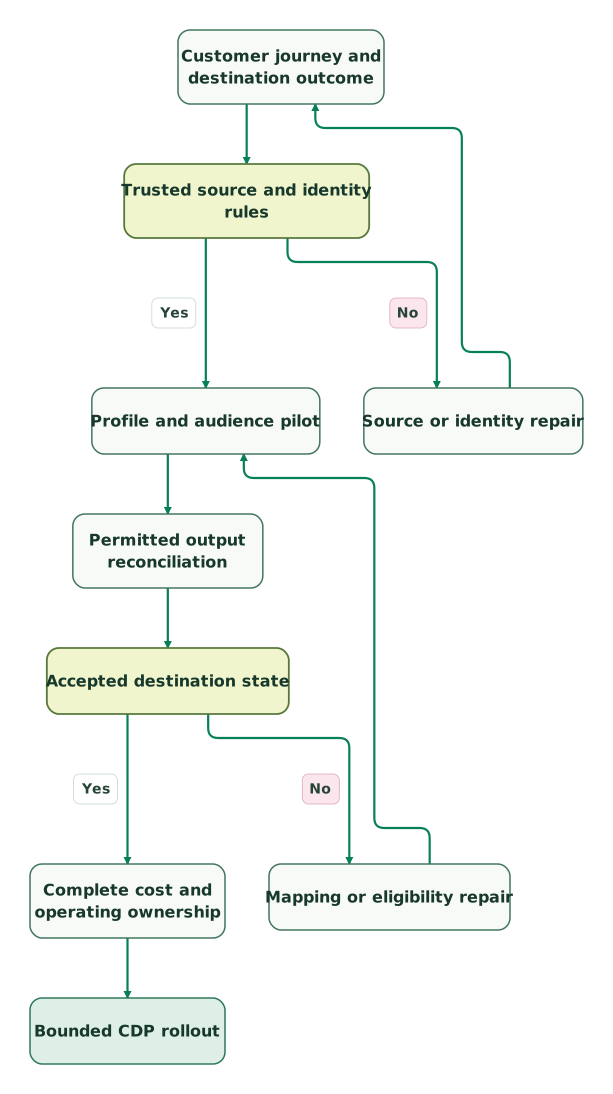
Read diagram as text
- Customer journey and destination outcome to Trusted source and identity rules.
- Trusted source and identity rules to Source or identity repair: No.
- Source or identity repair to Customer journey and destination outcome.
- Trusted source and identity rules to Profile and audience pilot: Yes.
- Profile and audience pilot to Permitted output reconciliation.
- Permitted output reconciliation to Accepted destination state.
- Accepted destination state to Mapping or eligibility repair: No.
- Mapping or eligibility repair to Profile and audience pilot.
- Accepted destination state to Complete cost and operating ownership: Yes.
- Complete cost and operating ownership to Bounded CDP rollout
CDP evaluation checklist
- A specific customer journey and accepted destination outcome.
- An authoritative source for each important customer attribute.
- Explicit treatment of known, anonymous and shared-device identities.
- Separate counts for events, profiles, audience members and outputs.
- A maintained permission boundary for each destination.
- Known changes, exclusions, duplicates and rejected records in the pilot.
- End-to-end freshness evidence rather than one stage's latency.
- Product packages and vendor billing units stated explicitly.
- Historical migration and retired-system access requirements.
- Named owners for source quality, identity, audiences and delivery.
The marketing data audit skill helps preserve the source and identity evidence. A useful CDP implementation leaves the team able to explain the customer record and correct the next downstream mismatch.
Keep reading
Browse all Data Warehouse guides
 Data Warehouse
CDP vs Data Warehouse: What Each Does and Whether You Need Both
A customer data platform (CDP) collects, unifies and activates customer data; a data warehouse stores and models it. Compare jobs, setups and costs.
Jafrin Akter AloLast updated 22 min read
 Data Warehouse
What is a composable CDP, and when should a small team pick one?
A composable CDP runs customer data platform jobs on your own warehouse. Compare vendors, costs, ownership and small-team fit, with a pilot plan.
Jafrin Akter AloLast updated 23 min read
 Data Warehouse
mParticle vs Segment: Identity, Event Routing and CDP Cost
Compare mParticle vs Segment by identity strategy, consent-aware outputs, event routing and CDP scope, with practical tests and clearly scoped cost examples.
Jafrin Akter AloLast updated 12 min read
Data warehouse & CDP
See the implementation scope, deliverables and acceptance checks.
Questions people ask
Does a CDP have to keep every supporting service inside one vendor database?
A CDP does not have to keep every supporting service inside one vendor database. The CDP Institute's definition allows services to be composed from external components while the CDP remains responsible for consistent customer context and usability. Evaluate that responsibility and the actual workflow, rather than treating a physical copy of all data as the defining requirement. See the CDP definition.
Can a customer-data pipeline subscription be assumed to include a full CDP?
A customer-data pipeline subscription should not be assumed to include a full CDP. Collection and routing can be packaged separately from resolved profiles, audiences and journey capabilities. List the required responsibilities and qualify the actual purchased products. Twilio Segment, for example, distinguishes Connections from the broader Connections, Unify and Engage package. See Segment scope.
Does a smaller destination audience always indicate missing CDP data?
A smaller destination audience does not always indicate missing CDP data. Some members can be intentionally excluded by a destination-permission rule, while other records may fail delivery. Reconcile membership, eligible output and accepted records separately. mParticle's documented consent filters illustrate this distinction by applying at forwarding without changing displayed audience membership. See consent-filter behavior.
Can an email address alone settle every CDP identity conflict?
An email address alone cannot settle every CDP identity conflict. Addresses can change, be shared or connect to different business relationships. Define stable identifiers and precedence, then test anonymous-to-known transitions, shared devices and conflicting inputs. The appropriate result depends on the customer model. A profile merge is useful only when the records actually belong to the intended customer.
Does a fast CDP ingestion endpoint guarantee a fresh marketing action?
A fast ingestion endpoint does not guarantee a fresh marketing action. Profile processing, audience refresh and destination delivery can add delay after the source event arrives. Measure the entire path from the business change to the accepted destination state and compare it with the use case's required freshness. Assign an owner to investigate the stage responsible for a delay.
Sources

Written by
Jafrin Akter AloData Engineer and Co-founder at Martechdevs and Growth and Analytics Partners
Jafrin writes practical guides to marketing technology, customer data, analytics and AI workflows. Martechdevs is a Growth and Analytics Partners company.