
5 Redshift Alternatives for Warehousing, Engineering and Event Queries
Choose Snowflake for a managed warehouse operating model, BigQuery for Google Cloud SQL analysis, Databricks for shared engineering and ML workflows, ClickHouse for defined analytical serving, or Athena for SQL over an AWS lake. The right Redshift alternative fixes a specific requirement. Compare that requirement with a repaired Redshift configuration before paying to move data, models and operational responsibilities.
On this page
Redshift alternatives compared
USD US list examples use AWS N. Virginia, except BigQuery in Iowa, and exclude storage and supporting services.
| Tool | Example entry billing basis | Best fit | Main tradeoff |
|---|---|---|---|
| Snowflake | Standard $2/platform credit; compute use depends on warehouse type | Managed SQL workloads with separate compute and governance | Editions, compute generation and other services affect the bill |
| BigQuery | $6.25/TiB on-demand after the first free TiB/month | Google Cloud SQL analysis and reporting | Query bytes, edition choice and cloud movement need control |
| Databricks | SQL Serverless Premium $0.70/DBU | Shared engineering, SQL and ML workflows | Several compute and service meters need explicit ownership |
| ClickHouse Cloud | Basic $0.2181/unit-hour; Scale $0.2985/unit-hour | Defined analytical serving and event queries | Data layout, correction handling and availability design matter |
| Amazon Athena | $5/TB scanned for SQL on-demand | Querying maintained data in an AWS lake | File layout, catalog and workload behavior determine value |
Sources: Snowflake rate card, BigQuery pricing, Databricks regional rates, ClickHouse pricing, Athena N. Virginia price list.
These units are different. A credit, DBU, compute unit and scanned TB cannot be ranked by their dollar amount alone. A useful quote states the quantity required to produce the accepted business result, then adds the rest of the architecture.
At Martechdevs, we design warehouse and analytics implementations around the reporting or operational job that needs improvement. The shortlist starts with the current failure, such as an unavailable capability, an unmaintainable pipeline or a measured delivery problem. It does not start with a request to replace every working component.
The Redshift repair option
Keep a current Redshift configuration in the comparison. Serverless and provisioned clusters have different economics, and current RG and RA3 node families have different data-lake query behavior. A workload priced from an old cluster assumption can make migration look more attractive than a current configuration review would. Cluster families.
Automatic table optimization can manage sort and distribution choices for eligible AUTO-configured tables. Supported zero-ETL integrations can also change the amount of custom replication work needed. These capabilities do not guarantee a fit, but they belong in the baseline. Table optimization, zero-ETL integrations.
| Current problem | Baseline investigation | Replacement requirement |
|---|---|---|
| Slow recurring report | Query shape, joins, data layout and concurrency | Same result within the required delivery window |
| Rising compute bill | Charged usage, transactions and environment ownership | Lower complete cost for accepted work |
| Complex engineering workflow | Supported runtime and surrounding services | Maintained transformations and recovery |
| Customer-facing event queries | Latency, freshness, tenant filters and peak reads | A serving contract under representative load |
| Expensive lake scans | File layout, selected columns and partitions | Suitable lake-query cost and governance |
The Redshift pricing guide explains the current meters and cost controls. Use it to separate a configuration problem from a platform limitation.
Warehouse and query alternatives
Snowflake for a managed warehouse model
- Best for: Teams wanting independently managed compute workloads over governed analytical data, with a SQL-centered operating model.
- Pros: Snowflake separates persistent storage from compute and offers its own managed platform services. Multiple workloads can have deliberately different compute configurations. Architecture.
- Cons: Warehouse generation, edition, serverless features and running time affect cost. A Standard fixed-warehouse estimate cannot be reused for every other compute model.
- Free plan and startup offer: Trial accounts run for 30 days or until their free balance is exhausted. Treat that as evaluation funding and budget recurring use separately. Trial terms.
- Choose it if: The accepted SQL workload, permissions and operating model justify the complete platform and migration cost.
- Skip it if: The current Redshift issue can be resolved within a smaller scope and no material requirement remains unmet.
For AWS N. Virginia Standard, a Gen2 X-Small warehouse consumes 1.35 platform credits/hour at $2/credit, giving $2.70 per running hour before other components. A Gen1 X-Small uses a different consumption rate. Keep the actual warehouse generation attached to every estimate. Snowflake consumption table.
The Redshift vs Snowflake guide provides the deeper comparison. Test SQL behavior, access and recovery rather than assuming a similar interface makes the migration mechanical.
BigQuery for Google Cloud analysis
- Best for: SQL-focused teams whose data and operational skills already fit Google Cloud.
- Pros: On-demand query pricing and edition-based capacity offer different ways to buy compute. BigQuery also supports supported ML and notebook workflows. Pricing, BigQuery ML.
- Cons: Moving an AWS estate can add data-transfer, identity and operating dependencies. Query habits and data layout influence scanned bytes.
- Free plan and startup offer: The on-demand model includes the first TiB of query processing per month. That allowance does not cover every product, storage requirement or capacity purchase. Free query allowance.
- Choose it if: The full Google Cloud design simplifies the work and passes the same reporting and access tests.
- Skip it if: The argument relies on cheap query bytes while ignoring the existing AWS data flows and operating commitments.
For cost control, maximum bytes billed can reject an on-demand query before execution. A LIMIT clause on a non-clustered table does not itself reduce the bytes read. Review the actual query inputs and scan estimates during the trial. Query controls.
Use Databricks vs BigQuery when the decision also includes substantial engineering or model-development work.
Databricks for shared engineering and ML
- Best for: Teams maintaining Spark-oriented processing, model-development work and SQL consumption under a shared data platform.
- Pros: Delta Lake and Unity Catalog support data management and governance around engineering and analytical workflows. Lakehouse architecture.
- Cons: The platform introduces choices across jobs, SQL, pipelines and interactive execution. Each requires a workload owner and the appropriate billing model.
- Free plan and startup offer: Free Edition has fair-use limits and no guaranteed reliability, support or SLA. Paid trials have separate terms and should be scoped to the intended workload. Free Edition limits.
- Choose it if: Broader engineering requirements are real and the team can maintain the chosen execution model.
- Skip it if: A simple SQL reporting task is the only requirement and the proposed design adds unneeded platform work.
Serverless notebooks and jobs have specific API and language boundaries, including no R or Spark RDD APIs. Select another supported compute mode where needed rather than assuming every existing Spark job moves unchanged. Serverless runtime limits.
The Databricks vs Redshift comparison separates complete AWS pipelines and their costs. Use the Databricks calculator with observed product-specific consumption.
ClickHouse for analytical serving
- Best for: Defined event-analysis and serving workloads with clear filters, response requirements and an owner for the data model.
- Pros: Ordering keys and sparse indexes support selective analytical access. Cloud compute services can be separated over shared data. Key design, Cloud warehouses.
- Cons: Correction and deduplication semantics need deliberate design. A successful load does not prove that the current business state is query-correct.
- Free plan and startup offer: ClickHouse Cloud offers $300 of trial credits for 30 days. Its Basic plan has limited storage and memory; price the production availability configuration separately. Plans and trial.
- Choose it if: The actual serving queries, freshness and correction cases pass under the required read load.
- Skip it if: The team expects a data copy alone to replace a broad warehouse and its surrounding workflows.
For ReplacingMergeTree tables, background merging does not guarantee immediate deduplication. A query needing resolved versions must apply the appropriate query-time logic and deletion handling. Include a duplicate update and a later correction in the acceptance test. Version resolution.
A bounded serving layer can be more appropriate than a complete warehouse replacement. ClickHouse vs Databricks examines that design, including the extra pipeline and operating cost.
Amazon Athena for an AWS lake-query workload
- Best for: Teams querying maintained S3 data with SQL and a clear owner for files, tables and the catalog.
- Pros: Athena queries data directly in S3, and its SQL service has an on-demand scanned-data model. It also offers separately priced capacity and Spark options. Athena scope, pricing.
- Cons: A lake-query service is not a drop-in implementation of every Redshift database feature. Stored procedures are unsupported, and transactional operations depend on table formats and capabilities. SQL limitations.
- Free plan and startup offer: Budget normal usage charges; general account credits depend on eligibility. The N. Virginia SQL rate is $5/TB scanned, with a minimum scan charge per successful or canceled query. Regional meter.
- Choose it if: The file-based design and actual query workload meet the reporting requirement with acceptable catalog and maintenance work.
- Skip it if: The required database behavior, concurrency or query response fails the trial and the proposed workaround removes the expected saving.
Athena supports read, write, time-travel and DDL operations for supported Iceberg tables, subject to its catalog and locking requirements. Do not generalize ordinary external-table limitations to every supported table format. Athena Iceberg support.
Best fit by workload
| Situation | First shortlist | Runner-up | Deciding evidence |
|---|---|---|---|
| Managed SQL warehouse replacement | Snowflake | Current Redshift repair | Complete workload cost and operational fit |
| Google Cloud-centered reporting team | BigQuery | Snowflake | Data locality, permissions and recurring query patterns |
| Shared custom engineering and ML work | Databricks | Current Redshift plus scoped supporting services | Actual runtime and lifecycle requirements |
| Customer-facing event analytics | ClickHouse | A suitable existing warehouse configuration | Tail latency, freshness and correction behavior |
| Occasional analysis of maintained S3 data | Athena | Redshift lake-query path | Bytes scanned, catalog work and accepted results |
A mixed estate can retain Redshift for some jobs and move one bounded workload. Give each system a purpose and an authoritative data contract. The financial case should include the added connection and operating burden rather than treating a partial move as a full retirement saving.
Comparable cost inputs and migration value
Start with a common output contract: required records, freshness, concurrency, retention and access. Then measure each candidate's billable quantities. Equal stored data volume does not imply equal query work or equivalent physical storage measures.
The following worked examples show unit mechanics, with other services excluded.
| Meter example | Assumption | Calculation | Amount |
|---|---|---|---|
| Athena N. Virginia SQL | 20 TB scanned | 20 × $5 | $100 |
| BigQuery Iowa on-demand | 20 TiB processed; full free allowance available | (20 − 1) × $6.25 | $118.75 |
| Snowflake AWS Gen2 X-Small | 40 running hours, Standard edition | 40 × 1.35 credits × $2 | $108 |
| Databricks SQL Serverless Premium | 200 DBUs in N. Virginia | 200 × $0.70 | $140 |
Sources: Athena regional rates, BigQuery pricing, Snowflake consumption, Databricks rates. These independent assumptions are not a performance ranking. Athena's published TB label and BigQuery's TiB label also need their actual vendor measurement definitions in a detailed estimate.
A trial should report the complete cost of the same accepted work. Add storage, ingest, transformations, transfers, BI licences, support and the team's ongoing responsibilities. An alternative that requires another paid processing stage needs that stage in its total.
For a hypothetical replacement, assume the current accepted workload costs $1,500/month and the new platform plus supporting services costs $1,100. A $9,600 migration budget takes 24 months to recover through the $400 monthly difference. If transition overlap adds $1,200, the simple payback becomes 27 months. Those are planning inputs, not vendor prices or client results.
The data warehouse cost guide helps account for the broader operating spend. Use the Snowflake calculator when that candidate needs a detailed compute budget.
Query limits and operational ownership
A cost control can either alert or interrupt work. Athena's per-query scanned-data threshold cancels a query after it exceeds the limit, and canceled queries can still incur charges. Its workgroup aggregate thresholds send notifications; they do not automatically cancel queries. Document the response and owner rather than describing all thresholds as a hard budget cap. Athena data controls.
For Snowflake fixed warehouses, running time includes idle periods before suspension. Configuration choices such as Auto-suspend should be tested against the expected access pattern. Other Snowflake compute models have their own billing rules, so preserve the model boundary in the estimate. Warehouse considerations.
Keep the reporting owner involved in the operating design. A lower bill is useful only if the dataset remains correct and available when the business needs it. Decide how to handle a failed refresh, an exhausted allowance and a required backfill before production depends on the replacement.
Replacement acceptance and cutover
Use an isolated candidate dataset before switching reports. Reconcile known records and business totals, including corrections and deleted data. Check permissions with restricted identities and prove that a failed run can resume without an unexplained gap.
Inventory stored procedures, views, orchestration, access policies, external connections and dashboards alongside tables. For each dependency, name its replacement or deliberate retirement. A row-count match cannot establish that these surrounding behaviors survived migration.
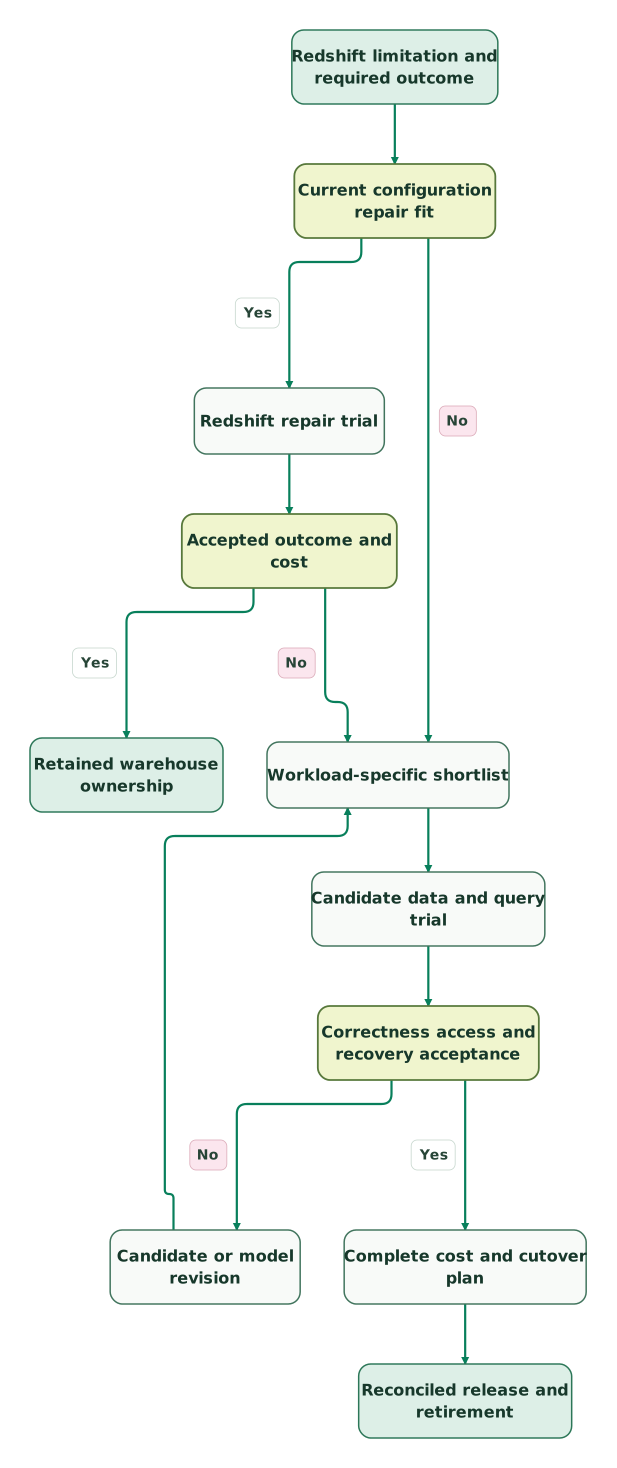
Read diagram as text
- Redshift limitation and required outcome to Current configuration repair fit.
- Current configuration repair fit to Redshift repair trial: Yes.
- Current configuration repair fit to Workload-specific shortlist: No.
- Redshift repair trial to Accepted outcome and cost.
- Accepted outcome and cost to Retained warehouse ownership: Yes.
- Accepted outcome and cost to Workload-specific shortlist: No.
- Workload-specific shortlist to Candidate data and query trial.
- Candidate data and query trial to Correctness access and recovery acceptance.
- Correctness access and recovery acceptance to Candidate or model revision: No.
- Candidate or model revision to Workload-specific shortlist.
- Correctness access and recovery acceptance to Complete cost and cutover plan: Yes.
- Complete cost and cutover plan to Reconciled release and retirement
Redshift replacement checklist
- A specific workload gap justifies the search.
- The current Redshift configuration remains a priced candidate.
- Each alternative is evaluated against the same accepted output contract.
- Billing units, regions and allowances are explicit.
- Stored procedures, permissions, models and reports have migration owners.
- Corrections, deletions and failure recovery pass representative tests.
- Storage, supporting services and operating work appear in the complete budget.
- Any remaining commitment and parallel-running cost are included.
- Cutover and rollback have one authoritative reporting path.
Use the marketing data audit skill for the evidence inventory and the warehouse design guide for the model contract. Our warehouse implementation scope connects the chosen replacement to delivery. The $99 audit includes a written assessment and a one-hour specialist call.
Keep reading
Browse all Data Warehouse guides
 Data Warehouse
Databricks vs BigQuery: SQL Reporting, Engineering and Workload Cost
Compare Databricks and BigQuery for SQL reporting, engineering and ML. Includes billing examples, runtime limits, cost controls and migration checks.
Jafrin Akter AloLast updated 11 min read
 Data Warehouse
ClickHouse vs Databricks: Event Analytics, Lakehouse Workflows and Cost
Compare ClickHouse and Databricks for analytical serving and wider data workflows. Covers Real-Time beta limits, corrections, pricing and acceptance tests.
Jafrin Akter AloLast updated 11 min read
 Data Warehouse
Databricks vs Redshift: AWS Reporting, Engineering and Total Cost
Compare Databricks and Redshift for AWS reporting, engineering and ML. See complete billing examples, runtime boundaries, pipeline checks and migration fit.
Jafrin Akter AloLast updated 11 min read
Data warehouse & CDP
See the implementation scope, deliverables and acceptance checks.
Questions people ask
Is Athena a drop-in Redshift replacement for every SQL workload?
Athena suits supported SQL analysis over lake data, but it does not implement every Redshift database behavior. Stored procedures are one important difference, and transactional operations depend on supported table formats. Inventory dependencies and trial the actual reports before migration. A low scan price is useful only when the surrounding file, catalog and operating design meets the requirement. Athena limitations.
Can a Redshift alternative be introduced for just one serving workload?
A bounded serving workload can move while other reporting stays on Redshift. Define the authoritative model, delivery timing, corrections and consumer access between systems. Include the extra pipeline and operating cost, and claim retirement savings only for resources actually removed. A partial architecture change is useful when it solves a measured requirement without creating an unowned second data definition.
Does a smaller Snowflake credit price prove it costs less than Redshift?
Credit price is only one input. The warehouse type, consumption rate, running time and other services determine the Snowflake amount, while Redshift has its own compute and storage meters. Measure the same accepted work and add supporting costs before comparing totals. Different billing units cannot establish a ranking simply because one printed dollar value is lower.
Will an Athena workgroup cost alert stop all further queries automatically?
Workgroup aggregate thresholds notify the configured recipients and do not automatically cancel queries. Per-query controls have different behavior and can cancel an individual query after its scan threshold is exceeded. Set an operational response for each control and understand the charges already incurred, rather than treating a notification as a guaranteed account-wide spending stop. Athena usage controls.
Should a Redshift migration be approved on subscription savings alone?
Savings need to include migration work, overlapping subscriptions or resources, remaining commitments and the replacement's operating cost. Calculate payback from the net recurring difference after those inputs are explicit. A missing capability can justify the project independently, but it needs an accepted business outcome and owner. Keep that rationale separate from a numerical saving the evidence does not support.
Sources
- Snowflake service consumption and rates
- Snowflake architecture
- Snowflake trial accounts
- Snowflake warehouse considerations
- BigQuery pricing
- BigQuery ML
- BigQuery query cost controls
- Databricks regional pricing data
- Databricks lakehouse architecture
- Databricks Free Edition limits
- Databricks Serverless runtime limits
- ClickHouse Cloud pricing
- ClickHouse ordering keys
- ClickHouse warehouses
- ClickHouse ReplacingMergeTree
- Athena N. Virginia regional price list
- Athena pricing models
- Athena overview
- Athena SQL limitations
- Athena Iceberg support
- Athena data-usage controls
- Redshift provisioned families
- Redshift table optimization
- Redshift zero-ETL integrations

Written by
Jafrin Akter AloData Engineer and Co-founder at Martechdevs and Growth and Analytics Partners
Jafrin writes practical guides to marketing technology, customer data, analytics and AI workflows. Martechdevs is a Growth and Analytics Partners company.