
Databricks vs Redshift: AWS Reporting, Engineering and Total Cost
Pick Redshift when the main requirement is an AWS analytical warehouse with SQL reporting and supported integrations. Pick Databricks when shared Spark engineering, SQL and machine-learning workflows justify its broader platform. Databricks vs Redshift should compare complete pipelines and accepted business outputs, with the chosen compute models named. The same hourly number can represent very different resources, work and additional costs.
On this page
Databricks and Redshift compared
USD list examples below use AWS N. Virginia and exclude storage, networking, optional services and commitments.
| Decision | Databricks | Amazon Redshift |
|---|---|---|
| SQL compute example | SQL Serverless Premium $0.70/DBU | Serverless on-demand $0.375/RPU-hour |
| Engineering compute example | Jobs Serverless Premium $0.35/DBU | Loading and SQL transformations consume the selected warehouse resources |
| Starting operating model | Shared engineering, SQL and ML workflows | AWS warehouse and SQL consumption |
| Data movement | Supported ingestion, jobs and pipeline services | Supported zero-ETL integrations plus other loading paths |
| Important configuration choice | SQL, jobs, interactive and pipeline compute | Serverless or a specific provisioned node family |
Sources: Databricks regional pricing data, AWS regional Redshift rates, Databricks architecture, Redshift zero-ETL.
A Databricks Unit, or DBU, measures consumption for a specific Databricks product. A Redshift Processing Unit, or RPU, measures Serverless compute capacity over time. Their prices do not establish equivalent performance. The comparison needs each platform's actual consumption for the required work.
At Martechdevs, we begin a warehouse implementation with the source-to-report workflow and the team responsible for it. The decision includes data arrival, transformations, permissions, reporting and recovery. A platform that makes one stage easier can still leave an expensive or unreliable handoff elsewhere.
AWS reporting and existing integration fit
Redshift is a natural starting candidate when the reporting estate and operational ownership already sit in AWS. Its managed warehouse supports SQL analytics, and supported zero-ETL integrations automate replication from specified databases and applications into a Redshift target. Check source, region and integration requirements before assuming a particular system is covered. Redshift integrations.
Replication still needs a downstream business model. An order table, payment table and advertising report can arrive correctly while producing an inflated revenue dashboard if their joins multiply rows. Define each table's grain and the accepted customer identifier before comparing platforms.
For example, an order with three line items and two payment attempts can become six rows after an uncontrolled join. Summing the order amount across those rows would multiply revenue. Neither Redshift nor Databricks can infer the intended accounting definition from that join alone.
Redshift's provisioned options also require a current comparison. RG and RA3 separate compute from managed storage. RG has an integrated data-lake query engine, while RA3 uses Spectrum for the corresponding lake-query workflow. Keep the node family visible in the architecture and budget. Provisioned cluster families.
For SQL table design, Redshift can automatically manage sort and distribution choices for tables configured with AUTO. A comparison that assumes every table always requires manual key tuning overstates the routine work. The team still needs to inspect workload behavior and data correctness. Automatic table optimization.
Shared engineering and ML workflows
Databricks combines Spark-based processing, Delta Lake and Unity Catalog. It is a strong starting candidate when engineers and data scientists need maintained transformations, notebooks, model development and SQL consumption in one operating environment. Lakehouse architecture.
Redshift also has machine-learning capabilities. Redshift ML can use SageMaker AI for model training and make supported predictions available through SQL; it also integrates with Bedrock for specified foundation-model workflows. Training, storage and external services have their own cost implications. Redshift ML.
Databricks Serverless notebooks and jobs have runtime limits. They support Spark Connect APIs and exclude R and Spark RDD APIs. A workload needing those excluded capabilities should be evaluated against another supported Databricks compute configuration; the restriction is specific to the Serverless mode. Runtime limits.
Databricks selection boundaries
- Best for: engineers and data scientists sharing Spark transformations, SQL consumption and custom model-development work.
- Pros: processing, Delta data management and catalog governance can support one maintained workflow.
- Cons: runtime compatibility and separately metered compute and services require an explicit architecture and budget.
- Free plan and startup offer: keep any approved trial or startup credits outside the steady-state cost comparison.
- Choose it if: the required libraries, transformations and ML lifecycle fit the selected runtime and have accountable owners.
- Skip it if: a narrow SQL reporting requirement already works and the broader platform has no accepted additional job.
The scope follows Databricks architecture and Serverless runtime limits.
Redshift selection boundaries
- Best for: an AWS reporting team with supported ingestion paths and a maintained SQL business model.
- Pros: managed warehouse operation, supported zero-ETL integrations and automatic table optimization can fit that environment.
- Cons: source coverage, node or Serverless choice, external-service costs and model correctness still need validation.
- Free plan and startup offer: confirm any eligible evaluation allowance separately; use the ongoing selected resource and storage rates for the operating budget.
- Choose it if: source-to-report delivery and the required SQL or supported ML tasks pass the same workload contract.
- Skip it if: the requirement depends on custom engineering or ML behavior that the proposed Redshift-centered design cannot support reliably.
The scope follows Redshift integrations, table optimization and Redshift ML.
Pipeline correctness and recovery
Both platforms support operations for changing analytical records. Delta MERGE supports inserts, updates and deletes, and Redshift MERGE combines matched and unmatched operations under its own rules. Write the intended key, version and delete behavior before translating the syntax. Delta MERGE, Redshift MERGE.
A migration test should include duplicate source records and multiple changes to the same business object. Databricks' duplicate-match evaluation depends on runtime behavior, while Redshift also restricts ambiguous source-to-target matches. An accepted source sequence needs a deliberate resolution rule before the merge.
Lakeflow AUTO CDC provides supported change-feed and snapshot patterns, including Type 1 and Type 2 history. Its pipeline requirements and billing are separate from the SQL warehouse reading the final table. Confirm the needed edition and source behavior before treating CDC as an included property of every Databricks configuration. AUTO CDC requirements.
Use the same failure scenario for both candidates: interrupt a source delivery, apply a correction during the interruption, then resume processing. The accepted result must include the correction once and preserve any required history. Compare recovery evidence and operating work alongside normal-run speed.
Our data warehouse design guide and dbt backfill guide cover the modeling and repair decisions that remain relevant whichever platform is selected.
Pricing examples with complete workload scope
For a hypothetical future trial, assume the accepted monthly workload needs 500 Databricks SQL Serverless DBUs plus 200 Jobs Serverless DBUs. Assume the comparable Redshift Serverless implementation consumes 1,000 RPU-hours across loading, transformations and queries. These are example inputs that must be replaced with measured workload use.
| Candidate component | Assumed quantity | Rate | Compute amount |
|---|---|---|---|
| Databricks SQL Serverless Premium | 500 DBUs | $0.70/DBU | $350 |
| Databricks Jobs Serverless Premium | 200 DBUs | $0.35/DBU | $70 |
| Databricks combined example | Two preceding product meters | Product-specific rates | $420 |
| Redshift Serverless on-demand | 1,000 RPU-hours | $0.375/RPU-hour | $375 |
Rates: Databricks public regional data, AWS N. Virginia price list. The $45 compute difference does not include storage, networking, pipeline products outside the stated job scope, ML services, tax or operating work. It is not evidence that one platform generally runs cheaper.
If the Databricks job actually needs 400 DBUs, its combined example becomes $490. If Redshift needs 1,400 RPU-hours, its compute amount becomes $525. The workload quantities decide the result; the entry unit rate alone cannot answer it.
A classic Databricks job is a different budget. The N. Virginia Premium Jobs Compute rate is $0.15/DBU, but customer-account infrastructure belongs beside that software-consumption line. Choosing the lower DBU price without the corresponding AWS costs understates the architecture. Databricks jobs pricing, regional rates.
Databricks' SQL pro and classic compute run in the customer's AWS account, unlike its Serverless SQL architecture. Keep that infrastructure boundary explicit when comparing configurations. Storage, connectivity and other services remain separate considerations. Warehouse types.
Redshift Serverless has a 60-second minimum and bills storage separately. In the same region, 1,000 GB of managed storage adds $24/month. Adding that only to the Redshift side still leaves an incomplete comparison until the Databricks storage and other corresponding components are priced. Serverless billing, regional storage rate.
Use the Databricks pricing guide, Databricks calculator and Redshift pricing guide for detailed budgeting. Keep actual commitments and trial credits separate from recurring list-price estimates.
Capacity, idle time and spend controls
Redshift Serverless base capacity and maximum capacity affect the resources available to the workload. Period RPU-hour limits can log, alert or disable user queries. An alert and a shutdown policy have different availability consequences, so name the chosen action before relying on a budget limit. Redshift capacity controls.
An explicit transaction left open can continue consuming Redshift RPUs. Canceled queries still incur their elapsed use. Review transaction completion and actual charged usage when an apparently quiet period costs more than expected. Billing behavior.
Databricks SQL Auto Stop controls idle warehouse shutdown, while warehouse size and cluster count affect different workload needs. A larger warehouse may help an expensive query; more clusters may address concurrent work. Validate the chosen change against the busy period and its cost. SQL warehouse settings.
Use product-specific Databricks usage records for allocation. The records identify SKU, unit and quantity and can include corrections. A list-price estimate needs the matching product and price interval, while the invoice reflects the applicable commercial terms. Usage records, price history.
Compare on-demand behavior with any reserved commitment using the eligible steady baseline. A quieter workload does not automatically eliminate an existing commitment. For Redshift, both Serverless reservations and provisioned reserved nodes require their own term and matching rules. Serverless reservations, reserved nodes.
Governance and ownership
Databricks Unity Catalog governs data and AI assets, permissions and lineage, with distinct managed and external asset lifecycles. Identify the platform and cloud identities responsible for access and maintenance. A successful query through an administrator account is insufficient evidence of the intended permission model. Unity Catalog.
For either candidate, test the real consumer identity. Include a restricted marketing analyst, an approved transformation service and a recovery operator. Document which actions each may perform and verify that access remains correct after the data refresh or schema change.
Keep the business definition outside an individual query owner's memory. Document the source record, accepted state, time boundary and owner for a metric such as qualified pipeline or recognized revenue. Platform consolidation helps only if those definitions become easier to maintain and audit.
Best fit by AWS workload
| Situation | First candidate | Runner-up | Deciding evidence |
|---|---|---|---|
| Established AWS SQL reporting with suitable ingestion | Redshift | Databricks SQL with the full pipeline priced | A specific engineering or lifecycle limitation |
| Shared Spark transformations and custom ML development | Databricks | Redshift with supported external ML components | A simpler supported workflow meeting the same requirement |
| Working Redshift warehouse with a slow report | Current Redshift model and capacity review | Databricks after an accepted replacement trial | Measured failure after a reasonable repair |
| Existing Databricks lakehouse with BI consumers | Appropriate Databricks SQL warehouse | Redshift with the migration and integration scope included | Accepted lower-cost alternative including transition work |
| Operational application data plus analytics | Incumbent with supported ingestion and a maintained model | The other platform after source and recovery validation | Source coverage, freshness and recovery evidence |
The Redshift alternatives guide widens the shortlist if neither operating model fits. Databricks vs BigQuery covers the Google Cloud decision, and ClickHouse vs Databricks focuses on analytical serving rather than replacing the whole platform.
Trial scope and migration economics
Databricks Free Edition is useful for learning and early evaluation, but it has fair-use limits and lacks guaranteed reliability, support and SLAs. Paid trials can have their own terms. Use a configuration representative of the required production workload before treating trial results as an operating commitment. Free Edition boundaries.
An evaluation should preserve the parts of the workload that make the decision hard.
| Evidence area | Representative case | Acceptance condition |
|---|---|---|
| Data correctness | Duplicate update and corrected revenue | Expected current state and history |
| Processing | Normal and backfill runs | Required completion and source impact |
| Reporting | Busy period and important filters | Accepted latency and concurrency |
| Security | Allowed and denied identities | Expected access boundaries |
| Recovery | Failed delivery and resumed processing | Complete, reconciled output |
| Budget | All compute and supporting resources | Reproducible monthly operating estimate |
Suppose an illustrative migration costs $24,000 and saves $600/month after added operating costs. Simple payback is 40 months before any additional transition expense. A missing capability may still justify the move, but that decision needs a defined outcome instead of being presented as a short-term saving.
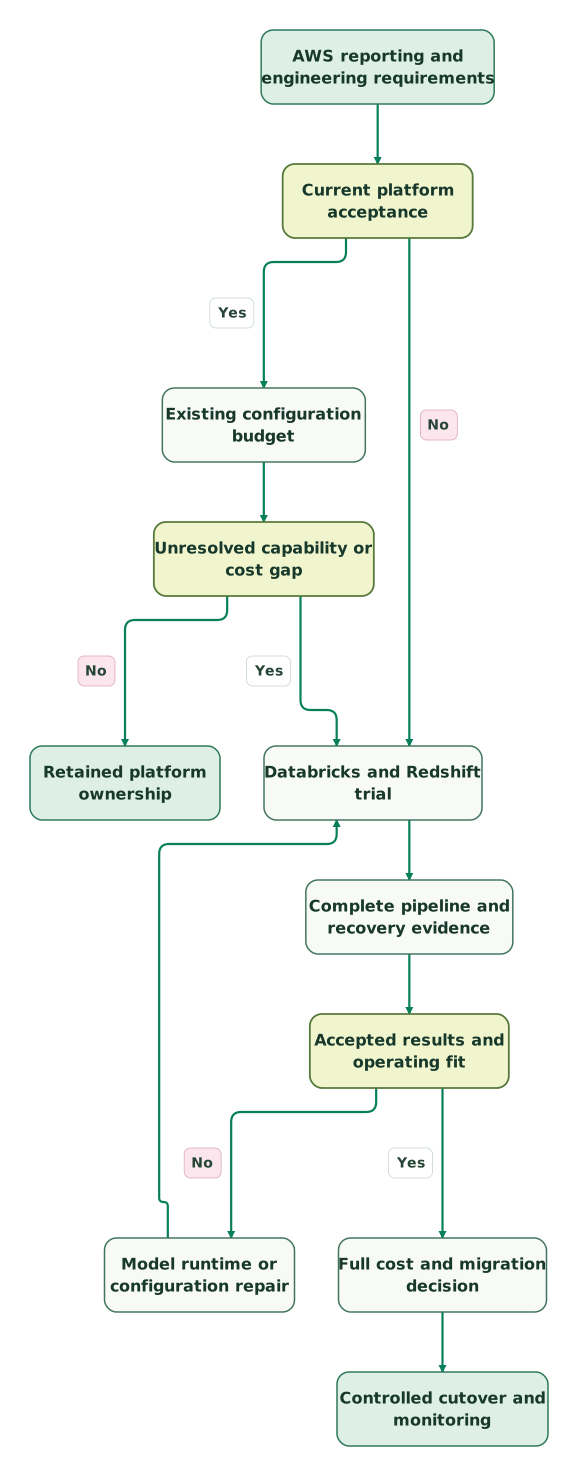
Read diagram as text
- AWS reporting and engineering requirements to Current platform acceptance.
- Current platform acceptance to Existing configuration budget: Yes.
- Current platform acceptance to Databricks and Redshift trial: No.
- Existing configuration budget to Unresolved capability or cost gap.
- Unresolved capability or cost gap to Retained platform ownership: No.
- Unresolved capability or cost gap to Databricks and Redshift trial: Yes.
- Databricks and Redshift trial to Complete pipeline and recovery evidence.
- Complete pipeline and recovery evidence to Accepted results and operating fit.
- Accepted results and operating fit to Model runtime or configuration repair: No.
- Model runtime or configuration repair to Databricks and Redshift trial.
- Accepted results and operating fit to Full cost and migration decision: Yes.
- Full cost and migration decision to Controlled cutover and monitoring
Databricks and Redshift selection checklist
- The required reporting, engineering and ML workflows are listed separately.
- Each proposed compute type and regional rate is explicit.
- Ingestion and correction behavior match the source contract.
- SQL results reconcile at the agreed business grain.
- Runtime and integration requirements pass before commitment.
- Storage, infrastructure, networking and supporting products appear in both budgets.
- Cost controls and commitments match the workload's availability needs.
- Restricted identities and recovery cases pass the same acceptance test.
- Migration value justifies the complete transition and operating cost.
Use the marketing data audit skill for the evidence inventory. Our warehouse implementation scope connects the chosen architecture to delivery. The $99 audit includes a written assessment and a one-hour specialist call.
Keep reading
Browse all Data Warehouse guides
 Data Warehouse
Databricks vs BigQuery: SQL Reporting, Engineering and Workload Cost
Compare Databricks and BigQuery for SQL reporting, engineering and ML. Includes billing examples, runtime limits, cost controls and migration checks.
Jafrin Akter AloLast updated 11 min read
 Data Warehouse
ClickHouse vs Databricks: Event Analytics, Lakehouse Workflows and Cost
Compare ClickHouse and Databricks for analytical serving and wider data workflows. Covers Real-Time beta limits, corrections, pricing and acceptance tests.
Jafrin Akter AloLast updated 11 min read
 Data Warehouse
5 Redshift Alternatives for Warehousing, Engineering and Event Queries
Choose a Redshift alternative by workload. Compare Snowflake, BigQuery, Databricks, ClickHouse and Athena with costs, repair options and migration checks.
Jafrin Akter AloLast updated 12 min read
Data warehouse & CDP
See the implementation scope, deliverables and acceptance checks.
Questions people ask
Does choosing Redshift rule out machine learning in the warehouse workflow?
Redshift ML supports specified model-training and prediction workflows and integrates with other AWS AI services. The decision depends on the required lifecycle, including training data, evaluation, deployment and operating ownership. Compare that actual workflow with Databricks rather than treating the presence of an ML feature as proof that both designs serve every modeling requirement equally. Redshift ML.
Is a Databricks DBU equivalent to a Redshift RPU-hour?
The units measure different consumption and have no general one-to-one conversion. Measure the quantities needed for the same accepted pipeline and query workload, then apply each regional product rate. Include the rest of the architecture before comparing totals. A lower published unit price can still produce a higher complete bill when more units or supporting services are required.
Does Redshift zero-ETL remove the need for a business data model?
Zero-ETL automates supported source replication into a Redshift target. The reporting model still needs identifiers, grain, correction rules and metric definitions. Test the joins and expected business totals after the data arrives, and confirm the source and region are supported. A maintained replication path reduces one operating responsibility while leaving the downstream analytical contract to the team. Integration scope.
Can a cheaper Databricks classic-job DBU rate establish a cheaper complete pipeline?
The classic-job DBU rate is one component of the architecture. Add the associated customer-cloud infrastructure, storage, networking and other services, then measure the work required to produce the accepted result. Keep that complete estimate separate from a Serverless product's billing model. Comparing only the software-consumption rate can leave essential resource costs outside the calculation. Jobs pricing.
Should every slow Redshift dashboard trigger a Databricks migration?
A slow dashboard first needs a workload diagnosis. Inspect its joins, data layout, repeated processing, concurrency and capacity before proposing another platform. Redshift supports automatic table optimization for eligible configurations, and a targeted model repair may meet the requirement. A migration becomes a useful option when a measured gap remains and its value justifies the transition cost. Table optimization.
Sources
- Databricks regional pricing data
- AWS Redshift N. Virginia price list
- Databricks lakehouse architecture
- Redshift zero-ETL integrations
- Redshift provisioned cluster families
- Redshift automatic table optimization
- Redshift machine learning
- Databricks Serverless runtime limits
- Databricks Delta MERGE
- Redshift MERGE
- Databricks AUTO CDC APIs
- Databricks jobs pricing
- Databricks SQL warehouse types
- Redshift Serverless billing
- Redshift on-demand cost controls
- Databricks SQL warehouse settings
- Databricks billable usage
- Databricks price history
- Redshift Serverless reservation terms
- Redshift reserved nodes
- Databricks Unity Catalog
- Databricks Free Edition limitations

Written by
Jafrin Akter AloData Engineer and Co-founder at Martechdevs and Growth and Analytics Partners
Jafrin writes practical guides to marketing technology, customer data, analytics and AI workflows. Martechdevs is a Growth and Analytics Partners company.