
Redshift Pricing: Serverless, Provisioned Nodes and Real Monthly Costs
Redshift pricing combines compute, stored data and additional services. For Serverless in US East (N. Virginia), the on-demand compute rate is $0.375 per RPU-hour, with managed storage billed separately. The worked examples below range from $72/month for a small scheduled workload to $7,320/month for sustained agency reporting, before snapshots, transfer and other services. Actual usage determines the bill.
On this page
Redshift billing units and starting rates
USD public list rates below apply to US East (N. Virginia), before tax, credits and negotiated discounts.
| Component | Billing unit | Published rate | Budget implication |
|---|---|---|---|
| Serverless on-demand compute | RPU-hour | $0.375 | Capacity multiplied by charged time |
| Serverless managed storage | GB-month | $0.024 | Average stored data adds a separate charge |
| Serverless unique snapshot storage | GB-month | $0.023 | Retained unique snapshot blocks have a separate meter |
| Provisioned RG xlarge compute | Node-hour | $0.7602 | Multiply by billable node count and time |
| Serverless one-year no-upfront reservation | Reserved RPU-hour | $0.293 | Committed coverage is paid throughout the term |
Source: AWS's regional Redshift price list. AWS's pricing overview explains the product categories and regional examples.
A Redshift Processing Unit, or RPU, measures Serverless compute capacity. Eight RPUs used for 30 minutes equal four RPU-hours. At $0.375/RPU-hour, that interval costs $1.50 before storage and other charges. An RPU-hour combines capacity and time; one hour on a clock can consume many RPU-hours. Serverless compute capacity.
Serverless is metered per second with a 60-second minimum. Provisioned clusters use their node-specific billing terms. Keep the two models separate when reading a price calculator. Serverless billing, provisioned billing.
At Martechdevs, we plan warehouse implementations around completed reporting and activation workloads. The useful cost measure is the bill for accepted results at the required freshness and concurrency, including loading and transformations. A low nominal capacity price does not establish that a configuration meets those requirements.
Redshift cost by company type
These monthly examples use N. Virginia on-demand Serverless at $0.375/RPU-hour and storage at $0.024/GB-month.
| Illustrative company | Charged compute assumption | Average stored data | Compute plus storage |
|---|---|---|---|
| Five-person startup | 4 RPUs × 2 hours × 22 days | 250 GB | $66 + $6 = $72 |
| Twenty-person SaaS | 8 RPUs × 4 hours × 22 days | 1,000 GB | $264 + $24 = $288 |
| B2B SaaS with 50 to 100 staff | 32 RPUs × 8 hours × 22 days | 2,000 GB | $2,112 + $48 = $2,160 |
| Agency with sustained reporting | 64 RPUs × 10 hours × 30 days | 5,000 GB | $7,200 + $120 = $7,320 |
The rates come from the regional price list. Company size is context for the example, not a sizing rule. Each scenario assumes that the stated charged capacity and runtime already reflect the workload; scaling beyond them increases cost. Manual snapshots, data transfer, S3, ingestion services, BI licences, support and delivery work are excluded.
For a first estimate, replace the assumed runtime with observed usage from the busiest representative reporting periods. Include scheduled transformations, dashboard refreshes, ad hoc analysis and development. Looking only at visible dashboard activity misses jobs running before anyone opens a report.
For provisioned compute, consider a separate worked example: two RG xlarge nodes running for an assumed 730 hours cost 2 × $0.7602 × 730 = $1,109.89. Add 1,000 GB of managed storage at $24 for $1,133.89 before other services. This is a billing calculation, not a performance equivalence with any Serverless row above. Regional node and storage rates.
RG and RA3 separate compute from managed storage. RG also has an integrated data-lake query engine, while RA3 uses Spectrum for that workflow. Specify the node family in any provisioned comparison rather than treating every cluster as the same product. Provisioned cluster differences.
Main Redshift bill drivers
Charged capacity and execution time
For Serverless, base capacity is the starting configuration and automatic scaling can increase the capacity consumed. The bill includes scaled capacity. Long-running transactions also matter: AWS states that an explicit transaction left open continues to consume RPUs, and canceled queries still incur the cost of time already used. Billing usage notes.
Separate a slow query from an expensive query before changing capacity. In a hypothetical test, 16 RPUs running for 20 minutes and 32 RPUs running for 10 minutes both consume 5.3333 RPU-hours, costing $2 at the example rate. If the larger configuration instead takes 15 minutes, it consumes eight RPU-hours and costs $3. Measure completed work and the billed interval together.
A small capacity setting can be appropriate for a light workload. It can also lengthen a congested reporting period. Record whether the proposed reduction preserves delivery time and concurrency rather than accepting a lower setting as proof of a lower monthly bill.
Stored data and snapshot retention
Average stored volume produces an ongoing charge even when on-demand compute is idle. Manual snapshot storage depends on unique retained blocks across active snapshots, so multiplying the full database size by the snapshot count can misstate the bill. Recovery points retained for less than 24 hours have separate documented treatment. Storage and snapshot billing.
Keep active storage and unique snapshots in separate budget lines. In the stated region, an illustrative 1,000 GB of active data costs $24/month, while 500 GB of separately billable unique snapshot blocks costs $11.50/month. Their combined storage amount is $35.50. Regional storage meters.
Storage units also need consistency. A price quoted per GB-month should be multiplied by the billable GB measure. Do not silently switch between decimal TB and 1,024 GB per TB when comparing a vendor example with your own estimate.
Additional services and environments
Cross-Region transfers, machine learning services and supporting AWS resources can add costs outside the core compute calculation. Serverless includes data-lake query compute in its RPU model; avoid adding the provisioned Spectrum scan formula to that same Serverless query. Additional billing components.
Inventory development, staging, temporary migration resources and recovery copies. Give each an owner and retirement condition. The team's total warehouse cost includes those resources even when the production workgroup is within its own budget.
Users and usage
Redshift's core bill follows compute and storage rather than a Redshift licence for each analyst. More readers can still create more queries, concurrency and refreshes. A hundred occasional readers using an efficient reporting layer may have a different impact from five analysts repeatedly rebuilding large intermediate tables. Redshift pricing model.
Separate the people using the warehouse from licences for the BI or analytics tools connected to it. The warehouse can have no per-reader fee while the reporting application still charges for each viewer or author. For procurement, keep warehouse, pipeline and BI costs in adjacent budget lines.
Our data warehouse cost guide covers that broader operating budget. Assign ownership of the workload causing the spend, so a finance review can connect the bill to a business purpose and an accountable team.
Serverless and provisioned fit
| Workload situation | Starting model | Selection evidence |
|---|---|---|
| Uncertain or intermittent demand | Serverless on-demand | Charged usage across representative active and idle periods |
| Steady, measured Serverless baseline | Partial reservation coverage | Eligible hourly coverage and commitment economics |
| Stable provisioned operating model | Appropriate RG or RA3 configuration | Completed workload cost, required features and recovery |
| Development with defined availability windows | Serverless or eligible scheduled cluster pause | Acceptable startup, resume and maintenance behavior |
| Critical reporting with bursts | Capacity and usage controls aligned to the service requirement | Peak concurrency, alert ownership and interruption policy |
Four base RPUs are available for supported regional configurations, including N. Virginia, and carry a managed-storage limit of 32 TB. Tables with many columns and high concurrency require additional consideration. The lowest base setting is an entry configuration, not a promise that any small company will run well on it. Capacity considerations.
Our Redshift vs Snowflake comparison provides the platform selection checks. Keep this pricing estimate attached to the same workload contract so the cost and architecture decisions stay aligned.
Redshift cost controls
Capacity ceilings and usage actions
Max capacity limits how far a workgroup can scale at a point in time. A maximum RPU-hour usage limit instead tracks consumption over a daily, weekly or monthly period and triggers a chosen action. They control different dimensions of the bill. On-demand capacity controls.
Usage actions can log, alert or turn off user queries. Logging and alerting leave the workload running; the shutdown action affects availability. Choose the response according to the workload's business importance and put an owner behind the alert. Usage-limit actions.
A hypothetical 1,000 RPU-hour monthly threshold corresponds to $375 of on-demand compute at the stated rate. It does not cap storage, every supporting service or a separate reservation commitment. Name the scope of the limit in the budget notes.
Query boundaries and workload design
Query monitoring rules can log or stop queries meeting specified conditions. Their actions and exclusions matter: AWS notes that an abort action does not stop COPY statements or maintenance operations such as ANALYZE and VACUUM. Use the rule for its supported workload rather than assuming one threshold controls every job. Query monitoring rules.
Investigate repeated full rebuilds, unnecessarily frequent refreshes, broad scans and duplicate dashboard requests. Change one cause at a time, then compare required outputs, completion time and charged use. A cost reduction that silently removes required records or misses the delivery deadline fails the business requirement.
Scheduled availability and usage evidence
Eligible provisioned clusters can pause and resume on a schedule. On-demand compute billing pauses, while storage remains chargeable. Queries are unavailable during the pause, and resume can take time. Reserved commitments continue according to their terms. Pause behavior, reserved-node commitments.
For Serverless, the SYS_SERVERLESS_USAGE view includes charged RPU-seconds and has seven days of retention. Its charged values are recorded after transactions end, so an active transaction can temporarily show zero charged seconds. Aggregate the relevant periods and retain longer-term evidence in your approved monitoring process. Usage view.
Reservations, credits and contract terms
Serverless reservations commit a quantity of RPUs for one year, with payment options. Usage above the covered level is on-demand, and the commitment remains billable when usage is lower. AWS states that purchased reservations cannot be changed or deleted; free Serverless credits do not apply to reserved RPUs. Reservation terms.
Using the listed N. Virginia no-upfront rate of $0.293 against $0.375 on-demand, the simplified utilization break-even is $0.293 ÷ $0.375 = 78.13%. This compares one continuously paid unit of reservation coverage with the same eligible on-demand usage. It assumes unchanged rates, no credits and no other contract benefit. Regional reservation rate.
A workload active only during office hours can therefore cost more under an oversized continuous commitment even when the reserved unit rate is lower. Analyze the eligible aggregate baseline over representative periods, including quiet weeks, before buying coverage. A peak-capacity setting is a poor substitute for that evidence.
Provisioned reserved nodes use separate one-year or three-year commitments tied to matching region and node characteristics. Resizing into a different node type does not automatically move an existing reservation to the new type. Review any remaining commitment before a family change or migration. Reserved-node terms.
Eligible first-time Serverless accounts can receive $300 of trial credit with a 90-day expiry. Keep the trial benefit separate from the recurring run rate and verify the account's eligibility. A short trial invoice can hide the eventual operating cost. Redshift free trial.
Redshift rate card in plain English
| Rate-card term | Budget meaning | Common estimation error |
|---|---|---|
| RPU-hour | Capacity consumed over charged time | Multiplying only by clock hours |
| Node-hour | One provisioned compute node for its billable time | Pricing the cluster as a single node |
| Managed storage | Stored data with its own regional rate | Assuming compute includes all storage |
| Unique snapshot storage | Retained snapshot blocks under the applicable rules | Multiplying every snapshot by full database size |
| Reservation | Paid coverage over a fixed term | Applying the discount only during active hours |
Use the AWS regional price list for the exact unit rate and the pricing page for the relevant product model. Save the region, node type or compute model, billing unit and term beside every rate in your estimate.
Budget decision and implementation
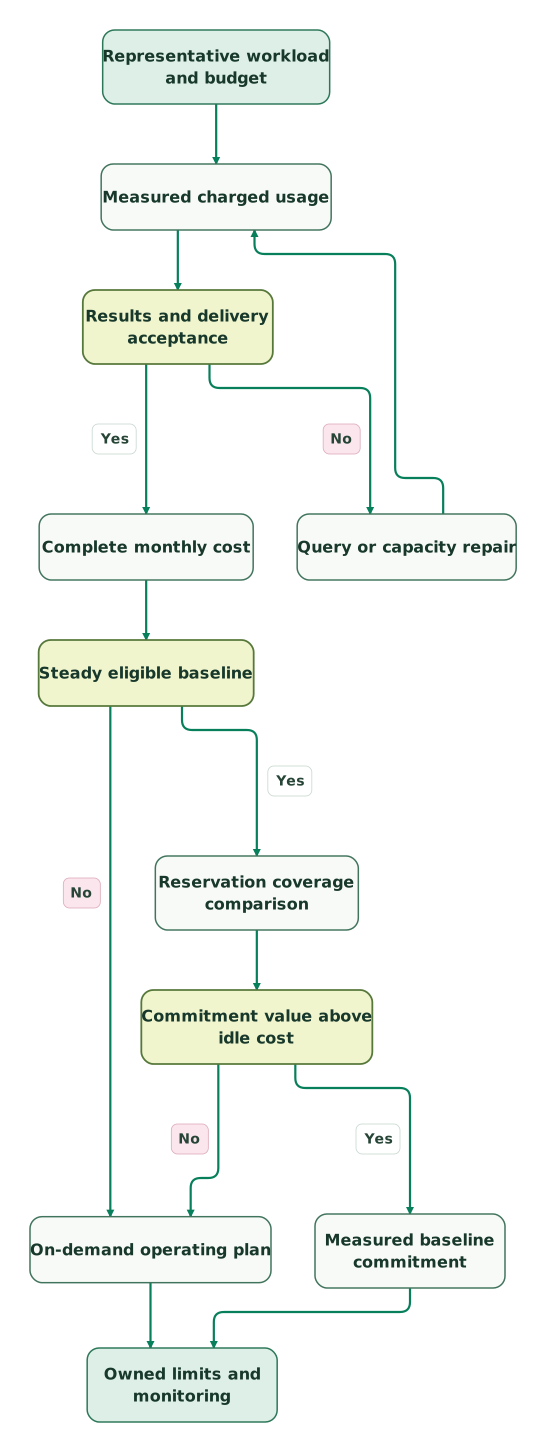
Read diagram as text
- Representative workload and budget to Measured charged usage.
- Measured charged usage to Results and delivery acceptance.
- Results and delivery acceptance to Query or capacity repair: No.
- Query or capacity repair to Measured charged usage.
- Results and delivery acceptance to Complete monthly cost: Yes.
- Complete monthly cost to Steady eligible baseline.
- Steady eligible baseline to Reservation coverage comparison: Yes.
- Steady eligible baseline to On-demand operating plan: No.
- Reservation coverage comparison to Commitment value above idle cost.
- Commitment value above idle cost to On-demand operating plan: No.
- Commitment value above idle cost to Measured baseline commitment: Yes.
- On-demand operating plan to Owned limits and monitoring.
- Measured baseline commitment to Owned limits and monitoring
Redshift budgeting checklist
- The region and compute model match every quoted rate.
- Charged capacity includes scaling, loading and transformations.
- Managed storage and unique snapshots have separate estimates.
- Supporting services and non-production environments have owners.
- Performance and business totals pass before capacity is reduced.
- Capacity ceilings and usage actions match interruption tolerance.
- Reservations use eligible baseline coverage and explicit term economics.
- Trial credits are excluded from the recurring operating budget.
Use the marketing data audit skill to organize the workload and ownership evidence. For platform options, compare Databricks alternatives or the latency-oriented choices in ClickHouse vs Snowflake. The software pricing tool helps keep the wider stack budget visible. Our warehouse implementation service connects the estimate to a delivery scope; the $99 audit includes a written assessment and a one-hour specialist call.
Keep reading
Browse all Data Warehouse guides
 Data Warehouse
Snowflake Pricing: Credits, Warehouse Sizes, Storage, Ingestion and AI Costs
Snowflake credit prices by edition and region, warehouse cost by size, Snowpipe and Cortex AI charges, with worked bills and spend controls.
Jafrin Akter AloLast updated 16 min read
 Data Warehouse
Databricks Competitors and Alternatives by Workload and Cost
Compare seven Databricks alternatives for SQL, Spark and real-time analytics. See billing units, operating tradeoffs and a migration payback example.
Jafrin Akter AloLast updated 12 min read
 Data Warehouse
ClickHouse vs Snowflake: Query Fit, Data Changes and Total Cost
Compare ClickHouse and Snowflake for event analytics and reporting. Review current update behavior, Interactive warehouses, compute costs and acceptance tests.
Jafrin Akter AloLast updated 12 min read
Data warehouse & CDP
See the implementation scope, deliverables and acceptance checks.
Questions people ask
Does Redshift Serverless charge every hour that the workgroup exists?
On-demand Serverless compute follows charged workload use, with a minimum billing interval, while stored data remains chargeable. A reservation creates a separate continuous commitment. Inspect transactions and background activity when apparent idle periods still produce usage, and distinguish the on-demand compute meter from storage and reservation lines before deciding that an idle workgroup should have a zero bill. On-demand billing.
Is a maximum RPU-hour limit also a maximum capacity setting?
They are separate controls. Max capacity sets the ceiling for automatic scaling, while an RPU-hour limit tracks consumption during a defined period and triggers the selected response. An alert does not stop queries. Configure both against the workload's budget and availability needs, then verify which action occurs before relying on either as a spending control. Capacity controls.
Can reserved Redshift nodes become free while the cluster is paused?
A reserved-node commitment continues through its term even when a matching cluster is paused or unused. Pause can suspend eligible on-demand compute billing, but it does not cancel the reservation. Compare scheduled on-demand usage against the full commitment before purchasing reserved capacity for a development or office-hours workload. Storage and supporting resources also need their own treatment. Reserved nodes.
Does the Serverless estimate need an extra Spectrum scan charge?
Serverless data-lake queries use its RPU-based compute model and do not carry a separate Redshift Spectrum scan charge. Supporting S3 and other service costs can still apply. For provisioned clusters, inspect the node family and query mechanism, because RG's integrated engine and RA3's Spectrum workflow have different implications. Keep the architecture beside the billing formula. Serverless billing, cluster families.
Is the $300 Redshift credit a permanent free allowance?
The Serverless trial credit is a limited offer for eligible first-time accounts and expires after 90 days. It should reduce a trial forecast separately from the expected ongoing bill. Measure the workload during that period, then budget its full compute, storage and other costs so the end of the credit does not become an unexpected operating expense. Trial terms.
Sources
- AWS Redshift N. Virginia regional price list
- Amazon Redshift pricing overview
- Redshift Serverless billing
- Redshift Serverless compute capacity
- Redshift on-demand capacity controls
- Redshift usage-limit actions
- Redshift Serverless reservations
- Redshift reserved-node terms
- Redshift provisioned cluster families
- Redshift cluster pause and resume
- Redshift query monitoring rules
- Redshift Serverless usage view
- Redshift free-trial terms

Written by
Jafrin Akter AloData Engineer and Co-founder at Martechdevs and Growth and Analytics Partners
Jafrin writes practical guides to marketing technology, customer data, analytics and AI workflows. Martechdevs is a Growth and Analytics Partners company.