
Databricks vs BigQuery: SQL Reporting, Engineering and Workload Cost
Pick BigQuery when your team mainly needs managed SQL analysis close to Google Cloud data and can control query consumption. Pick Databricks when shared data engineering, SQL and machine-learning workflows justify its broader operating model. Databricks vs BigQuery is a workload decision: compare the same accepted outputs, access rules, freshness and recovery before treating a price per unit as a platform ranking.
On this page
Databricks and BigQuery compared
USD examples below use Google Cloud Iowa list rates; storage, other products and commitments remain separate.
| Decision | BigQuery | Databricks |
|---|---|---|
| SQL compute price example | On-demand $6.25/TiB after the first free TiB per month | SQL Serverless Premium $0.70/DBU |
| Alternative compute model | Edition-based slot capacity | SQL warehouse types plus separate jobs and interactive compute |
| Starting operating model | Managed SQL analysis and Google Cloud integrations | Shared engineering, SQL and ML workflows |
| Model development | BigQuery ML, notebooks and connected AI services | Spark-oriented engineering and data/AI workflows |
| Important evaluation boundary | Query bytes, edition features and data location | Compute type, runtime support, governance and complete service cost |
Sources: BigQuery pricing, Databricks public pricing data, Databricks SQL warehouse types, BigQuery ML, Databricks lakehouse architecture.
BigQuery's TiB and Databricks' DBU measure different things. A TiB is a volume of processed data under the stated query model; a Databricks Unit, or DBU, measures product-specific compute consumption. Neither unit predicts how quickly your report will finish or how much work a platform completes.
At Martechdevs, we begin a warehouse and reporting implementation with the decisions the data must support. The first comparison uses a representative report, its transformation pipeline and the people responsible for changes. That reveals whether the team needs a different platform, a different workload configuration or a better data model.
SQL reporting and Google Cloud fit
BigQuery removes individual server provisioning from the core analytics workflow. Teams can use its on-demand query model or purchase capacity through editions and reservations. That makes it a natural starting point for SQL-heavy reporting when the relevant data, permissions and operational skills already sit in Google Cloud. BigQuery overview, compute models.
The practical question is whether the reporting model stays understandable. A marketing dashboard that joins advertising cost, product activity and CRM outcomes needs agreed identities and grain. Moving those tables into either product will not resolve a customer counted several times or a campaign cost joined to every order.
A useful marketing trial has a limited but complete scope: one acquisition source, one product event stream, a CRM outcome and a reconciled revenue definition. Trace one reported amount back to accepted source records. Include a refund or correction so the test covers changing business facts.
Our GA4 BigQuery export guide helps when Google Analytics is part of that design. The BigQuery implementation service focuses on turning source data into maintained reporting models, rather than treating table arrival as the final outcome.
Engineering and machine-learning fit
Databricks combines Spark-based processing, Delta Lake data management and Unity Catalog governance. It can support engineering and data-science work alongside SQL serving, which is useful when the same platform must own transformations, experimentation and downstream consumption. Lakehouse capabilities.
That breadth needs a concrete reason. A team maintaining complex Python transformations and model-development workflows has a different requirement from a team producing a daily channel-performance table. Choose the components the workload actually uses and assign owners for them.
BigQuery also supports machine learning and notebooks. BigQuery ML lets SQL practitioners build and evaluate supported models, while Colab Enterprise provides notebook workflows. Model training, external model calls and other AI operations can have their own prices. A claim that BigQuery only runs basic reporting would miss those options. BigQuery ML capabilities and costs.
Edition selection matters. BigQuery ML is unavailable in the Standard capacity edition, while other models and editions have different feature availability. Check the required operation against the selected configuration before comparing an inexpensive capacity rate with a fuller platform. Edition matrix.
Databricks has its own execution boundaries. Serverless notebooks and jobs support Spark Connect APIs and exclude R and Spark RDD APIs. Those restrictions describe that compute mode; they should not be generalized to every Databricks runtime. Inventory existing libraries and APIs before planning a serverless move. Serverless limitations.
BigQuery selection boundaries
- Best for: SQL-focused teams whose source data, permissions and operating skills already sit in Google Cloud.
- Pros: managed query execution and Google Cloud integrations can fit an existing reporting process.
- Cons: processed bytes, edition features, location and upstream model quality remain part of the operating design.
- Free plan and startup offer: the on-demand query allowance includes the first TiB monthly under its published account terms; other services and any approved credits need separate treatment.
- Choose it if: the required reports and supported analytical operations fit the selected compute and edition model.
- Skip it if: a required engineering workflow remains unsupported or unowned in the proposed configuration.
These boundaries follow BigQuery's overview, pricing and edition matrix.
Databricks selection boundaries
- Best for: teams with shared Spark engineering, SQL and model-development responsibilities.
- Pros: engineering and analytical consumers can work within the same maintained lakehouse design.
- Cons: compute types, runtime compatibility, governance and multiple usage components need deliberate selection.
- Free plan and startup offer: keep any approved evaluation credits separate from the recurring product and infrastructure budget.
- Choose it if: the team's actual transformations and model-development workflow justify the broader platform and have named owners.
- Skip it if: a straightforward SQL workload already meets its contract and the migration adds complexity without an accepted benefit.
The scope and runtime boundaries follow Databricks architecture and Serverless limitations.
Query cost and capacity economics
For BigQuery on-demand SQL, the paid amount depends on processed bytes after applicable allowances and rules. For Databricks SQL Serverless, multiply the applicable product's measured DBUs by its regional price. Add storage, ingestion, networking and other services separately. BigQuery rate card, Databricks pricing model.
Consider a hypothetical future pilot that completes the same reporting contract on both systems. Suppose its monthly BigQuery workload processes 50 TiB, with the full one-TiB allowance available, and its Databricks SQL Serverless workload consumes 500 DBUs in Iowa. These are assumed billing inputs, not measured performance results.
| Example | Calculation | Compute estimate |
|---|---|---|
| BigQuery on-demand | (50 − 1) TiB × $6.25 | $306.25 |
| Databricks SQL Serverless | 500 DBUs × $0.70 | $350.00 |
| Compute-only difference | $350.00 − $306.25 | $43.75 |
The rates come from Google and Databricks' current regional rate data. The example excludes storage, networking, supporting products, taxes and commitments. If another workload already consumed the BigQuery free allowance, the same 50 TiB costs $312.50 under these assumptions.
At the stated rates, $306.25 buys 437.5 Databricks SQL Serverless DBUs. This is an arithmetic comparison point. It becomes useful only after a pilot demonstrates how many DBUs the accepted workload needs. A table size cannot be converted directly into that number.
A warehouse configuration offers another planning view. Databricks' public Google Cloud calculator lists a 2X-Small SQL Serverless warehouse at four DBUs/hour, or $2.80/hour at the Iowa rate. Forty charged hours at that configuration cost $112 before other components. Larger sizes, more clusters and idle time change the amount. Databricks calculator data.
For steady BigQuery workloads, evaluate slot capacity separately from on-demand bytes. A capacity proposal needs the edition, reservation, baseline, autoscaling and commitment assumptions. Do not apply the on-demand free scan allowance to a capacity invoice. BigQuery editions.
Our Databricks pricing guide and cost calculator separate SQL, jobs, interactive use and other meters. Keep one complete budget for each candidate so a cheap SQL line does not conceal the engineering work needed to prepare it.
Cost controls and failure consequences
BigQuery's maximum bytes billed setting can reject an on-demand query before execution when its estimated processed data exceeds the limit. For clustered tables, that estimate can be an upper bound. A rejected query can therefore need investigation even if a previous execution processed less data. BigQuery query cost controls.
Partition filters, selected columns and reusable intermediate results affect repeated query work. A LIMIT clause on a non-clustered table does not reduce the bytes read merely because fewer rows are returned. Review the query's data access, rather than using its displayed result count as a cost estimate. Scan-control guidance.
Databricks SQL warehouses need deliberate Auto Stop and scaling settings. Idle warehouses continue accruing charges until stopped. For Serverless, the documented default Auto Stop is ten minutes; the UI minimum is five minutes, while the API supports one minute. Check the effect on both chargeable time and the user's next request. Warehouse settings.
Separate query latency from concurrency. Increasing a warehouse's size and increasing its cluster count are different decisions. An expensive query with substantial processing and many otherwise inexpensive simultaneous queries need different diagnosis. The trial should include the team's busy reporting period and a cold start, not only one warmed query.
Storage, locations and governance
BigQuery offers logical and physical storage billing. Physical storage can introduce time-travel and fail-safe charges that differ from the logical model. Select the actual storage option before comparing its price with object storage or another platform's compressed-data measure. BigQuery storage billing.
Databricks separates managed and external assets in Unity Catalog. Managed assets include lifecycle management of the underlying files, while external assets retain a different ownership boundary. Identify who can change or delete the files and which system owns table maintenance. Unity Catalog assets.
A shared file format cannot carry every application, permission and operational dependency automatically. Inventory views, jobs, connection identities, BI models and access policies alongside the tables. Migration effort is often concentrated in that surrounding system.
BigQuery supports row-level policies and column-level access controls. Databricks' governance layer also supports fine-grained permissions and lineage. Test a permitted user and a deliberately restricted user against the same sensitive example; checking that an administrator can query the table proves little about the intended boundary. BigQuery row security, column access, Unity Catalog.
Databricks runs on AWS, Azure and Google Cloud, with feature availability varying by region. For this comparison, keep data location and network transfer explicit even when both candidates use Google Cloud. A listed regional price does not prove every optional feature is available there. Databricks regions.
Best fit by team and workload
| Situation | First candidate | Runner-up | Deciding evidence |
|---|---|---|---|
| Google Cloud SQL reporting with maintained source models | BigQuery | Databricks with an accepted SQL workload | Correct joins, controlled query use and accepted delivery |
| Shared Spark engineering, SQL and ML work | Databricks | BigQuery with supported engineering and ML components | Runtime compatibility, clear ownership and complete cost |
| Existing BigQuery models serving the business well | Current BigQuery configuration | Databricks after a demonstrated unmet requirement | A specific unmet need before migration |
| Existing governed Databricks lakehouse with SQL consumers | Current Databricks SQL configuration | BigQuery after a complete transition comparison | Suitable warehouse type and service behavior |
| Mixed platform estate with proposed consolidation | Incumbent meeting the workload contract | The other platform after dependency and cost validation | Transition cost and measurable benefit |
For AWS-specific choices, use Databricks vs Redshift. For low-latency event serving, ClickHouse vs Databricks examines that separate decision. The Redshift alternatives shortlist adds other operating models without assuming every workload needs the same replacement.
Migration and acceptance evidence
Build the trial around a small dataset with difficult business cases. Include a corrected transaction, late-arriving event, duplicate source delivery and a timezone boundary. Expected results should be written before either implementation produces them.
| Acceptance area | Evidence | Release condition |
|---|---|---|
| Business correctness | Known record-level outcomes and agreed aggregates | Same accepted definition on both systems |
| Freshness | Source-to-report timestamps | Required delivery window met |
| Access | Allowed and denied user cases | Required policies enforced |
| Workload behavior | Busy period, cold start and representative queries | Accepted response and completion times |
| Recovery | Failed load or model run followed by repair | No unexplained gap or duplicated business outcome |
| Cost | Usage meters plus supporting services | Reproducible complete estimate |
A hypothetical migration budget of $12,000 needs 24 months to recover through $500/month of net savings. Add overlap and retirement work before presenting that as a payback estimate. If the primary gain is a new capability, define the outcome and its owner rather than forcing it into an unsupported savings story.
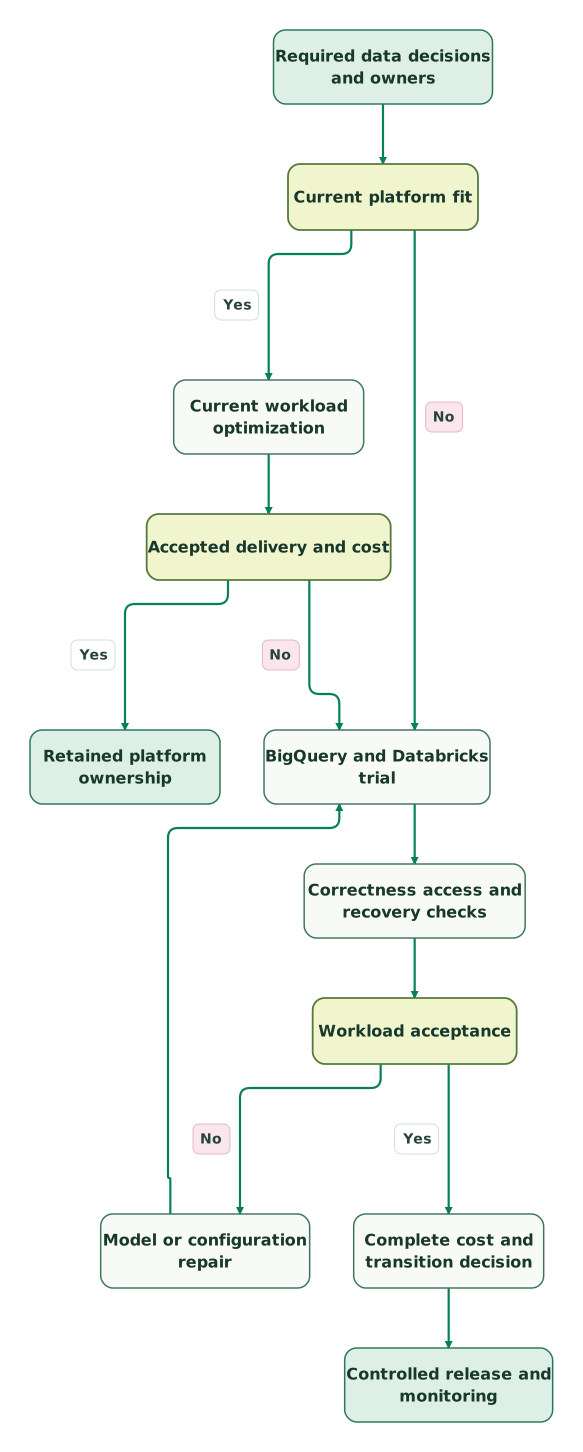
Read diagram as text
- Required data decisions and owners to Current platform fit.
- Current platform fit to Current workload optimization: Yes.
- Current platform fit to BigQuery and Databricks trial: No.
- Current workload optimization to Accepted delivery and cost.
- Accepted delivery and cost to Retained platform ownership: Yes.
- Accepted delivery and cost to BigQuery and Databricks trial: No.
- BigQuery and Databricks trial to Correctness access and recovery checks.
- Correctness access and recovery checks to Workload acceptance.
- Workload acceptance to Model or configuration repair: No.
- Model or configuration repair to BigQuery and Databricks trial.
- Workload acceptance to Complete cost and transition decision: Yes.
- Complete cost and transition decision to Controlled release and monitoring
Warehouse comparison checklist
- The reporting or engineering decision has a named business owner.
- Runtime, library and edition requirements match the selected configuration.
- Both candidates produce the same accepted business results.
- Billing examples name the region, product and allowance assumptions.
- Storage, ingestion, networking and operating work appear in the full budget.
- Query controls and Auto Stop behavior meet delivery requirements.
- Restricted users and recovery cases pass before release.
- Migration value covers the transition effort or a defined capability gap.
Use the marketing data audit skill for the evidence inventory, and our data warehouse design guide for the model structure. A warehouse implementation scope connects those decisions to delivery. The $99 audit includes a written assessment and a one-hour specialist call.
Keep reading
Browse all Data Warehouse guides
 Data Warehouse
Databricks vs Redshift: AWS Reporting, Engineering and Total Cost
Compare Databricks and Redshift for AWS reporting, engineering and ML. See complete billing examples, runtime boundaries, pipeline checks and migration fit.
Jafrin Akter AloLast updated 11 min read
 Data Warehouse
ClickHouse vs Databricks: Event Analytics, Lakehouse Workflows and Cost
Compare ClickHouse and Databricks for analytical serving and wider data workflows. Covers Real-Time beta limits, corrections, pricing and acceptance tests.
Jafrin Akter AloLast updated 11 min read
 Data Warehouse
5 Redshift Alternatives for Warehousing, Engineering and Event Queries
Choose a Redshift alternative by workload. Compare Snowflake, BigQuery, Databricks, ClickHouse and Athena with costs, repair options and migration checks.
Jafrin Akter AloLast updated 12 min read
Data warehouse & CDP
See the implementation scope, deliverables and acceptance checks.
Questions people ask
Does Databricks vs BigQuery mean Spark versus SQL only?
Both platforms cover more than that distinction. Databricks provides SQL warehouses alongside engineering and ML workflows, while BigQuery includes supported machine-learning and notebook capabilities. Compare the specific runtime, analysis and operating requirements the team needs. A broad platform label is less useful than a representative workload with clear correctness, access and delivery criteria. Databricks SQL, BigQuery ML.
Can BigQuery's scanned terabytes be converted directly into Databricks DBUs?
There is no general conversion because processed bytes and compute consumption measure different parts of execution. Use a representative workload to obtain each platform's billable quantity, then apply the matching rate and add supporting costs. The arithmetic break-even point is useful only after both candidates meet the same business results, concurrency, freshness and recovery requirements.
Does BigQuery Standard capacity include every BigQuery ML feature?
BigQuery ML is unavailable in the Standard capacity edition. Check the required model operation and edition before selecting capacity from its entry rate. Model training and connected AI services can also add distinct charges. A comparison that includes ML on one side must include the configuration and costs needed to perform that work on the other. ML availability.
Will a Databricks Serverless move preserve every existing Spark API?
Serverless notebooks and jobs support Spark Connect APIs and exclude Spark RDD APIs and R. Inventory the existing code, libraries and external-access requirements before choosing that compute mode. Test the needed operations in an isolated environment and select a suitable supported runtime when a requirement falls outside Serverless, rather than assuming the whole platform lacks that capability. Serverless boundaries.
Does a lower compute estimate justify replacing a working warehouse?
A lower compute estimate is one input. Include storage, data movement, engineering, parallel operation and the cost of preserving access and reporting behavior. A migration should recover its transition cost or deliver a clearly defined capability the current platform cannot provide within an acceptable scope. Keep the existing platform in the comparison until that value is established.
Sources
- BigQuery pricing
- BigQuery overview
- BigQuery ML capabilities and costs
- BigQuery editions
- BigQuery query cost controls
- BigQuery row-level security
- BigQuery column-level access
- Databricks pricing model
- Databricks public regional pricing data
- Databricks Google Cloud calculator data
- Databricks SQL warehouse types
- Databricks lakehouse architecture
- Databricks Serverless runtime limits
- Databricks SQL warehouse settings
- Databricks Unity Catalog assets
- Databricks Google Cloud regions

Written by
Jafrin Akter AloData Engineer and Co-founder at Martechdevs and Growth and Analytics Partners
Jafrin writes practical guides to marketing technology, customer data, analytics and AI workflows. Martechdevs is a Growth and Analytics Partners company.