
Redshift vs Snowflake: Cost, Workload Fit and Migration Checks
Pick Amazon Redshift when your warehouse belongs in an AWS operating model and its integrations, access controls and measured workload cost fit. Pick Snowflake when separate compute workloads, cross-cloud deployment choices and its wider data-platform capabilities justify the configuration. Redshift vs Snowflake is an edition-and-workload decision: test the same results, concurrency and recovery requirements before comparing the bills.
On this page
Redshift and Snowflake comparison
USD on-demand examples use AWS Northern Virginia, before storage, tax and additional services.
| Decision | Amazon Redshift | Snowflake |
|---|---|---|
| Compute price | Serverless example rate $0.375 per RPU-hour | Standard edition $2 per credit; Gen2 X-Small consumes 1.35 credits/hour on AWS |
| Starting configuration | Four base RPUs in supported regions, with capacity limits | Fixed warehouse sizes, or eligible Enterprise-or-higher Adaptive Warehouses |
| Main buying fit | AWS-centered warehouse and analytics operations | Workloads needing separate compute controls and broader cloud choices |
| Cost boundary | Serverless compute, managed storage and other applicable charges | Warehouse compute, storage, cloud services and separately metered features |
| Selection evidence | Correct results and acceptable cost under the real AWS workload | Correct results and acceptable cost under the chosen warehouse configuration |
Rates and capacity conditions: Redshift pricing, Redshift Serverless capacity, Snowflake consumption tables, Adaptive Compute eligibility.
A Redshift Processing Unit, or RPU, is Redshift Serverless's compute-capacity unit. A Snowflake credit is a billing unit whose consumption depends on the service and configuration. One RPU is not a hardware-equivalent substitute for one Snowflake credit. The table supplies the units for a budget, not a performance ranking.
At Martechdevs, we start a warehouse implementation with the reporting deadlines, source systems and data model. A daily finance reconciliation and a customer-facing dashboard can use the same tables while needing different latency, concurrency and failure handling. Make those requirements explicit before choosing either platform.
Architecture and operating fit
Redshift provides provisioned and serverless approaches within AWS. Snowflake separates storage from compute resources and is available on AWS, Azure and Google Cloud. Those are useful architectural choices, but an individual deployment still has a region, data movement, identity configuration and an operating owner. Redshift architecture, Snowflake architecture.
Amazon Redshift
- Best for: a warehouse team already operating AWS networking, identity, storage and analytical workloads.
- Pros: provisioned and serverless choices can fit the existing AWS operating model and supported data-sharing arrangements.
- Cons: capacity, storage, transfer and integration requirements still need a complete workload budget.
- Free plan and startup offer: first-time Redshift Serverless customers can receive $300 in compute and storage credit expiring after ninety days; no additional startup benefit is assumed. Trial eligibility.
- Choose it if: the accepted workload, access design and operating cost fit the team's AWS responsibilities.
- Skip it if: the required deployment or runtime cannot be supported by the proposed AWS design.
Reusing an operating model can matter more than an isolated query result. Include existing pipeline connections and support processes in the comparison.
Redshift's data sharing supports live access across clusters, workgroups, accounts and regions, with supported producer and consumer configurations. Do not dismiss it as a platform that always requires copying a separate warehouse for every audience. Check region and transfer charges alongside access. Redshift data sharing.
Snowflake
- Best for: teams needing independently managed analytical compute over shared stored data.
- Pros: virtual warehouses can separate scheduled transformations from business reporting audiences. Warehouse overview.
- Cons: extra compute resources create additional spending and ownership decisions.
- Free plan and startup offer: the trial ends after thirty days or exhaustion of its usage balance; apply any separate startup benefit only under approved terms. Snowflake trial.
- Choose it if: the required isolation, access and accepted workload justify the selected edition and compute configuration.
- Skip it if: the proposed resources add operating cost without resolving a meaningful workload requirement.
The isolation benefit depends on the actual workload and running time of each resource.
Creating several warehouses also creates several places to spend. Document which jobs use each warehouse, its owner and the conditions for suspension or scaling. A warehouse called development can still become an always-on production dependency if a dashboard quietly starts using it.
Serverless and fixed-warehouse billing
Redshift Serverless meters RPU-hours per second with a 60-second minimum. Its pricing includes Redshift Spectrum and concurrency scaling within Serverless, while managed storage is separate. Provisioned Redshift follows a different model, so a Serverless estimate should not be applied to a provisioned cluster. Redshift pricing, Serverless billing.
For Snowflake fixed standard warehouses, the credit rate depends on generation and size. In AWS, Gen1 X-Small uses one credit per hour and Gen2 X-Small uses 1.35. A running warehouse can consume credits while idle before suspension; short resumes and upward resizing have minimum-billing consequences. Consumption table, warehouse considerations.
Adaptive Warehouses add a different Snowflake option. They use query-based billing and a managed compute pool, require Enterprise or higher and are limited to supported regions. A fixed-size-hours formula does not describe their bill. Include an Adaptive candidate only when its metered cost and required capabilities have been evaluated directly. Adaptive Compute.
Compute-only budget examples
These are worked arithmetic examples for independently assumed configurations, not evidence that the configurations have equal speed or capacity.
| Purchase assumption | Monthly usage assumption | Calculation | Compute subtotal |
|---|---|---|---|
| Redshift Serverless, 4 RPUs | 30 billed hours | 4 × 30 × $0.375 | $45.00 |
| Snowflake Gen2 X-Small, Standard edition | 30 running hours | 1.35 × 30 × $2 | $81.00 |
| Redshift Serverless, 8 RPUs | 220 billed hours | 8 × 220 × $0.375 | $660.00 |
| Snowflake Gen2 Small, Standard edition | 220 running hours | 2.7 × 220 × $2 | $1,188.00 |
The rates come from AWS's Northern Virginia example and Snowflake's warehouse and regional price tables. Storage, retained snapshots, transfers, ingestion, other services and implementation are excluded.
Four base RPUs support up to 32 TB of Redshift managed storage. AWS also recommends limiting tables to 100 columns in that configuration, while explaining that wider tables can be created but risk exhausting memory. Exceeding the relevant resource boundaries requires a deliberate capacity change. A low entry configuration is therefore a candidate for testing, not a universal production size. Four-RPU limits.
A workload-based comparison
After the pilot, replace the assumed hours with the actual billed units for the same accepted work. Suppose a hypothetical reporting workload consumes 300 RPU-hours in Redshift and 54 Snowflake credits. The compute charges are $112.50 and $108 at the stated rates. That $4.50 gap is small enough that migration or operating differences could dominate the decision.
Now include one failed refresh, its retry and the waiting dashboard queries in both totals. A benchmark that removes failed work from the bill can reward the less reliable configuration. Keep cost per completed refresh or accepted report alongside latency and correctness.
Our Snowflake warehouse-size guide explains generation and minimum billing. The Snowflake calculator models the generation stated on its page; use the current Gen2 table for a Gen2 estimate. The full Snowflake pricing guide adds the rest of the invoice.
Performance and concurrency testing
Run representative queries against the same business dataset and acceptance criteria. Include the largest join, a selective lookup, an incremental transformation and the busiest dashboard interval. Measure elapsed time, queueing, failures and billed usage. A single cached query cannot establish the platform's cost or responsiveness for an entire reporting day.
Keep these conditions visible in the test record:
| Test dimension | Controlled input | Acceptance evidence |
|---|---|---|
| Correctness | Same data boundary, timezone and metric definition | Matching records and business totals |
| Cache state | Deliberate cold and warm runs | Separate timings and costs |
| Concurrency | Expected simultaneous users and refreshes | Queue time and response-time distribution |
| Freshness | Normal ingestion plus a delayed source | Age of the data in the final report |
| Recovery | One interrupted load and one safe replay | Completed workload without duplicate results |
Redshift supports automatic table optimization for sort and distribution choices. Tables with the appropriate AUTO settings can be adjusted from observed query patterns. The claim that every Redshift deployment requires constant manual distribution-key tuning is too broad. Automatic table optimization.
That automation still needs evidence. Inspect whether data movement, skew or a poor join drives a slow query before buying more capacity. For Snowflake, use the query profile guide to separate scanning, join expansion and spilling. Neither platform turns an incorrect many-to-many join into the intended revenue model.
Migration details that change the result
Treat migration as a change to data behavior, access and operations. SQL syntax is one part of the work. Decimal precision, timezone boundaries, null handling, case sensitivity and incremental update rules can change the report even when every statement compiles. Select difficult records deliberately instead of validating only a total row count.
Keys and constraints
Redshift primary, unique and foreign-key constraints are informational and are not enforced when data is loaded. Snowflake's standard-table primary, unique and foreign-key constraints are also generally informational; its hybrid tables have different enforcement behavior. Preserve actual integrity checks in the pipeline rather than relying on similar-looking DDL. Redshift constraints, Snowflake constraints.
In a worked migration test, load two rows with the same proposed business key and different update timestamps. Confirm the chosen survivor rule, the rejected or quarantined row and the final metric. Then test a late-arriving correction and a deleted source record. Those cases expose more risk than a clean sample containing one row per customer.
Dependencies and cutover
Inventory scheduled jobs, BI connections, extracts, credentials, sharing arrangements and downstream activation. A finance report can reconcile while an audience export still reads the old platform. Our marketing data model guide explains the contracts that should remain stable across the move.
Run a bounded parallel period. Freeze the source boundary for a reconciliation, explain every meaningful difference, then switch one controlled consumer. Keep the old read path available for the agreed rollback window. A rollback procedure must identify the source of truth for writes made after cutover, rather than simply point everyone back to an increasingly stale database.
Team and workload scenarios
| Situation | First candidate | Runner-up | Decision evidence |
|---|---|---|---|
| Small AWS-native reporting team | Redshift Serverless | Snowflake fixed warehouse | Actual capacity, idle pattern and existing AWS operations |
| Several teams needing independent compute ownership | Snowflake | Redshift with an appropriate workload design | Isolation, access and total recurring cost |
| Existing well-run Redshift warehouse | Keep and tune Redshift | Snowflake pilot | A specific unmet requirement and credible migration payback |
| Mixed data engineering and model-development requirements | Broader platform evaluation | Either warehouse for the SQL portion | Required runtime, deployment and governance capabilities |
| Customer-facing event analytics | Include a serving-engine test | Either warehouse for governed reporting | Peak concurrency, freshness and query shape |
For the final two rows, read Databricks competitors, ClickHouse vs Snowflake and ClickHouse alternatives. A warehouse comparison should not quietly assume that batch SQL, model training and an interactive product endpoint are the same purchase.
Spending controls and ownership
Assign a budget owner to each workload and reconcile usage against the forecast. Redshift Serverless supports explicit base and maximum capacity settings, with scaling behavior described by AWS. A higher maximum creates headroom; it also changes the amount of spend that an unexpected workload can generate. Serverless capacity controls.
Snowflake resource monitors can notify and suspend standard warehouses or disable Adaptive Warehouses. They do not cover all serverless and AI charges, and their thresholds should not be treated as an exact invoice ceiling. Review the rest of the account's consumption separately. Resource-monitor scope.
Maintain a small operating record: workload, owner, configuration, billing unit, expected usage, threshold, response and rollback. Review large deviations with query and pipeline evidence. A cost alert without a safe response leaves the team choosing between an unexpected bill and an unplanned reporting outage.
Selection and migration checklist
- The same reporting outcomes, freshness targets and access rules define both candidates.
- Region, edition, compute type and billing units are recorded beside every estimate.
- Cold, warm and concurrent tests include failures and retries in their costs.
- Duplicate keys, late corrections, deletions and timezone boundaries reconcile.
- Storage, snapshots, transfers, ingestion and operating ownership are included.
- Downstream reports and activation jobs have a named cutover owner.
- A rollback plan preserves a clear source of truth after the switch.
Use the marketing data audit skill to organize the workload, source and reconciliation evidence. Request a detailed warehouse implementation scope when that evidence needs to become a production build. For a bounded diagnosis first, the $99 martech audit includes a written assessment and a one-hour specialist call.
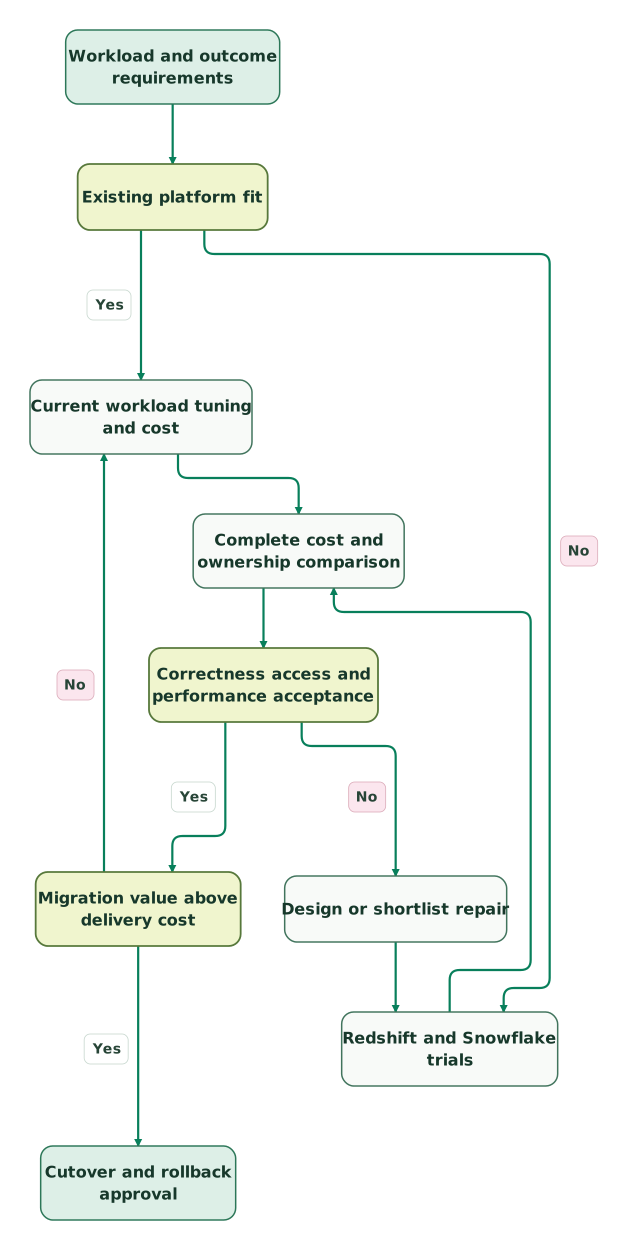
Read diagram as text
- Workload and outcome requirements to Existing platform fit.
- Existing platform fit to Current workload tuning and cost: Yes.
- Existing platform fit to Redshift and Snowflake trials: No.
- Current workload tuning and cost to Complete cost and ownership comparison.
- Redshift and Snowflake trials to Complete cost and ownership comparison.
- Complete cost and ownership comparison to Correctness access and performance acceptance.
- Correctness access and performance acceptance to Design or shortlist repair: No.
- Design or shortlist repair to Redshift and Snowflake trials.
- Correctness access and performance acceptance to Migration value above delivery cost: Yes.
- Migration value above delivery cost to Current workload tuning and cost: No.
- Migration value above delivery cost to Cutover and rollback approval: Yes
Keep reading
Browse all Data Warehouse guides
 Data Warehouse
Snowflake vs Databricks: Pricing, Performance, AI and Which to Choose
Snowflake suits SQL-first marketing teams; Databricks suits Spark and ML teams. Smallest warehouses: $2 to $2.70 vs $2.80 an hour. See a worked monthly bill.
Jafrin Akter AloLast updated 40 min read
 Data Warehouse
ClickHouse vs Snowflake: Query Fit, Data Changes and Total Cost
Compare ClickHouse and Snowflake for event analytics and reporting. Review current update behavior, Interactive warehouses, compute costs and acceptance tests.
Jafrin Akter AloLast updated 12 min read
 Data Warehouse
 Cost for a Small Company: Platform, Pipelines, People and Activation
Estimate what a data warehouse costs a small company each month: storage, compute, connectors, dbt, BI, activation and upkeep, with a worked example.
Jafrin Akter AloLast updated 18 min read
Data warehouse & CDP
See the implementation scope, deliverables and acceptance checks.
Questions people ask
Does Redshift Serverless remove the need to choose capacity?
Redshift Serverless still has capacity settings and workload limits. AWS manages scaling within the supported configuration, but the base, maximum and workload requirements remain part of the operating decision. Check the four-RPU restrictions, normal demand and peak behavior before using the smallest starting configuration as the forecast for a production reporting service. Capacity guidance.
Can Snowflake's cheapest credit price describe every warehouse option?
A credit price describes a region, edition and purchase arrangement, while each service consumes credits differently. A Gen2 warehouse, an Adaptive Warehouse and a serverless feature therefore need different usage estimates. Keep the account's price per credit separate from its consumption rate, then include storage and other services before comparing the complete bill. Consumption tables.
Is Redshift data sharing limited to one provisioned cluster?
Redshift supports data sharing across supported provisioned clusters, serverless workgroups, AWS accounts and regions. Confirm the producer and consumer configuration, permissions and applicable transfer costs for the actual arrangement. Sharing can reduce unnecessary data copies, but it still requires a clear owner for the data definition and for changes that could affect consumers. Sharing scope.
Can matching SQL outputs prove a warehouse migration is complete?
Matching outputs establish an essential part of the migration, but production readiness also includes permissions, freshness, scheduling, failure recovery and downstream consumers. Test the same reports through ordinary user roles and the actual pipelines. Keep a record of unresolved differences and the rollback procedure before switching the source used for commercial decisions.
Should an AWS-only company exclude Snowflake from its shortlist?
An AWS-only company can still evaluate Snowflake on AWS when the workload or operating model makes it useful. Existing AWS skills and integrations give Redshift a practical advantage to test, rather than an automatic win. Compare the required result and complete cost in the intended region, including the work needed to operate and maintain either configuration.
Sources
- Amazon Redshift pricing
- Redshift Serverless compute capacity
- Redshift Serverless billing
- Amazon Redshift architecture
- Redshift data sharing
- Redshift automatic table optimization
- Redshift table constraints
- Snowflake service consumption and price tables
- Snowflake trial conditions
- Snowflake architecture
- Snowflake warehouse overview
- Snowflake warehouse considerations
- Snowflake Adaptive Compute
- Snowflake constraints
- Snowflake resource monitors

Written by
Jafrin Akter AloData Engineer and Co-founder at Martechdevs and Growth and Analytics Partners
Jafrin writes practical guides to marketing technology, customer data, analytics and AI workflows. Martechdevs is a Growth and Analytics Partners company.