
Meta Pixel and HIPAA: Review the Data Before Sending Conversions
Meta Pixel and HIPAA decisions depend on the information disclosed, the recipient and the purpose of the transfer. A generic conversion name, hashed email or server-side integration does not make a patient event appropriate for advertising. Map the complete flow, stop unapproved sharing and keep clinical outcomes inside an approved reporting environment while legal, privacy and platform requirements are resolved.
On this page
Can a healthcare team use Meta Pixel for patient conversions?
Do not treat a standard Pixel installation or Conversions API connection as approval to send patient conversions. Establish whether the complete disclosure is permitted before enabling that path. An event can reveal care context through its origin, destination, timing and identifiers even when its name looks ordinary.
Protected health information, or PHI, includes identifiable health, care or payment information within HIPAA's scope. HHS explains that identifiers associated with treatment at a particular clinic can be PHI; removing the diagnosis field does not settle the classification. HHS explanation of PHI.
This guide is an implementation framework for US healthcare advertising, not a legal determination for a particular organisation. Your qualified privacy or legal owner decides the permitted disclosure; engineering supplies the evidence about what the system actually sends. The HIPAA analytics architecture guide covers the broader choice of internal reporting tools and agreements.
Keep three approvals separate: the organisation's applicable legal requirements, the destination's service and data-use terms, and the deployed configuration. Passing one does not supply the other two. A campaign that can run is not automatically a campaign whose patient-level measurement is approved.
At Martechdevs, Meta Conversions API implementation starts with that recipient and event map. The useful deliverable is a tested collection boundary, with a clear reporting plan for outcomes that must stay inside the organisation's approved environment.
Which journeys need immediate attention?
Start with portals, intake, scheduling and care-related audience exports. Hold unreviewed advertising transfers from those flows while establishing the facts. The following table is an engineering triage model, not a declaration that every public health-page visit is PHI.
| Journey or process | What to inspect | Starting action | Evidence needed |
|---|---|---|---|
| Patient portal, login and account registration | Account state, credentials, identifiers and care context | Stop unapproved advertising collection | Actual requests and the approved recipient map |
| Booking, intake, symptom or treatment-selection flow | Form data, selected services, confirmations and embedded tools | Isolate the flow from unapproved ad destinations | Browser, embed and backend observations |
| Public provider or condition content | URLs, referrers, campaign context and later navigation | Review the complete flow before allowing tags | Documented classification and synthetic journey tests |
| General corporate or recruitment content | Shared scripts and incoming care-related context | Consider a narrowly approved route | Route, field and recipient allowlists |
| CRM, scheduling or warehouse audience export | Patient-list membership, suppression logic and matching identifiers | Hold unapproved uploads | Export purpose, destination contract and exact selection rule |
The June 2024 court ruling vacated the part of HHS's guidance addressing an IP address combined with a visit to an unauthenticated public condition or provider page. HHS's current bulletin states that limited scope. It does not approve every portal, intake or appointment-data transfer. HHS tracking guidance and court notice.
That distinction matters operationally. Avoid both blanket assumptions: “a healthcare domain makes every visit PHI” and “a public URL makes every transfer permissible.” An unsubmitted intake form, an embedded scheduler and a general article can expose different information, even when all three are accessible without logging in.
Inventory the application as well as the website. An app SDK, booking provider or CRM automation can continue a disclosure after the marketing team removes a browser tag.
Why are neutral events, hashing and CAPI insufficient by themselves?
They change parts of the implementation without deciding whether the resulting disclosure is allowed. Review the information the recipient can learn from the whole request and its surrounding context.
A renamed event can preserve the same meaning
Imagine a hypothetical event named CompleteRegistration sent after a patient books a condition-specific appointment. Removing a condition from the name does not change the underlying action. A destination may still receive a source URL, a stable identifier or other context linking the action to that person.
Use neutral operational names inside an approved system when they reduce unnecessary detail. Do not treat renaming as de-identification or a way to evade a platform restriction. The business meaning and recipient remain part of the review.
Hashing supports matching, so it does not prove anonymity
A deterministic email hash may still be matched to a person by a recipient with the corresponding identifier. The important question is whether the disclosed record is identifiable in context, not whether the payload contains an @ character.
HHS provides Safe Harbor and Expert Determination as de-identification methods. Safe Harbor involves specified identifier removal and the absence of actual knowledge that the remainder identifies a person. A hash or a generic path is not, by itself, evidence that either method has been satisfied. HHS de-identification methods.
A server adds control and another place to inspect
Moving collection behind your own hostname can let you reject fields before forwarding them. It also creates request logs, queues, retries and destination mappings that need review. A business associate agreement with the intermediary covers the defined relationship; it does not automatically approve a later advertising disclosure. HHS business-associate guidance.
Inspect the final serialized request, not only the object your application first constructed. Meta's Python Business SDK includes event_source_url, referrer_url, user data and custom data in its server-event model. Its optional request-context helper can fill empty URL and matching fields before normalization, according to its preferences. Check your installed version and enabled helper behavior. Meta server-event implementation.
The SDK's user-data model includes IP address, user agent, fbc, fbp, external identifiers and contact identifiers. That is a concrete reason to audit matching configuration separately from event names. It is not a recommendation to populate those fields for a healthcare event. Meta user-data implementation.
The server-side tracking guide explains the transport and operating model. Use the Conversions API setup guide only after the particular event and destination have been approved; a technically accepted request cannot provide that approval.
What should be checked in Meta before releasing measurement?
Have the account owner record the applicable terms, the actual data-source notices and the proposed event's permitted use. Do this for the specific dataset and destination, rather than treating another advertiser's screenshot as your account's rule.
Use the Meta Business Tools Terms as a required contract-review resource. Retain the version that governs the account with the decision. Do not infer permission from a generic installation tutorial, a vendor's compatibility badge or the absence of a visible warning.
Ask the account owner to capture:
- The dataset and source domain or app involved.
- Any assigned category, restriction or diagnostic notice, including its exact scope.
- Which event the campaign currently uses and whether it is available for the intended purpose.
- Any geographic or product boundary stated in the notice.
- The factual basis for an appeal or review request, when the classification is disputed.
Keep the notice's actual wording. Do not turn an account-specific restriction into a universal claim that every healthcare advertiser loses the same events. If the platform decision is disputed, use its review process. Moving the same prohibited meaning into another event, domain or field is not a sound remediation plan.
An ordinary cookie-banner acceptance is also insufficient as a HIPAA authorisation. HHS explicitly distinguishes these. Maintain the visitor's technical consent state separately from the permission and recipient review for health-data use. HHS tracking obligations.
What do FTC cases show beyond HIPAA?
They show why advertising disclosures, privacy promises and customer-list uploads need review even when the relevant legal route is not HIPAA. Distinguish a complaint's allegations from a final order, and a civil penalty from money returned to consumers.
| Matter | What the cited primary record says | Legal or procedural distinction | Practical audit consequence |
|---|---|---|---|
| GoodRx | The FTC alleged prescription and health-data sharing, including advertising audiences; the announced proposed order included a USD 1.5 million civil penalty | First FTC Health Breach Notification Rule enforcement; the announcement described a proposed court order | Review list exports and their origin, not just website scripts |
| BetterHelp | The FTC finalized an order banning health-data advertising disclosures and requiring USD 7.8 million for consumer refunds | Final FTC order resolving deceptive-sharing allegations; not a HIPAA penalty | Check promises, identifiers and the meaning of the source activity |
| Hims & Hers | The FTC and state/local partners alleged health-data sharing through customer lists and website events, alongside subscription practices | Complaint under the FTC Act and ROSCA, with state claims; allegations are not court findings | Include audience uploads, tracking events and the actual disclosure purpose |
Primary records: GoodRx enforcement announcement, BetterHelp final order announcement, Hims & Hers complaint announcement.
The FTC's amended Health Breach Notification Rule applies to qualifying personal-health-record vendors and related entities outside HIPAA. It includes certain unauthorised disclosures within its breach definition; it is not limited to a hacker entering a database. Applicability still depends on the business and service. FTC HBNR explanation.
For a wellness brand, identify the applicable rules and promises instead of treating “outside HIPAA” as permission to share anything. For a regulated provider, review both the HIPAA questions and the other requirements that apply. The organisation's advisers should assess its actual facts and jurisdiction.
How do you audit every path that could send a healthcare event?
Follow a synthetic journey from the page to each recipient, including backend exports. Compare observed delivery with the approved design. A tag-manager screenshot or an empty reporting dashboard cannot show the whole path.
| Boundary | Evidence to inspect | Common failure | Required correction |
|---|---|---|---|
| Page and embedded components | Loaded scripts, initiators, requests, redirects and iframe traffic | A scheduler or plugin sends independently of the main container | Change or remove the actual integration |
| Event construction | Names, URLs, custom fields and matching configuration | A generic event still identifies a care action | Reassess the complete event and recipient |
| Serialization and forwarding | Final request after SDK defaults and transformations | A removed URL or identifier is populated again | Test the final payload and disable the unapproved path |
| Queues and retries | Pending jobs, replay policy and sender configuration | Old events are sent after the current tag is disabled | Quarantine or resolve queued transfers through the incident process |
| CRM and audience operations | Scheduled exports, destination lists and agency access | An old patient audience sync remains enabled | Review selection, purpose and recipient before resuming |
Start by preserving the configuration and containing confirmed unapproved sharing. Do not send a real patient's information to a debugging tool to demonstrate that the path exists. Use an approved test environment, synthetic records and harmless sentinel values.
Then test direct entry and navigation. A script loaded on a general page can remain active when a single-page application moves into booking. A consent change can reactivate a listener. A failed submission can trigger a generic lead event even though no appointment exists. Treat those as separate cases.
Keep a route-specific audit record. This example is a planning record, not a consent-setting command or proof of compliance:
journey: synthetic appointment completion
source_group: booking
intended_business_use: internal operational reporting
advertising_recipients: []
legal_review: pending
recipient_contract_review: pending
platform_review: pending
expected_advertising_deliveries: 0
test_cases:
  - direct_booking_entry
  - general_page_to_booking_navigation
  - failed_then_successful_submission
  - consent_state_change
  - embedded_scheduler
  - queued_server_retry
  - scheduled_audience_export
evidence_location: restricted_review_record
release: hold
An empty recipient list describes this example's intended design. The network and server evidence must establish whether the implementation follows it. Likewise, a successful local schema check cannot classify the actual payload, approve a vendor or prove that the production system sends nothing.
Which tests should pass after removing or restricting the Pixel?
Verify absence where delivery is excluded and expected behavior where a separate path is approved. Include a control that proves the inspection can detect a deliberate harmless test request in the approved test environment; otherwise, a silent log may simply be a broken observation method.
| Test case | Expected result for the excluded care flow | Evidence |
|---|---|---|
| Direct booking entry | No advertising delivery from the page or its components | Preserved browser and receiving-system observations |
| General page into booking without a full reload | No continuing ad listener or new care event | Navigation sequence and request initiators |
| Failed then successful synthetic submission | Internal statuses remain distinct; neither sends an unapproved ad event | Authoritative booking state and outbound traffic |
| Accept, reject and change cookie choices | The care-flow exclusion remains in force in every state | Choice state and resulting network behavior |
| Embedded scheduling component | Its own integrations follow the approved recipient map | Iframe, provider and server-side evidence |
| Pending server retry | A previously queued care event is not sent merely because the sender recovered | Queue disposition and sender audit record |
| Scheduled audience export | No unapproved patient list is transferred | Export-job configuration and destination history |
Inspect custom first-party collection hosts as well as obvious platform endpoints. A request can reach your collector successfully and then be forwarded to Meta outside the browser's view. Conversely, an internal collector used for approved operations is not an advertising disclosure merely because it receives an event; its purpose, terms and destinations determine the review.
Save redacted evidence references, owners, test results and the release identifier. Restrict raw request captures because the diagnostic record can itself contain sensitive information. Retest when a page template, booking vendor, SDK version or export changes.
How can a clinic measure advertising without uploading patient outcomes?
Separate media delivery, internal operational outcomes and causal measurement. They answer different questions and do not require the same data to leave the care environment.
| Decision | Evidence to use | What it establishes | What it does not establish |
|---|---|---|---|
| Is the campaign spending and generating clicks? | Advertising platform delivery reports | Spend and the platform's reported interactions | Which patients attended or why |
| Is the clinic receiving and serving demand? | Approved scheduling and billing reports | Operational volume, cancellations and capacity | Incremental effect of one advertising channel |
| Which source do new patients report? | An approved internal source question with unknowns retained | Self-reported source distribution | Verified ad exposure or causal attribution |
| Did a spending change create additional demand? | A properly designed experiment or suitable model | An estimate under explicit assumptions | Automatic proof from a before/after increase |
Consider a hypothetical clinic group with USD 4,800 in Meta spend and 1,600 platform-reported outbound clicks during one fixed reporting window. Its approved internal system records 60 first visits across all channels. Of those patients, 18 report Meta, 20 report another source and 22 have an unknown source. These are invented planning figures, not client results.
| Internal source response | First visits | Share of all first visits |
|---|---|---|
| Meta reported by the patient | 18 | 30.0% |
| Another source reported | 20 | 33.3% |
| Unknown or unanswered | 22 | 36.7% |
| Total | 60 | 100.0% |
The platform's cost per reported outbound click is 4,800 / 1,600 = USD 3. The internal source-response completeness is 38 / 60 ≈ 63.3%. The clinic can use those facts to investigate media costs and improve its internal reporting question, subject to the approved collection purpose.
It should not label 4,800 / 60 = USD 80 as Meta customer-acquisition cost, because 60 includes every channel. Dividing by the 18 self-reported Meta visits gives about USD 266.67 per self-reported first visit, which still is not an incremental acquisition cost. Preserve that label and the unknown group.
In this design, patient records, source answers and matching identifiers stay in the approved internal environment. Meta receives no patient-outcome upload. Any external aggregate report needs a separate disclosure assessment, including small cells and combinations that might identify someone. Aggregation is a reporting technique, not an automatic permission.
For budget causality, use the attribution, MMM and incrementality guide. A geo test needs a justified assignment unit, enough independent units and outcome volume, an appropriate observation period, and controls for spillovers and capacity changes. Six practices and four weeks are not a universal sufficient design. If the data cannot support the intended decision, keep the result descriptive rather than manufacturing a lift estimate.
Does switching the conversion to Google Ads solve the problem?
No. Review Google's requirements independently; a different destination does not remove the health context. The GA4 healthcare guide covers Google's analytics-specific boundary.
Google's customer-data policy prohibits sensitive-category conversions in enhanced conversions and store-sales uploads. Its health examples include purchases of medical services, prescription drugs and medical devices. Do not send a patient outcome through enhanced conversions simply because identifiers are hashed or an uploader accepts the request. Google customer-data policy.
Targeting is a separate question. Google's personalised-advertising policy restricts advertiser-curated audiences when promoting sensitive-interest categories, including health. The listed restricted features include Customer Match and your data segments. That rule is distinct from whether a particular ad may run or an internal report may exist. Google targeting restrictions.
Apply the same recipient inventory to every advertising destination in the stack. Keep legal permission, platform feature eligibility and technical delivery visible as separate decisions. The Consent Mode guide explains Google tag behavior; a signal setting cannot replace those decisions.
What should pass before the revised advertising measurement is released?
Release only the reviewed flow after its actual behavior matches the approved recipient and field map. Keep unresolved disclosures stopped and use the approved internal reporting route while the team resolves them.
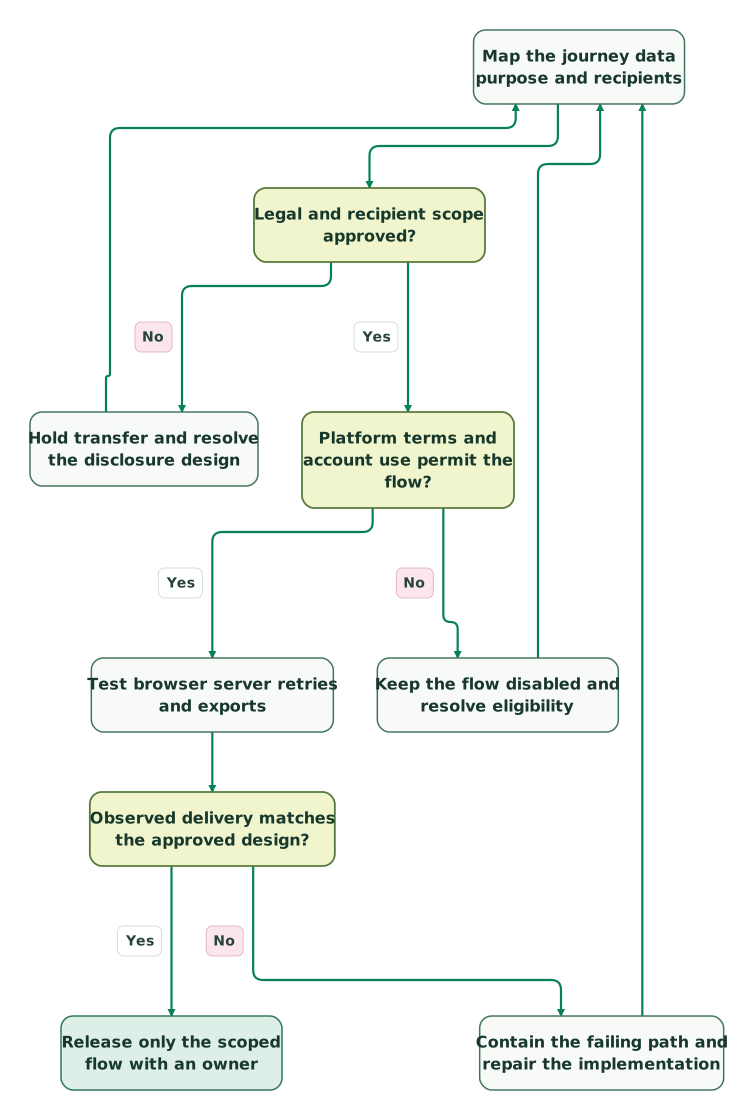
Read diagram as text
- Map the journey data purpose and recipients to Legal and recipient scope approved?.
- Legal and recipient scope approved? to Hold transfer and resolve the disclosure design: No.
- Hold transfer and resolve the disclosure design to Map the journey data purpose and recipients.
- Legal and recipient scope approved? to Platform terms and account use permit the flow?: Yes.
- Platform terms and account use permit the flow? to Keep the flow disabled and resolve eligibility: No.
- Keep the flow disabled and resolve eligibility to Map the journey data purpose and recipients.
- Platform terms and account use permit the flow? to Test browser server retries and exports: Yes.
- Test browser server retries and exports to Observed delivery matches the approved design?.
- Observed delivery matches the approved design? to Contain the failing path and repair the implementation: No.
- Contain the failing path and repair the implementation to Map the journey data purpose and recipients.
- Observed delivery matches the approved design? to Release only the scoped flow with an owner: Yes
Checklist
- Every care journey, component and export has an owner and recipient map.
- The disclosure's purpose and legal classification have qualified review.
- Contracts cover the actual processing and downstream use.
- Applicable platform terms and account notices are recorded.
- Event names, matching identifiers, URLs and surrounding context are reviewed together.
- Browser, embed, server, retry and audience paths have synthetic test evidence.
- Excluded care flows remain excluded after navigation and consent changes.
- Internal reports use clear populations, denominators and unknown categories.
- Possible historic exposure is handled through the incident process.
- New scripts, destinations and SDK changes trigger review.
Bring the route inventory and unresolved requests to the $99 martech audit. We can help implement collection controls and produce the evidence your privacy team needs, while keeping useful operational measurement inside its approved boundaries.
Keep reading
Browse all Tracking & Attribution guides
 Tracking & Attribution
OneTrust Pricing: Compare the Quote, Usage and Renewal
Compare OneTrust CMP quotes by package, visitor usage, implementation and renewal. Includes a cost worksheet, contract checks and clear budget examples.
Jafrin Akter AloLast updated 15 min read
 Tracking & Attribution
COPPA-Compliant Analytics: SDK, Consent and Data-Flow Checks
Review child-facing analytics, school authorization, SDKs and retention under COPPA. Includes a strict payload example and practical release tests.
Jafrin Akter AloLast updated 17 min read
 Tracking & Attribution
Shopify Cookiebot Consent Mode: Carry Choices Into Checkout
Connect Cookiebot choices to Shopify checkout and Google consent mode. Includes pixel boundaries, a privacy-state probe and seven purchase-flow tests.
Jafrin Akter AloLast updated 14 min read
Meta Conversions API
See the setup scope, acceptance checks and handover.
Questions people ask
What should happen to queued conversions when a healthcare data flow is disabled?
Hold the pending transfers as part of the same containment decision. Prevent automatic replay when a worker or integration restarts. The privacy and security owners should decide what evidence to preserve, what remediation is required and whether any transfer can resume. A change to the current tag does not alter the information already sitting in a queue.
Does setting a server event's opt_out flag stop Meta from receiving it?
No. Meta's Python SDK describes this flag as preventing ads-delivery optimisation while retaining attribution use. It is not a command to avoid transmission or a healthcare permission. Review whether the event may reach the destination at all before considering how it is used there. An excluded care event must remain excluded regardless of that setting. Meta event definition.
What should an agency receive to troubleshoot a healthcare campaign?
Give the agency the minimum approved diagnostic evidence: campaign and dataset configuration, redacted request structure, synthetic reproduction steps and the exact restriction notice. Do not hand over patient lists or raw care-journey captures because they make debugging convenient. Record access, permitted purpose and retention, and involve the privacy owner when the proposed diagnostic material itself may contain health information.
Can call-tracking numbers sit outside the healthcare advertising audit?
No. Include the call provider, number-assignment process, recordings or transcripts, caller identifiers, CRM writes and any advertising exports. A telephone channel can reveal the same care relationship as a booking form. Determine which processing is needed and permitted, then test the actual downstream paths. A clean browser Pixel configuration says nothing about a separate call-to-conversion integration.
Should a restricted conversion be replaced with a differently named custom event?
Only consider a replacement after reviewing the underlying data and intended use, not as a way to bypass the restriction. A new label can carry the same health-related meaning and matching information. Resolve an incorrect platform decision through its review process; otherwise redesign or stop the affected transfer and retain measurement through an approved internal route.
Sources
- HHS: Online tracking technologies and court notice
- HHS: PHI and de-identification methods
- HHS: Business associates
- Meta: Python Business SDK server-event implementation
- Meta: Python Business SDK user-data implementation
- Meta: Business Tools Terms for the account review
- FTC: GoodRx enforcement announcement
- FTC: BetterHelp final order announcement
- FTC: Hims & Hers complaint announcement
- FTC: Health Breach Notification Rule explanation
- Google: Customer-data policy
- Google: Personalised-advertising targeting restrictions

Written by
Jafrin Akter AloData Engineer and Co-founder at Martechdevs and Growth and Analytics Partners
Jafrin writes practical guides to marketing technology, customer data, analytics and AI workflows. Martechdevs is a Growth and Analytics Partners company.