
COPPA-Compliant Analytics: SDK, Consent and Data-Flow Checks
COPPA-compliant analytics starts with the audience, information collected and purpose of every data flow. A first-party endpoint or a vendor’s privacy setting cannot settle those questions. Separate child-facing product data from adult acquisition, establish the permitted collection and disclosure route, then verify SDK behavior, notices, retention and deletion in the shipped implementation.
On this page
When does COPPA apply to an analytics implementation?
The US Children’s Online Privacy Protection Rule applies to covered child-directed online services and operators with actual knowledge that they collect or maintain personal information from a child. It addresses collection, use and disclosure, including information collected through other parties. The rule defines a child as someone under 13. COPPA obligations, definitions.
Analytics can collect personal information before a form appears. Covered persistent identifiers include IP addresses and device identifiers; the definition also covers voice or image files, qualifying location information, government identifiers and identifying biometrics. Removing a name field does not resolve the rest of the payload. Rule definitions.
Have counsel determine audience classification, applicable jurisdictions and the lawful route for each purpose. Give that reviewer actual requests, SDK versions, recipient terms and data uses. An implementation team can prove what a system does; it cannot resolve an uncertain legal classification by renaming an event.
| Surface | Question to resolve | Implementation consequence |
|---|---|---|
| Product primarily directed to children | What collection and features are permitted for this audience? | Do not treat an adult-looking login as permission to load the ordinary marketing stack |
| Mixed-audience service | Does it meet the rule’s actual mixed-audience definition? | Review age determination and what runs before the result exists |
| General-audience service with known child users | What information establishes actual knowledge? | Propagate the resulting restrictions to the relevant collection paths |
| Adult sales or parent-purchase area | Is this a genuinely distinct adult journey, and what data enters it? | Keep student activity and child-linked identifiers out of its marketing feeds |
For a qualifying mixed-audience service, age determination must be neutral; the rule limits collection before that determination to its specified exceptions. “I am over 13” beside a preloaded tracker is not an engineering substitute for that assessment. Mixed-audience definition.
COPPA’s under-13 definition does not declare teenage data unrestricted. Other laws and provider policies can impose different obligations. Google’s personalized-advertising policy, for example, makes users under 18 ineligible for personalized advertising. Keep those age and purpose rules separate in the implementation. Google advertising restrictions.
At Martechdevs, analytics and tracking implementation turns the approved data-flow requirements into collection, routing and deletion controls. The useful deliverable is evidence that each boundary works throughout the product.
What does the amended COPPA rule require now?
The amended rule is already applicable under its general compliance deadline. It strengthens consent, notice, security and retention requirements that must be reflected in the implementation and operating procedures, rather than handled only by updating the privacy-policy page.
The final rule became effective on 23 June 2025, with 22 April 2026 as the general compliance deadline. Certain obligations for approved Safe Harbor programs had different earlier deadlines. These are regulatory dates, not a new grace period for an app launching now. Federal Register final rule.
| Requirement | Engineering or operating decision | Evidence to retain |
|---|---|---|
| Distinct disclosure choice where required | Represent collection/use permission separately from non-integral third-party disclosure | Versioned notice, verified choice and enforced destination rules |
| Notice for qualifying internal-operations identifiers | Explain the specific operations and restrictions | Published notice matched to actual configuration |
| Written security program | Assign an owner, assess risks and test safeguards | Risk assessment, access tests and provider assurances |
| Purpose-limited retention | Set justified deletion deadlines across all copies | Retention policy, deletion execution and failure alerts |
The relevant provisions are parental consent, online notice, security and retention. They answer different questions; one consent flag cannot represent the whole policy.
The final amendments did not adopt the proposed new school-authorization provisions. The FTC said it would continue enforcement in education technology under its existing guidance. Do not build a workflow around a proposal as though it became the final rule. Final rule explanation.
When can analytics use the internal-operations exception?
The specific exception in section 312.5(c)(7) requires collecting a persistent identifier and no other personal information, with the identifier used solely to support the service’s internal operations. It is a limited exception to prior parental consent, not a general analytics exemption. Consent exceptions.
The definition includes necessary service-function analysis, network operation, authentication and security. It restricts other uses, including behavioral advertising and unrelated individual profiling. The rule also distinguishes providers genuinely supporting those operations from third parties using the information for other purposes. Internal-operations and third-party definitions.
The amended exception requires an online notice describing the specific operations and the means used to prevent prohibited reuse. Do not copy older guidance saying that this route needs no notice. Notice requirements, section 312.4(d)(3).
| Proposed measurement | What needs examination | Safer implementation question |
|---|---|---|
| Diagnose failed content loads | Actual identifiers, error text, provider reuse and retention | Can a bounded outcome and duration bucket answer the reliability question? |
| Measure an individual student’s learning progress | Additional personal information and educational purpose | Does this belong in the authorized learning service instead of general analytics? |
| Attribute a student’s activity to an advertising profile | Cross-system linking and advertising purpose | Can acquisition be measured through the separately reviewed adult journey? |
| Use a session replay or crash SDK | Captured screens, input, breadcrumbs and automatic context | Can the specific diagnostic need be met without collecting those fields? |
“First-party” describes part of the architecture. It does not prove that the purpose qualifies, that no other personal information is collected or that a provider cannot reuse it. A company-controlled collector can still forward every event to an advertising platform. Conversely, the rule does not categorically ban every external service provider from supporting internal operations.
Treat the exception as a documented conclusion about a particular flow. If a later release adds an account ID, student answer, campaign join or new recipient, reassess the flow before deploying that change.
When is separate parental consent required for disclosure?
Where the rule requires it, parents must be able to consent to collection and use without consenting to third-party disclosure. Separate verifiable parental consent is required for that disclosure unless it is integral to the service. This is not a universal “all third parties always need a second consent” rule, and a commercial preference does not by itself establish the integral-disclosure exception. Section 312.5(a).
Have the legal review identify the applicable route and any exception, then implement that exact scope. A verified parent authorizing an educational function does not automatically authorize an additional advertising use. Provider prohibitions and other applicable law still apply even when consent exists.
A useful permission record distinguishes the person providing authorization, the covered child or educational scope, the purpose, recipients, notice version, verification evidence, current status and withdrawal handling. Restrict access to that record; do not copy verification documents into analytics.
The rule requires notice of material changes to previously consented practices. That means a new recipient or purpose needs review before a configuration change silently broadens the original permission. Direct notice requirements.
A conventional cookie banner and Consent Mode v2 solve different implementation problems. Neither should be treated as proof that a parent was verified or that a particular child-data disclosure was authorized. Keep the child-data decision separate from the adult site’s ordinary consent management.
What can a school authorize, and where does FERPA fit?
A school can authorize collection in the limited educational context described by FTC guidance: use for the school’s benefit without another commercial purpose. The operator must provide appropriate notice and support the school’s review, deletion and control rights. The operator remains responsible for its COPPA obligations. FTC school guidance.
The FTC’s education-technology policy prohibits repurposing school-authorized child information for unrelated marketing or advertising. It also emphasizes necessary collection, limited retention and security. A school buying a license does not supply a marketing audience made from its students. FTC education-technology policy.
In practice, keep the district contract, teacher administration, learning records and parent-acquisition lists separate. A parent email supplied to arrange a child’s school access should not become a consumer upsell contact merely because the address belongs to an adult. Establish any separate marketing relationship through its own reviewed collection and permission path, without importing the child’s school behavior.
FERPA is a separate education-records framework. Under its school-official exception, an outsourced provider must perform an institutional function, be under the school’s direct control over the records and meet use/redisclosure conditions. Access must reflect legitimate educational interests. A data-processing agreement’s existence alone does not prove those conditions. US Department of Education, sections 99.31 and 99.33.
Ask the school and legal reviewer to identify the actual FERPA route, any state requirements and the contractual instructions. Then map those instructions to access, destinations and deletion. Do not describe FERPA as a badge that an analytics tool can attach to every possible deployment.
How should child product data and adult acquisition be separated?
Separate the collection paths and downstream permissions, not just the dashboard names. The child-facing application should not inherit the marketing site’s tag container, advertising identity or unrestricted event forwarding.
| Area | Data needed for its job | Keep out of its marketing path |
|---|---|---|
| District sales | Adult buyer contact, organization and sales opportunity | Student rosters, individual learning events and assessment data |
| Parent acquisition | Reviewed adult-site campaign and purchase journey | Child profiles or school activity used to enrich an audience |
| Student learning service | Authorized educational records and required account functions | Generic CDP fan-out into advertising or prospecting tools |
| Operational diagnostics | Approved reliability fields with controlled retention | Free text, screenshots, account context or automatic identifiers added without review |
Use separate collection configurations, credentials and destination permissions where they make the separation enforceable. Distinct domains or subdomains can help operations, but do not establish a legal exemption. Review shared cookies, cross-domain linking, global identity calls, common API gateways and server-side forwarding.
An adult campaign parameter should not be carried into every subsequent child event. Likewise, clearing a browser cookie is insufficient if the backend still joins the child account to the parent’s advertising profile. Document the legitimate account relationship inside the service separately from any marketing use.
Make the receiving service enforce the event contract. If every source writes to one unrestricted stream and a downstream dashboard merely hides student rows, the information has already reached that stream. Use a tracking plan with property limits that defines both permitted fields and permitted recipients.
Which SDK and platform rules need separate checks?
Review every SDK that can collect information, including its automatic behavior and dependencies. Legal permission, store eligibility and provider terms are separate gates; passing one does not override the others.
| Platform or component | Verified boundary | What to check in the build |
|---|---|---|
| Apple Kids Category | Third-party analytics is generally excluded, with limited exceptions that restrict identifiable child, device and network information | Actual SDK payload and eligibility for the limited exception |
| Google Play Families | Child and unknown-age handling restricts specified identifiers; APIs and SDKs must meet the applicable child-directed requirements | Declared audience, SDK version, permissions and behavior before age is known |
| Google personalized advertising | Under-18 users are ineligible; advertiser-curated audiences cannot use uploaded customer information from viewers of child-directed content | Audience exports, tags and server-side upload populations |
| Google Analytics | Terms require lawful processing, appropriate notices and adherence to data restrictions and applicable product policies | Events, identifiers, linked products, exports and account settings |
Apple’s limited analytics exception includes restrictions on IDFA and information that can identify a child or device. A parental gate is also distinct from legal consent for personal-data collection. Apple guidelines, sections 1.3 and 5.1.4.
Google Play’s full policy prohibits listed identifiers from children and unknown-age users in mixed-audience apps; solely child-directed apps have corresponding restrictions. Its advertising rules additionally restrict interest-based advertising and require the appropriate self-certified ad SDK versions. These requirements do not certify the rest of the app. Google Play Families policy.
Google’s advertising rules and Analytics terms must be evaluated for the actual implementation. Do not conclude that GA4 is universally permitted or universally prohibited on children’s services from a single switch or a general terms page.
For a concrete configuration example, Firebase’s iOS collection setting can disable Analytics by default. A runtime setAnalyticsCollectionEnabled choice persists across launches and overrides that default. Test an existing installation and account change, not only a fresh install. Disabling ad personalization alone is different from disabling collection. Firebase collection controls.
A vendor’s “Kids SDK” label still needs evaluation. Singular explicitly says that using its Kids Apps SDK does not necessarily establish COPPA compliance. Treat a specialized build as a technical component to inspect, not a legal conclusion. Singular Kids SDK guidance.
The mobile app stack guide covers the broader purchase, identity and messaging architecture. For a child-facing product, evaluate those components before enabling their ordinary cross-tool integrations. In the example below, advertising SDKs, general session replay and marketing audience exports are excluded by design.
What would a narrow diagnostic implementation look like?
Start with one question the product team needs to answer, and collect only the fields needed for that question. The following reading-app example is hypothetical. Its purpose is to detect reader-screen loading failures, not measure individual students or approve a particular legal basis.
The app has a school-licensed learning service and a separately reviewed parent subscription journey. Learning records stay in the appropriate service. Diagnostics use a dedicated collector. Adult acquisition has its own events and permissions; it receives no student activity from either product path.
For the diagnostic stream, the team proposes four fields:
| Field | Allowed values in this example | Why the field is needed |
|---|---|---|
event | reader_load_result | Distinguishes this narrow diagnostic contract |
outcome | loaded, failed | Counts successful and failed load outcomes |
duration_bucket | under_1s, 1_to_5s, over_5s | Shows broad performance differences |
app_build | release_a, release_b | Helps compare the deployed releases |
No child, session, classroom, lesson or advertising identifier is part of this payload. No text input, page URL, assessment result or screenshot is accepted. The collector must still be reviewed for IP addresses, headers, cookies, access logs and infrastructure processing. A small JSON body does not make the whole request anonymous.
This original Python validator checks only the parsed JSON body. Run equivalent validation before transmission and at the receiver. Keep invalid payloads out of ordinary application logs; an error report that prints the rejected body can recreate the collection you intended to prevent.
ALLOWED = {
    "event": frozenset({"reader_load_result"}),
    "outcome": frozenset({"loaded", "failed"}),
    "duration_bucket": frozenset({"under_1s", "1_to_5s", "over_5s"}),
    "app_build": frozenset({"release_a", "release_b"}),
}

def validate_diagnostic(payload):
    if type(payload) is not dict or set(payload) != set(ALLOWED):
        raise ValueError("invalid diagnostic schema")
    for field, choices in ALLOWED.items():
        value = payload[field]
        if type(value) is not str or value not in choices:
            raise ValueError("invalid diagnostic value")
    return dict(payload)
The validator accepts {"event": "reader_load_result", "outcome": "failed", "duration_bucket": "over_5s", "app_build": "release_b"}. Adding student_id, a nested property or an arbitrary URL makes it fail. The error messages deliberately omit field values.
This does not inspect headers, stop another SDK, enforce authorization or delete stored records. The receiver also needs request-size limits, appropriate abuse controls and a JSON parser policy for duplicate keys. A duplicate key may disappear before this function receives the dictionary, so test the raw request parsing separately.
Suppose a synthetic test captures 240 valid load outcomes, including 18 failures. That is a 7.5% failure rate per recorded load outcome, not the percentage of children affected. It cannot show unique-student retention or join an individual’s sessions. Preserve those limits instead of adding identity fields just to make a growth dashboard look complete.
Define the emitting boundary too. One load attempt should produce one terminal outcome under the example contract. Retries that create extra observations can distort the rate. If the implementation cannot establish complete, non-duplicated observation coverage, label the report accordingly and repair the collection behavior before using it as a precise reliability measure.
How should retention, security and vendor contracts work?
Assign a justified retention period to each purpose and verify deletion across the systems that hold the information. The amended rule prohibits indefinite retention and requires a written policy describing purposes, business need and deletion timeframes, included in the online notice. Section 312.10.
For illustration, the reading-app team proposes a seven-day maximum for its raw diagnostic stream, based on its release-investigation process. That is a hypothetical engineering policy requiring approval, not a COPPA minimum, maximum or safe harbor. Learning records, billing records and authorization evidence have different purposes and need their own decisions.
Set the deletion deadline from the agreed collection or receipt boundary, in a documented timezone. A retry, export or transfer into a backup should not silently restart the retention clock. Include gateways, vendor storage, warehouse copies, support exports and recovery procedures in the inventory. Test what happens when a deletion job fails and when a backup is restored.
The written security program must have an accountable employee, at least annual risk assessments, safeguards, regular testing and at least annual evaluation. Before relevant providers collect or maintain children’s information, the operator must take reasonable steps to assess their capability and obtain written security assurances. Section 312.8.
Translate those duties into a contract and configuration review. Identify the permitted purposes, recipient roles, subprocessors, access model, secondary-use restrictions, deletion process, incident handling and evidence the provider can supply. Do not accept “we are a processor” as a complete account of what happens to the data.
Parents also have rights to review covered information, refuse further collection or use and direct deletion, with reasonable requester verification. Build a route that can reach the relevant copies without making the request unnecessarily burdensome. Section 312.6.
For the diagnostic example, avoid collecting a new identifying key solely to make an identity-free report look like a user database. Have the privacy owner document what the stream can and cannot associate with a person, how requests are handled and how scheduled deletion applies. The authoritative learning service needs its own account-level rights workflow.
What should the release test actually prove?
Test the shipped artifact and every relevant collection path against the approved specification. A dependency list shows what is installed; network and storage evidence show what actually happens. Neither alone establishes the whole implementation.
Use synthetic accounts and records. Capture browser and app requests, backend forwarding and relevant storage without exposing real children’s information in a test report. Verify that your inspection setup can see the traffic it is supposed to see; a proxy that misses a transport path cannot prove no collection occurred.
| Test case | Evidence to inspect | Passing result for the hypothetical design |
|---|---|---|
| Clean startup before any authorization | Network, storage and SDK initialization | Only the reviewed pre-authorization flows occur |
| Parent-to-child account or surface switch | Identity state, cookies, queues and destination requests | Adult marketing state is not carried into the diagnostic stream |
| Attempt to send an extra property | Client result, receiver result and rejection logs | Request is rejected without retaining its forbidden contents |
| SDK update or remote configuration change | Built dependencies, initialization and actual requests | No unreviewed recipient, field or collection behavior appears |
| Withdrawal or changed authorization | Queued and future events plus server-side jobs | Uses dependent on the withdrawn permission stop under the approved policy |
| Retention deadline and failed deletion job | Source, destination and copies in the retention inventory | Expired information is deleted; failures are visible and handled |
| Offline queue and reconnect | Original collection context and current routing eligibility | Stale permission or a changed account does not release an ineligible upload |
| Teacher export or support investigation | Selected records, recipient and access audit | Only the authorized educational/support scope is disclosed |
If a request has already been sent, a later UI change cannot make that disclosure never have happened. Handle the incident and any available deletion process through the approved response plan. For queued work, check the current permission and recipient eligibility immediately before dispatch.
Keep a release record containing the build hash, SDK versions, configuration, approved data-flow decision, test evidence and unresolved findings. Recheck after SDK, vendor-term, audience, purpose or destination changes. A successful test on a blank installation does not cover a returning device with old settings and queued events.
How do you decide whether a flow can ship?
Release only after the audience and collection route are resolved, the applicable provider requirements are met and the implementation passes its tests. Keep an unresolved child-data flow disabled while the owner revises or removes it.
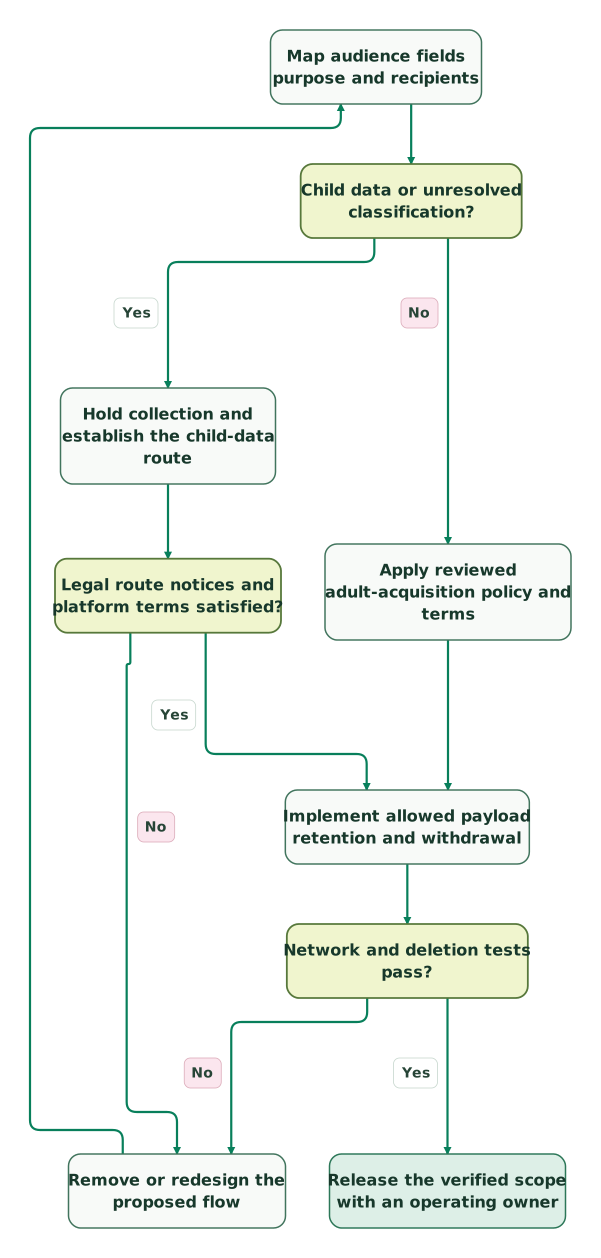
Read diagram as text
- Map audience fields purpose and recipients to Child data or unresolved classification?.
- Child data or unresolved classification? to Hold collection and establish the child-data route: Yes.
- Child data or unresolved classification? to Apply reviewed adult-acquisition policy and terms: No.
- Hold collection and establish the child-data route to Legal route notices and platform terms satisfied?.
- Legal route notices and platform terms satisfied? to Remove or redesign the proposed flow: No.
- Remove or redesign the proposed flow to Map audience fields purpose and recipients.
- Legal route notices and platform terms satisfied? to Implement allowed payload retention and withdrawal: Yes.
- Apply reviewed adult-acquisition policy and terms to Implement allowed payload retention and withdrawal.
- Implement allowed payload retention and withdrawal to Network and deletion tests pass?.
- Network and deletion tests pass? to Remove or redesign the proposed flow: No.
- Network and deletion tests pass? to Release the verified scope with an operating owner: Yes
The diagram summarizes the release decision. It does not determine whether a particular use qualifies for an exception or whether consent is sufficient under every applicable law. Those conclusions belong in the approved data-flow record before implementation.
Checklist
- Audience classification and unresolved cases have an accountable legal decision.
- Each SDK and backend destination has a defined purpose and allowed data contract.
- The consent or exception route includes its required notice and enforceable limits.
- School-authorized data stays within the permitted educational scope.
- Adult acquisition cannot inherit or export child activity.
- Retention, rights requests and provider assurances cover the actual stored copies.
- Startup, switching, retries, withdrawal and deletion tests pass on the shipped build.
If your team cannot trace a student event from collection through its final recipients and deletion, start with the $99 martech audit. Bring the audience decision, SDK list and vendor agreements. The implementation scope should identify the exact flows to remove, constrain or verify.
Keep reading
Browse all Tracking & Attribution guides
 Tracking & Attribution
OneTrust Pricing: Compare the Quote, Usage and Renewal
Compare OneTrust CMP quotes by package, visitor usage, implementation and renewal. Includes a cost worksheet, contract checks and clear budget examples.
Jafrin Akter AloLast updated 15 min read
 Tracking & Attribution
Shopify Cookiebot Consent Mode: Carry Choices Into Checkout
Connect Cookiebot choices to Shopify checkout and Google consent mode. Includes pixel boundaries, a privacy-state probe and seven purchase-flow tests.
Jafrin Akter AloLast updated 14 min read
 Tracking & Attribution
Meta Pixel and HIPAA: Review the Data Before Sending Conversions
Audit Meta Pixel, CAPI and patient-list exports before sharing healthcare data. Includes seven test cases, policy boundaries and an internal reporting example.
Jafrin Akter AloLast updated 15 min read
Analytics & tracking
See the implementation scope, deliverables and acceptance checks.
Questions people ask
Does putting the collector on our own subdomain remove the problem?
No. A company-controlled hostname changes where a request first arrives; it does not establish the purpose, recipients or legal route. Inspect the collector’s headers, logs, identity joins and downstream forwarding. A request can pass through your infrastructure and still reach an advertising or analytics provider. Treat the subdomain as an architectural component whose behavior needs evidence.
Can a disabled SDK still create a release problem?
Yes, if the disabling control does not cover initialization, old runtime settings, background work or another bundled component. Test a clean install and an existing installation, including offline queues and account switching. Record which collection paths the setting actually controls. Removing an unnecessary SDK may simplify the design, but verify the resulting build and network behavior rather than assuming a dependency edit completed the work.
Can we reuse a school parent-contact list for a consumer launch?
Do not treat school authorization as permission for unrelated marketing. Establish a separate, reviewed adult acquisition path and avoid importing child activity or school-derived audience segments into it. The FTC limits school authorization to its educational context. A contact’s being an adult does not by itself establish permission to repurpose the information. FTC school guidance.
Is passing an App Store parental gate verifiable parental consent?
No automatic equivalence exists. Apple explicitly distinguishes its parental-gate requirement from consent under children’s privacy laws. A gate may control access to a purchase or external link while a separate legal consent process governs collection and disclosure. Specify the job of each control, then test both. Do not reuse a gate-success flag as universal permission for SDK initialization. Apple Kids guidelines.
Can aggregate diagnostics tell us which children need help?
The four-field payload alone does not tell you which child had the failure. The complete request and infrastructure may still expose IP addresses, headers or other identifiers, so review those separately. Use the diagnostic report for reliability questions. Student-specific help needs an authorized educational data flow with appropriate access; adding a join key changes the diagnostic design and requires reassessment.
Sources
- eCFR: COPPA operator obligations, section 312.3
- eCFR: COPPA definitions, section 312.2
- Google: Restricted targeting in personalized advertising
- Federal Register: Final COPPA amendments
- eCFR: Parental consent, section 312.5
- eCFR: Notice, section 312.4
- eCFR: Security, section 312.8
- eCFR: Retention and deletion, section 312.10
- FTC: COPPA frequently asked questions, schools section
- FTC: Education technology policy statement
- US Department of Education: FERPA regulations
- Apple: App Review Guidelines
- Google: Play Families policies
- Google: Analytics terms of service
- Google: Firebase Analytics collection controls
- Singular: Kids Apps SDKs FAQ
- eCFR: Parental review and deletion rights, section 312.6

Written by
Jafrin Akter AloData Engineer and Co-founder at Martechdevs and Growth and Analytics Partners
Jafrin writes practical guides to marketing technology, customer data, analytics and AI workflows. Martechdevs is a Growth and Analytics Partners company.