
OneTrust Pricing: Compare the Quote, Usage and Renewal
OneTrust prices its CMP Base and CMP Suite packages by quote, using average daily visitors across channels and properties. The subscription is only part of the budget: support, implementation, internal maintenance and renewal terms can change the decision. Start with the exact package and usage definition, then compare the first year and renewal on the same scope instead of relying on an advertised minimum from another buyer's deal.
On this page

How much does OneTrust cost for the work you need?
OneTrust does not publish a fixed CMP Base or CMP Suite rate on its pricing page. Request a written quote for the specific package, usage tier, properties and term. The page also does not establish a universal minimum annual commitment that every buyer must pay. OneTrust pricing and packaging.
A reported transaction price elsewhere can describe a different product, legacy module, negotiated scope or billing period. A procurement median is not a current CMP rate card. Treat a quoted amount as comparable only when you can identify what it includes, the allowed usage and the conditions that change it.
The practical first question is whether you need a website consent tool, a cross-channel CMP, privacy-request operations or a known-customer preference system. Those are different jobs. The CMP comparison covers selection across vendors; this guide shows how to make the OneTrust proposal reviewable.
At Martechdevs, our consent and tracking implementation work connects the purchased scope to real collection behavior. Before accepting a larger package, ask which required workflow it improves and who will operate that workflow after launch.
Which OneTrust package belongs on the quote?
Request the package that covers your required outcomes, with separately identified products for any additional job. OneTrust's package descriptions distinguish CMP Base, CMP Suite, Universal Consent & Preference Management and Privacy Automation.
| Offering | Relevant scope | Stated usage basis | Question before buying |
|---|---|---|---|
| CMP Base | Cookie, mobile-app and CTV consent, plus consent-rate optimization | Average Daily Unique Visitors | Can the required properties and enforcement paths work within this package? |
| CMP Suite | CMP capabilities plus Privacy Notice Management and DSR Automation | Average Daily Unique Visitors | Will the team actually operate the notice and data-subject-request workflows? |
| Universal Consent & Preference Management, or UCPM | Customer consent and preferences across the journey | Data subjects | Do you need a durable preference record and downstream synchronization? |
| Privacy Automation Base | Data mapping, assessments and regulatory research | Admin users and privacy assets | Are internal privacy operations part of this purchase? |
The package document also lists Privacy Notice Management when CMP is purchased with Privacy Automation Suite. Ask the vendor to check overlapping entitlements before adding another package for the same capability. OneTrust solution packages.
OneTrust's feature reference assigns separate API and use-case scope to CMP and UCPM. A demonstration of a branded preference center does not establish that the CMP-only quote includes the same customer-profile workflow. Write the required SKU and integration outcome into the proposal. Consent and preference package features.
Company headcount is not a substitute for these usage units. A ten-person publisher can have more consent traffic than a fifty-person consultancy. Likewise, administrator seats for a privacy-operations product should not be multiplied by every employee merely because the procurement form asks for company size.
What does Average Daily Unique Visitors actually measure?
Average Daily Unique Visitors, or ADUV, measures OneTrust's defined daily consent-infrastructure activity over its averaging period. It is not your CRM customer count, GA4 engaged-user count or the number of people who click Accept.
OneTrust describes daily usage from CMP loading or consent validation, with same-browser or device visits deduplicated within the day and return visits counted again on later days. It does not perform cross-device person deduplication for this meter. Its FAQ describes a rolling 365-day ADUV average and excludes bot traffic. OneTrust usage FAQ.
The Active users dashboard distinguishes this renewal metric from filtered daily or monthly activity. Changing the date filter does not change the displayed rolling ADUV used for renewal. Its examples also count one person using two devices as two impressions. Active users dashboard.
Use a simple hypothetical full-year calculation to understand the averaging effect. Assume the vendor-defined combined daily count is 1,000 on 335 days and 5,000 on 30 campaign days, with every day present:
Daily-count total = 335 × 1,000 + 30 × 5,000 = 485,000
Average over 365 days = 485,000 / 365 ≈ 1,328.77
The result is about 32.9% above the 1,000 baseline, even though the campaign peak is five times that baseline. This is an illustration of a rolling average, not a OneTrust invoice or a promise about your tier. Obtain the actual meter calculation and tier threshold for your account.
When preparing that evidence, distinguish a genuine zero-traffic day from a missing export. Dropping zero days raises the calculated average; treating missing days as zero can lower it falsely. Confirm the denominator for a new deployment with less than a full year of history, and ask how newly added properties enter the licensed scope.
Request the relevant property breakdown and the renewal ADUV together. Keep website, app and CTV activity visible. Do not reduce the figure by merging logged-in identities across devices unless the contract's meter actually performs that operation.
What should happen when usage exceeds the purchased tier?
The applicable order form and usage terms should state how an excess becomes a commercial change. OneTrust's pricing guidance says sustained usage above a tier leads to a transition discussion with the account executive; its packaging guidance says excess usage may require an amendment or upgrade. Neither statement supplies your account's price or a universal overage rate. Pricing FAQ, Usage-meter guidance.
Ask for these terms alongside the quote:
| Usage question | Required written answer | Why it changes the budget |
|---|---|---|
| What is the licensed meter? | Unit, averaging period, property scope and included tier | Different definitions can produce different qualifying volumes |
| When does an excess count? | Threshold, observation period and notification method | One campaign spike may differ from sustained growth |
| How is additional cost calculated? | Next-tier price, effective date and any proration | A later invoice may concern earlier usage |
| Can scope decrease? | Downgrade timing and treatment of retired properties | Lower traffic does not automatically change a committed subscription |
| Which version applies? | The usage terms incorporated into the order | An older online document may describe another contract |
OneTrust maintains multiple versions of its product descriptions and usage terms. Have the applicable version attached to the order. Do not assume an old grace period or billing formula remains available merely because a search result still exposes it.
Operationally, give finance and the CMP owner the same usage evidence. The person who receives a renewal quote should know about a new app, an acquired brand or a traffic campaign before deciding whether the increase is unexplained.
Is there a free OneTrust CMP plan, trial or startup offer?
The public CMP pricing page does not publish a free-production allowance, a standard trial duration or a startup discount schedule. Budget the written offer you receive. Do not convert the absence of a public rate into an assumed free tier or a guaranteed concession.
OneTrust's contracting guidance describes demos and trials before purchase. Its public free-trial URL currently routes to Contact Sales. Request the evaluation scope, duration, permitted data, technical support and transition to production explicitly. A demo, a trial tenant and a production subscription are different commitments. Contracting guidance, Evaluation contact route.
For a startup offer, ask what eligibility evidence is required, which package and usage limit it covers, when the concession ends and what the next term costs. Treat an unspecified future discount as zero in the base budget. Record a negotiated concession only after it appears in the proposal.
Legacy CookiePro customers should inspect their existing account before assuming they must replace it. OneTrust's CookiePro page says existing customers can still access their environment, manage billing and purchase products within the app. That continuity does not establish the price or terms available to a new CMP buyer. CookiePro transition information.
Which costs should sit beside the subscription?
Separate the recurring licence and support from one-time implementation, internal operating time and exit work. This makes a quote useful to the people who must deliver the project, not just to the person comparing annual invoices.
OneTrust says new subscriptions include self-service onboarding, with additional professional services purchased under a statement of work. That does not establish a standard implementation percentage or fixed deployment fee. OneTrust contracting overview.
Its Support Description names Essential, Plus, Premier and Signature packages. Essential applies when another package is not specified. Base support covers break-fix help and excludes customization, new configuration, training and implementation work; Success Packages do not apply to free trials or proofs of concept. Check the entitlements in the proposed package rather than treating “support included” as an implementation service. OneTrust Support Description.
| Cost component | What to specify | Acceptance evidence |
|---|---|---|
| Recurring software and support | Package, tier, support entitlement and billing schedule | Itemized order with all recurring components |
| Initial implementation | Properties, integrations, languages, custom behavior and migration | Named deliverables and test cases |
| Internal operation | Inventory review, policy changes, releases and escalation | Assigned owner and realistic capacity |
| Growth changes | Additional properties, volume or workflows | Priced amendment process and lead time |
| Exit or replacement | Exports, replacement scripts, consent continuity and overlap | A feasible transition plan before cancellation |
For implementation, include first-visit, refusal, granular-choice, saved-choice and withdrawal tests for the real tag and SDK paths. A scan and a displayed banner do not prove that all destinations follow the approved state. Use the Consent Mode v2 guide for the Google signaling layer and retain separate checks for other tools.
Price work against actual complexity. Three properties sharing one maintained template can require less effort than one application with custom navigation, embedded vendors and several release teams. Ask the supplier to state assumptions and exclusions so a fixed fee has a meaningful boundary.
How can a small team build a first-year and renewal budget?
Use the actual software quote as an input, then add the work and renewal assumptions separately. Headcount provides organizational context; it is not the CMP billing formula.
These are hypothetical implementation-planning examples for ten-, twenty-five- and fifty-person businesses. All effort is valued at an assumed USD 75 per hour. The licence and purchased support remain the unknown annual quote Q; external services, tax, overuse and migration costs are not included in this first table.
| Team and proposed scope | Initial internal hours | Monthly internal hours | Year-one internal cost | Recurring annual internal cost |
|---|---|---|---|---|
| 10 people; one conventional website | 12 | 1 | USD 1,800 | USD 900 |
| 25 people; three sites sharing a release process | 36 | 3 | USD 5,400 | USD 2,700 |
| 50 people; web and app implementation with several owners | 80 | 6 | USD 11,400 | USD 5,400 |
For the middle example, 36 × 75 + 12 × 3 × 75 = USD 5,400. The first-year budget is Q + USD 5,400 before external work and other excluded costs. These hours are planning assumptions, not measured OneTrust deployment times or Martechdevs prices.
Now illustrate the effect of a first-year concession. The following amounts are entirely synthetic procurement inputs, not a OneTrust quote or market-price estimate: USD 18,000 annual recurring software and purchased support before discounts, a 20% first-year discount, USD 6,000 one-time external implementation, 36 initial internal hours and three monthly hours at USD 75. Renewal increases the undiscounted recurring amount by an assumed 5%, with no usage-tier or scope change.
| Budget line | First year, USD | Renewal year, USD | Assumption |
|---|---|---|---|
| Recurring software and purchased support | 14,400 | 18,900 | 18,000 × 80%; then 18,000 × 105% |
| External implementation | 6,000 | 0 | One-time project; no additional year-two work assumed |
| Initial internal setup | 2,700 | 0 | 36 × 75, only in the first year |
| Ongoing internal operation | 2,700 | 2,700 | 3 × 12 × 75 each year |
| Total economic cost | 25,800 | 21,600 | Subscription invoice and valued internal effort combined |
The two-year total is USD 47,400. The recurring invoice rises 31.25%, from USD 14,400 to USD 18,900, although the assumed underlying uplift is 5%. Losing the introductory discount explains the difference. Meanwhile, total economic cost falls because the initial implementation does not repeat. Those are two different budget stories.
Keep invoiced cash and internal effort in separate columns in the working spreadsheet. Here the first-year supplier cash total is USD 20,400 before tax; USD 5,400 is valued internal work. If purchased support is already included in the recurring input, do not add it again under another name.
Use this compact planning template to compare offers. Null means the information is still missing, not free:
proposal: onetrust_cmp_candidate
currency: USD
package_and_skus: null
usage_meter_and_tier: null
properties_and_channels: []
initial_term_months: null
recurring_before_discount: null
first_term_discount: null
support_included_in_recurring: null
external_implementation: null
initial_internal_hours: null
monthly_internal_hours: null
internal_hourly_cost: null
renewal_price_or_formula: null
overuse_price_and_effective_date: null
nonrenewal_deadline_and_notice_method: null
export_and_removal_plan: null
Add a growth scenario using the vendor's next-tier quote, not a guessed cost per visitor. Keep a no-discount renewal scenario even when sales expects another concession. Compare total commitments over the full term; an annual amount divided by twelve does not make an annual contract cancellable monthly.
Which renewal and exit terms need attention before signing?
Read the actual order and incorporated terms with the person who approves the contract. The public Master Terms set the initial subscription length through the order form and describe twelve-month automatic renewals, with at least thirty days' nonrenewal notice. They also make payment obligations noncancellable and paid amounts non-refundable except where the agreement says otherwise. Reseller renewals have a separate order-form provision. OneTrust Master Terms.
Record the exact notice recipient, method and deadline in the procurement record. Put the internal decision date early enough to obtain a replacement quote and test an exit. Do not wait until the contractual deadline to start comparing suppliers.
Negotiate or clarify the commercial variables that remain uncertain: renewal price, how an introductory discount expires, the permitted increase formula, future tier prices, scope reductions and any multi-year commitment. A request for an increase cap is a negotiation position, not a statement that OneTrust has already offered one.
Exit planning needs more than a CSV button. OneTrust's subscription guidance says ordinary application/data access ends on termination or expiry and describes requested portability under contractual terms. The Master Terms separately provide a sixty-day customer-content export exception after termination and require removal of related components within thirty days. Arrange the access mechanism and exports before expiry instead of assuming normal tenant access continues. Subscription access and portability, Master Terms, components and termination.
Identify the configurations, purpose mappings, consent records and operational evidence needed by the replacement. Test whether the new system can interpret them. Exportability does not mean another CMP can safely treat every old preference as a new grant. The martech handover guide helps assign the people, access and operating records needed for that transition.
When is OneTrust worth evaluating against a simpler CMP?
Evaluate OneTrust when its required cross-channel or privacy-operation scope reduces work you actually have, and compare a web-focused alternative when the requirement is smaller. Choose by the tested workflow and total commitment, rather than by employee count alone.
| Situation | First evaluation | Runner-up | What decides |
|---|---|---|---|
| Small team with website consent only | Cookiebot Core | Scoped OneTrust CMP Base quote | Required controls, operating effort and complete cost |
| Web, mobile and CTV under one governance owner | OneTrust CMP Base | A separately scoped web/app CMP proposal | Enforced behavior across all required surfaces |
| Consent plus notice and privacy-request workflows | OneTrust CMP Suite | Base plus an existing request-operation system | Whether the wider workflows replace real work and avoid duplicate entitlements |
| Known-customer preferences synchronized to CRM | UCPM scoped with the required CMP | The existing preference system with a maintained integration | Identity, change propagation and the actual licensed scope |
Cookiebot Core uses per-domain subpage pricing and does not use traffic as that billing unit; its limited free plan covers one domain with up to 50 subpages, and it advertises a fourteen-day Premium trial. Those are different economics from OneTrust's quoted usage model, not proof that the products cover identical work. Cookiebot pricing, Cookiebot domain and page budgeting.
OneTrust as the candidate
- Best for: teams that can name the consent, notice, request or preference workflows they need to operate together.
- Pros: package scope can cover several customer surfaces and related privacy operations.
- Cons: usage definitions, implementation responsibilities and renewal terms need a detailed proposal.
- Free tier and startup offer: do not budget an unconfirmed allowance or discount; obtain the evaluation and paid-continuation terms.
- Choose it if: the actual configuration passes acceptance tests and its total commitment fits the operating plan.
- Skip it if: required capabilities remain unproven or the additional package does not replace meaningful work.
What should pass before approving the OneTrust quote?
Approve the quote when the package, meter, implementation and renewal can be explained from written evidence, and the required behavior has passed evaluation.
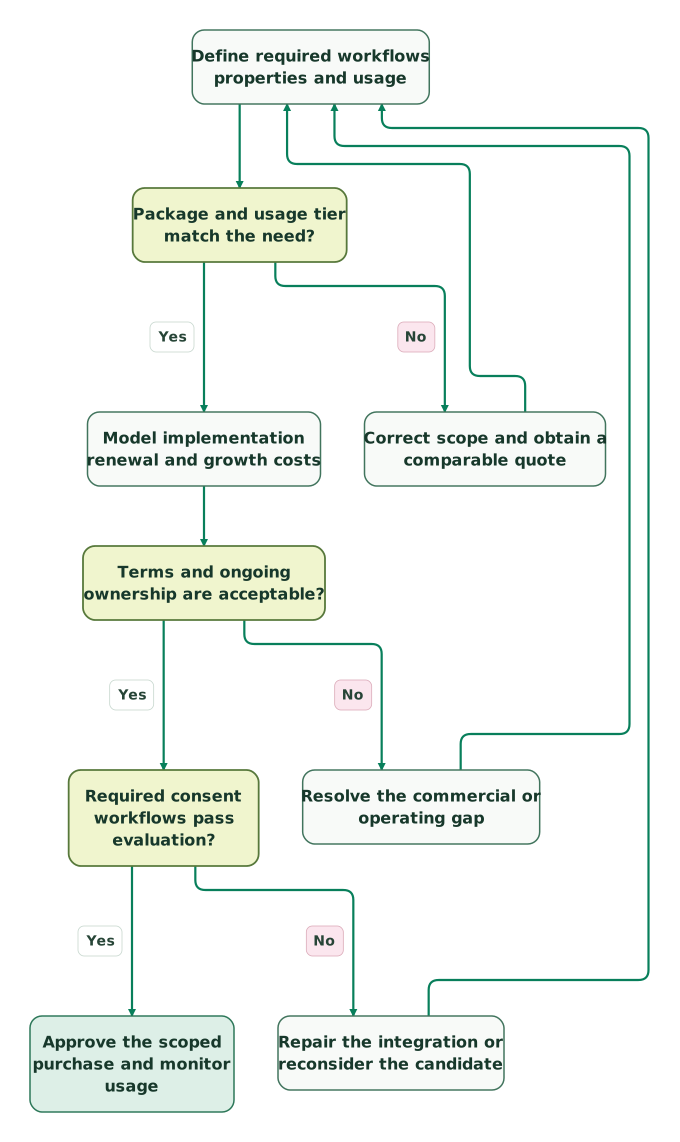
Read diagram as text
- Define required workflows properties and usage to Package and usage tier match the need?.
- Package and usage tier match the need? to Correct scope and obtain a comparable quote: No.
- Correct scope and obtain a comparable quote to Define required workflows properties and usage.
- Package and usage tier match the need? to Model implementation renewal and growth costs: Yes.
- Model implementation renewal and growth costs to Terms and ongoing ownership are acceptable?.
- Terms and ongoing ownership are acceptable? to Resolve the commercial or operating gap: No.
- Resolve the commercial or operating gap to Define required workflows properties and usage.
- Terms and ongoing ownership are acceptable? to Required consent workflows pass evaluation?: Yes.
- Required consent workflows pass evaluation? to Repair the integration or reconsider the candidate: No.
- Repair the integration or reconsider the candidate to Define required workflows properties and usage.
- Required consent workflows pass evaluation? to Approve the scoped purchase and monitor usage: Yes
Checklist
- The package and every required SKU are named.
- Licensed properties, channels and usage calculations are reproducible.
- Current volume, campaign growth and the next tier are priced separately.
- Support and implementation deliverables have distinct owners.
- Initial concessions and the renewal formula are visible.
- Cash invoices and internal effort are not counted twice.
- The nonrenewal deadline and notice method are recorded.
- Consent records and configuration can be exported through an agreed process.
- Required first-visit, refusal, saved-choice and withdrawal journeys pass.
- Someone owns usage monitoring and changes after launch.
Bring the proposal, property inventory and unresolved workflow to the $99 martech audit. The useful result is a scoped buying decision and an implementation plan the team can maintain, with the cost of the next term visible before the first one begins.
Keep reading
Browse all Tracking & Attribution guides
 Tracking & Attribution
5 Cookiebot Implementation Mistakes and How to Fix Them
Diagnose late consent defaults, missing updates, duplicate Cookiebot installs and unmanaged embeds. Use six concrete journeys to verify actual tag behaviour.
Jafrin Akter AloLast updated 10 min read
 Tracking & Attribution
Shopify Cookiebot Consent Mode: Carry Choices Into Checkout
Connect Cookiebot choices to Shopify checkout and Google consent mode. Includes pixel boundaries, a privacy-state probe and seven purchase-flow tests.
Jafrin Akter AloLast updated 14 min read
 Tracking & Attribution
Do you need a cookie banner for GA4? A six-country decision guide
Compare GA4 consent, notice and opt-out requirements across the US, Canada, UK, Ireland, Australia and NZ, then turn the assessment into working controls.
Jafrin Akter AloLast updated 15 min read
Analytics & tracking
See the implementation scope, deliverables and acceptance checks.
Questions people ask
Should a OneTrust quote be divided by employee count to compare value?
Only as an internal allocation, not as a substitute for the quoted meter. CMP usage depends on the relevant visitor activity, while other packages can use administrators, assets or profiles. Compare the required outcome and total committed cost first. A smaller workforce can operate a much larger digital audience, so cost per employee can misrepresent both usage and fit.
Does accepting fewer cookies necessarily reduce OneTrust's usage bill?
No. Consent-infrastructure activity can count even when the visitor never presses Accept, so a lower acceptance rate is not a reliable usage-reduction strategy. Review the licensed meter and property activity instead. Preserve a genuine choice for visitors, and do not change banner behavior merely to chase a presumed billing effect that the contract does not establish.
Can a retired website be removed from the renewal calculation immediately?
Do not assume an immediate reduction. Confirm when the property stops contributing new activity, how the averaging window treats earlier days and when the contract allows a lower tier. Keep evidence that the site and its CMP deployment were actually retired. A deleted dashboard filter or a lower current traffic month does not by itself establish a revised subscription price.
How should a reseller proposal be compared with a direct OneTrust offer?
Compare the same package, usage tier, term, support and implementation scope, then identify which party supplies each obligation. Check the reseller's renewal and payment documents alongside the OneTrust terms governing service use. A lower headline fee can represent different services or commitments; preserve the complete contractual chain and confirm who handles billing questions, support escalation and exit assistance.
Can the team rely on another buyer's OneTrust renewal increase?
Use it as a reason to ask better questions, not as your forecast. The other buyer may have changed volume, packages, discounts or contract terms. Build your renewal from the applicable price formula and licensed scope, with explicit assumptions for growth. If those terms are missing, obtain them before approval rather than replacing uncertainty with an anecdotal percentage.
Sources
- OneTrust: Pricing and packaging
- OneTrust: Solution packages
- OneTrust: Consent and preference package features
- OneTrust: Consent and preference usage FAQ
- OneTrust: Active users dashboard
- OneTrust: Solution pricing and usage meters
- OneTrust: Product descriptions and usage-terms versions
- OneTrust: Legal Center and contracting guidance
- OneTrust: Evaluation contact route
- OneTrust: CookiePro transition
- OneTrust: Support Description
- OneTrust: Master Terms
- OneTrust: Account subscriptions and portability
- Cookiebot: Pricing and plans

Written by
Jafrin Akter AloData Engineer and Co-founder at Martechdevs and Growth and Analytics Partners
Jafrin writes practical guides to marketing technology, customer data, analytics and AI workflows. Martechdevs is a Growth and Analytics Partners company.