
PostHog vs Pendo: Product Analytics, Guidance and Cost
Pick Pendo when product adoption and maintained in-app guidance are central to the team's work; pick PostHog when engineering-led analytics, experiments and release decisions define the requirement. PostHog vs Pendo involves overlapping capabilities with different operating emphasis and billing units. Test the customer journey, identity rules and person responsible for the next change before choosing from a free allowance.
On this page
PostHog vs Pendo comparison
Prices and allowances below use public USD terms; Pendo paid plans require a scoped quote.
| Decision | Pendo | PostHog |
|---|---|---|
| Free analytics allowance | Pendo Free: 500 monthly active users | 1 million product analytics events per month |
| Paid starting basis | Base, Core and Ultimate use custom MAU volume and requested pricing | Analytics events above the free allowance; first paid band $0.00005/event |
| Guidance emphasis | In-app guides included in Base and Free scope | Evaluate the required intervention alongside analytics, flags and experiments |
| Replay scope | Core includes replay; Free excludes it | Separate monthly allowance of 5,000 recordings |
| Main evaluation owner | Product adoption and customer education owner | Product engineering and analytics owner |
Sources: Pendo plans, Pendo Free details, PostHog pricing and product analytics rates. A Pendo MAU and a PostHog event are different units. Neither allowance describes the complete implementation cost.
We would begin with the action the team wants to take. A product manager maintaining a targeted onboarding guide has a different recurring job from an engineer measuring a feature release. Both may inspect a funnel, but the next change and its owner can favor a different platform.
At Martechdevs, we define the events, identities and activation measures behind that choice through our product analytics implementation service. The pilot should demonstrate an accepted business outcome and a maintenance path, rather than simply produce a dashboard.
Pendo and PostHog decision blocks
Pendo
- Best for: Product and adoption teams that need usage analysis and a maintained in-app guidance program.
- Pros: Pendo includes product analytics and guides in its Base offer. Its guide editor supports overlays such as tooltips, polls and multistep tours, with separate creation and publishing permissions. See plans and overlay guides.
- Cons: The required paid package needs a quote, and a guidance program still needs an owner for targeting, content and interface changes.
- Free plan and startup offer: Pendo Free covers 500 MAUs and unlimited internal users, with guides and core analytics. It excludes session replay and third-party integrations. No startup concession is assumed. See Free scope.
- Choose it if: A product or customer education team will regularly publish and maintain targeted guidance, and the selected package supports the whole workflow.
- Skip it if: The purchase is mainly for code-driven release measurement and the guidance program has no defined owner or useful purpose.
PostHog
- Best for: A technical product team connecting event analysis, replay context, feature flags and experiments to release decisions.
- Pros: Product analytics uses shared events, people and properties and can connect an insight with related replays, flag exposure and experiments. See the product analytics overview.
- Cons: Usage is spread across product-specific billing units. The team must maintain the event and identity design and separately prove any required adoption intervention.
- Free plan and startup offer: The monthly allowance includes 1 million analytics events, 5,000 replays and 1 million feature-flag requests. The free offer requires no card; extra startup credits are excluded unless approved. See PostHog allowances.
- Choose it if: Engineers and product analysts can own instrumentation and use the resulting evidence to make controlled product changes.
- Skip it if: The intended operators need a specific guidance or education workflow that the proposed setup has not demonstrated.
Adoption guidance and release measurement
A guidance program starts with an audience and a task. Define the user who needs help, the point at which help appears and the action that makes the help unnecessary. A tour completed for its own sake is a weak success metric. The meaningful outcome may be a successfully connected data source or a first approved report.
Pendo's guide documentation separates guide creation from publishing and supports overlays with several content types. That is useful when a product team needs an approval process for changes shown inside the application. The trial should include a draft, review, publication to a limited audience and retirement after the task is complete. See Pendo guide creation.
A release-measurement workflow starts elsewhere: exposure to a change, an eligible population and an agreed outcome. PostHog's analytics can connect to feature flag and experiment context, giving a technical team a route from product behavior to release investigation. The product overview describes that connection, but the team still needs to define the evaluation correctly. See PostHog analytics.
These are working emphases, not exclusive feature claims. Avoid choosing Pendo because someone says PostHog only supplies charts, or choosing PostHog because someone says Pendo only supplies tours. Ask each candidate to demonstrate the exact intervention and measurement your team will operate.
For a replay-first investigation, use Fullstory vs Pendo. For event analysis paired with session evidence, Fullstory vs Mixpanel provides another shortlist. The point is to select the recurring work that matters, rather than assemble a universal ranking.
User identity and account-level adoption
A visitor identifier is a measurement choice. If the application creates a new identifier after every login, analytics can exaggerate the number of people while fragmenting each person's journey. If several people share one identifier, the opposite problem occurs. Decide the stable user key and test the signed-out-to-signed-in transition.
Pendo Free defines its MAUs using unique Visitor IDs over a thirty-day period. That makes identity design relevant to both the analytical population and the plan boundary. The documentation also notes qualifications for anonymous and identified visitors under different subscriptions. See Pendo MAU rules.
PostHog documents linking anonymous and identified activity and provides an explicit identify flow. Use the account's stable user identifier, then test logout, another user on the same device and a return visit. The expected result should follow the real person rather than whichever browser state happens to remain. See PostHog identification.
For B2B software, a person and an account are different populations. One administrator completing setup may activate a workspace while several colleagues have never opened the product. Track both if the business needs both, with a clear definition of the account-level milestone and the user-level behavior.
Consider a hypothetical cohort of 120 workspaces and 600 users. Suppose 72 workspaces complete the agreed account activation milestone, while 210 users complete the individual task. Account activation is 72 ÷ 120 = 60%. User completion is 210 ÷ 600 = 35%. Neither rate is a substitute for the other, and the difference is not a measurement failure by itself.
Our identity merge guide and SaaS activation metrics guide explain the prerequisites. Complete this work before evaluating whether a platform's default report answers the business question.
Pendo vs PostHog usage budgets
A hypothetical application with 750 active users and twenty captured analytical events per user produces 15,000 events. That exceeds Pendo Free's 500-MAU boundary while remaining within PostHog's 1-million-event analytics allowance. This is a unit illustration; it does not mean the two free packages provide equivalent guidance, replay, integration or governance features.
Pendo Free also changes behavior after its MAU threshold is exceeded. Its documentation describes restrictions on creating new guides, NPS surveys and segments, with reports showing generalized trends from a random sample of 500 visitors. A free evaluation above that boundary therefore cannot be treated as a complete-population acceptance result. See Pendo Free limits.
The following hypothetical PostHog examples cover analytics events only, in USD, using the published graduated rates. They exclude replay, flags, other products, platform packages, taxes and implementation.
| Monthly analytics demand | Calculation | Analytics subtotal | Basis |
|---|---|---|---|
| 1 million events | Within monthly free allowance | $0 | Analytics only |
| 1.5 million events | 500,000 × $0.00005 | $25.00 | First paid band |
| 2 million events | 1,000,000 × $0.00005 | $50.00 | First paid band exhausted |
| 2.5 million events | $50 + 500,000 × $0.0000343 | $67.15 | Next graduated band |
The source is PostHog product analytics pricing. Apply the rate to the events in each band. Charging every event at the final marginal rate would produce the wrong total.
Ask Pendo for a quote containing the required MAU definition, applications, guides, replay, integrations, support and commitment. Ask PostHog for the full cost of the selected products and platform requirements. The analytics-event subtotal above does not price an entire Pendo replacement.
Use the product analytics pricing guide and software pricing tool to keep that scope visible. Add the people who maintain the setup. A hypothetical eight hours of monthly work valued internally at $90/hour is $720/month or $8,640/year. Those assumptions should be replaced with the team's actual workload before using them in a purchase decision.
Capture boundaries and an actionable pilot
Capture should preserve useful evidence without collecting unnecessary content. Review identity properties, URLs, page text, form fields and any recorded network detail. The test should show what is actually received and visible to the analyst, not merely whether a masking option is enabled.
PostHog documents that web replay input fields are masked by default, while general page text is not masked by default. Its privacy controls run before masked data leaves the device. That distinction matters for applications that display customer information outside forms. See PostHog replay privacy.
Use synthetic values in the evaluation and verify the recorded result before broader capture. Repeat that check after changing components, routes or capture settings. A change that fixes an event can also change the content available in a replay, so the affected validations should travel together.
For Pendo guidance, use a test user who qualifies, another who should be excluded and a user who completes the task during the guide sequence. Confirm that the right audience receives the right help and that completed work does not keep triggering the same intervention. Record the expected result before reviewing the platform output.
Measure the product outcome separately from exposure. A guide impression tells you that a guide was shown. A completion event should describe the actual business task, ideally reconciled with its source record. Neither an impression nor a button click proves that a user successfully completed the intended work.
Best fit by product team
| Company or operating model | Best fit | Runner-up | Decision reason |
|---|---|---|---|
| SaaS team with a named customer education owner | Pendo | PostHog | Maintained guidance is a recurring responsibility |
| Engineering-led product team measuring releases | PostHog | Pendo | Instrumentation and release evidence drive the work |
| Small product with fewer than 500 measured MAUs | A scoped free pilot | The other qualified tool | Required features and ownership decide the fit |
| B2B product with several users per workspace | Identity and account model first | Either qualified platform | Person and account adoption need distinct definitions |
| Team whose main question concerns a broken interaction | Replay-focused shortlist | Pendo or PostHog with qualified replay scope | Detailed failure evidence may drive the choice |
Product analytics and guidance decision
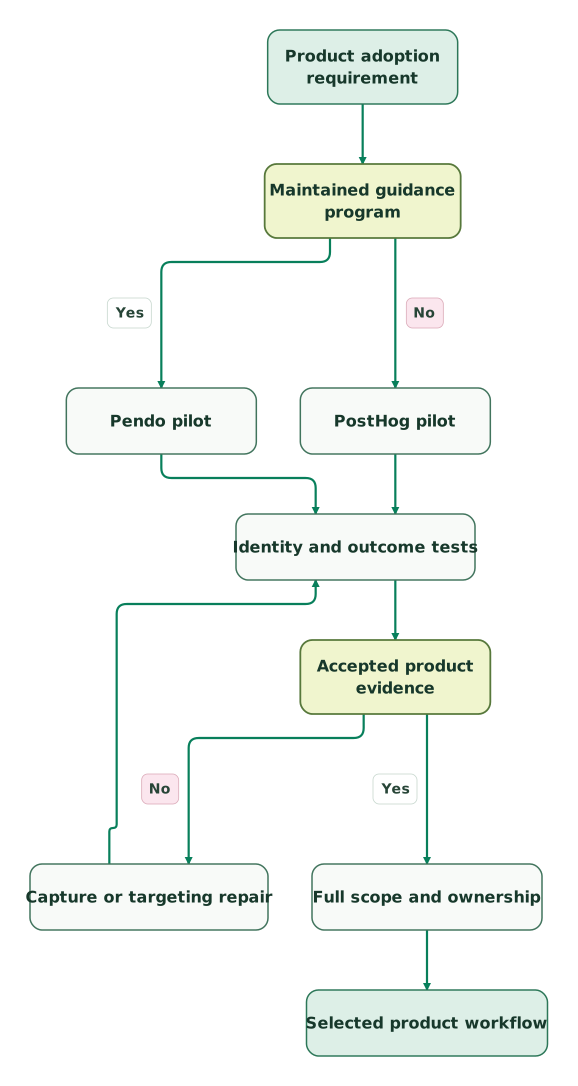
The graph branches on the team's main adoption job, then joins at identity and outcome validation. A failed check returns to capture or targeting repair and repeats the affected test before the complete budget is reviewed.
Read diagram as text
- Product adoption requirement to Maintained guidance program.
- Maintained guidance program to Pendo pilot: Yes.
- Maintained guidance program to PostHog pilot: No.
- Pendo pilot to Identity and outcome tests.
- PostHog pilot to Identity and outcome tests.
- Identity and outcome tests to Accepted product evidence.
- Accepted product evidence to Capture or targeting repair: No.
- Capture or targeting repair to Identity and outcome tests.
- Accepted product evidence to Full scope and ownership: Yes.
- Full scope and ownership to Selected product workflow
Pendo and PostHog evaluation checklist
- A recurring product decision and a named intervention owner.
- Stable user identity and a separate account-level definition where required.
- Agreed activation events and conversion windows.
- A qualifying, excluded and already-completed test user.
- A capture review using synthetic sensitive values.
- A paid-package comparison matching guides, replay and integrations.
- A budget separating MAUs, events, recordings and flag requests.
- A repeatable repair test after instrumentation or targeting changes.
- A second maintainer able to update the report or intervention.
The marketing data audit skill can structure the source and identity review. Preserve the pilot's accepted cases with the tracking plan so the next product release can repeat them.
Keep reading
Browse all Product Analytics guides
 Product Analytics
Fullstory vs Pendo: Session Evidence, Product Guidance and Cost
Compare Fullstory and Pendo for investigation and product adoption. Review current replay and guidance scope, free limits, useful metrics and complete quote requirements.
Jafrin Akter AloLast updated 11 min read
 Product Analytics
Fullstory vs Mixpanel: Event Analysis, Replay and Product Decisions
Choose Fullstory or Mixpanel by the product decision and investigation workflow. Compare current analytics and replay offers, event costs and cohort calculations.
Jafrin Akter AloLast updated 11 min read
 Product Analytics
Best Product Analytics Tools for Startups: 7 Options Compared by the Job They Do
Compare GA4, Mixpanel, Amplitude, PostHog, Heap, Pendo and Statsig on free tiers, experiments, server-side events, raw data export and warehouse options.
Jafrin Akter AloLast updated 27 min read
Product analytics
See the implementation scope, deliverables and acceptance checks.
Questions people ask
Do 500 Pendo MAUs equal 500 PostHog events?
Five hundred Pendo MAUs do not equal five hundred PostHog events. Pendo's free-plan MAU definition counts unique Visitor IDs within its stated period, while PostHog analytics bills captured events. One person can create many events. Estimate each unit separately from the intended tracking design and compare the complete feature scope, using Pendo and PostHog definitions.
Can a Pendo Free trial above its MAU threshold validate full-population conversion?
A Pendo Free evaluation above its MAU threshold should not be treated as a full-population conversion result. Pendo documents generalized trends based on a visitor sample after the limit is exceeded, alongside creation restrictions. Keep the evaluation within its qualified scope or arrange the needed paid access before accepting a population-level report. See Free limits.
Does PostHog's free analytics allowance include unlimited replay capture?
PostHog's free analytics allowance does not imply unlimited replay capture. Analytics and replay have separate units and allowances; the published monthly replay allowance is 5,000 recordings. Estimate the required recording policy independently from event volume and include any additional product usage in the budget. The current PostHog pricing page lists those boundaries.
Should Pendo guide completion be the main activation metric?
Pendo guide completion should be the main activation metric only if completing the guide is itself the business outcome you intend to measure. Usually the useful milestone is a real task, such as connecting a source or completing a workflow. Measure that outcome separately, then use guide exposure and completion to investigate the path toward it.
Can one account activation rate replace a user adoption rate?
An account activation rate cannot replace a user adoption rate when the business needs both. One administrator can activate a workspace while most members remain inactive. Define each population and milestone explicitly, then review their relationship. A lower user rate and a higher account rate can both be correct because they describe different units of adoption.
Sources

Written by
Jafrin Akter AloData Engineer and Co-founder at Martechdevs and Growth and Analytics Partners
Jafrin writes practical guides to marketing technology, customer data, analytics and AI workflows. Martechdevs is a Growth and Analytics Partners company.