
Google Ads Audit: Evidence, Priorities and Release Checks
A useful Google Ads audit establishes whether the account is optimizing for the right business outcome before recommending changes to bids or budgets. Start with goals and measurement, then review search intent, targeting, ads and landing pages. Finish with a short, evidence-backed change plan that names an owner and a retest for each finding.
On this page
Audit coverage
Keep the evidence period, campaign scope and business objective visible throughout the review.
| Audit area | Evidence | Decision | Owner |
|---|---|---|---|
| Goals and conversion actions | Action settings and campaign goal selections | Correct optimization outcome | Marketing and analytics |
| Event implementation | Controlled success and failure cases | Reliable trigger, identity and value | Engineering and analytics |
| Search intent | Search terms, keywords and exclusions | Relevant demand and defensible exclusions | Paid media |
| Targeting and delivery | Locations, audiences, schedules and status | Intended reach and eligibility | Paid media |
| Ads and landing pages | Current assets and completed customer journey | Consistent promise and usable destination | Marketing and web team |
| Budget and bidding | Spend, mature outcomes and strategy settings | Affordable, measurable allocation | Marketing and finance |
| Change control | History, proposed edits and acceptance criteria | Reviewable release | Account owner |
This Google Ads audit checklist is a workflow for producing findings, not a claim that every account has the same defects. Begin with read-only exports and settings records. Preserve the original evidence before making changes so that the team can separate the condition found from the condition after a repair.
When conversion reliability is uncertain, analytics and tracking support can connect the account goal, website event and business record. A campaign may have well-written ads while its bidding signal counts the wrong action, so measurement deserves an early decision gate.
Audit scope and evidence
- Record the account, currency, time zone, campaign types and review dates.
- Write the business outcome for each campaign group, such as accepted purchases or qualified sales opportunities.
- Export performance with the conversion columns and segments needed to test that outcome.
- Save the relevant goal, bidding, targeting and automation settings.
- Review change history around the period where performance changed.
- Record known business changes, including offers, inventory, pricing and website releases.
Choose a comparison period that suits the conversion delay and seasonality. A short period may reveal a broken landing page, but it may be too immature to judge acquisition economics. Keep operational defects separate from performance hypotheses that need more observations.
Google's change history can show account, campaign and ad-group edits from the past two years, including budget changes and the actor associated with changes. Use that timeline to identify plausible causes, while recognizing that timing alone does not prove causation. Google Ads change history.
The initial evidence pack should be small enough for another person to review. Include the export, relevant settings and a concise description of the concern. Avoid collecting unrelated customer information or turning the audit into an unrestricted download of every available table.
Conversion goals
Map each campaign to the goals it actually uses. Account-default goals affect campaigns using those defaults; campaigns with other goal combinations need separate inspection. Changing a shared action or goal can therefore affect more than the campaign currently on screen. Conversion goal management.
Check the action's business definition, source, value, counting setting and role in optimization. A page view, form start, accepted lead and closed sale can all describe different stages. Their names should make the distinction clear enough that a new account owner can understand the report.
Primary actions are used in the Conversions column and for bidding when their relevant standard goal is selected. Secondary actions are generally observational, but custom goals are an important exception: actions inside a selected custom goal can be used for bidding regardless of their primary or secondary label. Primary and secondary actions.
That exception belongs in the audit. Marking a diagnostic action secondary is not sufficient evidence that every campaign ignores it. Inspect custom goals and campaign selections before approving the optimization map.
For purchases, identify whether native website tracking, an Analytics import or another source represents the accepted outcome. More than one source can be useful for comparison, but do not assume two similarly named purchase actions should both influence the same goal. Record the intended measurement design before changing either one.
For leads, trace a sample from submission through the stage the business considers valuable. A form completion may be legitimate but commercially unqualified. Decide whether the audit is evaluating lead capture, lead quality or revenue, then select evidence that matches that question.
Conversion implementation
Run controlled cases that distinguish a successful business action from a nearby interaction. A purchase test should include completed payment, failed payment, confirmation-page reload and a second distinct order. A lead test should distinguish a click on Submit from an accepted submission and any subsequent duplicate attempt.
Google provides Tag Assistant for investigating unverified, inactive or attention-needed conversion actions. Use it to inspect the relevant implementation and retain the result with the event's business evidence. A tag firing is not proof that the business action occurred or that the platform attributed a sale. Tag Assistant diagnostics.
For native coded website actions, the conversion label guide explains the destination and action identifiers. The audit should inspect those identifiers together with the trigger, monetary fields and transaction identity rather than copying an identifier into a tag and declaring the action repaired.
Google documents duplicate handling for the same conversion action and transaction ID. Each distinct purchase needs its own ID, while a repeat delivery for that same purchase should retain it. A constant ID can undercount different purchases; a new random ID on every reload can undermine duplicate prevention. Transaction ID guidance.
Check consent behavior against the approved implementation. Basic and advanced Consent Mode have different loading and transmission behavior, so a declined choice is not evaluated through a universal assumption that no request should exist. Record the intended default, update and resulting tag behavior. Consent Mode overview.
Where enhanced conversions are enabled, inspect their diagnostics and the source of user-provided data. Google's current guidance describes a unified setting accepting data from website tags, Data Manager and API connections. Review the actual connected routes and relevant diagnostics rather than following an old checklist that assumes mutually exclusive setup methods. Enhanced conversions diagnostics.
For deeper measurement failures, use Google Ads conversion diagnostics and the GTM container audit skill. Keep account attribution, tag execution and accepted business records as separate evidence layers.
Search intent and exclusions
Review actual search terms alongside keywords, ad groups, landing pages and the intended customer. A term with spend and no recorded conversion deserves investigation, but that observation alone does not establish irrelevance. Check the available volume, conversion maturity and whether the measurement is trustworthy.
The search terms report is not a complete list of every query. Google omits some terms with insufficient activity for privacy reasons; search terms insights can aggregate otherwise hidden queries into themes. State that coverage limit when presenting a query audit. Search terms reporting.
Group the visible evidence into practical categories: clearly irrelevant intent, relevant intent with weak landing-page alignment, relevant intent with insufficient evidence, and strong candidates for further investment. Each category implies a different action. A long list of automatic exclusions can remove useful demand if these distinctions are skipped.
Negative keywords need match-type review. Google states that negative keywords do not match close variants or other expansions, so a single excluded form does not necessarily cover related variants. Also inspect where the exclusion is applied and whether it conflicts with valuable queries elsewhere. Negative keyword behavior.
Use the negative keyword workflow skill to prepare a reviewable candidate list. Preserve the query, proposed negative, match type, scope and reason. Have the campaign owner check the exclusions before application, then monitor whether intended searches remain eligible.
Targeting and customer journey
Inspect included and excluded locations together with the advanced location option. Google's default targeting can include physical presence and location interest; a campaign restricted to people in or regularly in an area uses a different option. The right choice depends on the offer and customer journey. Advanced location options.
A local service might need a different reach definition from a destination business serving people planning travel. Record the intended audience first, then compare settings and observed outcomes. Do not label an out-of-area interaction as waste until the business explains whether that person could be a valid customer.
Review networks, audience settings, exclusions, schedules and device performance within the campaign type being audited. Preserve intentional differences. A setting appropriate to one campaign should not be copied across the account merely to make the structure look uniform.
Follow the ad promise through the landing page and conversion path. Confirm the destination, offer, availability, currency, form behavior and success state. Include the relevant mobile layout and any redirects. A strong click-through rate is of limited value when a visitor reaches a mismatched offer or cannot complete the task.
The impressions and clicks guide helps separate visibility from engagement. Use the CTR calculator to check the arithmetic, then assess the quality of the resulting traffic with business outcomes. Treat a higher CTR as a diagnostic signal rather than an automatic business improvement.
Budget and bidding
Review budget decisions only after the measurement basis is accepted or its limitations are clearly recorded. Check the campaign objective, selected strategy, constraints, spend pattern and mature conversion value. Compare ratios with absolute contribution and the amount of useful demand available.
Search impression share can help explain eligibility and delivery constraints. Google defines it as received impressions divided by estimated eligible impressions; it is not a share of every search in the market. Changes to targeting or auction competitiveness can alter that estimated opportunity set. Impression share.
Use search impression share to distinguish budget and rank limitations before proposing a budget increase. More eligible impressions are only useful if the resulting customer acquisition remains acceptable. A delivery constraint does not establish the economic value of removing it.
For revenue-led campaigns, good ROAS targets connects the bidding discussion to margins and reporting definitions. A target that exceeds the account's realistic opportunity may reduce volume, while a lower target can increase spend without satisfying the business's required contribution. Document the intended tradeoff instead of recommending a universal setting.
Finding priorities
Prioritize confirmed measurement and customer-journey failures before speculative optimization ideas. Within each group, consider the breadth of the affected scope, business consequence, confidence in the diagnosis and effort needed for a safe repair.
| Illustrative finding | Evidence | Risk | Owner | Retest |
|---|---|---|---|---|
| Submit click treated as an accepted lead | Failed-form case still fires the action | Bidding signal includes failures | Analytics and engineering | Valid and invalid submissions |
| Repeated order with a new transaction ID | Reload produces a different ID | Duplicate measurement | Engineering | Same order twice, distinct order once |
| Irrelevant query family | Query intent conflicts with the offer | Unproductive traffic | Paid media | Exclusion scope and eligible queries |
| Expired landing-page promotion | Ad and destination disagree | Customer confusion | Marketing and web team | Full ad-to-conversion journey |
| Low recent reported ROAS | Incomplete conversion maturity | Premature budget decision | Paid media and analytics | Same cohort after agreed delay |
These are illustrative audit cases, not findings from an inspected account. Preserve that distinction in an audit template until the reviewer has evidence for each row.
Affected-spend example
Suppose a hypothetical review covers four non-overlapping campaigns during the same month and currency. Campaign A spent $2,000 and has an untrusted lead trigger. Campaign D spent $500 and has untrusted purchase duplication. Campaigns B and C spent $1,500 and $1,000 respectively, with no identified measurement defect in this limited review.
The reviewed spend is $5,000. The spend associated with the two affected campaigns is $2,500, or 50%. This is a measure of exposure to an unreliable decision signal. It is not evidence that $2,500 was wasted, that every conversion is wrong, or that repairing tracking will recover that amount as savings.
If a campaign has both defects, count its spend once when calculating the combined exposure. Keep the finding-level rows for remediation, but use unique campaign identifiers for the aggregate. This avoids inflating the apparent scale of the problem by adding overlapping findings.
Repair and release workflow
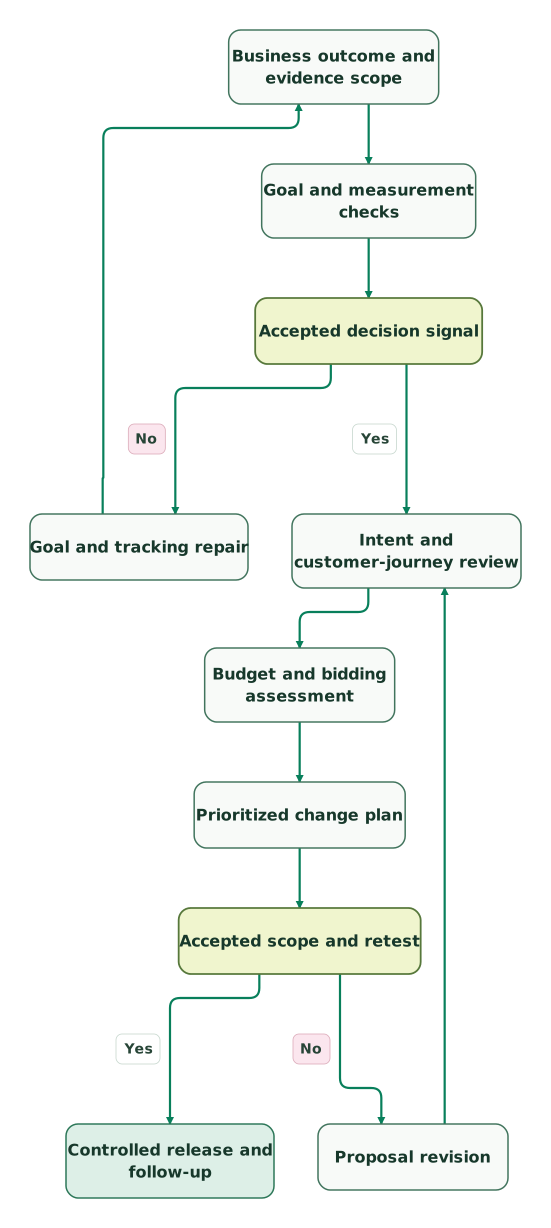
Read diagram as text
- Business outcome and evidence scope to Goal and measurement checks.
- Goal and measurement checks to Accepted decision signal.
- Accepted decision signal to Goal and tracking repair: No.
- Goal and tracking repair to Business outcome and evidence scope.
- Accepted decision signal to Intent and customer-journey review: Yes.
- Intent and customer-journey review to Budget and bidding assessment.
- Budget and bidding assessment to Prioritized change plan.
- Prioritized change plan to Accepted scope and retest.
- Accepted scope and retest to Proposal revision: No.
- Proposal revision to Intent and customer-journey review.
- Accepted scope and retest to Controlled release and follow-up: Yes
A measurement repair returns to the business outcome because changing the trigger or goal may change what the account optimizes. A proposal revision repeats the downstream assessment so that a new exclusion, landing-page plan or budget assumption is considered in context.
Write the proposed change as a before-and-after behavior, not merely a setting name. For a form repair, that might be: an invalid submission currently fires the lead action; after the change, only an accepted submission should do so. Include the failure case, the success case and the evidence required to accept the repair.
Keep the change record with its rollback method and review date. Separate implementation acceptance from later performance evaluation. The former asks whether the change behaves as specified; the latter asks whether it improves the outcome over a suitable period.
Google Ads audit checklist
- Account, dates, currency and campaign scope are recorded.
- Business outcomes match the selected campaign goals.
- Custom goals and secondary-action exceptions are inspected.
- Success, failure, replay and distinct-order cases are documented.
- Values, currencies and transaction identities match source records.
- Consent and enhanced-conversion routes match the intended design.
- Search-term coverage limits and exclusion scope are explicit.
- Locations and other targeting settings fit the customer journey.
- Ads, landing pages and conversion paths agree.
- Budget recommendations use accepted, sufficiently mature evidence.
- Affected-spend totals exclude overlap and avoid savings claims.
- Each accepted finding has an owner, retest and review date.
Keep reading
Browse all Tracking & Attribution guides
 Tracking & Attribution
Google Ads conversion diagnostics: "setup is incomplete" and "needs attention" explained
Diagnose incomplete setup, inactive tags and enhanced-conversion alerts. Verify campaign goals, event delivery, offline uploads and the 2026 API changes.
Jafrin Akter AloLast updated 15 min read
 Tracking & Attribution
Why Google Ads and GA4 conversions do not match, and how to reconcile them
Google Ads and GA4 count conversions on different dates, models and rules. Align them step by step, check third-party estimates and report one number.
Jafrin Akter AloLast updated 14 min read
 Tracking & Attribution
HubSpot Google Ads Integration: 7 Checks for Missing Leads and Conversions
Fix HubSpot Google Ads integration problems across account access, tracking templates, native lead forms, lifecycle events, conversion values and campaign goals.
Jafrin Akter AloLast updated 12 min read
Analytics & tracking
See the implementation scope, deliverables and acceptance checks.
Questions people ask
Should a Google Ads audit start with negative keywords?
Usually it should start with business goals and measurement. Negative keywords are useful, but their priority depends on the quality of the outcome data and the relevance of the queries. Confirm what the account is optimizing for, then review exclusions alongside landing-page alignment, campaign scope and the maturity of the observed results.
Can a secondary conversion action still affect bidding?
Yes, a secondary action can be used for bidding when it belongs to a custom goal selected for the campaign. The label alone therefore does not settle the audit question. Inspect campaign goal selection and custom-goal contents together, and document the intended role of each action before recommending a change.
Does the search terms report contain every search that triggered an ad?
No, some low-activity terms are omitted for privacy reasons. The visible report remains useful for intent review, but its rows should not be described as the full query universe. Use available aggregated insights where relevant and state the coverage limit when estimating the scale of a query-related finding.
Is spend on a campaign with broken tracking automatically wasted spend?
No, broken tracking makes the decision signal unreliable, but it does not prove that every click lacked business value. Report the associated spend as affected exposure and investigate actual customer outcomes separately. Avoid presenting that exposure as recoverable savings or claiming that a measurement repair will produce an equivalent cash return.
Should all audit recommendations be applied in one release?
No, sequence changes according to their dependencies and acceptance criteria. Repairing a conversion definition may need to precede a bidding decision, while an unrelated landing-page error can have its own release. Keep the before-and-after evidence, rollback method and review date so the team can distinguish implementation correctness from later performance effects.
Sources

Written by
Jafrin Akter AloData Engineer and Co-founder at Martechdevs and Growth and Analytics Partners
Jafrin writes practical guides to marketing technology, customer data, analytics and AI workflows. Martechdevs is a Growth and Analytics Partners company.