
Attio CRM Review: Data Models, Team Access and Daily Operations
Attio is a strong CRM candidate when your team needs a deliberate relationship model and will maintain the rules behind it. This Attio review focuses on the work that determines fit: records, process-specific lists, communication sharing, automation and reliable reporting. Choose it after those boundaries pass a realistic evaluation, particularly if private customer records are a requirement.
On this page
Attio CRM evaluation
The useful verdict depends on the customer model and access boundaries the team needs.
| Evaluation area | Attio strength | Important boundary | Acceptance evidence |
|---|---|---|---|
| Customer model | Objects, relationships, attributes and process lists | Custom objects require a qualifying paid plan | Distinct entities have distinct records |
| Everyday work | Email and calendar context around records | Sharing settings need deliberate configuration | Another teammate can continue the correct conversation |
| Collaboration | List and dashboard access controls | A private list does not hide underlying records | Restricted-user checks match the requirement |
| Automation | Workflows and AI-assisted actions | Shared workspace credits need operating controls | Correct result, owner and usage for each route |
| Cost | Free entry and workspace-plus-user subscriptions | Required objects and governance can change the plan | Complete qualified subscription and renewal budget |
Sources: Attio data model, sharing and permissions, credit management and pricing.
Attio's flexibility is valuable when the business can describe its relationships clearly. It creates more design responsibility when the team expects the CRM to decide what a customer, opportunity or renewal means. The product evaluation should therefore include the person who will maintain the model, not only the people who will use its views.
At Martechdevs, CRM and lifecycle implementation connects those design decisions with actual customer work. We define the records, ownership and acceptance cases before expanding automation. The CRM examples guide is a useful starting point for describing the process without committing to a vendor.
The Attio data model
Attio separates four useful ideas. An object describes a type of entity; a record is one instance; an attribute stores a value; and a list runs a particular process over records. A relationship attribute connects records. These distinctions are documented in Attio's model guide.
Use an attribute for a current value such as the commercial owner. Use a view when the team needs a filtered presentation of the same records. Use a list when a process needs its own status, timing or other data. Create a separate object when the thing being tracked has its own identity, relationships or reporting requirements.
The difference matters when a company has several contracts. One company-level Renewal date cannot describe two agreements with different dates, amounts and owners. Replacing the date every time a new contract arrives loses information. An object model should preserve the agreements separately and connect them to the company.
Attio requires Pro, Enterprise or Ultra for custom objects and custom relationships, with administrators creating custom objects. Custom-model prerequisites. Treat that as a qualification step before presenting a lower-priced plan as sufficient for the proposed design.
The simplest acceptable model is usually easier to maintain. A separate object for every department's view can create unnecessary synchronization and duplicate definitions. Start with the entity and its lifecycle, then decide which teams need different views or process lists around it.
A reproducible relationship example
Consider a hypothetical company with three contacts and two annual contracts. The amounts below are illustrative business data, not Attio prices.
| Company | Contract | Annual value, USD | Renewal month |
|---|---|---|---|
| Cedar Studio | Support agreement | $6,000 | March |
| Cedar Studio | Analytics agreement | $4,000 | September |
The correct annual contracted value is $10,000. If an export or downstream report joins each contract to all three contacts, it produces six rows and a naive sum of $30,000. The company did not buy three copies of each contract; the report multiplied the commercial records through a relationship.
This example is a reporting design check, not a claim that Attio automatically creates that incorrect total. Ask the evaluation team to identify the entity being counted, the relationship used and the intended total. The same issue can occur in a spreadsheet or another CRM if the reporting grain is left undefined.
Keep contact roles separate from contract value. A billing contact, sponsor and technical contact can all be important without each owning a copy of the agreement amount. The CRM property ownership guide helps document which record and system may update each commercial value.
An acceptable pilot should show two contracts, three people, one company and a $10,000 annual total for the stated scope. Then change the owner of one agreement. Only the appropriate ownership and related work should change; the historical amount and other agreement should remain understandable.
Lists, record visibility and private work
Attio's permissions deserve a direct evaluation before the team imports sensitive relationship data. Its sharing reference distinguishes visibility controls for lists, dashboards and emails from the underlying records. Restricting a list does not make its company or person record private to that list's members.
The object-access guide likewise separates viewing from editing. Read-only access is an action boundary, not proof that the record is hidden. If the requirement is that one team must not discover another team's customer records, test that exact requirement before accepting the design.
Create an ordinary member for the evaluation. Give that member access to the intended process list, then inspect the related all-records pages, notes, linked records and search results. Do not use an administrator account as the only evidence because the administrator's visibility is expected to be broader.
There is a useful difference between a team that needs separate working queues and a team that needs strict record confidentiality. The first may be served by list controls. The second may require a different workspace design or a different product. A visual separation between lists is not enough to decide which requirement has been met.
Email and calendar context
Attio can build context from connected email and calendar activity, but sharing is a configuration decision. The email-sharing guide describes metadata, subject and fuller sharing options according to the plan. Check what teammates can see before connecting a mailbox containing internal and customer correspondence.
Use two controlled conversations in the pilot: one that should be shared with the team and one that should remain restricted. Inspect the result as the sender and as the ordinary member. A successful mailbox connection proves that authentication worked; it does not prove that every conversation has the intended visibility.
Also check which person or company receives the context. Shared mailboxes, consultants working for several businesses and contacts with more than one address can expose ambiguous associations. Record the matching rule rather than relying on a familiar display name to identify the customer.
The daily workflow should remain straightforward after those controls are configured. A salesperson should find the current relationship, understand the recent interaction and record the next commitment. If the operator needs several manual searches to assemble that picture, include the extra work in the evaluation rather than treating automatic capture as the completed outcome.
Automation and AI consumption
Attio's credit model separates personal Ask Attio credits from a shared workspace pool. Ask Attio uses personal credits first and can then consume workspace credits, subject to administrator controls. The credit-management guide states that no workspace limit is set for Ask Attio by default.
That creates an operational question: how much shared capacity should remain available for the workflows the business depends on? Configure a sensible boundary, monitor actual consumption and name the person who responds when usage changes. Buying a larger package is not the only possible response to an unexpectedly expensive route.
For a lead-assignment workflow, test an eligible record, an excluded record, a missing owner and a repeated trigger. The acceptance result should include the correct owner and task, without a second unwanted action after a retry. These are evaluation cases to implement, not claims that every workflow has identical default behavior.
The current credit reference charges workflow blocks on the executed path and excludes the failed block and later blocks after a failure. Workflow consumption. Inspect the run details for both a successful path and a failed path, then compare the result with the business outcome and expected usage.
For AI-assisted updates, define the accepted fields and review boundary. A suggested next action can be useful while a proposed company merge or commercial-stage change needs stronger evidence. The value comes from the maintained process around the action, not from the presence of an AI button.
Subscription scope and an eight-user example
Attio's current paid pricing combines a workspace amount with additional users. The following US prices are USD monthly equivalents on annual billing. Taxes, additional credits and other paid options are excluded.
| Plan | Published basis | Eight-user calculation | Annual subscription, USD |
|---|---|---|---|
| Plus | $40/workspace, one user included; $35/additional user | ($40 + 7 × $35) × 12 | $3,420 |
| Pro | $100/workspace, one user included; $79/additional user | ($100 + 7 × $79) × 12 | $7,836 |
| Pro with Governance add-on | Pro plus $30/user/month annually | ($653 + 8 × $30) × 12 | $10,716 |
Source: Attio plans and Governance add-on. Eight users are a hypothetical requirement. Plus allows up to ten users, but custom-object or advanced-control needs can still make Pro the qualified option. The cheaper row is relevant only if it supports the required model and access controls.
Free permits up to three users, 50,000 records and three objects. It is useful for learning the working model, but a free workspace is not evidence that a custom-object production design fits without a paid subscription. The Attio pricing guide covers the wider billing model; this review uses cost to test product fit rather than repeating every allowance.
The startup program advertises 80% off annual Pro and credits in the first year and 30% in the second for approved eligible workspaces of up to ten seats. Eligibility includes venture backing or a participating partner affiliation, recent signup and incorporation less than five years ago. Confirm the approved scope and normal renewal amount before using the concession in a hiring or runway decision.
Use the software pricing tool to preserve the chosen plan, seat count and additions. Keep migration and operating effort outside the licence line so that a discount does not hide the work needed to maintain the CRM.
Import quality and ongoing administration
Attio's CSV troubleshooting guide distinguishes duplicate records from duplicate list entries. A unique attribute helps the import find an existing record. A repeated entry in a process list is a different problem and can sometimes represent legitimate repeated work.
Choose matching keys before the first import. A company name is not a reliable substitute for a stable identifier or an appropriately mapped unique domain. A person appearing under two names may still be the same record, while two people with the same name may be different people.
- Define the entities and relationships required by the pilot.
- Create only the attributes and lists needed for those tasks.
- Prepare a small import with unique matching attributes and known exceptions.
- Compare created records, updated records and list entries separately.
- Validate communication sharing and ordinary-member access.
- Run the intended workflow, including an exclusion and a failed route.
- Reconcile the business report and repeat affected checks after repairs.
Maintain the model after launch. A new field needs an owner, meaning and permitted update source. A new list needs a purpose and a retirement decision when the process ends. Without those habits, flexible software can accumulate several conflicting versions of the same customer process.
Product fit and alternatives
Attio fits a team that can explain its entities, accepts the documented visibility model and has someone responsible for ongoing configuration. It is a weaker fit when the buying requirement assumes private underlying records, or when nobody will maintain the distinctions among objects, lists and reports.
An ordinary deal-and-activity sales process may need less modeling. Attio vs Pipedrive examines that choice. A team centered on Google Workspace correspondence can also review Copper CRM vs Pipedrive. Those comparisons are useful after the requirements are clear, rather than as substitutes for defining them.
Evaluation and repair workflow
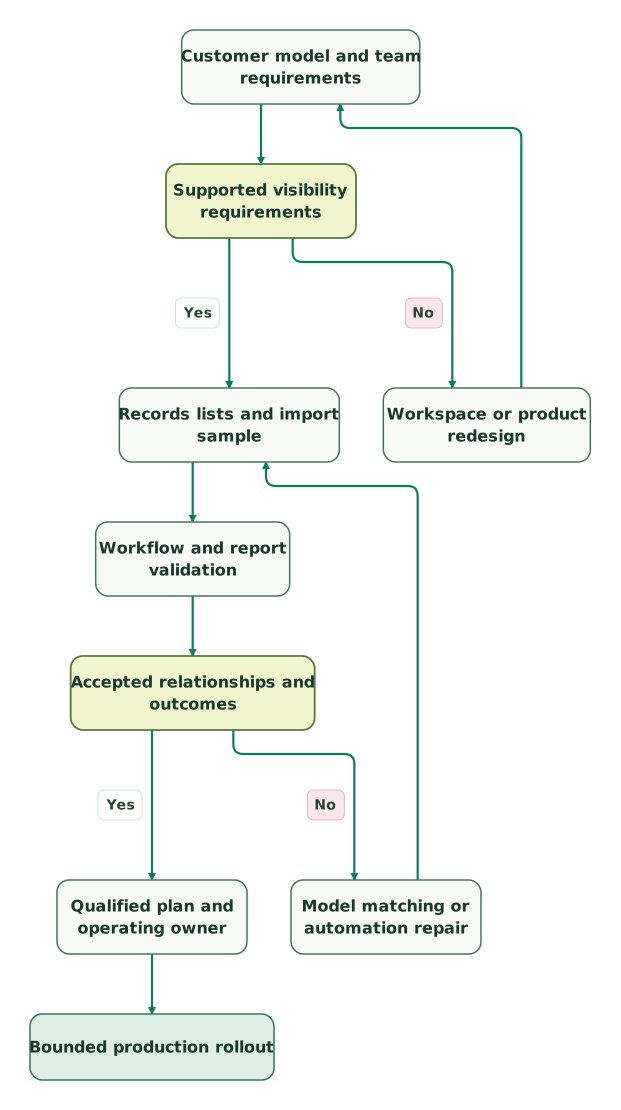
Read diagram as text
- Customer model and team requirements to Supported visibility requirements.
- Supported visibility requirements to Workspace or product redesign: No.
- Workspace or product redesign to Customer model and team requirements.
- Supported visibility requirements to Records lists and import sample: Yes.
- Records lists and import sample to Workflow and report validation.
- Workflow and report validation to Accepted relationships and outcomes.
- Accepted relationships and outcomes to Model matching or automation repair: No.
- Model matching or automation repair to Records lists and import sample.
- Accepted relationships and outcomes to Qualified plan and operating owner: Yes.
- Qualified plan and operating owner to Bounded production rollout
The two repair paths solve different problems. A visibility failure can require a different design before data enters the workspace. A matching or reporting failure requires another pass through the sample records. Neither should be accepted simply because the main dashboard looks plausible.
Attio review checklist
- Define the entity represented by every object and report row.
- Separate current attributes from process-specific list data.
- Qualify the plan required for custom objects and relationships.
- Test underlying record visibility with an ordinary member.
- Inspect shared and restricted correspondence separately.
- Map a unique identifier before the first CSV import.
- Reconcile records, list entries and commercial totals independently.
- Set and monitor the shared-credit boundary for Ask Attio.
- Test exclusions, failures and repeated automation triggers.
- Name the model owner and approve the normal renewal budget.
The CRM data hygiene audit skill can prepare the sample and the field-ownership review. Keep those artifacts with the configuration so a later administrator can repeat the checks.
Keep reading
Browse all CRM & Lifecycle guides
 CRM & Lifecycle
Attio pricing in 2026: seats, AI credits and the startup discount
Calculate Attio costs across paid seats and shared AI credits. Compare Plus and Pro, model startup discounts and control workflow consumption.
Jafrin Akter AloLast updated 10 min read
 CRM & Lifecycle
Attio vs Pipedrive for sales teams and relationship models
Pick Attio for custom relationships or Pipedrive for a deal-driven sales routine. Compare current billing, ten-user budgets, credits and migration checks.
Jafrin Akter AloLast updated 11 min read
 CRM & Lifecycle
Best CRM for startups: seven options ranked on price, integrations, reporting and fit
Compare HubSpot, Attio, Pipedrive, Zoho, monday CRM, Freshsales and Close for startups, ranked on price at 5, 10 and 20 seats, integrations and reporting.
Jafrin Akter AloLast updated 30 min read
CRM & marketing automation
See the implementation scope, deliverables and acceptance checks.
Questions people ask
Does a private Attio list make its customer records invisible to other members?
A private Attio list does not make its underlying customer records invisible to other workspace members. Attio distinguishes list access from record visibility, so an evaluation must test both. If confidentiality requires separating the customer records themselves, resolve the workspace or product design before importing the data rather than relying on a restricted process list.
Is every process in Attio better represented by a custom object?
Every process does not need a custom object in Attio. A current value may belong in an attribute, a filtered presentation in a view and process-specific information in a list. Use a custom object when the entity needs its own identity, relationships or reporting. This keeps the model understandable and avoids unnecessary configuration and plan requirements.
Can Attio import counts differ from the number of rows in the original file?
Attio import counts can differ from the original file's row count because matching unique attributes may identify the same record more than once. Record creation, record updates and list entries are different outcomes. Reconcile each separately and inspect the expected matches, rather than treating a lower created-record count as automatic evidence of missing data.
Can Ask Attio use credits intended for workflow automation?
Ask Attio can use shared workspace credits after a member's personal credits are exhausted, subject to administrator controls. That shared pool also supports workflows and other AI features. Set an appropriate usage boundary and monitor consumption against the operational work the team needs, instead of assuming personal allowances always isolate conversational usage from automation capacity.
Does a successful Attio demo establish that a multi-contract report is correct?
A successful demonstration does not establish that a multi-contract report is correct. Validate the entities and relationships against a small set with known totals, including a company with several contacts and agreements. The report should count each commercial record at the intended grain. Repeat that reconciliation after changing matching rules, relationships or the report definition.
Sources

Written by
Jafrin Akter AloData Engineer and Co-founder at Martechdevs and Growth and Analytics Partners
Jafrin writes practical guides to marketing technology, customer data, analytics and AI workflows. Martechdevs is a Growth and Analytics Partners company.