
Attio pricing in 2026: seats, AI credits and the startup discount
Data Engineer and Co-founder, martechdevs
Last updated 10 min read
Attio's current annual prices are $35 per user per month for Plus and $79 for Pro; monthly payment is $44 and $99 respectively. Free supports up to three seats, while Plus stops at ten. The full budget also depends on workspace credits for automation and AI. Count actual CRM users, select the required features and estimate credit consumption before choosing a plan.
Last updated: 6 October 2026. Public USD prices before taxes; annual figures are monthly equivalents.
The seat price is easy to calculate. The less visible question is whether a busy AI user and an automated enrichment workflow are drawing from the same shared allowance. In Attio, they can be.
What do Free, Plus and Pro cost?
Attio's current pricing lists Free at $0, Plus at $44 monthly or $35 on annual billing, and Pro at $99 monthly or $79 annually. Enterprise is quoted. The published seat limits are three for Free, ten for Plus and no fixed seat limit for Pro.
Use the current selected billing period when comparing with older articles or an existing subscription. Your own billing page and agreement determine the terms of a legacy account; current new-customer prices do not prove an existing workspace has already changed.
Martechdevs' CRM and lifecycle service connects the CRM to product, billing and customer workflows. The wider stack examples show where a focused CRM fits without requiring every employee to become a daily CRM operator.
When should you move from Free to Plus or Pro?
Choose the lowest plan that supports the real working process. Attio's plan documentation describes the differences in permissions, reports, objects, email and automation. Every member of a workspace uses the same plan, and separate workspaces have separate subscriptions.
Free can support a very small team validating its process. Plus is worth evaluating when a team within the ten-seat limit needs its additional collaboration and email capabilities. Pro becomes relevant when you need more seats or the higher tier's features, rather than simply because the company has hired more people.
The current report allowances are three on Free, fifteen on Plus and one hundred on Pro. Check whether you need more distinct reports, a feature within a report or a shared cross-system model. Those are different problems and may have different solutions.
For sequences, advanced access rules and the object model you intend to build, verify the exact plan entitlement. A successful trial of Pro can make a lower plan feel unexpectedly constrained if nobody records which trial features the team adopted.
How do seat credits and workspace credits differ?
Seat credits are personal monthly allowances for Ask Attio. Workspace credits are shared and can cover workflows, AI attributes and Ask Attio after personal credits run out, unless an administrator restricts that use. Personal seat credits cannot be pooled between users. Attio's credit-management guide.
The pricing comparison currently lists these included amounts:
- Free: 100 seat credits per user and 250 workspace credits monthly.
- Plus: 500 seat credits per user and 1,500 workspace credits monthly.
- Pro: 1,000 seat credits per user and 10,000 workspace credits monthly.
The shared pool is per workspace. Ten Pro seats do not turn the 10,000 workspace allowance into 100,000 workflow credits. They provide ten separate personal Ask Attio allowances in addition to the shared pool.
Credits renew monthly on the billing-date schedule, including within an annual subscription. Keep the reset date visible in the operating record so calendar-month reports are not mistaken for the exact subscription period.
Why can Ask Attio affect an automated workflow's capacity?
Ask Attio consumes personal credits first and can continue using the shared pool. Attio documents that workspace use is unrestricted by default unless an administrator sets a limit. A team should therefore decide how much shared capacity is available for ad hoc AI work.
Reserve sufficient capacity for necessary workflows and monitor actual usage. A meeting-preparation prompt and a batch of AI attributes can vary in cost depending on model, context and web research. Avoid assigning a universal “one prompt equals one credit” assumption.
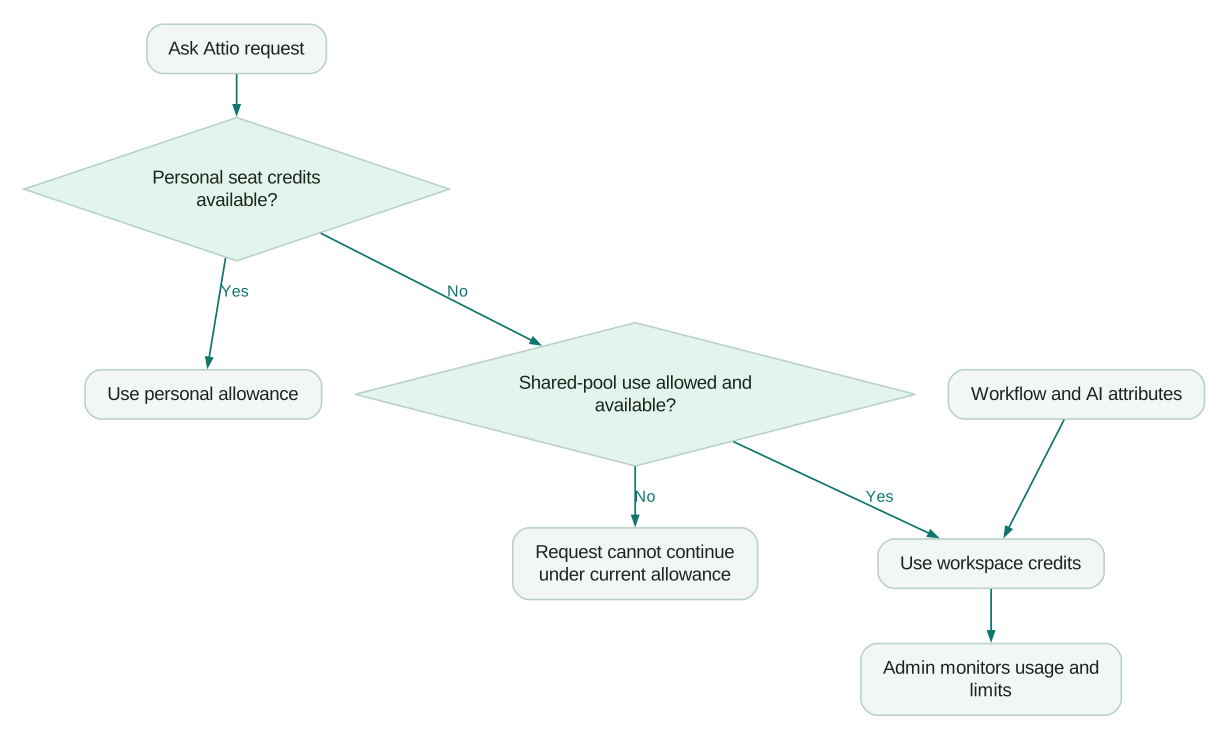
A useful policy identifies the workflows that must remain available, their normal consumption and the person responsible for a capacity alert. Buying more credits without finding the largest consumer can leave an accidental loop running indefinitely.
What would 10-, 25- and 50-person companies pay?
These examples use illustrative CRM seat requirements and the current annual list prices. They are not benchmarks, and they exclude extra credits, implementation, integrations and taxes.
Ten employees, three CRM users
If three users and the Free capabilities are sufficient, the seat subscription can be $0. If those same users need Plus, the annual equivalent is 3 × $35, or $105 a month and $1,260 a year. Pro would be $237 a month equivalent and $2,844 a year.
Count the actual users and required capabilities. The company's other seven employees do not create a licence cost merely because they exist, but people who need direct workspace access must be licensed appropriately.
Twenty-five employees, eight CRM users
Eight Plus seats cost $280 a month equivalent, or $3,360 annually. Eight Pro seats cost $632 a month equivalent, or $7,584 annually. The annual difference is $4,224 before credits and other costs.
Evaluate what that difference buys for the eight users: required permissions, sequences, reporting or other features. Do not upgrade every user just to solve a workflow-volume problem without comparing the available credit package and feature requirements.
Fifty employees, fifteen CRM users
Fifteen seats exceed Plus's ten-seat limit, so Pro is the relevant self-serve reference. At $79, the monthly equivalent is $1,185 and the annual seat total is $14,220. Monthly payment at $99 would be $1,485, or $17,820 over twelve unchanged months.
That produces a $3,600 annual arithmetic difference between the payment options. Confirm the final billing total and subscription terms. Annual commitment is a choice about expected use and flexibility as well as the displayed discount.
How should you estimate workflow credits?
Model the paths records actually take. Count eligible records, execution frequency and the charged steps on each path, then add variable AI consumption observed in a sample.
Attio's current credit guide lists many record, task, sequence-enrolment and HTTP-request workflow blocks at one credit per execution, while AI and some other blocks are variable. Direct integration use and sequence sending have different rules from executing those actions inside a workflow. Check the specific block rather than applying one rate to an entire record.
For an original example, assume a Plus workspace processes 400 eligible records a month. Each executes three one-credit blocks, giving 1,200 workspace credits before AI or other work. The 1,500 included allowance leaves 300 under those assumptions.
If the same workflow accidentally runs five times per record, consumption becomes 6,000 credits. Fixing the trigger or re-entry rule can be more useful than buying capacity for the repeated work. Verify whether repeat execution is intentional before changing it.
Measure a small representative batch, including records that take different branches. Check both successful results and unsuccessful paths in the usage view. A clean test using only perfect records can underestimate production consumption and maintenance.
When should you buy credits instead of upgrading the plan?
Compare the additional credit package with the total seat-price increase, provided the lower plan includes all required features. Attio's pricing page lists separate workspace-credit packages; their price depends on the billing selection.
An eight-user move from Plus to Pro raises the annual seat equivalent by $352 a month. It also changes included shared capacity and features. If capacity is the only constraint, compare the available credit package with that $352 difference. If a Pro feature is required, extra Plus credits cannot supply it.
Keep the comparison specific to the workload. A one-off migration and a continuing daily workflow need different purchasing decisions. Confirm whether a package changes the recurring subscription and how removal takes effect before adding it.
Is Attio free or discounted for startups?
Attio's current startup programme advertises 80% off the annual Pro plan and credits in the first year, then 30% off in the second. Eligibility requires a venture-backed company incorporated less than ten years ago and a workspace created within the last ninety days. The published offer is limited to workspaces of up to ten seats.
Apply early and wait for confirmed eligibility before treating the discount as part of a committed budget. The ten-seat condition matters: a fifty-person company with fifteen CRM users should not assume the public startup offer covers its configuration.
Using the current $79 annual-equivalent Pro seat price as an illustrative base, eight seats have a $7,584 annual list total. An 80% discount would reduce that seat component to $1,516.80 in year one. A 30% discount would make year two $5,308.80 if the base price and terms were unchanged.
Those calculations exclude credits and assume the stated discount applies to that configuration. Confirm the actual offer, renewal basis and purchased extras. The rise from the first year to the second should be in the budget before the team builds its process around Pro.
How can you control AI costs without making the CRM less useful?
Run AI enrichment when the output changes a decision. A field that nobody uses for qualification, routing or preparation does not need to refresh on every record update.
Attio's AI-attribute documentation explains how those attributes are configured and run. Set eligibility around missing or stale information, then inspect quality on a sample. A completed AI field can still contain a weak inference that a seller must correct.
Store the source and refresh context where the workflow supports it. Define when a human should review uncertain information before an outbound message or record change. The cost of an incorrect action can outweigh the credits saved by skipping a quality check.
Use existing verified data before researching it again. For product and billing facts, a dependable integration may be preferable to an AI inference. The context-engineering guide explains how to give an assistant those facts and definitions.
Should reporting move to a warehouse to avoid an upgrade?
Only if the full operating cost and analytical need justify it. A warehouse can combine CRM, product and billing history, but it needs extraction, modelling, permissions and maintenance. Building that solely to avoid a few native reports can cost more than the upgrade.
For an illustrative comparison, a $200 monthly integration plus four hours of maintenance at $80 costs $520 a month. That exceeds the $352 monthly seat difference in the eight-user example. The warehouse may still be worthwhile for cross-system questions, but the business case should describe those benefits honestly.
Use the stack audit process to compare tool cost with the work it replaces and the responsibilities it adds.
A checklist before choosing an Attio plan
- Count people who need direct workspace access.
- List required objects, reports, permissions and sequence features.
- Check the selected monthly or annual price.
- Separate personal seat credits from the workspace pool.
- Measure workflow consumption on representative records.
- Set a policy for Ask Attio use of shared capacity.
- Compare credit packages with the full seat-upgrade cost.
- Apply for startup benefits within the eligibility window.
- Forecast year two and the undiscounted renewal case.
- Include integrations, data quality and maintenance in the budget.
At Martechdevs, we connect CRM, product and billing data to the customer workflows your team needs to run. Start with the free martech AI audit, or explore an AI assistant built around your approved workflows.
Questions people ask
Can a twenty-five-person company use Attio Plus?
The relevant limit is workspace seats, not total employees. A company with eight appropriate CRM users can evaluate Plus if its features meet the need. A workspace requiring more than ten seats needs a different plan.
Can unused seat credits help another user or a workflow?
Seat credits are personal and cannot be transferred between members. Workflows use the shared workspace allowance under the documented rules. Budget the two pools separately.
Does paying annually provide a year's credits at once?
Attio documents monthly credit renewal on the billing-date schedule even for annual subscriptions. Do not assume the annual payment creates one freely spendable annual pool. Check the workspace's current billing details for the exact reset date.
Is the startup discount available to every new business?
The published programme has venture-backing, company-age, workspace-age and seat conditions. Apply and obtain confirmation rather than assuming that a new account qualifies. Model the later years before making a longer-term commitment.
What is the cheapest useful Attio setup?
It is the lowest plan that supports the actual users, data model and workflows at a manageable operating cost. Start with limited automation, measure credits and expand the parts that save work or improve customer decisions. Avoid designing the process around features that were only available during a trial.
Sources
- Attio, Pricing, checked October 2026.
- Attio, Plans and features, checked October 2026.
- Attio, Manage workspace and seat credits, checked October 2026.
- Attio, Startup programme, checked October 2026.
- Attio, AI attributes, checked October 2026.
Written by
Jafrin Akter AloData Engineer and Co-founder, martechdevs
Jafrin Akter Alo is a data engineer and co-founder of martechdevs, where the team has delivered 74+ martech, data and growth stack implementations.