
CRM Examples for Sales, Customer Service and Renewals
Useful CRM examples show how a customer record leads to a clear next action, not just which software a company buys. A sales pipeline, service queue, project handoff and renewal process need different records and ownership rules. Start with the work your team must complete, then choose the CRM structure and product that preserve those relationships.
On this page
CRM examples by business process
These examples describe operating patterns; the named products illustrate documented capabilities rather than a price ranking.
| CRM example | Main records | Next action | Illustrative product capability |
|---|---|---|---|
| Sales opportunity management | Company, contact, deal and activity | Assigned seller completes a dated follow-up | Pipedrive links deals and activities |
| Client delivery handoff | Customer, won deal and project | Delivery owner accepts the scope | Copper connects sales and projects |
| Customer support | Contact, company and ticket | Service owner resolves the request | HubSpot associates tickets with customer records |
| Contract renewal | Customer, agreement and renewal work | Account owner reviews the specific agreement | Attio models entities and relationships |
| Partner relationship management | Partner, contacts and opportunities | Partner owner follows the relevant introduction | CRM relationships preserve distinct roles |
Sources: Pipedrive's record model, Copper projects, HubSpot associations and Attio's data model.
A CRM, or customer relationship management system, coordinates information about customers and the work around those relationships. A contact list is part of that system, but an operational example also needs ownership, status, timing and a result that someone can verify.
At Martechdevs, CRM and lifecycle implementation starts with a specific customer path. We define which record represents each part of the work and what another person needs to continue it. This prevents a software selection from becoming a collection of disconnected fields and automated notifications.
Sales pipeline example
Imagine a hypothetical business selling implementation projects. One company has two potential purchases: a reporting project and a separate CRM cleanup. The same contact may discuss both, but each purchase has its own scope, amount, expected close date and decision process.
Create one company record, the appropriate contact records and two opportunities. Keep the next activity attached to the relevant opportunity. A call about the reporting proposal should not silently advance the CRM cleanup opportunity simply because both involve the same person.
Pipedrive's record model distinguishes people, organizations, deals and activities. Its activity reference describes actions such as calls, meetings and tasks that can be linked to those records. These are useful building blocks for the example, although the final process still needs configuration.
Define a stage from evidence. Proposal sent might require a dated proposal and a known recipient. Commercial review might require the buyer to have accepted the scope for discussion. A generic status such as Hot is harder for another seller to interpret and can produce inconsistent reports.
The acceptance case is simple: another seller opens the opportunity and identifies the buyer, current evidence, amount, next commitment and owner. If that seller must read a long note to discover that the proposal was withdrawn, the structured record has not kept up with the conversation.
A small pipeline calculation
Use the following hypothetical snapshot to verify a pipeline report. All amounts are USD; the percentages are planning assumptions, not measured win rates or a revenue forecast.
| Opportunity | Status | Amount, USD | Assumed probability | Weighted amount, USD |
|---|---|---|---|---|
| Reporting project | Open | $12,000 | 20% | $2,400 |
| CRM cleanup | Open | $8,000 | 50% | $4,000 |
| Support renewal | Open | $5,000 | 80% | $4,000 |
| Completed workshop | Won | $4,000 | 100% | Outside open pipeline |
The open pipeline is $12,000 + $8,000 + $5,000 = $25,000. The illustrative weighted open amount is $10,400. Including the won workshop in an open-pipeline chart would produce $29,000 and answer a different question. A label such as Total value is insufficient without the status and period definition.
Adding two follow-up activities to the reporting project should not double its amount. The opportunity is the unit of commercial value; activities describe work around it. If an export repeats the opportunity once per activity, sum at the intended opportunity level before presenting the result.
Keep the same small snapshot available for future report changes. It catches a wrong status filter, an unintended relationship multiplier and a misplaced probability rule more clearly than comparing two large dashboards whose underlying populations are unknown.
Client delivery example
A hypothetical consultancy has accepted a proposal and now needs to deliver the work. The sales opportunity records what was sold. The delivery project records the agreed work, responsible team, start date, dependencies and completion criteria. Both relate to the same customer.
Copper's project workflow includes project pipelines, tasks and a transition from closed deals into delivery work. This illustrates a CRM with project coordination in the same environment. It does not mean every project-management feature or automation belongs in every subscription, so confirm the edition behind the intended design.
The handoff should carry enough information to act: scope reference, customer contact, delivery owner, promised date and unresolved dependency. Sending an internal notification without those details simply moves the need for investigation from one team to another.
Give the receiving owner an explicit acceptance step. If a customer has not supplied access or approved the final scope, record that dependency rather than marking delivery as started. The sales result can remain won while the delivery project correctly remains waiting for prerequisites.
For teams choosing between a Google Workspace routine and a deal-centered routine, Copper CRM vs Pipedrive examines the product decision. Keep the process example separate from that buying choice: the necessary handoff exists regardless of the chosen CRM.
Customer service example
A customer reports an issue while an expansion opportunity is still open. The support request needs its own owner, severity, status and resolution. The sales opportunity still needs its commercial owner and next action. Combining both into one stage field makes one process overwrite the other.
HubSpot's association guide documents relationships among contacts, companies, deals and tickets. A ticket can therefore be connected to the relevant customer context without being treated as another sale. Subscription and permission requirements still apply to particular association features.
The practical acceptance case starts with a known customer and an existing opportunity. Create a controlled support request and verify the ticket links to the correct records. The sales owner should understand that an unresolved issue exists, while the service owner should retain responsibility for the resolution.
Avoid translating an association into an automatic business decision. A ticket connected to a deal does not necessarily mean the deal should pause or the account should be marked at risk. Define the conditions and responsible reviewer for that decision, especially when a minor question and a serious service failure share the same ticket system.
Completion should include a resolution and a next step where needed. Closing the ticket does not automatically establish customer satisfaction or renewal readiness. Record the outcome appropriate to the service process and let the account owner interpret it alongside the broader relationship.
Renewal and account-management example
A hypothetical software customer has two agreements with different renewal dates. One supports the core product; the other covers a separate service. The account record provides shared context, while each agreement needs its own commercial terms and renewal work.
Attio's data-model guide explains the distinction between an entity, an attribute, a view and a process list. A recurring agreement with its own relationships and reporting can justify a distinct entity. A filtered list of customers due for review is a different requirement.
Do not store every renewal in one company-level date that changes whenever an agreement is added. Preserve the individual agreement and connect the upcoming review to it. Otherwise, a report can appear complete while showing only the most recently edited date.
Define the action before choosing the reminder schedule. A renewal task might require the account owner to review product adoption, current service issues and the commercial contact. A notification that says Renewal soon without those prerequisites does little to improve the decision.
The Attio review examines model and access boundaries for that product. Whatever system is selected, test a customer with more than one agreement and verify that completing one renewal does not erase the next action for the other.
Partner relationship example
A partner can introduce several prospects while also being a customer. The CRM should preserve the role in each relationship instead of assigning one universal label that makes all interactions look the same.
For a hypothetical referral process, connect the partner company, the person making the introduction and the resulting opportunity. Give the opportunity a commercial owner and the partner relationship a continuing owner. Those responsibilities may belong to different people.
HubSpot documents associations between different objects and between records of the same object. Its guide also distinguishes association labels and their subscription requirements. Use the actual relationship capability available in the selected plan rather than assuming a text field creates a reliable link.
The acceptance case is whether the team can explain an introduction without duplicating the prospect or losing the partner's involvement. A report should count the opportunity once while retaining its referral context. If two partners contributed, define the attribution rule rather than allowing duplicate relationship rows to double the opportunity value.
Keep partner-specific information separate from the customer's own commercial status. An active partnership does not imply that every referred prospect is qualified, and a lost referred opportunity does not automatically end the partnership.
The minimum useful customer model
Start with a small set of fields that the process actually uses. A field that nobody owns or acts on is difficult to keep accurate. A missing field that determines routing or reporting can make the whole process unreliable.
| Record or field | Purpose | Authoritative owner | Validation example |
|---|---|---|---|
| Customer identity | Stable reference across systems | Defined customer master | Existing customer recognized on a repeated import |
| Commercial owner | Responsibility for the sale | Sales ownership process | Reassignment changes the next task correctly |
| Opportunity status | Evidence of the current sale | Sales process | Lost opportunity excluded from open pipeline |
| Service status | Progress of the request | Support process | Closed ticket retains the recorded resolution |
| Agreement date | Specific contractual milestone | Commercial agreement process | Two agreements keep separate dates |
The CRM property ownership guide covers update direction and conflicts in more detail. A CRM can be the working screen without being the authoritative source for every field. For example, payment state may originate in billing even when the account team needs to see it beside the customer.
Also distinguish a record association from activity visibility. HubSpot's activity-association guide describes rules for connecting activity history to records. A linked company and deal should not be assumed to display every identical activity automatically in every configuration.
A working CRM example in seven steps
- Select one process with a clear owner and an observable completion condition.
- Describe the customer, commercial and operational entities involved.
- Define the small set of fields that determine the next action and report.
- Create a hypothetical sample with an ordinary case, a duplicate and an exception.
- Perform the intended workflow as the ordinary employee who will use it.
- Reconcile the resulting records, permissions, tasks and totals.
- Repair the failing rule and repeat the same sample before expanding.
Keep the fixture deliberately small. Five well-chosen records can expose a wrong owner mapping more clearly than a large import. Include a customer with two contacts, a repeated event or import, a closed outcome and an item waiting for missing information.
A written acceptance condition turns the example into something another person can reproduce. Instead of Leads work correctly, use Existing customer retained, one new opportunity created, owner assigned and follow-up due on the agreed date. The latter can be checked without relying on the original configurator's interpretation.
CRM software choice and operating cost
Choose software after the process passes a small design review. Pipedrive, Copper, HubSpot and Attio can illustrate different working models, but the presence of a named feature is only the start of the selection. Edition, permissions, integration direction and the administrator's workload still matter.
The CRM selection guide provides a broader software shortlist. Use the software pricing tool for the qualified configuration, including paid users, required additions and retained tools. Do not turn a conceptual example into an assumed free-plan entitlement.
Include the cost of maintaining the process. Someone must review failed updates, approve model changes, resolve duplicates and keep reports aligned with the business definition. Those responsibilities exist whether the system is inexpensive, heavily automated or part of a wider platform.
Example validation and repair workflow
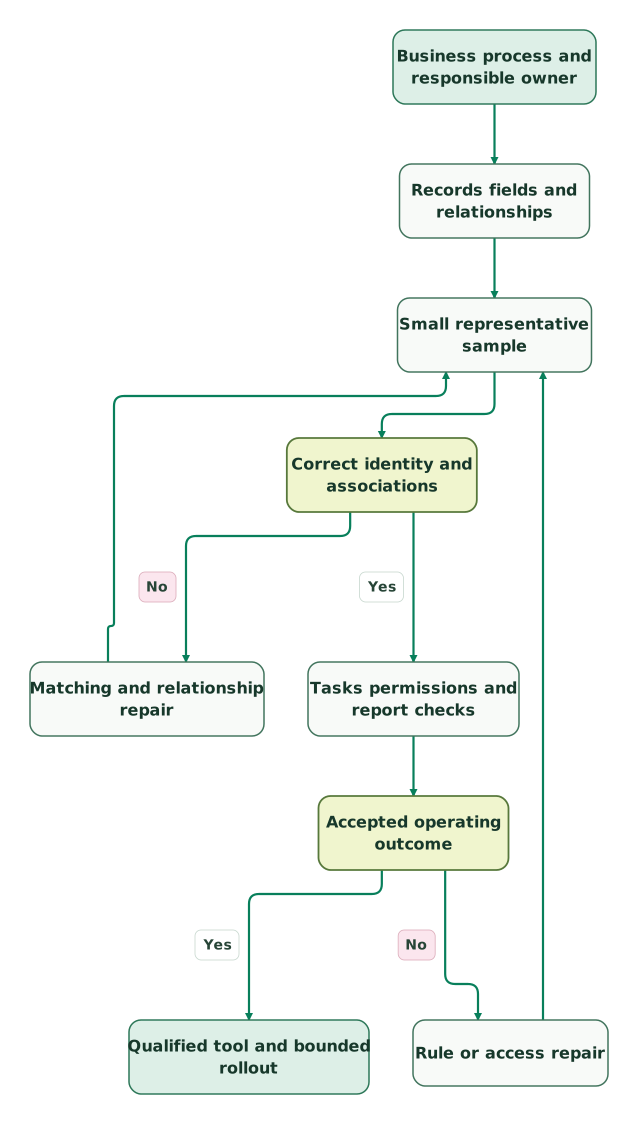
Read diagram as text
- Business process and responsible owner to Records fields and relationships.
- Records fields and relationships to Small representative sample.
- Small representative sample to Correct identity and associations.
- Correct identity and associations to Matching and relationship repair: No.
- Matching and relationship repair to Small representative sample.
- Correct identity and associations to Tasks permissions and report checks: Yes.
- Tasks permissions and report checks to Accepted operating outcome.
- Accepted operating outcome to Rule or access repair: No.
- Rule or access repair to Small representative sample.
- Accepted operating outcome to Qualified tool and bounded rollout: Yes
The repair returns to the representative sample because a field or relationship change can affect both work assignment and reporting. Rechecking only the screen where the error appeared can miss the effect elsewhere in the customer process.
CRM examples checklist
- Name the process and the person accountable for its result.
- Separate customers, commercial opportunities and operational work.
- Define the identity and relationship rules for repeated records.
- Give each active item a clear owner and next action.
- Keep sales, support, delivery and renewal statuses distinct.
- Document field ownership and update direction.
- Verify reports with known records and expected totals.
- Test ordinary-user access and required activity visibility.
- Include an exception and a repeated import or trigger.
- Revalidate the sample after repairs and before rollout.
The CRM data hygiene audit skill helps prepare the records and ownership checks. Keep the sample, expected outcomes and configuration notes together so the next administrator can repeat the review.
Keep reading
Browse all CRM & Lifecycle guides
 CRM & Lifecycle
Best CRM for startups: seven options ranked on price, integrations, reporting and fit
Compare HubSpot, Attio, Pipedrive, Zoho, monday CRM, Freshsales and Close for startups, ranked on price at 5, 10 and 20 seats, integrations and reporting.
Jafrin Akter AloLast updated 30 min read
 CRM & Lifecycle
CRM Property Ownership: Stop Integrations Overwriting Good Data
Stop CRM integrations overwriting useful data with property-level ownership, explicit blank rules and stable matching. Includes a renewal-field contract and tests.
Jafrin Akter AloLast updated 10 min read
 CRM & Lifecycle
Lead routing for small teams: ownership, rules and reliable handoffs
Build reliable lead routing in HubSpot or Salesforce. Define ownership, fallback paths and response clocks, then compare native routing with software costs.
Jafrin Akter AloLast updated 11 min read
CRM & marketing automation
See the implementation scope, deliverables and acceptance checks.
Questions people ask
Is a spreadsheet of customer names a complete CRM example?
A spreadsheet of customer names is a contact-list example, but it does not demonstrate the whole CRM process. A useful operational example also shows responsibility, current status, the next action and the relationship to sales or service work. Add those elements and an acceptance check before deciding whether the spreadsheet or a dedicated CRM can support the team.
Can the same company have several open opportunities without being duplicated?
The same company can have several open opportunities without duplicating the company record. Each opportunity represents a distinct commercial decision with its own amount, timing and status. Link the opportunities to the shared customer and appropriate contacts, then ensure reports count the commercial records at the intended level rather than multiplying value through related people or activities.
Does a support ticket belong in the sales pipeline because it affects a deal?
A support ticket does not need to become a sales opportunity merely because it affects a deal. Keep the ticket's service owner, status and resolution separate, then connect it to the relevant customer and commercial context. Define any escalation or deal-review rule explicitly so a routine question and a serious service problem do not trigger identical sales actions.
Should a weighted pipeline amount be presented as guaranteed revenue?
A weighted pipeline amount should not be presented as guaranteed revenue. It combines opportunity values with assumed or modeled probabilities for a defined population and period. Show those assumptions and keep closed outcomes separate from open pipeline. Reconcile the underlying opportunities first, because a correct multiplication cannot repair missing records, duplicated values or an incorrect status filter.
Can one CRM renewal-date field represent every agreement for an account?
One account-level renewal-date field cannot faithfully represent several agreements with different dates. Preserve each agreement as a distinct record or another suitable structured entity, then connect the relevant renewal work to it. A customer summary can show an upcoming date, but the underlying agreements must remain available so completing one renewal does not hide another.
Sources

Written by
Jafrin Akter AloData Engineer and Co-founder at Martechdevs and Growth and Analytics Partners
Jafrin writes practical guides to marketing technology, customer data, analytics and AI workflows. Martechdevs is a Growth and Analytics Partners company.