
RevOps: Revenue Operations Roles, Handoffs and Measurement
RevOps, short for revenue operations, is the operating function that connects marketing, sales, customer success and finance around shared customer processes and reliable information. Its value is practical: a qualified request reaches an owner, a sold agreement reaches delivery and billing, and the resulting numbers can be explained. Start with those handoffs before adding software or reorganizing the team.
On this page
Revenue operations responsibilities
A useful RevOps charter names the shared process, the responsible business owner and the evidence of completion.
| Area | RevOps responsibility | Business decision owner | Useful evidence |
|---|---|---|---|
| Marketing-to-sales handoff | Definitions, routing and exception visibility | Marketing and sales leadership | Accepted or returned request with a reason |
| Pipeline measurement | Consistent stages, periods and reporting rules | Sales leadership | Reconciled opportunity population |
| Commercial approval | Connected quote, approval and order process | Authorized commercial and finance owners | Approved version and recorded exceptions |
| Customer onboarding | Reliable transfer of scope and ownership | Delivery or customer success | Accepted handoff with prerequisites |
| Renewal and expansion | Connected account, agreement and product context | Account and customer-success leaders | Specific renewal decision and next action |
Salesforce's RevOps overview describes the alignment of marketing, sales, customer success and finance across the revenue lifecycle. The ownership model above is a practical starting point to adapt to your organization, rather than a universal reporting structure.
Revenue operations is broader than the CRM application. It includes the definitions, responsibilities and operating routines that make the application useful. A perfectly synchronized field can still carry an unclear business meaning, while an accurate dashboard can still leave nobody responsible for acting on an exception.
At Martechdevs, GTM engineering implementation turns those shared decisions into maintained workflows. We connect the source record, eligibility rules, owner and accepted outcome, then retain enough evidence to investigate failures. RevOps supplies the business agreement around that work and keeps it aligned as the company changes.

RevOps, sales operations and CRM administration
The titles overlap in practice, particularly in small companies. The distinction is the scope of responsibility, not the label on a person's job description. A small team can assign several roles to one person while keeping the decisions and responsibilities clear.
Sales operations concentrates on the sales organization's working system, such as territory rules, pipeline process and seller reporting. RevOps addresses the connections across the wider customer and revenue lifecycle. Salesforce's comparison makes this broader scope explicit.
CRM administration maintains the application through which much of that work happens. Salesforce's administrator role description includes users, data, security, analytics and product management. A CRM administrator may implement the agreed lifecycle rule without owning the commercial definition behind it.
| Role or function | Primary responsibility | Example deliverable | Boundary |
|---|---|---|---|
| RevOps | Shared revenue operating model | Accepted handoff and metric definitions | Business leaders retain commercial decisions |
| Sales operations | Sales-team process and execution support | Territory and pipeline rules | Wider customer processes need other owners |
| CRM manager or administrator | Maintained CRM capability | Tested field, workflow and access changes | Application access does not grant policy authority |
| GTM engineer | Reliable implementation across tools | Routing or enrichment workflow with failure handling | Automation implements agreed business rules |
| Finance operations | Financial process and controls | Billing, collection and financial reconciliation | CRM activity alone does not establish an accounting result |
The CRM manager guide describes the platform role in more detail. The GTM engineer guide covers the technical implementation role. A clear boundary allows those people to collaborate without making every request an argument about job titles.
A concrete marketing-to-sales handoff
Consider a hypothetical company receiving requests through a website. Marketing wants to know which requests are useful, sales needs a responsible owner and finance eventually needs an accurate agreement and customer identity. RevOps connects the definitions and evidence across that path.
Start with eligibility. A job application, vendor solicitation or existing customer's support question may arrive through the same form as a sales inquiry. Sending every submission to the same sales queue produces activity without demonstrating useful demand.
Next define acceptance. Marketing-qualified and sales-qualified describe different judgments. HubSpot's lifecycle reference distinguishes marketing's readiness judgment from sales' qualification of a potential customer. The MQL vs SQL guide develops that handoff without assuming one universal score threshold.
A useful contract includes the source, the eligibility reason, the receiving owner, the response target and the return path. If sales returns a request, the reason should identify what needs to change: missing information, incorrect market fit, duplicate customer or timing. A returned item should not simply disappear from the shared report.
Treat assignment, acceptance and response as separate events. A workflow can assign an owner immediately while the request remains unread. A seller can respond without accepting the opportunity. Combining those events into one Handled status makes it difficult to locate the actual delay.
A reproducible handoff measurement example
Assume a hypothetical cohort of 200 inquiries received during one week. The team reviews qualification and opportunity outcomes over a fixed thirty-day observation window. Its response target is an illustrative four business hours, measured with an agreed working calendar.
| Cohort event | Count | Interpretation | Reconciliation |
|---|---|---|---|
| Received inquiries | 200 | Original cohort | Every source request retained |
| Excluded requests | 40 | Outside the stated sales process | Recorded exclusion reasons |
| Eligible inquiries | 160 | Population needing a sales handoff | 200 − 40 |
| Assigned inquiries | 152 | Named sales owner present | Eight eligible items remain unassigned |
| Responses within target | 120 | Timely response under the chosen clock | Subset of assigned eligible inquiries |
| Sales-accepted inquiries | 104 | Acceptance criteria met | Distinct from response timing |
| Created opportunities | 26 | Qualified commercial work | Subset of the accepted cohort |
Assignment coverage is 152 ÷ 160, or 95%. Timely response among assigned inquiries is 120 ÷ 152, approximately 78.9%. Timely response across the entire eligible cohort is 120 ÷ 160, or 75%. Both response percentages can be mathematically correct, but only the second includes the cost of leaving eligible requests unassigned.
Opportunity creation among sales-accepted inquiries is 26 ÷ 104, or 25%. It should not be calculated by dividing this week's new opportunities by this week's current MQL count if those groups contain different people. Keep the original cohort, observation window and definition version with the report.
These figures are illustrative, not benchmarks or evidence of a company's performance. Their purpose is to make the denominator visible. RevOps should be able to explain the eight unassigned inquiries before celebrating the assignment rate or recommending a new scoring system.
Shared definitions and authoritative systems
Choose an authoritative source for each important value. The CRM may own the commercial owner and opportunity stage, while billing owns invoice status and the product system owns actual usage. A shared customer identifier connects those records without requiring every application to become authoritative for every field.
The CRM property ownership guide explains how update direction, blanks, stale data and manual overrides affect that design. RevOps should approve the business meaning and escalation route; administrators and engineers implement and validate the rules.
Keep definitions specific enough to use. Customer could mean a signed contract, an activated account, a paid invoice or a current subscription. Several definitions can be useful in different reports, but each needs a clear name and source. A board report and a support queue should not quietly use different populations under the same label.
Preserve the definition version when a process changes. If a team tightens sales-acceptance criteria, a lower accepted count may reflect a rule change rather than worse demand. Annotate the reporting period and compare like definitions where possible, rather than treating every movement as a performance change.
The operating rhythm
RevOps needs a repeatable way to turn exceptions into decisions. A meeting without a prepared exception list often becomes a tour of dashboards. A queue without an accountable decision-maker becomes a growing backlog.
| Review interval | Main input | Decision | Recorded output |
|---|---|---|---|
| Daily or each working cycle | Failed routing and urgent handoffs | Recovery owner and priority | Corrected item or explicit escalation |
| Weekly | Aging queues and definition conflicts | Process repair and accountable owner | Accepted action with a due date |
| Monthly | Cohort outcomes and operating capacity | Scope or resource adjustment | Changed rule with supporting evidence |
| Before a material release | Proposed field, workflow or metric changes | Approval and rollout scope | Test evidence and recovery plan |
Adapt the timing to the business. A high-volume response queue may need frequent review, while a low-volume enterprise sales process may need a different rhythm. The important part is that the next decision is visible and the owner can explain what happened to the previous action.
Keep urgent recovery separate from longer-term improvement. An unassigned customer request needs an immediate owner. The underlying territory-rule repair may need analysis and testing. Closing the urgent item should not erase the improvement work, and waiting for the improvement should not leave the customer unattended.
Commercial work and the deal desk
Commercial exceptions often cross several teams. A discount affects the quote, a payment arrangement affects billing and a delivery commitment affects customer success. RevOps should make those dependencies visible without treating itself as the approver for every decision.
The deal desk guide describes a structured intake and approval process. The output should be an approved version of the commercial arrangement, with any relevant conditions attached. A general message saying Approved is weaker evidence if the quantity, term or price changed afterward.
Salesforce CPQ's approval-rule documentation illustrates the distinction between a rule's conditions and its approver. The broader operating principle is to route a defined exception to an authorized decision-maker, then preserve the resulting decision with the correct version.
A first-month RevOps plan
- Map one customer path from initial request to the accepted commercial or service outcome.
- Name the responsible business owner at every handoff.
- Agree the eligibility, status and measurement definitions for that path.
- Inspect a small sample of ordinary records and known exceptions.
- Build a visible queue for failures, missing owners and unresolved conflicts.
- Repair the highest-impact failure and repeat the same acceptance cases.
- Establish a review routine and document the next decision before expanding scope.
Choose a path with an observable result. A goal such as Improve alignment is difficult to verify. A goal such as Every eligible inquiry has an owner or an explicit exception state by the agreed deadline gives the team a concrete test.
Avoid starting with a replacement of the entire technology stack unless the current tools cannot support the defined requirement. A field-ownership correction or a missing acceptance step may resolve the problem with less disruption. The software pricing tool helps compare complete operating configurations when a tooling decision becomes necessary.
Team structure and capacity
A small organization may begin with a named RevOps owner and shared support from marketing, sales, customer success and finance. A larger organization may need dedicated process, systems and analytics roles. The appropriate structure depends on the work and decision complexity, not a universal employee threshold.
Document which requests the team accepts. Pipeline reporting, lifecycle changes, routing incidents and commercial process improvements may belong in scope. Routine copy edits or an unrelated website redesign may need another owner. Clear intake prevents the function from becoming a miscellaneous support desk.
Measure capacity using actual work categories. An urgent integration failure and a planned report improvement should not compete only on ticket age. Record impact, affected customers, available workaround and the decision owner. This makes prioritization explainable without inventing a complicated scoring framework before the team understands its workload.
AI can assist with investigation or preparation, but the operating owner still needs evidence and a controlled action. The AI for RevOps guide covers that narrower implementation topic. Establishing the basic process remains useful even if no AI system is involved.
RevOps validation and repair workflow
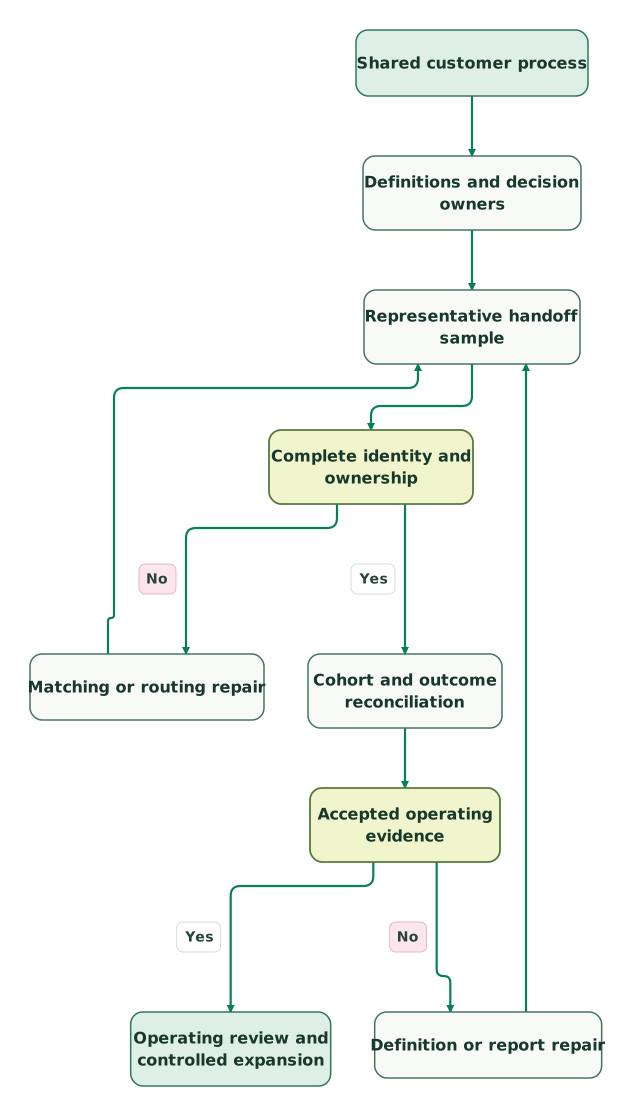
Read diagram as text
- Shared customer process to Definitions and decision owners.
- Definitions and decision owners to Representative handoff sample.
- Representative handoff sample to Complete identity and ownership.
- Complete identity and ownership to Matching or routing repair: No.
- Matching or routing repair to Representative handoff sample.
- Complete identity and ownership to Cohort and outcome reconciliation: Yes.
- Cohort and outcome reconciliation to Accepted operating evidence.
- Accepted operating evidence to Definition or report repair: No.
- Definition or report repair to Representative handoff sample.
- Accepted operating evidence to Operating review and controlled expansion: Yes
Every repair returns to the same customer cases. A reporting change can reveal a routing gap, and a new routing rule can change the report population. The process is ready to expand when the team can trace both the work and the measurement through those changes.
Revenue operations checklist
- Define one customer path and its accepted outcome.
- Name business decision owners separately from system implementers.
- Record eligibility, acceptance, response and completion as distinct events.
- Choose authoritative sources for customer and commercial values.
- Preserve a stable cohort, observation window and definition version.
- Make unassigned and failed items visible in the operating review.
- Separate urgent recovery from the underlying process improvement.
- Keep commercial approval attached to the correct version.
- Repeat the representative sample after a rule or report repair.
- Expand tooling and team scope only after the current process is maintainable.
The CRM data hygiene audit skill helps prepare the identity and ownership sample. Use it alongside the business process review, since clean records alone cannot define the responsibility for the next action.
Keep reading
Browse all GTM Engineering guides
 Martech AI
AI for RevOps: Useful Workflows, Reliable Data and a Pilot That Proves Value
Choose useful AI workflows for RevOps, compare native tools with custom agents, and test evidence quality, missed issues, forecast accuracy and real effort.
Jafrin Akter AloLast updated 13 min read
 GTM Engineering
What Is a GTM Engineer? Role, Skills, Salary and Hiring
A GTM engineer builds revenue workflows across CRM, data and automation. See the role, skills, pay example, hiring test and a measurable first project.
Jafrin Akter AloLast updated 14 min read
 CRM & Lifecycle
Lead routing for small teams: ownership, rules and reliable handoffs
Build reliable lead routing in HubSpot or Salesforce. Define ownership, fallback paths and response clocks, then compare native routing with software costs.
Jafrin Akter AloLast updated 11 min read
GTM engineering & outbound
See the implementation scope, deliverables and acceptance checks.
Questions people ask
Does RevOps require marketing, sales and finance to report to one manager?
RevOps does not require every related function to report to one manager. The essential requirement is a shared operating agreement with clear decision owners, definitions and escalation paths. A centralized team or a coordinated group can support that agreement. Choose the structure from the work and authority required, rather than assuming an organization-chart change will repair an unclear handoff.
Can a CRM administrator perform revenue operations work?
A CRM administrator can perform revenue operations work when the role includes the relevant process and decision responsibilities. Platform expertise alone does not grant authority to define qualification, commercial policy or financial reporting. Make those boundaries explicit, then give the administrator the business support needed to implement and maintain the agreed rules without guessing on behalf of other teams.
Is assignment coverage the same as timely sales response?
Assignment coverage is different from timely sales response. Assignment means an eligible request has a responsible owner; response means that owner has taken the defined action within the agreed clock. Measure both and retain unassigned requests in the eligible population. Otherwise, a response report can hide the inquiries that never reached a salesperson in the first place.
Should a new RevOps function begin with a complete software replacement?
A new RevOps function should begin with the customer process and its failure evidence before deciding on a complete software replacement. Some problems come from missing ownership, conflicting field definitions or an untested rule. Qualify the necessary capability, test a bounded repair and compare complete transition costs before treating a new platform as the solution to every operating issue.
Can RevOps claim revenue growth from a cleaner handoff alone?
RevOps cannot establish revenue growth from a cleaner handoff alone. It can demonstrate an operating change, such as fewer unassigned requests or more timely responses, using a consistent definition and cohort. Revenue outcomes also depend on demand, customer fit, sales execution and other factors. Keep the measured improvement separate from a broader causal claim that the evidence does not establish.
Sources

Written by
Jafrin Akter AloData Engineer and Co-founder at Martechdevs and Growth and Analytics Partners
Jafrin writes practical guides to marketing technology, customer data, analytics and AI workflows. Martechdevs is a Growth and Analytics Partners company.