
CRM Manager Responsibilities, Skills and a Practical Operating Plan
A CRM manager makes the customer system usable, reliable and aligned with the work the business needs to complete. The role connects data quality, process changes, reporting, access and employee adoption. Define whether the job owns the platform, lifecycle campaigns or both before hiring, then give it clear decision partners and a manageable change process.
On this page
CRM manager responsibilities
Use a written role charter to distinguish the manager's operating responsibility from decisions owned by the business.
| Responsibility | CRM manager's deliverable | Business partner | Acceptance evidence |
|---|---|---|---|
| Customer data | Maintained identity, field and quality rules | Data and process owners | Known records reconcile correctly |
| Process configuration | Tested fields, stages and workflows | Sales, marketing and service leaders | Expected next action for representative cases |
| Access | Role-based access and offboarding process | IT and security | Ordinary-user checks and recorded changes |
| Reporting | Defined, reproducible reports | Metric owners | Totals trace back to the correct records |
| Adoption | Practical guidance and feedback process | Team managers | Employees complete their actual work |
| Change management | Prioritized requests and controlled releases | RevOps and technical owners | Test evidence, owner and recovery plan |
Salesforce's administrator role description includes users, data, security, analytics and product management. HubSpot's CRM administration guide similarly describes recurring data, workflow, integration and user-support work. A CRM manager may coordinate those responsibilities directly or work with specialist administrators.
The title alone does not establish the scope. For one organization, the role may mainly maintain a sales platform. Another may expect campaign planning, segmentation and customer communications as well. Write those expectations down so platform maintenance and campaign performance do not become competing, unspoken obligations.
At Martechdevs, CRM and lifecycle implementation includes the handover needed for continuing ownership. The receiving manager should know the data model, required integrations, acceptance cases and response to a failed update. A configuration is easier to maintain when those artifacts are part of the delivery.
Role boundaries and decision authority
A CRM manager needs authority to maintain the system, but that authority is different from deciding every business policy represented in it. Sales leadership should approve qualification and pipeline definitions. Finance should approve financial process requirements. Security and IT should establish the organization's access expectations.
The RevOps guide describes the shared operating model around those decisions. The CRM manager turns the agreed process into maintained capability, identifies conflicts and brings unresolved decisions to the appropriate owner.
Separate four responsibilities for a material change: the person requesting the outcome, the person approving the business rule, the person implementing it and the person accepting the result. Small teams can combine roles, but combining them should be deliberate. A technical administrator should not have to guess which sales definition leadership intended.
| Request | Required decision | CRM manager's action | Completion condition |
|---|---|---|---|
| New sales stage | Evidence required for entry and exit | Configure fields, views and reports | Sellers apply the same definition |
| New customer field | Meaning, owner and update source | Add the field and validate integrations | Conflicting updates are resolved |
| New manager access | Approved visibility and edit scope | Apply and test access | Required work succeeds without excess access |
| New dashboard | Metric population and period | Build and reconcile the report | Known cases produce expected totals |
| New nurture workflow | Audience, exclusions and stop condition | Coordinate configuration and testing | Eligible customers receive intended treatment |
For lifecycle-stage work, the MQL vs SQL guide helps separate qualification decisions from software labels. The manager can enforce a definition that the business has agreed; software configuration cannot resolve an unresolved disagreement about that definition.
Data ownership and customer identity
The CRM manager should know which identifiers connect customer records across the CRM, billing, marketing and product systems. A repeated import or a new integration must recognize the existing customer before changing fields or creating work.
Name the authoritative source for important values. The sales owner may be maintained in the CRM, payment status in billing and usage in the product. Define how blanks, stale updates and approved manual corrections behave. The CRM property ownership guide develops that contract in detail.
Data quality needs an operating queue rather than an occasional cleanup project. A missing owner on an active opportunity is different from an obsolete optional field on a closed record. Prioritize by the effect on current work and reporting, then route the correction to someone who can establish the right value.
Avoid treating every duplicate as a simple deletion decision. Two records with similar names may represent different companies, while one person may legitimately be connected to several accounts. Preserve the identity and relationships needed by the business, and verify the outcome after any merge or remapping.
Access and continuing account ownership
Test access through the actual employee roles. A sales representative, team manager, marketer and support colleague can need different views and actions. An administrator's successful test proves little about an ordinary user's ability to complete the same task.
HubSpot's permissions guide distinguishes permissions from the tools available through a user's seat and describes object-level actions such as view, create, edit and delete. The implementation therefore needs both the right subscription access and the appropriate permissions.
Review integration accounts as part of the same operating model. A connector owned by a departed employee can continue to affect data even when ordinary staff access has been removed. Record the business owner, technical owner and recovery route for each required connection.
Make offboarding include work transfer. Deactivating a user should be coordinated with reassignment of active customers, tasks, scheduled reporting and owned integrations. The relevant acceptance test is that the departing person's required work has a continuing owner, not merely that their login no longer succeeds.
Reporting and reconciliation
A dashboard needs a metric owner, a population and a time definition. Open pipeline, booked revenue, invoices and cash collection describe different things. The manager should expose those differences instead of using one vague Total revenue label across unrelated reports.
Reconcile reports with small known samples. Include an open item, a closed item, a customer with several contacts and a record outside the selected period. The CRM examples guide shows why linked activities and contacts can multiply a commercial amount when reporting grain is unclear.
Keep report changes connected to process changes. A new stage, relationship or owner rule can change the population even when nobody edits the dashboard. Add report reconciliation to the acceptance checklist for changes that affect fields used in management reporting.
Salesforce's administrator guidance treats actionable analytics as a responsibility beyond simply constructing a chart. The manager's deliverable is a report people can interpret and trace to records, with a clear response when the result is disputed.
A realistic capacity example
Assume a hypothetical CRM manager has forty working hours available in a week. The following allocation is a planning example, not a staffing benchmark or a recommended service commitment.
| Work category | Planned hours | Main output | Capacity risk |
|---|---|---|---|
| Incident and user support | 8 | Restored work and explained issues | Urgent work can expand unexpectedly |
| Data-quality review | 6 | Prioritized corrections and recurring causes | Cleanup can grow without source repairs |
| Planned configuration changes | 12 | Tested improvements | Unclear requirements create rework |
| Enablement and handover | 6 | Employees completing the intended tasks | Feature releases without adoption |
| Access and release review | 4 | Accepted controls and change evidence | Review skipped under delivery pressure |
| Unallocated capacity | 4 | Room for changes in demand | No space for ordinary variation |
The planned work totals 36 hours, leaving four hours unallocated. Incident and user support represents 8 ÷ 40, or 20% of available time. If that work rises to fourteen hours while every other category remains unchanged, demand becomes 42 hours. The plan no longer fits the forty-hour capacity.
The response should be an explicit decision: reduce scope, move a deadline, add suitable support or repair the cause of repeated incidents. Assuming the manager will absorb every increase hides the tradeoff and can push testing or access reviews out of the week.
For a separate hypothetical quality sample, six of 120 active opportunities lack an owner. The missing-owner rate is 6 ÷ 120, or 5%. Fixing those records matters, but the manager should also identify the creation or reassignment path producing them. A lower count after manual cleanup is not proof that the underlying process is repaired.
Use the software pricing tool when a new licence or integration is proposed to reduce operating work. Compare the actual qualified scope and maintenance requirement; a cheaper subscription can still add work that the current team cannot absorb.
Change intake and release evidence
Every material request should describe the business outcome before the proposed configuration. A request for three new fields may really be a request to identify stalled renewals. The manager needs enough context to judge whether fields, a view, an existing report or a process change is the better response.
Capture the affected users, data, integrations and reports. Set an owner for the business rule and describe the acceptance case. A due date without those details does not make the change ready to implement.
- Record the requested business outcome and responsible decision-maker.
- Inspect existing fields, workflows and reports for overlap.
- Identify the affected records, integrations and employee roles.
- Prepare the smallest change that can meet the requirement.
- Test ordinary cases, exclusions, access and a known failure.
- Reconcile downstream reports and repeat the checks after repair.
- Release to a bounded scope with an owner and recovery plan.
Keep a simple decision record after release. It should explain what changed, why the business needed it and how the team can verify the result. That record is more useful for the next administrator than an unexplained collection of fields and workflows.
Skills and a practical hiring exercise
Look for evidence of process analysis, data modeling, access design, reporting and communication. Platform knowledge matters, but the candidate should also explain how a requested change affects the people using it.
Salesforce's role description includes both technical and nontechnical skills. A certification or familiar tool name can support an application, but a practical exercise shows whether the person can apply the concepts to your operating problem.
Give the candidate a small hypothetical case: two records for one customer, an unassigned active opportunity and a report total that exceeds the known commercial amount. Ask for the investigation order, the evidence needed and the acceptance checks. Avoid requiring access to real customer information for the exercise.
Assess the reasoning as well as the proposed fix. A strong response distinguishes identity, ownership and reporting grain, asks who approves the business meaning and preserves a way to reverse a mistaken change. A response that starts by deleting records without understanding their relationships exposes a material operating risk.
First-month deliverables
The first month should produce an understandable operating map before a large redesign. Give the manager access to the relevant stakeholders and existing configuration owners, then agree a small number of visible outcomes.
| Period | Focus | Concrete deliverable | Acceptance owner |
|---|---|---|---|
| Initial review | Current customer workflows and system ownership | Process and integration inventory | Business sponsor |
| Definition review | Identity, stages and important fields | Agreed ownership and meaning sheet | Process owners |
| First repair | One recurring issue affecting current work | Tested correction and known sample | Receiving team |
| Operating handover | Intake, review and continuing support | Maintained queue and review routine | CRM manager and sponsor |
The objective is a continuing operating capability. A large number of new fields or closed support tickets does not establish that the CRM is healthier. Use accepted customer workflows, accurate reports and fewer repeated failures as more meaningful evidence.
Change and repair workflow
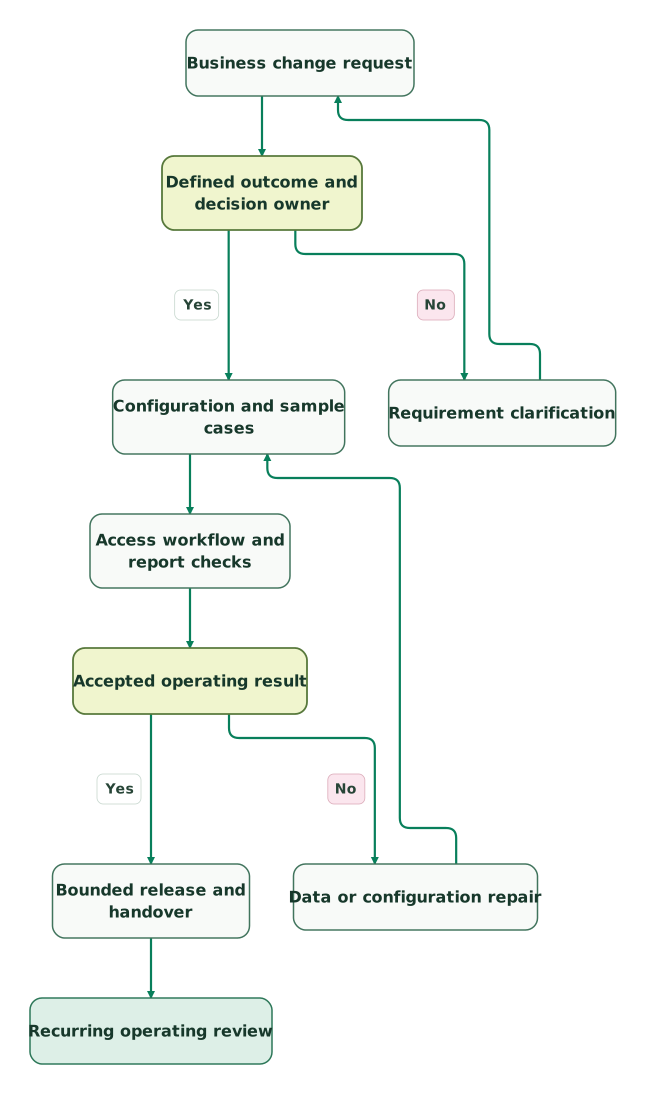
Read diagram as text
- Business change request to Defined outcome and decision owner.
- Defined outcome and decision owner to Requirement clarification: No.
- Requirement clarification to Business change request.
- Defined outcome and decision owner to Configuration and sample cases: Yes.
- Configuration and sample cases to Access workflow and report checks.
- Access workflow and report checks to Accepted operating result.
- Accepted operating result to Data or configuration repair: No.
- Data or configuration repair to Configuration and sample cases.
- Accepted operating result to Bounded release and handover: Yes.
- Bounded release and handover to Recurring operating review
Requirement clarification returns to the request rather than starting implementation with an assumed policy. A configuration repair repeats the sample because field and access changes can affect several workflows at once.
CRM manager checklist
- Define platform, lifecycle and campaign responsibilities explicitly.
- Name business policy owners separately from technical implementers.
- Maintain customer identity and field-ownership rules.
- Prioritize data-quality work by its effect on active processes.
- Test access with ordinary employee roles.
- Include integrations and active work in offboarding.
- Reconcile reports against a known sample after relevant changes.
- Keep a realistic capacity plan with room for urgent work.
- Require acceptance evidence and a recovery plan for material releases.
- Preserve operating notes for the next person maintaining the system.
The CRM data hygiene audit skill helps structure the initial record review. Pair it with interviews about the actual customer work so the manager can distinguish a data symptom from a missing process decision.
Keep reading
Browse all CRM & Lifecycle guides
 CRM & Lifecycle
CRM Property Ownership: Stop Integrations Overwriting Good Data
Stop CRM integrations overwriting useful data with property-level ownership, explicit blank rules and stable matching. Includes a renewal-field contract and tests.
Jafrin Akter AloLast updated 10 min read
 CRM & Lifecycle
CRM Examples for Sales, Customer Service and Renewals
Explore practical CRM examples for sales, support, project delivery, renewals and partnerships, with record models, a checked pipeline example and setup steps.
Jafrin Akter AloLast updated 12 min read
 CRM & Lifecycle
Lead routing for small teams: ownership, rules and reliable handoffs
Build reliable lead routing in HubSpot or Salesforce. Define ownership, fallback paths and response clocks, then compare native routing with software costs.
Jafrin Akter AloLast updated 11 min read
CRM & marketing automation
See the implementation scope, deliverables and acceptance checks.
Questions people ask
Does the CRM manager own every business rule stored in the CRM?
The CRM manager does not automatically own every business rule stored in the CRM. Sales, marketing, service, finance and security leaders retain responsibility for their policy decisions. The manager coordinates the implementation, exposes conflicts and maintains the accepted configuration. A written responsibility split prevents technical access from being mistaken for authority to decide commercial or operational policy.
Can one person manage the CRM and run lifecycle campaigns?
One person can manage the CRM and run lifecycle campaigns if the scope, skills and capacity support both jobs. Make campaign planning, content, audience decisions and platform maintenance explicit in the role charter. Track the competing workload and name backup owners, because an urgent system incident can otherwise remove the time needed to operate customer communication responsibly.
Is the number of closed CRM support tickets a sufficient performance measure?
Closed support tickets are an incomplete performance measure for a CRM manager. A large count can reflect repeated failures or a narrow definition of completion. Include whether the underlying cause was repaired, the customer workflow remains usable and the same issue returns. Assess accepted operating outcomes alongside workload, rather than rewarding activity that leaves the system dependent on constant intervention.
Should CRM access testing use only an administrator account?
CRM access testing should include the ordinary roles that perform the work, rather than only an administrator. Administrators often have broader visibility and actions than sales, marketing or service employees. Validate the required record, edit and workflow behavior as each relevant role, then check that the test did not grant unnecessary access simply to make the scenario succeed.
Can a new CRM manager safely begin by removing unused-looking fields?
A new CRM manager should inspect dependencies before removing fields that appear unused. A field may support an integration, report, workflow or historical interpretation even when it is absent from the main screen. Identify its owner and purpose, review references and agree a retirement plan. Validate affected processes before deletion or replacement so a cleanup does not create a new operating failure.
Sources

Written by
Jafrin Akter AloData Engineer and Co-founder at Martechdevs and Growth and Analytics Partners
Jafrin writes practical guides to marketing technology, customer data, analytics and AI workflows. Martechdevs is a Growth and Analytics Partners company.