
MQL vs SQL: Qualification Criteria, Handoffs and Conversion
An MQL is a marketing-qualified lead that meets the agreed conditions for sales review; an SQL is a sales-qualified lead that sales has assessed as a potential customer. MQL vs SQL separates two decisions, not two score ranges. Define the evidence, receiving owner and return path for each stage before using either label to measure marketing or sales performance.
On this page
MQL and SQL comparison
The definitions below are an operating framework to adapt to your sales process.
| Criterion | Marketing-qualified lead | Sales-qualified lead | Required agreement |
|---|---|---|---|
| Main judgment | Ready for a sales review | Assessed by sales as a potential customer | Written acceptance criteria |
| Evidence | Relevant fit and meaningful interest | Confirmed commercial context and a viable next step | Evidence sufficient for the business |
| Responsible team | Marketing or the originating qualification team | Receiving sales team | Named owner at the handoff |
| Next action | Review, accept or return with a reason | Progress the qualified sales conversation | Action and timing |
| Measurement | Cohort entering the handoff | Qualified members of that cohort | Stable population and observation window |
HubSpot's lifecycle-stage definitions describe MQL as marketing's readiness judgment and SQL as sales' qualification of a potential customer. Organizations can customize their stages, so a label in a CRM is useful only when the team agrees what evidence belongs behind it.
A lead in sales is a person or organization being considered for a potential commercial relationship. An inquiry, newsletter subscription and active opportunity represent different amounts of evidence. Calling all of them SQLs makes the pipeline look fuller while reducing the label's usefulness for the next decision.
At Martechdevs, CRM and lifecycle implementation connects qualification rules to ownership, timestamps and follow-up work. The goal is an observable handoff: the right person receives the record, can explain its qualification and has a defined next action.
Qualification evidence and score thresholds
An MQL definition should explain why sales should spend time on the record. Useful evidence can include customer fit, an explicit request, relevant product activity or a meaningful combination of behavior. The acceptable combination depends on the business and its sales capacity.
A numeric score can help prioritize that evidence, but a threshold is not an explanation by itself. A contact with many low-intent interactions may accumulate more points than a suitable buyer who submits one clear request. Keep fit and engagement visible so the team can see the difference.
HubSpot's lead-scoring reference distinguishes engagement scores, fit scores and combined scores. It also describes configurable thresholds. That supports using separate dimensions; it does not establish a universal score at which every business should create an MQL.
The lead-scoring model guide covers model design and validation. This article focuses on the decision after the evidence is available: whether to send the record for sales review, who accepts it and what happens when it does not qualify.
A practical qualification contract
Write the entry and exit rules in terms another person can apply. A rule such as Interested in our product is too broad if marketing treats a content download as interest while sales expects an active buying project.
The following is a hypothetical contract for a business selling a defined service. It is a starting example, not a recommended universal policy.
| Stage or outcome | Example requirement | Recorded evidence | Responsible action |
|---|---|---|---|
| MQL entry | Relevant organization and a meaningful request or signal | Fit reason, signal and timestamp | Assigned seller reviews the request |
| SQL acceptance | Sales confirms a relevant need and an agreed commercial next step | Qualification note and next action | Seller continues the conversation |
| Missing information | Fit or intent remains uncertain | Specific missing detail | Owner gathers the detail |
| Timing return | Relevant need with no present sales step | Reason and review condition | Agreed nurture or later review |
| Disqualification | A documented exclusion applies | Exclusion reason | Appropriate non-sales handling |
Keep exclusions explicit. A job applicant, partner inquiry, existing-customer support request or duplicate form submission may require useful work without belonging in the new-sales qualification queue. Route those records to the correct process instead of forcing them through a sales stage to keep a report tidy.
Direct buying requests may take a shorter path. If a suitable buyer asks for a commercial discussion and sales immediately confirms the requirement, the workflow does not need artificial delay just to make every record spend time in every label. Preserve the actual events and the reporting definition used for that path.
Sales acceptance and commercial context
Sales acceptance should establish enough information for the next commercial action. A relevant need, suitable use case, responsible contact and agreed next step may matter more than a completed questionnaire. Define the minimum evidence for the way your business sells.
Avoid requiring every detail before any conversation can begin. Some information can only be learned through discovery. The distinction is between a record that deserves a sales review and one that sales has assessed sufficiently to progress under the agreed process.
An SQL is also different from a created opportunity. HubSpot's default lifecycle model gives Opportunity its own meaning through an associated deal. Your process can use different names, but preserve the commercial distinction between qualification and an active transaction with its own scope and value.
Record the evidence near the decision. A qualification status without the reason becomes difficult to audit after ownership changes. The next salesperson should be able to understand why the lead was accepted and what the customer expects without asking the previous owner to reconstruct the conversation.
Handoff ownership and response timing
Qualification is incomplete if the record has no receiving owner. Specify the assignment rule, fallback queue and response target separately from the MQL definition. Otherwise, a higher MQL count can create a larger unattended backlog.
The lead-routing guide explains territory, capacity and fallback choices. For qualification reporting, retain distinct timestamps for MQL entry, assignment, sales review, SQL acceptance and the first meaningful response. Each event answers a different operational question.
A response target needs a clock. State whether the deadline uses elapsed time or working hours, which calendar applies and how holidays are handled. A request received outside the agreed service window should be measured consistently, without silently changing the rule after the result is known.
Also define escalation. If the assigned seller cannot act, a visible exception and substitute owner are better than leaving the record in a technically assigned state. The RevOps guide places these responsibilities in the broader revenue operating model.
A cohort-based conversion example
Assume a hypothetical cohort of 120 records first becomes MQL during one week. Observe that same cohort for thirty days. At the cutoff, sales has reviewed 50 of those records and accepted 30 as SQLs. The numbers are illustrative and are not benchmarks.
| Measure | Calculation | Result | Meaning |
|---|---|---|---|
| Review coverage | 50 reviewed ÷ 120 MQLs | 41.7% | Share of the original cohort reviewed |
| Qualification among reviewed records | 30 SQLs ÷ 50 reviewed | 60% | Acceptance within the reviewed subset |
| MQL-to-SQL conversion | 30 SQLs ÷ 120 MQLs | 25% | Qualification across the original cohort |
| Unreviewed population | 120 − 50 | 70 records | Work without a completed review |
The 60% result describes a different population from the 25% result. Reporting only acceptance among reviewed records can hide the seventy records still waiting. The appropriate response may be a capacity or routing repair before any change to the MQL criteria.
Now suppose another ten original-cohort records become SQL after the cutoff. The longer-window conversion would be 40 ÷ 120, approximately 33.3%. That does not make the original thirty-day result wrong. It demonstrates why the observation window belongs beside the percentage.
Do not divide all SQLs created this month by all MQLs currently visible this month and call it a cohort conversion rate. The SQLs may come from earlier cohorts, while current-stage counts may exclude people who already progressed. Preserve entry events and the selected reporting window.
Recycled leads and repeated qualification
A returned lead needs a reason and an intended next state. Timing, missing information and genuine disqualification require different treatment. Returning all records to a generic nurture list makes it difficult to know what should trigger another review.
Set a re-entry condition that reflects new evidence. A changed buying timeline, new qualifying request or relevant account change can justify another sales review. Repeated tracking of the same old interaction should not create endless new handoffs.
Decide how reporting counts requalification. A first-time MQL cohort and a requalified cohort can both be useful, but combining them without a definition can inflate demand. Retain a stable identity and a qualification event so one person can have a history without becoming several indistinguishable customer records.
HubSpot's lifecycle guidance notes that default automatic lifecycle updates move forward. Recycling therefore needs an explicit design for the chosen system, rather than assuming that every automation will move a lifecycle value backward. The HubSpot lifecycle guide covers that implementation detail.
A small acceptance fixture
Use a controlled sample before activating the handoff. The cases below define expected business decisions; they do not claim default behavior in a particular CRM.
| Sample case | Evidence | Expected decision | Failure signal |
|---|---|---|---|
| Suitable buyer with explicit request | Relevant fit and current commercial question | Sales review with an owner | Record remains unassigned |
| Highly engaged unsuitable organization | Repeated activity but excluded fit | Appropriate exclusion or alternate route | Engagement overrides the exclusion |
| Existing customer asking for support | Customer identity and service issue | Support handoff | New-sales MQL created |
| Duplicate submission | Same identity and same request | Existing work retained or updated | Two sellers receive the same request |
| Previous return with new evidence | Changed timing and a new relevant request | Requalification under the defined rule | Old return state blocks legitimate review |
Run the sample as the ordinary users who will perform the work. The marketer should understand the qualification reason, the seller should see the next action and the manager should reconcile the cohort. A successful administrator-only demonstration cannot establish that the receiving team has the required access.
After correcting a matching or routing rule, repeat all affected cases. A fix for duplicate submissions can also change how a returning customer is recognized. Keep the expected result for each case so the review checks behavior instead of relying on a plausible-looking dashboard.
Implementation sequence
- Agree the business meaning of MQL, SQL and any intermediate review state.
- Define the eligibility, exclusion and direct-request routes.
- Assign owners, fallback handling and response clocks.
- Record the qualification reason and stage-entry events.
- Configure the CRM fields, rules and views around those definitions.
- Run the representative sample and reconcile the cohort report.
- Repair failures, repeat the checks and approve a bounded rollout.
Keep the scope proportional to the problem. A team can begin with a small, explainable rule set and improve it from observed outcomes. A complicated score that nobody can explain is difficult to repair and can turn a straightforward handoff into an opaque dependency.
If the implementation needs a new paid feature, compare its cost only after the required behavior is clear. The software pricing tool helps organize qualified CRM and automation costs. MQL and SQL themselves are business concepts, not software plans with universal prices or free tiers.
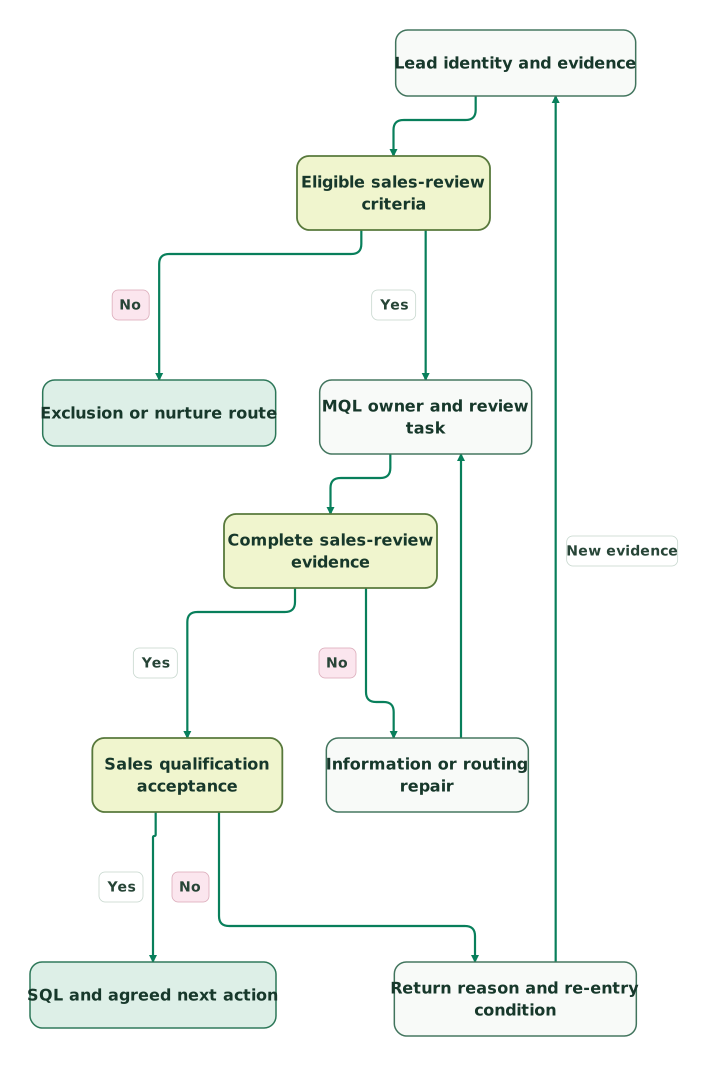
Qualification and repair workflow
Read diagram as text
- Lead identity and evidence to Eligible sales-review criteria.
- Eligible sales-review criteria to Exclusion or nurture route: No.
- Eligible sales-review criteria to MQL owner and review task: Yes.
- MQL owner and review task to Complete sales-review evidence.
- Complete sales-review evidence to Information or routing repair: No.
- Information or routing repair to MQL owner and review task.
- Complete sales-review evidence to Sales qualification acceptance: Yes.
- Sales qualification acceptance to SQL and agreed next action: Yes.
- Sales qualification acceptance to Return reason and re-entry condition: No.
- Return reason and re-entry condition to Lead identity and evidence: New evidence
The repair loop returns missing information or ownership to the review stage. The separate re-entry loop requires new evidence before qualification begins again. That preserves useful history without repeatedly treating the same unchanged record as new demand.
MQL and SQL checklist
- Define each stage in plain language with required evidence.
- Keep fit and engagement visible as separate considerations.
- Document exclusions and direct commercial-request routes.
- Assign the receiving owner and a fallback queue.
- Separate assignment, review, acceptance and response timestamps.
- Define the response clock and escalation responsibility.
- Preserve the original cohort and observation window in reports.
- Distinguish first qualification from requalification.
- Record return reasons and the evidence needed for re-entry.
- Repeat representative cases after changing matching or routing.
The CRM data hygiene audit skill can help prepare the identity and ownership sample. Use the accepted fixture as part of the ongoing handoff review, especially after changes to form fields, scoring or territories.
Keep reading
Browse all CRM & Lifecycle guides
 CRM & Lifecycle
HubSpot Lifecycle Stages: Set Them, Correct Them and Keep Salesforce in Step
HubSpot lifecycle stages explained: forward and backward changes, forms, Salesforce ownership, custom stages and the dates behind your conversion reports.
Jafrin Akter AloLast updated 15 min read
 CRM & Lifecycle
Lead Scoring: Build a Model With Fit, Engagement and Clear Actions
Build a lead scoring model for your sales motion. Separate fit, engagement and routing, use the worked SaaS example, and test the ranking at real sales capacity.
Jafrin Akter AloLast updated 17 min read
 CRM & Lifecycle
Lead routing for small teams: ownership, rules and reliable handoffs
Build reliable lead routing in HubSpot or Salesforce. Define ownership, fallback paths and response clocks, then compare native routing with software costs.
Jafrin Akter AloLast updated 11 min read
CRM & marketing automation
See the implementation scope, deliverables and acceptance checks.
Questions people ask
Does a high lead score automatically make someone an SQL?
A high lead score does not automatically make someone an SQL. The score summarizes selected evidence, while SQL should represent the sales qualification decision defined by the business. Preserve the fit and engagement inputs, give sales the relevant context and record the acceptance reason. A threshold can prioritize review without replacing the commercial judgment behind qualification.
Can a direct demo request bypass a separate MQL waiting stage?
A direct demo request can follow a shorter route when the business's criteria support it. A suitable buyer with an explicit commercial request may receive immediate sales review rather than waiting for a scheduled scoring process. Record the actual qualification events and keep the reporting definition clear so a faster route does not disappear from the funnel or distort cohort counts.
Does a low MQL-to-SQL percentage prove marketing supplied poor leads?
A low MQL-to-SQL percentage does not prove poor lead quality by itself. Missing assignments, slow reviews, incomplete information and a short observation window can all affect the result. Separate review coverage from acceptance among reviewed records, then inspect the recorded return reasons. Change the qualification criteria only after the evidence identifies a problem with those criteria.
Should every returned SQL be changed into a brand-new lead?
A returned SQL should not automatically become a brand-new lead. Preserve the customer's identity, previous qualification evidence and reason for return. Define whether the next action is information gathering, nurture, disqualification or a later review. If new evidence triggers requalification, record that event distinctly so reporting can separate repeat consideration from first-time demand.
Can current lifecycle-stage counts reproduce a historical conversion cohort?
Current lifecycle-stage counts cannot reliably reproduce a historical conversion cohort because records may have progressed beyond their earlier stages or changed through corrections. Preserve the entry events and select the original population, definition and observation window. Then measure how many members reached the intended outcome, rather than dividing two current snapshots that may describe different people.
Sources

Written by
Jafrin Akter AloData Engineer and Co-founder at Martechdevs and Growth and Analytics Partners
Jafrin writes practical guides to marketing technology, customer data, analytics and AI workflows. Martechdevs is a Growth and Analytics Partners company.