
ClickHouse Alternatives: Six Competitors by Workload and Cost
Choose Apache Pinot for a focused application-analytics service, Druid for event-oriented aggregation, and StarRocks for analytical joins and changing records. Choose Snowflake or BigQuery when the main requirement is a broader managed warehouse; consider PostgreSQL for a smaller workload the existing team can operate. Keep ClickHouse as the baseline until an alternative solves a specific constraint at an acceptable total cost.
On this page
ClickHouse alternatives compared
USD rates are public references for the stated deployment; a $0 software licence excludes hosting, support and operation.
| Alternative | Starting price or licence | Best fit | Main tradeoff |
|---|---|---|---|
| Apache Pinot | $0 open-source software licence | Application-facing analytical queries | Index, ingestion and upsert-state design need ownership |
| Apache Druid | $0 open-source software licence | Event analytics with useful aggregation dimensions | Rollup and query design affect retained detail |
| StarRocks | $0 open-source software licence | Analytical joins and mutable records | Table model and primary-key state need testing |
| Snowflake | Standard edition $2/credit on AWS Northern Virginia | Shared managed analytics and reporting | Warehouse type, running time and extra services shape cost |
| BigQuery | First 1 TiB of US on-demand queries free monthly, then $6.25/TiB | Google Cloud analytics and intermittent SQL | Scan volume and repeated queries need controls |
| PostgreSQL | $0 open-source software licence | Smaller analytical workloads near an existing relational model | Protect transaction work and define refresh freshness |
Sources: Pinot licence, Druid licence, StarRocks licence, Snowflake rates, BigQuery pricing, PostgreSQL licence.
The first three rows compare self-managed software, while the Snowflake and BigQuery rows describe managed services. Price the operating model before treating the zeroes as a saving. A managed commercial service based on an open-source engine has its own contract, capacity and support terms.
At Martechdevs, we begin a warehouse and analytics design with the query, data changes and operating requirement that prompted the shortlist. A slow dashboard may need a different ordering key. A requirement for a different record-update model or support arrangement may justify another engine. Document the constraint before starting a migration.
Replacement triggers and the ClickHouse baseline
Keep a precise record of the problem: tail latency under concurrent load, delayed data, incorrect current-state results, operating effort or an unacceptable bill. Attach the affected queries and their expected result. A generic complaint that the platform is complex gives a replacement project no acceptance test.
ClickHouse supports several capabilities that older comparisons overlook. Cloud services can share stored data while scaling compute separately, and current lightweight updates can make row changes visible through patch parts. Verify the supported configuration before deciding that the feature you need requires another database. Cloud warehouses, lightweight UPDATE.
Its ordering key also affects how much data a query reads. Test the important filters and inspect the query plan before increasing hardware or rebuilding the stack. The primary-key design guide explains the sparse-index model.
For a broader comparison with the current platform, use ClickHouse vs Snowflake. The alternatives below focus on the requirement each candidate could solve.
Event and application analytics competitors
Apache Pinot
Pinot is designed for low-latency, high-throughput analytical applications with streaming and batch data. It belongs in a test for customer-facing analytics or a repeated query service whose latency and concurrency requirements are explicit. Its advertised performance should become a test target for your workload, rather than an assumed result. Pinot introduction.
- Best for: A product team building a clearly defined analytical service with an owner for ingestion and indexing.
- Pros: Purpose-built analytical ingestion and query capabilities, with supported upsert modes for current-state data.
- Cons: Upsert bookkeeping can consume memory; table type and update mode affect the supported behavior.
- Free plan and startup offer: The Apache-licensed software has no licence fee. A commercial hosted service or cloud-credit offer requires its own terms. Pinot project.
- Choose it if: Representative queries, updates and failure recovery pass at the expected concurrency.
- Skip it if: The organization needs a broad managed data platform but has budgeted only for a query engine.
Pinot's current upsert guide distinguishes full and partial modes across REALTIME, OFFLINE and HYBRID tables. It also describes the in-memory mapping from primary keys to record locations. Model the actual key count and retention before declaring an upsert-heavy service affordable. Pinot upsert scope and memory.
Apache Druid
Druid fits event-oriented exploration and aggregation, including analytical applications with concurrent queries. Its data rollup can reduce stored detail by combining events at ingestion. That can be a valuable design when the required dimensions and metrics are understood. Druid introduction, rollup.
- Best for: Event analytics where the team can define useful aggregation granularity and retention.
- Pros: A model centered on analytical events and an explicit ingestion-time rollup option.
- Cons: Rollup trades away individual-event querying for the combined records; joins need attention to the selected execution path.
- Free plan and startup offer: Apache Druid is open-source software. Hosting, support and any startup grant are separate purchasing decisions. Druid project.
- Choose it if: The chosen granularity preserves the questions the product must answer and the peak-load test passes.
- Skip it if: The design discards event detail that customer support, product analysis or later investigations still require.
Druid supports joins. Its native-query join path uses a broadcast hash-join model, so non-base datasources must fit in memory under that path. Inspect the actual query execution plan rather than applying that statement indiscriminately to every Druid execution mode. Druid datasource and join behavior.
StarRocks
StarRocks deserves an evaluation when analytical joins and changing records are central to the requirement. It provides a cost-based optimizer and a Primary Key table model designed for updates. Test those capabilities with the relationships and change patterns that are difficult in the current implementation. StarRocks features, Primary Key tables.
- Best for: Analytical applications with joined data and a defined current-record model.
- Pros: Explicit table models and support for replacing existing primary-key records and updating selected columns.
- Cons: Primary-key indexes and data-change processing have resource costs; adopting the engine does not define the correct business key for you.
- Free plan and startup offer: The open-source project uses Apache License 2.0. A managed hosting contract and any credits remain separate. StarRocks licence.
- Choose it if: The current-state and join tests pass without an unmanageable preprocessing or operating burden.
- Skip it if: A new table engine is being used to postpone resolving duplicate identities or conflicting update owners.
The Primary Key table's sort key can be defined separately from its primary key. That distinction lets query ordering and record identity be designed for their respective jobs. Test both: a good filter layout cannot compensate for a key that merges two different business entities. Primary Key design.
Broader warehouse and simpler relational choices
Snowflake
Snowflake is a candidate when the required system includes shared modeling, reporting, governance and independently managed analytical workloads. A team can also evaluate its Interactive warehouse option for suitable repeated queries. Compare the actual warehouse types and access design instead of assuming all Snowflake queries have the same operating behavior. Snowflake architecture, Interactive analytics.
- Best for: A managed analytical platform serving several business consumers.
- Pros: Separate compute choices and a broader set of managed data-platform capabilities.
- Cons: Edition, warehouse type, running pattern and extra services can materially change the invoice.
- Free plan and startup offer: A temporary trial is available; eligible startups can apply for program credits. Use only approved benefits in the budget. Trial terms, startup program.
- Choose it if: The full reporting and operating scope passes with a supportable design and cost.
- Skip it if: The comparison assumes a standard warehouse and an Interactive deployment have identical minimum-running economics.
For an AWS-centered shortlist, the Redshift vs Snowflake guide adds the alternative AWS warehouse model. Use Databricks competitors when Spark, streaming or model-development capabilities also belong in the purchase.
BigQuery
BigQuery fits Google Cloud analytics where on-demand query processing or reserved capacity matches the workload. It is a useful candidate for a reporting requirement that does not need a separate always-on application-serving design. Its query cost follows the selected pricing model, not a fixed universal per-user charge. BigQuery pricing.
- Best for: Google Cloud reporting and analytics with explicit scan or capacity controls.
- Pros: On-demand and capacity-based options, with a public per-TiB rate for the appropriate on-demand case.
- Cons: Repeated wide scans and a badly designed dashboard can create costs far above the original estimate.
- Free plan and startup offer: The first 1 TiB of monthly on-demand query processing is free in the cited US model. Promotional cloud credits have their own eligibility and expiry. Usage allowances.
- Choose it if: The representative report workload meets its freshness and response requirement at the expected query volume.
- Skip it if: The project requires predictable application latency but the evidence only covers one analyst's intermittent query.
An illustrative 5 TiB monthly US on-demand query workload costs (5 - 1) × $6.25 = $25 for query processing after the allowance. That figure excludes stored data and other services. Keep the actual bytes processed visible when a dashboard or scheduled report repeats the same scan.
PostgreSQL
PostgreSQL can be the pragmatic alternative for a smaller analytical workload that the existing team can operate without adding another distributed database. Its relational model and materialized views may cover a bounded reporting need. Protect transactional capacity and agree on refresh freshness before moving a report onto the application's primary database. PostgreSQL materialized views.
- Best for: A limited reporting or operational-analytics job close to existing relational data.
- Pros: Reuse of a familiar model and operating skills, with a free software licence.
- Cons: Analytical load can compete with transactional work; stored summaries require a deliberate refresh and access design.
- Free plan and startup offer: PostgreSQL's licence permits use without a fee. Cloud hosting, replicas, support and any provider credits are additional. PostgreSQL licence.
- Choose it if: The real load and growth test pass with a modest, maintainable configuration.
- Skip it if: The only evidence is that a small sample fits, while production concurrency and retained history are much larger.
PostgreSQL's concurrent materialized-view refresh requires a suitable unique index and an already populated view; only one refresh can run against that view at a time. Include refresh behavior in the acceptance test instead of treating a materialized view as automatically fresh. Refresh requirements.
Best fit by scenario
| Situation | First candidate | Runner-up | Decision evidence |
|---|---|---|---|
| Customer-facing event analytics | Pinot | Tuned ClickHouse | Peak concurrency, index design and update-state memory |
| Event aggregation with stable dimensions | Druid | ClickHouse | Rollup granularity and retained detail |
| Changing records with analytical joins | StarRocks | Tuned ClickHouse | Key semantics, update load and join cost |
| Shared business reporting across teams | Snowflake | BigQuery | Cloud, governance and complete operating scope |
| Intermittent Google Cloud SQL analytics | BigQuery | Snowflake | Processed bytes or reserved capacity under the real schedule |
| Small relational reporting job | PostgreSQL | Keep the existing analytical service | Transactional impact, freshness and growth headroom |
These are pilot priorities. A candidate becomes the recommendation only after its configuration passes the same business and operating requirements. A product being purpose-built for a category does not establish that it will outperform a working deployment on your particular queries.
Total-cost comparison
Compare software, infrastructure, support and the time needed to keep the service operating. Include ingest workers, metadata services, backups, monitoring, data transfer and a realistic recovery process. A self-managed engine can be a good choice, but a zero licence price does not imply a zero replacement budget.
A hypothetical monthly budget illustrates the difference:
| Cost line | Assumption | Monthly amount |
|---|---|---|
| Compute | Three instances at an assumed $180 each | $540 |
| Storage | Assumed retained data cost | $80 |
| Monitoring | Assumed service cost | $60 |
| Backup | Assumed retained backup cost | $40 |
| Operating effort | Assumed internal support budget | $600 |
| Total | All assumptions above | $1,320 |
These are planning inputs, not a vendor quote or a measured client deployment. Against a hypothetical complete current cost of $1,700, the saving is $380 monthly. A $6,000 migration would take about 15.8 months to recover on those unchanged assumptions.
Adding an assumed 10% contingency to the candidate raises it to $1,452 and extends simple payback to about 24.2 months. That sensitivity is useful: a modest operating-cost error can change the decision. Replace the inputs with pilot evidence and the team's actual responsibilities before approving the work.
For the existing ClickHouse Cloud baseline, its pricing page separates compute, compressed storage, backups, ClickPipes and transfer. Reconcile those categories first. A large invoice caused by continuous ingestion or unnecessary retained data may need a configuration change rather than a different engine.
Pilot and migration design
Choose one workload with a named owner, an accepted result and a clear service target. Copy a representative dataset with difficult cases and replay the same ingestion sequence. Measure complete query and data-change behavior under concurrent load, then test recovery. Keep the current system available until the target's output can be reconciled.
The pilot should include a repeated event, a late correction, a deleted entity, an empty field and a changed tenant or account relationship. Agree which records remain as history and which represent current state. Those definitions should survive the move even when the destination uses a different table model.
Evaluate the reporting layer too. A new SQL dialect, function result or timestamp convention can change a chart without causing an API error. Compare business totals and selected records at an agreed boundary, then check the freshest part of the dataset while updates continue.
For a phased move, route one controlled consumer to the candidate and retain a documented fallback. Record where new writes land and how they return if the team rolls back. Running two databases temporarily should have an end condition and a budget, rather than become an unexplained permanent dependency.
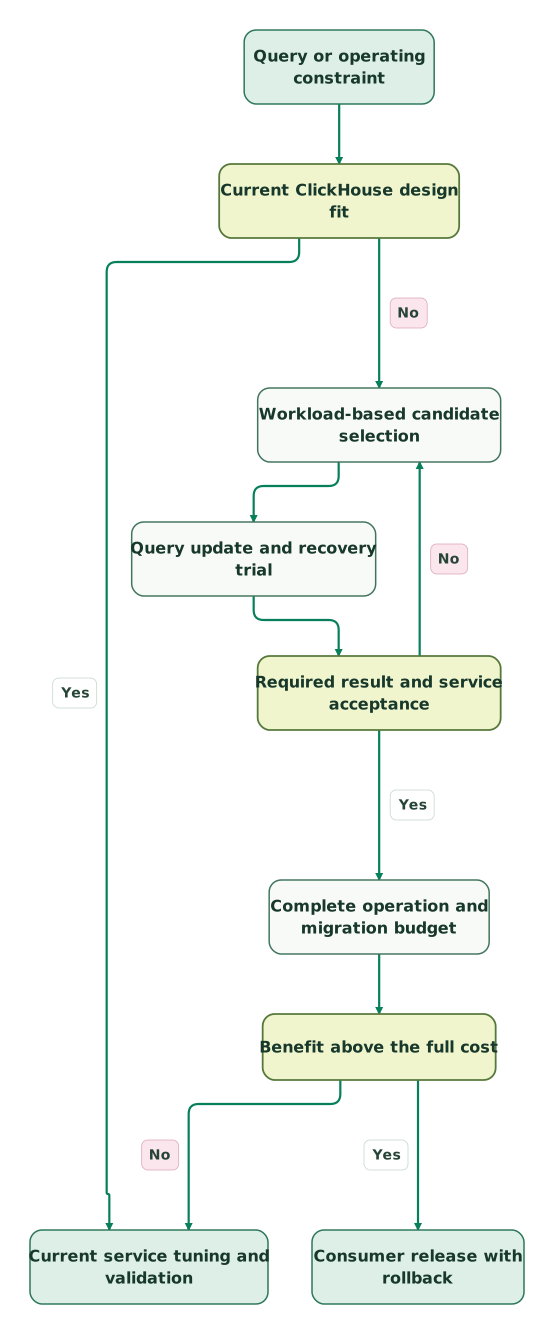
Read diagram as text
- Query or operating constraint to Current ClickHouse design fit.
- Current ClickHouse design fit to Current service tuning and validation: Yes.
- Current ClickHouse design fit to Workload-based candidate selection: No.
- Workload-based candidate selection to Query update and recovery trial.
- Query update and recovery trial to Required result and service acceptance.
- Required result and service acceptance to Workload-based candidate selection: No.
- Required result and service acceptance to Complete operation and migration budget: Yes.
- Complete operation and migration budget to Benefit above the full cost.
- Benefit above the full cost to Current service tuning and validation: No.
- Benefit above the full cost to Consumer release with rollback: Yes
Replacement checklist
- A specific query, data-change or operating constraint justifies the shortlist.
- The current ClickHouse configuration is a measured baseline.
- Event detail, current-state semantics and retention remain explicit.
- Concurrent queries and ingestion pass correctness and freshness checks.
- The team can operate the destination's indexes, state and recovery process.
- Software, hosting, backups, transfer and support all appear in the budget.
- Migration payback remains acceptable under realistic cost changes.
- One owner can execute cutover, reconcile results and roll back safely.
Use the marketing data audit skill to structure the workload evidence. Request a detailed analytics implementation scope, or start with the $99 martech audit for a written assessment and one-hour specialist call.
Keep reading
Browse all Data Warehouse guides
 Data Warehouse
ClickHouse vs Snowflake: Query Fit, Data Changes and Total Cost
Compare ClickHouse and Snowflake for event analytics and reporting. Review current update behavior, Interactive warehouses, compute costs and acceptance tests.
Jafrin Akter AloLast updated 12 min read
 Data Warehouse
Databricks Competitors and Alternatives by Workload and Cost
Compare seven Databricks alternatives for SQL, Spark and real-time analytics. See billing units, operating tradeoffs and a migration payback example.
Jafrin Akter AloLast updated 12 min read
 Data Warehouse
Redshift vs Snowflake: Cost, Workload Fit and Migration Checks
Compare Redshift and Snowflake by compute cost, workload fit, concurrency and migration. Use explicit billing examples and a practical acceptance checklist.
Jafrin Akter AloLast updated 11 min read
Data warehouse & CDP
See the implementation scope, deliverables and acceptance checks.
Questions people ask
Is Pinot upsert support limited to real-time tables?
The current Pinot guide documents upsert support across REALTIME, OFFLINE and HYBRID tables, with different supported modes. Full and partial upsert capabilities depend on that table configuration. Read the version-specific conditions and test replay, ordering and retained key state before migrating a mutable dataset; an older blanket real-time-only claim can exclude a valid option. Pinot upserts.
Does Druid rollup preserve every original event for later investigation?
Ingestion-time rollup combines records and trades away the ability to query individual events from the rolled-up representation. Keep raw detail separately when support, audit or future product questions require it. Define the retained dimensions, time granularity and metrics before release, and include that additional storage and ingestion path in the operating budget. Druid rollup.
Can StarRocks use a different sort key from its business identifier?
StarRocks Primary Key tables support a separately specified sort key, allowing record identity and query layout to serve different purposes. That flexibility still needs a correct primary key and a tested update policy. Validate duplicate identities, partial changes and query filters together, because a better sort layout cannot repair two business entities mapped to one record. Primary Key tables.
Can the existing PostgreSQL database handle our analytical dashboard?
It can be a candidate when the real workload fits its capacity and the team can protect transactional work. Test the largest query, peak concurrency, retained history and required freshness. A materialized view can reduce repeated work, but refresh behavior and indexing still need an operating plan. Passing a small sample alone does not establish production headroom.
Should we migrate solely because another engine has a free licence?
A free licence is one cost line. Hosting, backups, monitoring, recovery and the people maintaining the system can outweigh that saving. Compare the complete current and proposed operating budgets, then include migration and parallel running. A replacement is financially useful only when the expected benefit survives those costs and the service still meets its requirements.
Sources
- ClickHouse Cloud pricing
- ClickHouse Cloud warehouses
- ClickHouse lightweight UPDATE
- ClickHouse primary-key design
- Apache Pinot introduction
- Apache Pinot project and licence
- Pinot upsert support and capacity
- Apache Druid introduction
- Apache Druid project and licence
- Druid rollup
- Druid datasources and joins
- StarRocks features
- StarRocks project and licence
- StarRocks Primary Key tables
- Snowflake consumption and price tables
- Snowflake architecture
- Snowflake Interactive analytics
- Snowflake trial terms
- Snowflake Startup Accelerator
- BigQuery pricing
- PostgreSQL licence
- PostgreSQL materialized views
- PostgreSQL concurrent refresh

Written by
Jafrin Akter AloData Engineer and Co-founder at Martechdevs and Growth and Analytics Partners
Jafrin writes practical guides to marketing technology, customer data, analytics and AI workflows. Martechdevs is a Growth and Analytics Partners company.