
ZoomInfo vs Lusha for Sales Data, Enrichment and Team Costs
Pick Lusha for a smaller, clearly scoped contact-data workflow; pick ZoomInfo when a broader account-data, enrichment and activation requirement justifies a tailored package. ZoomInfo vs Lusha should be evaluated against the same target list and destination records. The right purchase supplies usable data at an acceptable complete cost, with update rules that your operations team can maintain.
On this page
ZoomInfo and Lusha comparison
Paid budgets should use the selected US package in USD, with users, credit volume, billing term and delivery requirements specified.
| Decision criterion | Lusha | ZoomInfo | Practical consequence |
|---|---|---|---|
| Entry cost | Free with 40 credits/month; Starter $49.90/month billed monthly, 400 credits and 1 seat | Custom package quote | A free sample and an enterprise quote serve different purposes |
| Evaluation | Permanent Free allowance | Typically 7-day free trial, with terms and limits that can vary | Agree the sample and export scope before evaluation |
| Data charges | Standard email reveal 1 credit; phone reveal 5 credits; delivery may add charges | Quote based on the use case and required scope | Compare complete accepted records, not raw credit totals |
| Main shortlist reason | A bounded data and enrichment workflow | Broader account data, orchestration and multiple destinations | Require a working demonstration of the intended scope |
| Repeated work | Re-viewing revealed data is free; new fields and other actions have their own rates | Public page advertises repeat retrieval within a year | Confirm the applicable contract and update definition |
Sources: Lusha pricing, Lusha credit guide, ZoomInfo pricing and ZoomInfo trial terms. ZoomInfo's repeat-retrieval offer should be written into the relevant scope before it is used in a recurring enrichment budget.
A smaller team may need one correct contact method for a carefully selected prospect. A larger operation may need company hierarchies, record maintenance and the same accepted data delivered to sales, marketing and a warehouse. Buying the broader arrangement makes sense only if those additional jobs are real and have owners.
At Martechdevs, we scope a sales-data implementation from the business records and destinations. That gives procurement a defined workload to price and gives the trial an acceptance test. It also makes the decision about replacing a provider separate from the decision about changing the rest of the sales stack.

Tool decision blocks
Lusha
- Best for: A small team or a bounded business unit that needs contact data and enrichment for a defined target segment.
- Pros: Its Free plan gives a persistent evaluation route, while paid packages let the team select the required volume and capabilities.
- Cons: An email, a phone number and a CRM write can consume different amounts. The cost of a complete output is larger than a single email-reveal rate.
- Free plan and startup offer: Free includes 40 credits/month, one seat and no credit card. No standard startup discount is included in this comparison; any approved concession should be separate from the regular renewal budget.
- Choose it if: The matched sample covers your accounts and the existing CRM process receives the needed fields with acceptable action-level cost.
- Skip it if: The planned scope requires broader account relationships or governance that the proposed package has not demonstrated.
ZoomInfo
- Best for: An operation evaluating a broader combination of account data, enrichment and activation across several systems.
- Pros: Its enrichment offering describes entity resolution and delivery to sales tools, warehouses and advertising destinations.
- Cons: The custom pricing model requires scope discipline. A broad proposal can include capabilities that the team has no clear plan to operate.
- Free plan and startup offer: The trial page describes a typical seven-day evaluation without a credit card, ending automatically; duration and terms can vary. No universal startup price or ongoing free allowance is assumed here.
- Choose it if: A representative multi-destination test and written contract support the additional jobs your business needs.
- Skip it if: Your requirement is a small contact lookup task and the proposed arrangement adds cost and administration without meaningful incremental coverage.
A vendor's product breadth is a reason to test a use case, not proof that every customer should buy it. Keep the shortlist narrow enough that the team can review actual records and failures. A confident recommendation should name the work that improves and the cost of obtaining that improvement.
Account coverage and person accuracy
Evaluate account coverage before person coverage. A company can have several domains, a trading name, subsidiaries and an ultimate parent. Decide the level at which your sales team assigns territory and ownership. A correct person attached to the wrong account can still cause a duplicate or a routing problem.
Create a reference sample containing ordinary accounts and the cases that make matching difficult. Include a company that recently changed its name, a subsidiary with a separate website and a business with several brands. The point is to reveal how the proposed workflow handles those relationships, rather than to reward the largest returned list.
Then define the person requirement. A useful contact must have the relevant role, current employer and required channel. Record title and employer mismatches separately from missing emails or numbers. A provider should not receive credit for finding a person who left the account merely because the contact method still works.
| Test layer | Acceptance question in plain terms | Retained evidence | Failure treatment |
|---|---|---|---|
| Company match | The returned company is the intended account | Source domain and destination company ID | Manual review or matching repair |
| Company relationship | Parent and subsidiary remain distinguishable | Relationship fields and territory outcome | Model correction |
| Person match | The person currently holds the relevant role | Name, employer and role review | Rejection or further verification |
| Contact method | The required email or phone is usable | Method type and validation outcome | Missing-field queue |
| Destination write | The approved data reaches the correct existing record | CRM ID and write result | Mapping repair and repeat test |
Use consistent definitions across both providers. Database totals often include different kinds of records and geographic coverage. They cannot answer how many relevant people are available at your own named accounts. A measured sample can support that narrower decision without pretending to establish a universal quality ranking.
Recurring enrichment and field ownership
Recurring enrichment needs a policy for accepted changes. A job move, company acquisition or domain change can be relevant, but each changes the business relationship in a different way. Preserve historical employment where your process needs it, and avoid replacing a known customer account solely because a new external value appeared.
Lusha's credit guide distinguishes re-viewing data already revealed from paying for newly revealed fields. Its FAQ also says unchanged or duplicate records written to a CRM are not charged as new writes. Test that distinction using your actual integration route and account pricing version.
ZoomInfo's pricing page advertises paying for a record and retrieving it again free for a year. Its enrichment page describes ongoing data updates. Request the applicable definition of record, retrieval, refresh and delivery in the order, including the point at which a changed identity or new field creates another charge.
An enrichment job should not have authority over every CRM field. Sales owns the next action and commercial stage. Billing owns payment state. A data provider can supply firmographic or contact information within an approved scope. Keep the source, previous accepted value and update time for fields that affect routing, so a disputed change can be explained.
The CRM property ownership guide helps define those boundaries. If enrichment currently breaks assignments, fix the ownership rule before judging another provider by the same broken process.
A hypothetical team budget and coverage threshold
Assume a hypothetical team has two scoped offers. Offer A costs $9,600/year and supports the required workflow for 4,800 unique approved contacts. Offer B costs $18,000/year and supports 9,000 unique approved contacts. These are invented planning inputs for a comparison method, not Lusha or ZoomInfo prices and not measured vendor coverage.
| Hypothetical offer | Annual cost | Approved contacts per year | Cost per approved contact |
|---|---|---|---|
| Offer A | $9,600 | 4,800 | $2.00 |
| Offer B | $18,000 | 9,000 | $2.00 |
| Offer B with only 6,000 approved contacts | $18,000 | 6,000 | $3.00 |
At an equal $2 cost per approved contact, the larger offer needs 9,000 useful outputs to match the unit economics of Offer A. If the team can only work 6,000 records, the additional capacity does not produce value merely by being available. Budget according to the approved audience and the team's capacity to act.
Now assume Offer B replaces another necessary subscription costing $3,600/year. Its net annual software cost for the comparison becomes $14,400, provided that old subscription can actually be retired. At 9,000 approved contacts, $14,400 ÷ 9,000 is $1.60 per contact. At 6,000 contacts it is $2.40. Keep the consolidation assumption visible until the replacement workflow passes.
Implementation and ongoing operations remain separate costs. If a wider setup requires an additional $4,000 in hypothetical project work, include that in the first-year budget. A first-year total and a recurring subscription are different comparisons. The software pricing tool can keep those lines together without hiding the assumptions.
For a broader quote review, use the ZoomInfo pricing guide. The Apollo vs Lusha comparison is useful when the potential saving comes from combining prospecting and outreach, while Apollo vs Cognism narrows a phone-led data evaluation.
Best fit by buying team
| Company size or operating model | Best fit | Runner-up | Decision reason |
|---|---|---|---|
| One seller validating a narrow segment | Lusha Free evaluation | ZoomInfo scoped trial | Start with a small coverage test before a wider commitment |
| Small sales team retaining its engagement tools | Lusha | ZoomInfo | A bounded data role can keep the project manageable |
| RevOps team supplying several business systems | ZoomInfo evaluation | Lusha configured package | Delivery, updates and ownership matter alongside contact coverage |
| Enterprise with complex account hierarchies | Matched hierarchy trial | Either vendor by accepted results | A wrong parent relationship can invalidate routing and reporting |
| Team considering vendor consolidation | ZoomInfo scoped proposal | Lusha plus retained tools | Count savings only for products that can be retired |
The broadest vendor is not automatically the best fit for the largest company. A large company can have a small, isolated prospecting requirement. A small company can need difficult account matching. Define the intended workload and evaluate the specific package, rather than using company size as a substitute for requirements.
Trial design and repair workflow
Agree trial access before submitting a sample. Confirm whether the team may export the selected fields, write to a test CRM destination and inspect the credit or usage record. A search-only demonstration cannot validate a production enrichment job that must maintain existing records.
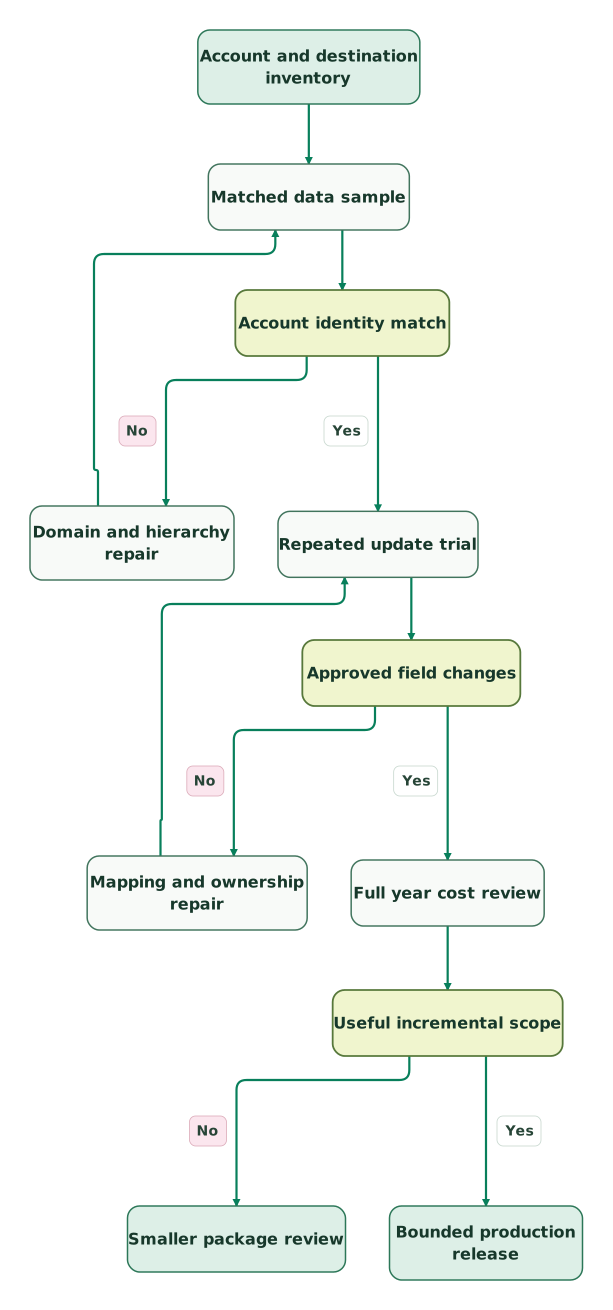
Read diagram as text
- Account and destination inventory to Matched data sample.
- Matched data sample to Account identity match.
- Account identity match to Domain and hierarchy repair: No.
- Domain and hierarchy repair to Matched data sample.
- Account identity match to Repeated update trial: Yes.
- Repeated update trial to Approved field changes.
- Approved field changes to Mapping and ownership repair: No.
- Mapping and ownership repair to Repeated update trial.
- Approved field changes to Full year cost review: Yes.
- Full year cost review to Useful incremental scope.
- Useful incremental scope to Bounded production release: Yes.
- Useful incremental scope to Smaller package review: No
The repeated update trial should contain an unchanged record, a new contact, a changed employer and a suppressed person. Inspect both the destination values and the reported charge. A repeat retrieval may be free while a different action in the same workflow still consumes credits or usage.
Both Lusha's integration catalogue and ZoomInfo's enrichment offering describe routes into other tools. Confirm whether each selected connector is native or partner-maintained, then assign someone to monitor failures. A supported integration still needs operational ownership.
Use a small production release after the test passes. Compare new and updated records with the approved sample, review exclusions and check that the sales team sees the correct account owner. Expand only after those outcomes are understood. The waterfall enrichment guide is useful if the accepted design retains a second provider for a specific missing segment.
ZoomInfo vs Lusha checklist
- Define the account level used for territory, ownership and reporting.
- Include subsidiaries, renamed companies and several domains in the test sample.
- Separate company matches, relevant people and usable contact methods.
- Confirm trial export and destination-write scope before judging the workflow.
- Record charges for reveals, delivery, repeat retrieval and changed fields.
- Preserve field ownership, suppression and source history in the CRM.
- Price the actual users, usage, destinations and contract term.
- Count consolidation savings only after the old product can be retired.
- Re-run identity and update checks after the relevant repair.
- Approve the first production cohort before broad enrichment.
The CRM data hygiene audit skill helps establish the acceptance criteria. A provider should earn the purchase through useful accepted records and a maintainable update process, with the required commercial scope written down.
Keep reading
Browse all GTM Engineering guides
 GTM Engineering
Apollo vs Cognism for Prospecting, Phone Data and CRM Workflows
Compare Apollo and Cognism by phone-data coverage, credits, CRM handoff and complete workflow cost, with a usable-record budget and a controlled trial plan.
Jafrin Akter AloLast updated 12 min read
 GTM Engineering
Apollo vs Lusha for Prospecting, Credits and CRM Enrichment
Compare Apollo and Lusha by usable contact coverage, paid workflow scope, credit charges, renewal rules and CRM updates, with a reproducible credit example.
Jafrin Akter AloLast updated 11 min read
 GTM Engineering
Apollo vs ZoomInfo for Startups: Choose on Coverage and Cost
Compare Apollo and ZoomInfo using current pricing, usable contact coverage, CRM workflows and total cost. See when Clay or Lusha belongs on your shortlist.
Jafrin Akter AloLast updated 12 min read
GTM engineering & outbound
See the implementation scope, deliverables and acceptance checks.
Questions people ask
Is ZoomInfo's quoted package directly comparable with Lusha Free?
A ZoomInfo package is not directly comparable with Lusha Free unless both cover the same required work. Lusha Free is useful for a small evaluation, while a tailored package may include broader data and delivery scope. Compare the paid setup that each workflow actually needs, then keep trial access separate from the production budget and expected volume.
Does repeat retrieval include every possible CRM action for free?
Repeat retrieval should not be assumed to include every CRM action. A contract or account schedule may distinguish viewing existing data, revealing a new field, refreshing a changed identity and writing to a destination. Record those actions separately in the trial and ask the vendor to confirm the applicable charges before using a repeat-access offer in the budget.
Can an account-hierarchy mismatch matter more than a missing phone number?
An account-hierarchy mismatch can matter more when it sends a valid contact to the wrong territory, owner or customer record. A missing phone number is visible; a wrong relationship can quietly distort routing and reporting. Include parents, subsidiaries and alternative domains in the sample, then validate the destination account rather than accepting a plausible company name.
Should a small team buy a broader package for future expansion?
A small team should buy future capacity only when the expansion has a credible workload, owner and budget. Start with the required current scope and document the cost of adding users, data or destinations later. A wider contract can be reasonable, but unused capabilities should not be counted as savings or as proof that the purchase will generate more pipeline.
Can Lusha remain a second source after a ZoomInfo rollout?
Lusha can remain a second source if it adds usable coverage for a defined segment or missing field. Specify the first-source failure that triggers it and measure the additional accepted records. Keep matching and suppression rules shared across both providers so the extra coverage does not create duplicate people, conflicting company relationships or unplanned enrichment charges.
Sources

Written by
Jafrin Akter AloData Engineer and Co-founder at Martechdevs and Growth and Analytics Partners
Jafrin writes practical guides to marketing technology, customer data, analytics and AI workflows. Martechdevs is a Growth and Analytics Partners company.