
Apollo vs Lusha for Prospecting, Credits and CRM Enrichment
Pick Apollo.io if your team wants prospecting and outreach in the same daily workflow; pick Lusha if you want a focused data layer that fits an existing sales process. Apollo vs Lusha depends on usable coverage, the actions charged to your credit balance and the CRM record that reaches a seller. Compare those outputs before choosing from headline database totals.
On this page
Apollo and Lusha comparison
Use the selected US package in USD for paid budgeting; the free starting terms below have different usage rules.
| Decision criterion | Apollo | Lusha | Selection consequence |
|---|---|---|---|
| Free entry | Permanent free plan with 75 credits/seat/month, plus eligible trials | Permanent free plan with 40 credits/month and 1 seat | Enough to inspect fit, with limits on a broad sample |
| Paid starting scope | Basic $49/seat/month billed annually or $65 monthly | Starter $49.90/month, billed monthly; 400 credits and 1 seat | Quote the team and actual work together |
| Core buying reason | Prospecting linked with sequencing and sales execution | Contact data, enrichment and delivery into other tools | Compare the complete workflow you intend to keep |
| Credit accounting | Verified email 1 credit; verified phone 8 credits; other actions separate | Standard email reveal 1 credit; phone reveal 5 credits | Credits are different commercial units |
| Export and integration | Confirm plan and CRM capabilities | CRM export can add 1 credit per written record | Include delivery in the usable-record budget |
The commercial details are in Apollo pricing, Lusha pricing and Lusha's credit guide. Lusha's FAQ distinguishes its permanent Free plan from its paid packages. Lusha Starter's monthly entry package is $49.90 for 400 credits and one seat. The right paid total depends on your required credits and workflow; a record count alone does not determine it.
A small team often wants the shortest path from a target account to an accountable next action. If Apollo replaces separate data and outreach tools, that combination can justify choosing it even when another vendor returns similar contacts. If the team already has a well-run engagement system, Lusha deserves a trial as a data source without forcing that process to move.
At Martechdevs, we design prospecting and CRM enrichment workflows around approved outputs. A person must match the target, survive exclusion rules and arrive in the correct CRM record before the workflow is complete. That definition makes the comparison more useful than counting downloads.

Tool decision blocks
Apollo.io
- Best for: A small sales team evaluating one place for target-list building, email sequencing and related execution.
- Pros: Basic includes sequencing and core integrations, so the data choice can also simplify the daily sales workflow.
- Cons: All seats on an account use the same plan level. Credit consumption and higher-plan requirements can change the economics for a team with mixed needs.
- Free plan and startup offer: Apollo Free provides 75 credits per seat per month, with a 14-day Basic or Professional trial. Its startup program offers eligible businesses 50% off for one year on Basic or Professional, up to five seats.
- Choose it if: Reps can discover, approve and work relevant prospects with fewer manual handoffs in the proposed configuration.
- Skip it if: You would retain the entire existing engagement stack and the evaluated data provides no meaningful advantage for your market.
Lusha
- Best for: A team that wants contact data and enrichment to serve an existing CRM and sales routine.
- Pros: Its integration catalogue distinguishes integrations built by Lusha from partner integrations, giving the implementation review a concrete starting point.
- Cons: Email, phone, API, export and other actions can have different charges. A monthly credit allowance cannot be read as the number of complete contacts delivered to the CRM.
- Free plan and startup offer: The Free plan provides 40 credits/month for one seat without a credit card. No universal startup discount is assumed; any additional offer belongs in the approved order.
- Choose it if: Its sample supplies the required people and fields, and the data arrives in the existing workflow with acceptable credit consumption.
- Skip it if: The selection rests on the idea that every returned contact costs one credit, regardless of phone, enrichment or delivery requirements.
Lusha also offers sales-engagement functions, so a data-layer recommendation does not mean it is limited to a browser lookup. Evaluate the exact product scope you intend to use. The more daily workflow you move into either vendor, the more important permissions, activity ownership and reporting continuity become.
A usable-contact definition
Write a shared definition before testing either tool. For an email-led program, the required output might be a current decision-maker at a target company with an approved work email and no exclusion. A phone-led program may require a direct number and a particular location. Those are different acceptance tests.
Maintain the original target list as the denominator. A vendor can return many people who are outside the desired role or company size. Removing no-match accounts from the report makes a weak provider appear stronger. Keep separate counts for requested accounts, matched accounts, relevant contacts and approved contact methods.
| Record condition | Accepted treatment | Reason |
|---|---|---|
| Correct person, current employer, required contact method | Eligible for the next controlled step | Meets the defined data requirement |
| Correct person, old employer | Review queue | The person may belong to a different target account |
| Relevant account, unrelated employee | Excluded from role coverage | A company match is not a decision-maker match |
| Existing customer or suppressed contact | Excluded from prospecting | Enrichment must respect the existing relationship |
| Duplicate person returned by both sources | One accepted person with source history | Duplicate data does not create another prospect |
Use the same segments in both trials. A provider that covers large US software companies well may behave differently for a narrow industrial role in another country. You do not need to establish a universal winner. You need a supplier that covers the segments your team will actually work.
The Apollo vs Cognism comparison is useful if verified phone data becomes the decisive requirement. The ZoomInfo vs Lusha comparison covers a broader data-delivery and enrichment decision. Keep the shortlist tied to a concrete gap in the sample.
Credit units and a hypothetical Lusha workload
Lusha's published standard rates are one credit for an email reveal and five for a phone reveal. Its credit guide also lists one credit per API or MCP call returning up to 25 results, one credit per CRM export record and different rates for waterfall results. The guide explicitly notes that rates can vary by pricing version, so confirm the applicable account schedule. Lusha credit rules.
Consider a hypothetical month with 200 newly revealed emails, 60 newly revealed phone numbers and 200 new CRM writes. Assume standard reveals, no waterfall, no API calls and no other paid actions. The same person may need both an email and a phone; these are action counts, not an invented total of 260 unique people.
| Hypothetical action | Volume | Published rate | Credit requirement |
|---|---|---|---|
| Standard email reveals | 200 | 1 credit/email | 200 |
| Standard phone reveals | 60 | 5 credits/phone | 300 |
| New CRM writes | 200 | 1 credit/record | 200 |
| Total | Defined actions above | Separate rates | 700 |
An email-only estimate would budget 200 credits and miss 500 credits of the planned work. The 40-credit Free allowance would cover 40 standard email reveals if used only for those actions, or eight standard phone reveals if used only for phones. Neither illustration includes exports or other chargeable activity.
Now assume 20 of the planned phone numbers are found through waterfall at eight credits each, replacing 20 standard five-credit reveals. The additional requirement is 20 × (8 minus 5) = 60 credits, and the total becomes 760. This is a hypothetical rate calculation, not an observed success rate or a claim that those matches will be available.
Apollo's pricing schedule lists one credit for a verified email and eight for a verified phone. The same hypothetical 200 emails and 60 phones therefore require 200 × 1 + 60 × 8 = 680 credits for those reveals alone. Add any other chargeable actions separately. The Apollo credit usage page explains reviewing actual usage by activity and user. This reveal-only total is a different scope from the Lusha example that includes CRM writes.
One-user subscription scope
Apollo Basic costs $49 per seat per month billed annually, including 30,000 credits per seat per year upfront. Monthly billing is $65 per seat with 2,500 monthly credits. Lusha Starter costs $49.90/month on monthly billing with 400 monthly credits and one seat. The credit units differ, so equal subscription totals would not imply equal output. Apollo pricing, Lusha pricing.
For a hypothetical one-user account, Apollo Basic annual billing is $49 × 12 = $588. Twelve monthly Basic payments total $780. Twelve monthly Lusha Starter payments total $598.80. These base-only calculations exclude additional credits, integrations and other products. Confirm the required actions and accepted records before using the small subscription difference as a purchasing reason.
Credit renewal and ordinary-year costs
Credit timing affects a seasonal team. Lusha says unused monthly credits can accumulate up to twice the plan's monthly limit while the subscription remains active; annual credits are provided upfront and reset at the annual cycle's end. Apollo says unused credits expire at the billing-cycle boundary and do not roll over. Lusha renewal rules, Apollo renewal rules.
Those rules should shape the purchase, not encourage unnecessary reveals before a reset. Collect only the data the workflow needs. A large unused allowance does not make irrelevant contacts valuable, and a consumed credit does not create permission to contact somebody.
Apollo's startup discount is conditional on approval and applies to a defined scope. Its program page lists fewer than 20 employees, no existing subscription, a valid company domain and partner affiliation among the criteria. Separate the first-year reduction from the ongoing plan and any other subscriptions retained in the stack.
Use the software pricing tool to compare annual cash commitment, included credits, additional usage, retained engagement tools and integration work. The Apollo pricing guide provides a deeper checklist for the order. A sensible budget uses the required paid plan after evaluation, rather than every capability temporarily visible in a trial.
Best fit by team workflow
| Company size or operating model | Best fit | Runner-up | Decision reason |
|---|---|---|---|
| Founder-led outbound with few existing tools | Apollo | Lusha | Prospecting and outreach can share a daily workspace |
| Established CRM and engagement system | Lusha | Apollo | Evaluate data delivery without assuming a workflow replacement |
| Small team testing a narrow email segment | Both free entry options | Paid scoped trial | Start with coverage and action accounting before a commitment |
| Phone-led team with selected priority accounts | Matched phone-data trial | Apollo or Lusha by result | Number quality and required fields should decide the winner |
| Operations team enriching CRM records repeatedly | Lusha evaluation | Apollo | Match, overwrite and renewal rules are central to cost |
These recommendations depend on the proposed implementation. If a team already operates Apollo successfully, replacing its data source can introduce additional reconciliation. If Lusha supplies a specific missing segment, a bounded second-source role may be easier to maintain than a complete platform replacement.
The waterfall enrichment guide explains the second-source approach. Set an explicit failure condition for calling another provider, such as a missing required email after a verified company match. Re-enriching every record through every source increases spend and creates more conflicting values to resolve.
CRM updates and failure handling
Before connecting either provider, decide which fields it may create, fill or replace. Treat person identity, company relationship and sales ownership as separate decisions. A vendor value can fill an empty company field while leaving a manually confirmed account relationship untouched.
Retain the source and the time of the update for fields that affect routing or qualification. When a rep disputes a phone number or employer, the administrator needs to trace the change. A single merged value without provenance makes it harder to improve the process.
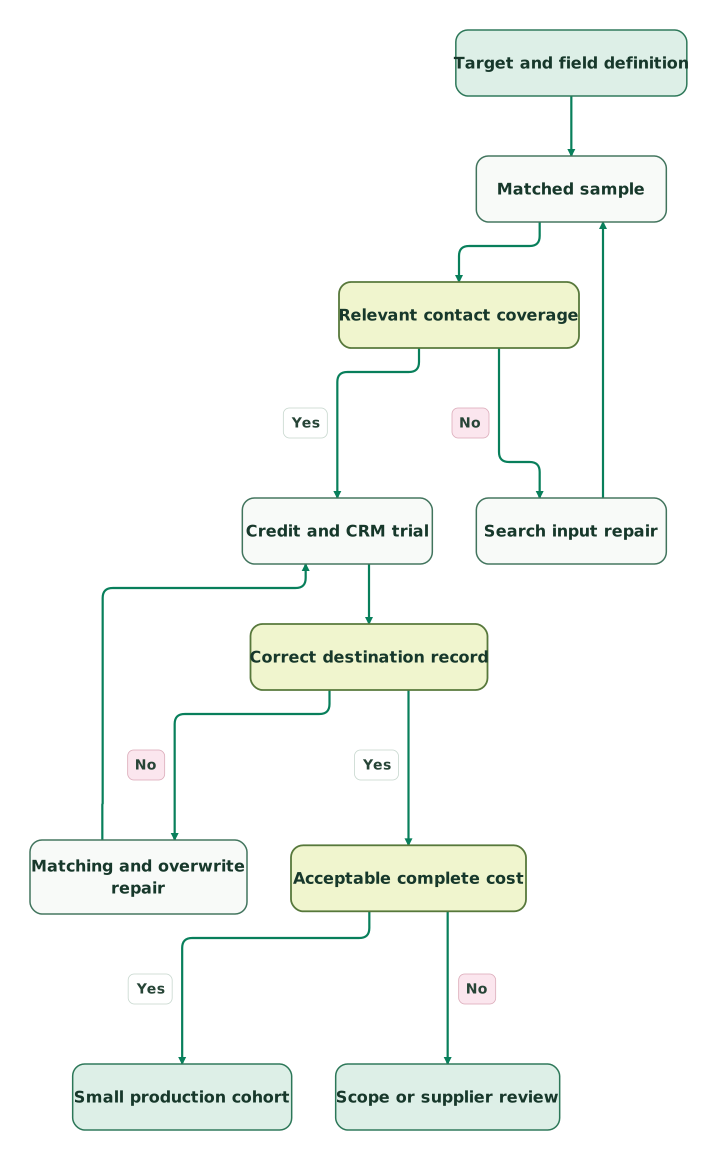
Read diagram as text
- Target and field definition to Matched sample.
- Matched sample to Relevant contact coverage.
- Relevant contact coverage to Search input repair: No.
- Search input repair to Matched sample.
- Relevant contact coverage to Credit and CRM trial: Yes.
- Credit and CRM trial to Correct destination record.
- Correct destination record to Matching and overwrite repair: No.
- Matching and overwrite repair to Credit and CRM trial.
- Correct destination record to Acceptable complete cost: Yes.
- Acceptable complete cost to Small production cohort: Yes.
- Acceptable complete cost to Scope or supplier review: No
The credit and CRM trial repeats after a matching repair because the change can alter the number of chargeable writes. A process that writes duplicates may consume more credits and create more work at the same time. Check both outcomes together.
Test a record with an existing email, a person whose employer changed, a company with several domains and a suppressed contact. Inspect the destination after the write, then run the same approved input again. The repeated run should produce the intended update behavior without silently creating another person or reopening a prospect who should remain excluded.
Apollo vs Lusha evaluation checklist
- Define a usable contact by role, current company, location and required channel.
- Preserve requested-account and requested-person denominators throughout the test.
- Give both vendors the same representative inputs and review criteria.
- Count email, phone, API, waterfall and CRM actions separately.
- Confirm the pricing version and credit renewal rules for the selected account.
- Include retained engagement tools and the ordinary renewal in the budget.
- Define matching, overwrite, suppression and source-history rules.
- Test repeated writes and employment changes on a bounded sample.
- Re-run the credit and destination checks after every relevant repair.
- Expand only after the approved CRM output matches the intended target list.
Use the CRM data hygiene audit skill for matching and overwrite decisions. The Apollo implementation mistakes guide helps identify the point where the prospecting result becomes a CRM or outreach failure.
Keep reading
Browse all GTM Engineering guides
 GTM Engineering
Apollo vs Cognism for Prospecting, Phone Data and CRM Workflows
Compare Apollo and Cognism by phone-data coverage, credits, CRM handoff and complete workflow cost, with a usable-record budget and a controlled trial plan.
Jafrin Akter AloLast updated 12 min read
 GTM Engineering
ZoomInfo vs Lusha for Sales Data, Enrichment and Team Costs
Choose between ZoomInfo and Lusha using account coverage, enrichment rules, trial scope and complete team costs, with a hypothetical usable-contact budget.
Jafrin Akter AloLast updated 11 min read
 GTM Engineering
Apollo vs ZoomInfo for Startups: Choose on Coverage and Cost
Compare Apollo and ZoomInfo using current pricing, usable contact coverage, CRM workflows and total cost. See when Clay or Lusha belongs on your shortlist.
Jafrin Akter AloLast updated 12 min read
GTM engineering & outbound
See the implementation scope, deliverables and acceptance checks.
Questions people ask
Do forty Lusha credits mean forty complete contacts with phone numbers?
No, forty Lusha credits do not mean forty complete email-and-phone contacts. Standard email reveals cost one credit and phone reveals cost five, with other actions potentially adding charges. Forty credits cover eight standard phone reveals if used only for phones. Define the required fields and delivery actions before translating a credit allowance into a usable contact count.
Can Apollo replace a separate outreach subscription during a Lusha comparison?
Apollo can be evaluated as a replacement for a separate outreach subscription if its selected plan supports the team's actual sequence and operating requirements. Include that potential consolidation in the trial, then test replies, exclusions, CRM activity and ownership. Remove the old subscription from the budget only after the team has approved the replacement workflow and transition scope.
Should both providers enrich every contact to improve coverage?
Both providers should not automatically enrich every contact. Use the second provider for a defined missing field or failed first-source result, then retain the evidence behind the accepted value. Running every record through both increases charges and conflict handling. Measure the additional usable output from the second source before expanding that part of the workflow.
Can a Lusha API lookup cost more than a workspace reveal?
A Lusha API lookup can include an API-call charge alongside the data revealed, while a workspace search follows its own rules. Its credit guide lists separate rates for calls, reveals and exports and notes that account pricing versions can differ. Test the exact delivery route you plan to use before budgeting from the cost of an interactive lookup.
Is a shared Apollo credit pool suitable for a mixed sales team?
A shared Apollo credit pool can suit a mixed team if an administrator sets spending expectations and monitors usage by person and action. All seats use the same plan level, so one group's requirements can influence the whole account's subscription. Model the highest required edition and the combined consumption, then check whether the resulting arrangement fits the team's actual work.
Sources

Written by
Jafrin Akter AloData Engineer and Co-founder at Martechdevs and Growth and Analytics Partners
Jafrin writes practical guides to marketing technology, customer data, analytics and AI workflows. Martechdevs is a Growth and Analytics Partners company.