
Looker Pricing: Platform Quotes, User Licences and the Full BI Bill
Looker pricing combines a quoted platform subscription with user licences, then adds the data and operating costs of the deployment. Google publishes edition entitlements but directs buyers to sales for the platform amount. Price the required user roles, API volume, security and embedding scope together, and include warehouse queries, implementation and any applicable Conversational Analytics consumption in the same budget.
On this page
Looker platform pricing and scope
Looker Google Cloud core uses annual commitments with quoted amounts; included users and API allowances vary by edition.
| Edition | Platform amount | Included users | Monthly query / administrative API allowance |
|---|---|---|---|
| Standard | Sales quote | 10 Standard and 2 Developer | 1,000 / 1,000 |
| Enterprise | Sales quote | 10 Standard and 2 Developer | 100,000 / 10,000 |
| Embed | Sales quote | 10 Standard and 2 Developer | 500,000 / 100,000 |
Sources: Looker pricing, Google Cloud core entitlements. The included user counts are a starting allowance, not the full audience you can assume at no additional cost.
At Martechdevs, we connect the warehouse and reporting implementation to the decisions a team needs to make. A shared revenue model, a dashboard for internal managers and an embedded customer-facing product can require different Looker packages even when the same data sits underneath.
Looker, original deployments and Data Studio
This guide's edition table applies to Looker Google Cloud core. Looker original and customer-hosted contracts use their own licensing descriptions and can have different allowances. For example, Google's original-platform descriptions distinguish Standard, Advanced and Elite packages. Match the product and deployment on the order before applying an online comparison. Looker original licensing.
Data Studio is a separate reporting product, with a no-charge offering and a paid Pro version. Google's former Looker Studio address now directs to Data Studio. Its free report-viewing terms do not establish free access to a Looker instance. Data Studio product and pricing.
If the requirement is a small marketing dashboard built from existing sources, start with the Data Studio pricing guide. If the requirement includes a maintained semantic model, controlled exploration or product embedding, compare the full operating scope of Looker and other BI candidates. The BI-tool pricing guide provides that wider comparison.
User types and paid access
Map users to tasks before negotiating quantities. Developers maintain the model and platform; Standard users build and explore analysis; Viewers consume the prepared content within their permitted scope. The licence is an entitlement boundary, and the configured permissions can narrow it further.
| User type | Typical work | Important boundary |
|---|---|---|
| Developer | LookML development, administration and API work | Administrative access still needs authorization |
| Standard | Explores, SQL Runner and dashboard creation | No Development Mode or Looker API-interface entitlement |
| Viewer | Existing dashboards and Looks, filtering, scheduling and downloads | No Explore, SQL Runner or dashboard creation |
Google's user entitlement matrix supports these distinctions. A Viewer is not automatically prohibited from every export or drill action, so test the intended access instead of assuming that a lower-priced role makes sensitive data safe.
Build the commercial seat list from approved jobs. A manager who needs to change filters may fit Viewer access; an analyst creating new questions may need Standard; a person maintaining LookML needs Developer rights. A shared login is not a substitute for a supported licence and traceable access design.
Also identify non-human access. An integration performing API work needs an approved identity and entitlement. Avoid treating a service account as an unpriced exception simply because it is absent from the employee directory.
Edition boundaries that change the quote
The core entitlement matrix caps Standard at fifty total users, including the included users. Enterprise and Embed remove that stated maximum. Enterprise adds capabilities such as private connections and customer-managed encryption keys; signed and cookieless embedding belong to Embed. Edition limits.
Private embedding and signed embedding are different features. Google's core overview makes private embedding available across editions while limiting signed embedding to Embed. State the required authentication and audience model before describing “embedding” as a sufficient requirement. Core embedding support.
The API allowance can become a buying constraint before employee count does. A small team running programmatic exports or an embedded product can have substantial query API demand. Record ordinary, peak and scheduled-call quantities, and ask how excess usage is treated in the proposed agreement.
A security requirement can also move a small team beyond Standard. Include network, encryption and deployment constraints in the request for a quote before choosing a package from user count. Then validate any AI-feature restrictions for that same configuration; feature availability across security settings should not be inferred from the edition name alone.
A public contract example in context
A 2021 Central Texas Regional Mobility Authority procurement packet contains a twelve-month Carahsoft quote with Looker Hosted platform, an add-on instance and fifteen Viewer users. The Looker lines total $87,612: $58,800 for the platform, $23,520 for the add-on instance and $5,292 for the Viewers. The larger $161,112 procurement total also includes Apigee. Original public purchase packet.
That historical purchase shows how instances and users create separate lines. Its amount applies to that specific historical procurement. Keep the dated product scope attached to the figures rather than using the whole procurement amount as a generic Looker starting price.
For a current decision, request an itemized offer with platform edition, included users, additional users by type, non-production instances and any external distribution rights. A single annual total prevents the buyer from seeing which part changes when the audience grows.
Worked budgets by company type
The following USD model uses assumed monthly-equivalent rates: $3,000 platform, $150 per additional Developer, $75 per additional Standard user and $20 per Viewer. It assumes two Developer and ten Standard users are included. These are planning inputs, not published Google prices or expected quotes. Data, AI usage, tax and implementation are excluded.
| Company situation | Required user mix | Monthly equivalent | Annual subtotal |
|---|---|---|---|
| Five-person team | 1 Developer, 4 Standard | $3,000 | $36,000 |
| Twenty-person analytics audience | 2 Developer, 10 Standard, 8 Viewer | $3,160 | $37,920 |
| Fifty-person internal audience | 3 Developer, 17 Standard, 30 Viewer | $4,275 | $51,300 |
| Two-hundred-person organization | 5 Developer, 35 Standard, 160 Viewer | $8,525 | $102,300 |
The fifty-user calculation is $3,000 + 1 × $150 + 7 × $75 + 30 × $20 = $4,275. Charge only the additional Developer and Standard quantities in this model; charging for the included allowance again would overstate the budget.
The platform assumption is held constant to make the seat arithmetic visible. The two-hundred-user case requires an appropriate edition and a fresh platform quote; the table does not imply Standard can exceed its maximum or that Enterprise costs the same amount.
The five-person case illustrates the fixed-cost effect. Using fewer than the included users does not, by itself, establish a smaller platform price. A lean team should demonstrate why the shared model and operating capabilities justify that commitment.
For the twenty-person case, add hypothetical one-time delivery of $12,000, monthly warehouse cost of $250 and monthly model maintenance of $400. First-year cost becomes $37,920 + $12,000 + 12 × ($250 + $400) = $57,720. A flat-scope second year is $45,720 before price changes or additional consumption. The data-warehouse cost guide helps scope the connected operating lines.
Warehouse queries and refresh costs
Looker produces queries against the connected data system. Include warehouse processing, storage and data movement in the reporting budget. Extra viewers can affect both the licence population and query demand, while a scheduled workload can consume compute without another person logging in.
For a hypothetical US BigQuery on-demand workload, assume five hundred uncached queries each process 50 GiB. That is 25,000 GiB, or 24.4140625 TiB. After the one-TiB monthly free allowance, if fully available to this workload, query processing is approximately $146.34 at $6.25 per TiB. Storage and other services remain additional. BigQuery rates and allowances.
Keep the free allowance at its actual billing scope; another workload may already consume it. Measure processed data rather than estimating cost from the number of dashboard views. Different filters, tiles and cache results can produce different underlying query work.
Looker's datagroups can coordinate query caching and persistent derived-table rebuilds with data changes. A maximum cache age controls when a query needs fresh results, while the rebuild policy has its own work and timing. Caching and datagroups.
Set a freshness requirement before shortening every refresh interval. Rebuilding a costly model repeatedly is useful only when the business needs the new data at that frequency. Test the first load after invalidation, normal cached use and scheduled deliveries together.
Conversational Analytics allowances and future charges
Google's pricing page provides promotional Conversational Analytics access without additional-usage billing, within fair-use limits, through 31 January 2027. Its published schedule starts monthly allocations and extra-usage billing on 1 February 2027. Keep that future charge separate from the current promotional period. Conversational Analytics pricing.
The announced monthly instance pool grows with activated paid users: one million input and 20,000 output data tokens per internal named user; 250,000 input and 5,000 output per embed user. Production has a sixty-million input and 1.2-million output minimum. Non-production has a forty-million and 800,000 baseline. Unused allocations do not roll over; extra usage is priced at $3 per million input tokens and $20 per million output tokens. Token allowances and rates.
A future-period worked example with one hundred internal named users has a 100M input and 2M output pool. If usage is 130M input and 2.5M output, the extra amount is 30 × $3 + 0.5 × $20 = $100. This is a forecast under the announced schedule, not a charge during the promotion.
The token model adds another reason to distinguish seats from activity. A small number of people can generate substantial conversational work, and longer context or output can change consumption. Measure accepted use cases before turning the allowance into a question-count promise.
Looker's System Activity dashboards provide operating visibility, including Conversational Analytics usage. Use the promotional period to establish the actual input/output distribution, with a named owner for the later billing transition.
Trials, contracts and growth planning
Google's core overview describes ninety-day trial instances. Moving to a paid non-trial deployment requires a new instance and an import rather than a direct in-place upgrade. Plan the pilot's handover before its expiry so useful model and acceptance work is preserved. Core trials.
A trial is different from an ongoing free production platform. Confirm the quoted subscription and any approved startup credits separately, including whether those credits apply to Looker or only to other cloud services. Do not treat a general cloud benefit as an automatic discount on a negotiated BI contract.
The pricing page describes one-, two- and three-year subscription terms and allows additional charges for usage beyond the subscribed allowance unless the agreement says otherwise. Looker commercial structure. Request the applicable excess rate and approval process before allowing programmatic use to grow.
For renewal, retain the current seat inventory, product scope, API use and consumption history. Ask for the next-term price at the current scope and at the planned scope. A discount tied to a longer commitment should be evaluated against the cost of unused seats, a changed audience and an additional instance.
Non-production also needs an explicit line. Google says it cannot replace production use and does not receive the same SLA coverage. For embedded development, the recommended staging configuration can add another instance. Non-production scope. Keep testing, release ownership and production reliability inside the buying plan.
Best fit by reporting scenario
| Situation | First scope to evaluate | Alternative | Acceptance evidence |
|---|---|---|---|
| Small internal team below the user ceiling | Core Standard | Simpler reporting tool | Shared-model benefit exceeds fixed commitment |
| Internal BI with private networking | Core Enterprise | Another governed BI platform | Required security and ordinary-user tasks |
| External signed embedding | Core Embed | Another embedded analytics product | Tenant isolation, authentication and API load |
| Existing original deployment | Current contract and migration options | Core proposal | Entitlement mapping and total transition cost |
| Small connector-based marketing report | Data Studio | Core only with a larger justified scope | Useful report delivery without unnecessary platform work |
Compare Tableau pricing, Power BI licensing and Metabase pricing on the same audience, security and maintenance requirements. The cheapest subscription may require more model work elsewhere, while a broad platform may contain capabilities the team will never use.
Looker quote and deployment acceptance
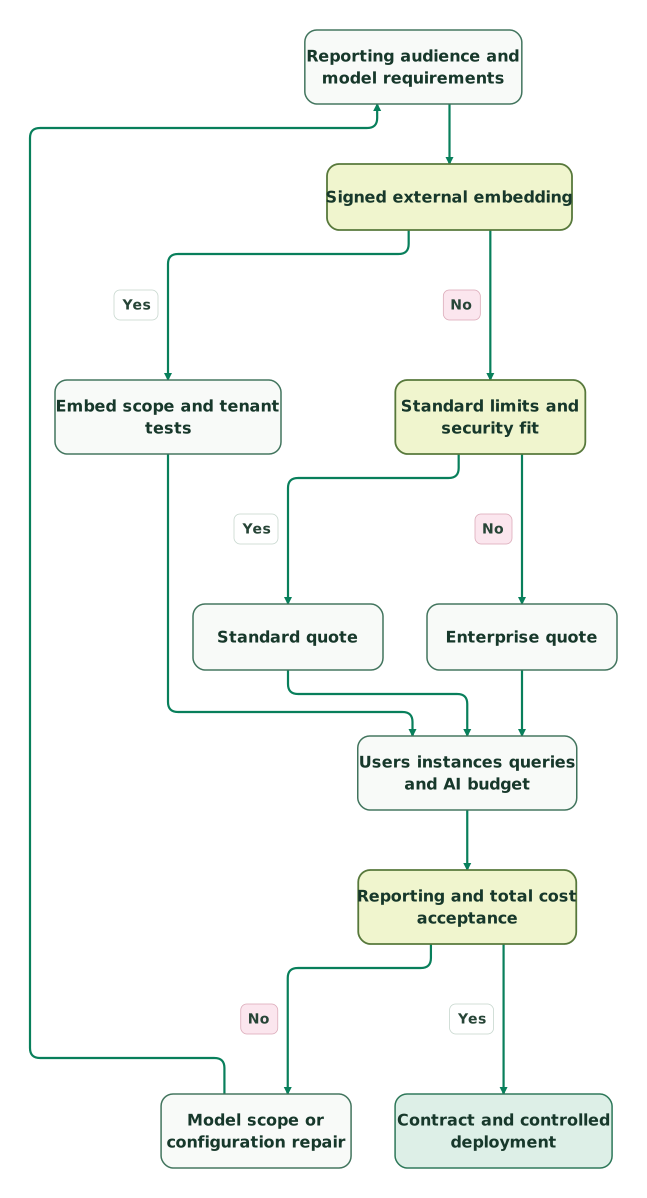
Read diagram as text
- Reporting audience and model requirements to Signed external embedding.
- Signed external embedding to Embed scope and tenant tests: Yes.
- Signed external embedding to Standard limits and security fit: No.
- Standard limits and security fit to Standard quote: Yes.
- Standard limits and security fit to Enterprise quote: No.
- Embed scope and tenant tests to Users instances queries and AI budget.
- Standard quote to Users instances queries and AI budget.
- Enterprise quote to Users instances queries and AI budget.
- Users instances queries and AI budget to Reporting and total cost acceptance.
- Reporting and total cost acceptance to Model scope or configuration repair: No.
- Model scope or configuration repair to Reporting audience and model requirements.
- Reporting and total cost acceptance to Contract and controlled deployment: Yes
Checklist
- The proposal names core, original or customer-hosted deployment correctly.
- Developer, Standard and Viewer tasks match the purchased access.
- Included users are deducted once from additional-user quantities.
- User ceilings, API limits and required security fit the selected edition.
- Embedded customers cannot access another tenant's data.
- Warehouse, refresh, staging and model-maintenance costs are included.
- Conversational Analytics promotion and later rates have separate budgets.
- Trial migration, renewal terms and excess usage have assigned owners.
Use the marketing data audit skill to collect the source and metric evidence. Our semantic-layer guide explains the model's role in consistent answers. Request a warehouse and reporting scope when the purchase depends on reliable data, maintained metrics and a usable reporting workflow.
Keep reading
Browse all Data Warehouse guides
 Data Warehouse
Tableau Pricing 2026: License Costs per User, Free Options, Cloud and Server
Creator $75, Explorer $42, Viewer $15 a month on Standard, billed yearly; $115, $70 and $35 on Enterprise. See budgets for 5 to 50 users and the free options.
Jafrin Akter AloLast updated 20 min read
 Data Warehouse
Power BI Pricing: Pro, Premium Per User and Fabric Licensing
Compare Power BI Pro at $14 and PPU at $24, annual team costs, F64 viewer rules, Fabric capacity and the licence mistakes that increase your bill.
Jafrin Akter AloLast updated 11 min read
 Data Warehouse
Metabase Pricing: Plans, How Billing Works and the Real Operating Cost
Metabase is free to self-host; Starter is $100 a month and Pro $575. See how billing counts users, what 10 to 50 people pay, and add-on and hosting costs.
Jafrin Akter AloLast updated 15 min read
Data warehouse & CDP
See the implementation scope, deliverables and acceptance checks.
Questions people ask
Does Looker's platform subscription include every employee as a paid user?
The core platform includes stated Standard and Developer allowances, with additional access depending on the selected user types and contract. Count the actual people and roles, then subtract included quantities once. Also check the edition's total-user ceiling. A platform subscription does not establish that an unlimited internal audience or external customer population is included without further licensing. Core entitlements.
Can a Looker Viewer create new dashboards or use Explore?
Viewer entitlement covers consuming prepared content and permitted filtering, scheduling and downloads, while dashboard creation and Explore belong to higher user types. Test the person's real tasks before choosing the licence. Permissions can further restrict access, and a Viewer licence alone should not be treated as a guarantee that exporting or sensitive-data access is disabled. User rights.
Does Looker's announced token pricing apply during the promotional period?
Google states that additional Conversational Analytics usage is not billed during the promotion through 31 January 2027, within fair-use limits. The published allocation and extra-usage schedule begins on 1 February 2027. Keep current and future budgets separate, and use observed input/output consumption to estimate the later charge instead of treating every question as an identical unit. Pricing schedule.
Can a ninety-day Looker trial become the paid instance without migration?
Google's core overview says a trial cannot be directly upgraded into a non-trial instance. The transition requires creating the target instance and importing the data. Include that step in the pilot plan, with ownership for configuration, access and validation, so the evaluation ends with a deployable handover rather than an assumption that the existing trial will continue unchanged. Trial transition.
Is a low Looker seat quote enough to forecast the BI budget?
The platform fee, additional instances, warehouse queries, AI consumption and implementation can materially change the total. Price the exact roles and required edition, then add the workload and ongoing model ownership. Keep first-year delivery separate from recurring costs so a discounted seat line does not conceal the amount the reporting service needs to operate reliably.
Sources
- Looker Google Cloud core pricing
- Core edition and user entitlements
- Core deployment, embedding and trial overview
- Looker original licensing descriptions
- Data Studio product and pricing
- Central Texas Regional Mobility Authority public purchase packet
- BigQuery pricing
- Looker caching and datagroups
- Looker System Activity dashboards

Written by
Jafrin Akter AloData Engineer and Co-founder at Martechdevs and Growth and Analytics Partners
Jafrin writes practical guides to marketing technology, customer data, analytics and AI workflows. Martechdevs is a Growth and Analytics Partners company.