
Metabase Pricing: Seats, Hosting, Embedding and the Real Operating Cost
Data Engineer and Co-founder, martechdevs
Last updated 9 min read
Metabase's cost depends on your plan, account count, deployment and optional usage. A useful budget separates internal reporting from customer-facing embedding, then adds warehouse queries and maintenance. Open Source has no license fee, but self-hosting still needs an operating owner. Paid plans can become necessary because of access requirements before your audience becomes large.
Last updated: 11 September 2026.
The most expensive mistake is choosing a plan from the number of dashboard builders while forgetting everyone who needs access. A founder, a department head and a customer opening embedded analytics can each affect a deployment differently. Count the proposed accounts and test the delivery method before approving the budget.
What are the published Metabase prices?
On 11 September 2026, Metabase lists these USD prices, excluding applicable taxes:
- Open Source: free software, self-hosted.
- Starter: $100 monthly with five users included; additional users $6 monthly. Annual pricing is $1,080 plus $65 per additional user per year.
- Pro: $575 monthly with ten users included; additional users $12 monthly. Annual pricing is $6,210 plus $130 per additional user per year.
- Enterprise: custom pricing, starting at $20,000 annually on the public page.
The annual base prices are commitments paid on an annual basis, not month-to-month subscriptions at the displayed monthly equivalent. Confirm your selected deployment and commercial terms at purchase. Metabase pricing.
Write the planned invoice in full: base subscription, extra accounts, optional services and taxes. Then add the costs outside Metabase. Our warehouse and reporting service scopes those data and operating requirements alongside the dashboard, because software selection alone does not determine the cost of trustworthy reporting.
Which requirement moves you to Pro?
Choose the least expensive plan that passes your required workflow. Metabase's comparison lists row and column permissions, database-managed row permissions, database routing and application permissions under Pro and Enterprise. Its curated Library is also gated to those plans. Plan comparison.
That makes permissions a purchasing input, not a configuration detail to discover after signing up.
Suppose a SaaS company needs regional managers to explore their own customer records while excluding other regions. The acceptance test is not whether the dashboard has a region filter. It is whether the manager can reach another region through the question builder, a different saved question, a download or any other allowed route.
Before choosing a plan, document:
- The people or customer accounts needing access.
- The records and fields each group may see.
- Whether they need a fixed report or freedom to ask new questions.
- Whether access rules live in Metabase, the database or the embedding application.
- Who approves changes and tests that restrictions still hold.
Some teams can meet their needs through a narrowly prepared dataset and simple reporting. Others require application-enforced isolation or database impersonation. Do not purchase a cheaper configuration by quietly weakening the requirement.
The Metabase implementation guide goes deeper into the access and modeling checks that should accompany the purchase.
What counts as a billable user?
Metabase's detailed billing guide counts accounts that exist and have not been deactivated, even if nobody signs in. Its daily calculation uses the maximum account count over a 36-hour window; accounts across instances sharing a license token are counted separately. Monthly charges are prorated. Annual payments and true-ups are non-refundable, and reductions do not refund prepaid accounts. Billing rules.
Treat the People list as part of financial administration. A list of monthly active readers is not an adequate purchasing forecast.
Create an account inventory before rollout. Record a business owner and an expected retention rule for employees, contractors, service identities and customer users. Some identities may not need a normal interactive account at all; confirm the integration's supported access method before creating one.
Use your identity provider's offboarding process where appropriate, then verify the resulting Metabase account state. Disabling an employee elsewhere and deactivating the relevant application account are not assumptions you should leave untested.
Avoid promising a precise invoice reduction on the afternoon you remove an account. Reconcile the billing view after its documented counting window and refresh, then check the next invoice. Your contract and payment cadence determine the actual adjustment.
A 25-account example: compare the full subscription
Assume 25 accounts remain billable for the whole period, with no optional usage, taxes, discounts or contractual changes. These calculations use the published rates above; they are illustrative budgets rather than quotes.
Starter monthly would be $220: the $100 base plus 20 extra accounts at $6. Annual pricing would be $2,380: $1,080 plus 20 at $65.
Pro monthly would be $755: the $575 base plus 15 extra accounts at $12. Annual pricing would be $8,160: $6,210 plus 15 at $130.
Compare those annual totals with your expected account stability. Do not treat a yearly discount as a saving if you are committing to an audience you have not validated.
More importantly, this calculation does not establish that Starter is suitable. If the required access design depends on Pro capabilities, the cheaper total is not a viable alternative. Compare Pro with other configurations that meet the same requirement, or redesign the scope deliberately.
A useful pilot question is: how many people need to explore, and how many only need a specific decision delivered to them? Answer that from actual work. Do not impose inconvenient access arrangements simply to make a spreadsheet look cheaper.
How does embedding change the budget?
Metabase distinguishes guest embedding from authenticated embedding. Its billing documentation says authenticated full-app and modular embedding users count as users; guest embeds do not require those viewer accounts. Embedding billing.
Those options are not interchangeable product experiences. Start with what the customer must do, then choose an approach.
A fixed account-health report might need a small set of filters. A customer analytics workspace might need exploration, saved work and broader interaction. Prototype those tasks inside your product, using the authentication and data isolation you intend to ship.
For guest embeds, Metabase documents server-signed tokens and locked parameters as the mechanism for restricting data before it reaches the browser. Guest embedding documentation.
That creates implementation responsibilities. The server must derive the authorized customer from the authenticated session, not accept a customer ID supplied by the browser as proof of access. Test a tampered request, an expired token, an account switch and an unauthorized report identifier. These are recommended acceptance tests, not a claim that a specific deployment has passed them.
Estimate embedding with three separate inputs:
- The customer experience and access controls required.
- The billable account population under the chosen method.
- The engineering work needed to integrate, test and maintain it.
If you expect thousands of end customers, request a written commercial model using a realistic population and growth scenario. A small internal BI estimate is not a forecast for a customer-facing product.
What does self-hosting add?
Self-hosting moves work onto your team. Metabase's Docker guide distinguishes its local quick start from a production setup and requires a production-ready application database for production use. That application database stores the reporting configuration; it is separate from the business data you analyze. Docker production guidance.
Budget for the running service, its application database, backups, monitoring, network access and upgrades. Add the time needed to test restores and troubleshoot incidents. If the only person who can recover the service is unavailable, the operating design needs improvement regardless of its hosting price.
Use an illustrative comparison to make the tradeoff visible. Suppose self-hosting infrastructure costs $70 monthly and maintenance takes three hours at an assumed $75 per hour. The operating subtotal is $295 before warehouse queries or any paid license.
Suppose a managed option requires one hour of your own monthly administration instead. That saves two hours, worth $150 at the same assumed labor rate. The relevant question is whether its subscription premium is justified by that avoided work and the reliability you need.
These are planning assumptions, not Metabase or cloud-provider prices. Replace them with your team's measured maintenance work after the pilot. A team with an established platform operation will have a different cost from a team building one for a single reporting application.
Which usage charges belong outside the seat estimate?
Warehouse compute remains a separate cost. A low-cost report can still repeatedly scan an expensive query. Include the data warehouse, connector and transformation costs needed to supply each dashboard, even when another department pays those invoices.
AI also requires a separate usage assumption. Metabase's AI settings distinguish your own provider credentials from its managed Cloud AI service; an MCP client's model is separate from those built-in provider settings. AI configuration.
At this review, the public pricing page and detailed billing guide described the managed AI charging basis differently. Confirm the rate and included allowance in your account or written quote before budgeting it. Do not build a purchase decision around an unresolved documentation difference. Pricing, billing guide.
For any optional transforms, storage or AI capability, request the unit, allowance, reset period and overage behavior. Ask whether a limit blocks further use, creates an extra bill or only produces an alert. Those outcomes have different operational consequences.
Start with a representative week of work. Record the questions asked, transformations run and data refreshed, then model an ordinary month and a busy month. A demo session with a few questions does not establish production usage.
How should you make the purchase decision?
Put the requirement, account forecast and operating plan into one decision record. Each should have an owner who can explain its assumptions.
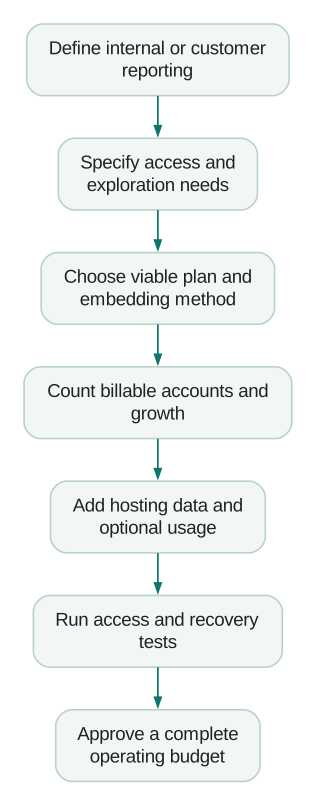
Separate one-time work from recurring work. Modeling source data, rebuilding a dashboard and integrating authentication may be implementation tasks. User administration, warehouse queries and maintaining transformations continue after launch.
For a founder evaluating a proposal, ask what will be delivered beyond “Metabase installed.” A useful scope identifies the datasets, metric definitions, access groups, dashboards, acceptance tests and handover. A login page alone is not a reporting system.
If your current tool already serves the required decisions, include improving it as an option. The Data Studio alternatives guide provides a report-based comparison method, while metric contracts help make the outputs comparable across tools.
What should your pre-purchase checklist contain?
- The chosen plan supports the demonstrated access requirements.
- The account forecast includes internal and embedded users where applicable.
- Annual commitments and account-reduction rules are understood.
- The deployment has a named maintenance and recovery owner.
- Warehouse, connector and optional usage costs are separate budget lines.
- Any unclear rate is confirmed in the checkout or written agreement.
- The pilot includes restricted-user, offboarding and recovery tests.
- The implementation scope defines the reports and decisions it must support.
After launch, compare forecast and invoice using the same account-count definition. Then compare reporting usefulness: are people making the intended decisions, or asking for exports because the model still does not answer their questions? Cost control is worthwhile, but a cheap unused report is still wasted work.
Questions people ask
Is Metabase completely free?
The Open Source edition has no software license fee. Your deployment still needs infrastructure and someone to maintain it, plus the data systems it queries. Check whether that edition meets your required access and reporting workflow before comparing costs.
Do inactive readers still affect billing?
An unused account can still count if it has not been deactivated. Review application account state, not only login activity. Reconcile changes with the documented billing calculation and your subscription terms.
Is self-hosted Pro free because we provide the server?
Self-hosting and software edition are separate choices. Running your own infrastructure does not remove a paid edition's license requirement. Compare the selected license and your hosting costs together.
Can guest embedding reduce per-user costs?
Guest viewers do not require the same billable accounts as authenticated embedding, but the experience and access design differ. Validate that the supported interaction fits the product and that server-side authorization is correct. Do not substitute a public or weakly restricted report for required customer isolation.
Should a small team buy an annual plan immediately?
Use the pilot to validate account demand, required features and operating ownership first. A longer commitment can fit a stable deployment, while uncertainty about audience or product fit favors retaining flexibility. Compare total committed spend, not just the advertised monthly equivalent.
Sources
- Metabase: Current pricing. Accessed 11 September 2026; prices and optional usage terms can change.
- Metabase: Plan comparison. Accessed 11 September 2026.
- Metabase: How billing works. Accessed 11 September 2026; managed AI pricing basis differs from the public pricing page at review.
- Metabase: Guest embedding. Accessed 11 September 2026.
- Metabase: Running in Docker. Accessed 11 September 2026.
- Metabase: AI settings. Accessed 11 September 2026.
Written by
Jafrin Akter AloData Engineer and Co-founder, martechdevs
Jafrin Akter Alo is a data engineer and co-founder of martechdevs, where the team has delivered 74+ martech, data and growth stack implementations.