
Airbyte Alternatives for Managed Pipelines, Connector Control and Cost
Choose Fivetran for a managed connector workflow, Stitch for a bounded source-and-destination requirement with replicated-row pricing, or Meltano Open for code-owned pipelines with an engineering operator. Useful Airbyte alternatives must preserve updates, deletions and recovery behavior. Compare those outcomes and complete operating costs before replacing a connector because its first load looked simpler elsewhere.
On this page
Airbyte competitors compared
Public USD starting offers below have different usage units and deployment responsibilities.
| Tool | Starting price and billing basis | Best fit | Main tradeoff |
|---|---|---|---|
| Fivetran | Free up to 500,000 connection MAR/month; paid usage estimated by plan and connection | Managed source-to-warehouse replication | MAR differs from total replicated rows |
| Stitch | Standard from $100/month at the displayed 5-million-row tier | A qualified set of standard sources and destinations | Repeated updates and nested records can affect row usage |
| Meltano Open | Free self-hosted software; infrastructure and operations separate | Engineering-owned pipelines in code | The team owns runtime, monitoring and connector work |
| Airbyte, retained baseline | Core free to self-host; Standard from $20/month with five credits | Existing connectors or custom-source requirements | Metering, plan scope and hosting choice require review |
See Fivetran pricing, Stitch pricing, Meltano's deployment and pricing options and Airbyte pricing. Airbyte Standard and Plus use volume-based credits, while Pro and Enterprise Flex use capacity arrangements. A free software distribution is a different purchase from a managed service.
We would first identify the reason for leaving Airbyte. A missing connector field, an unstable schedule, an unexpected bill and an unowned deployment require different remedies. A small configuration repair can be preferable to a migration if the connector already supplies the required data correctly.
At Martechdevs, we define source contracts, destination models and failure ownership through our data warehouse implementation service. The useful trial includes a changed record and a restart, rather than ending after the first successful import.
Airbyte and alternative decisions
Airbyte
- Best for: Teams whose existing connector coverage or source customization fits their warehouse requirement.
- Pros: The current offer includes managed and self-hosted options, with plan-specific scheduling and capacity choices. Its sync modes separate source reading from destination writing.
- Cons: A connector name does not prove every stream supports the required update or delete behavior. Self-hosted operation needs a dedicated owner.
- Free plan and startup offer: Core is free to self-host under Elastic License 2.0. Cloud has a 14-day trial with 400 credits, described as about 100 GB, without a card; metering varies by source type. No startup concession is assumed. See Airbyte terms.
- Choose it if: The required streams pass the incremental, deletion and recovery tests, and a bounded improvement solves the current problem.
- Skip it if: A representative source remains unreliable under the qualified configuration and another tool demonstrably supplies the accepted output.
Fivetran
- Best for: A team that wants to evaluate managed replication and a defined support boundary for its required connectors.
- Pros: Standard includes managed connectors, fifteen-minute sync scope and platform access controls. The trial can focus the data team on source qualification and output reconciliation. See Fivetran plans.
- Cons: Usage depends on distinct active rows within the documented connection boundaries. Additional connections, history mode and source behavior can change the budget.
- Free plan and startup offer: Free includes up to 500,000 connection MAR/month; each new connection has a fourteen-day free trial. Activation and transformation allowances are separate. No startup credit is included in the regular budget. See pricing.
- Choose it if: The relevant connector and required plan pass a real update/recovery workload at an acceptable complete cost.
- Skip it if: The estimate treats every source as equivalent or assumes the warehouse's final row count is the billing measure.
Stitch
- Best for: A team with a limited set of qualified standard sources and a straightforward warehouse destination requirement.
- Pros: Standard publishes a row-based entry offer, with one destination, ten standard sources and five users in the listed scope. See Stitch pricing.
- Cons: Updated rows, copies and rows created by de-nesting can contribute to usage. A source with frequent full replication may consume more than its stored row count suggests.
- Free plan and startup offer: Stitch advertises a fourteen-day trial without a card, with unlimited rows during the trial. This is an evaluation period rather than a permanent free production allowance. No startup discount is assumed. See trial terms.
- Choose it if: The source types, destination count and measured row demand fit the selected plan and the trial preserves required data changes.
- Skip it if: A required source or destination falls outside the assumed Standard scope, or repeated replication makes the chosen row allowance unsuitable.
Meltano Open
- Best for: An engineering team that wants to own pipeline configuration, deployment and connector behavior in code.
- Pros: Meltano uses Singer taps and targets, manages their configuration and retains incremental state for subsequent runs. See replication documentation.
- Cons: The self-hosted setup needs infrastructure, monitoring and recovery ownership. Free software does not remove the work of maintaining its connectors.
- Free plan and startup offer: Meltano Open is the self-hosted open-source option. Meltano Cloud is a separate managed offer; no cloud fee or startup concession is inferred from Open's free availability. See Meltano options.
- Choose it if: The team can maintain code and state deliberately and values control over the pipeline's implementation.
- Skip it if: The purpose of leaving Airbyte is to eliminate self-hosted operating work and no one will own that work in Meltano.
Connector coverage and source behavior
Start with the specific streams and fields the business uses. A CRM connector can support contacts while missing the custom object or historical field that makes the report useful. A marketing connector can expose daily totals while the business needs a different attribution window or breakdown.
Record the required source object, key, update marker, deletion behavior and historical range. Include source API limits and the credentials used to retrieve data. A missing field can be caused by source permissions, not the integration vendor.
| Source requirement | Trial case | Acceptance evidence |
|---|---|---|
| New record | Create a known source record | Correct destination key and values |
| Updated record | Change a non-key business value | Expected current state without duplicate identity |
| Deleted record | Remove or mark a test record deleted | Documented destination treatment |
| Historical correction | Update an older period | Correct modeled result after the next qualified sync |
| New field | Add a representative field | Intended schema handling and downstream visibility |
Airbyte's sync-mode documentation distinguishes incremental and full-refresh reading from append, overwrite and deduplicated writing. That is a useful vocabulary for every candidate. A product label such as incremental is incomplete without knowing how the destination represents the resulting history. See Airbyte sync modes.
Keep bulk warehouse ingestion separate from event collection and activation. If the requirement is application SDK collection and identity routing, mParticle vs Segment covers that decision. If it is sending prepared warehouse audiences back to business tools, use Hightouch alternatives.
State, retries and recovery
The second sync is often more informative than the first. It shows whether the connector recognizes changes, resumes from the correct point and preserves the intended destination key. A restart test then shows whether a partially completed load can be repeated without corrupting the accepted model.
Meltano documents that incremental replication resumes using the same state identifier. Treat that state as part of the pipeline's operational data, with appropriate persistence and recovery. A container or scheduled task that loses state can turn an incremental job into unexpected repeated work. See Meltano replication state.
For every shortlisted tool, test a failure at a safe boundary in an isolated destination. Record the last accepted source position, retry the job and reconcile business keys and values. The objective is the correct result after recovery, rather than a green status alone.
Distinguish freshness from scheduling. A fifteen-minute schedule does not guarantee data appears fifteen minutes after the business event. Source availability, API delay, extraction, loading and transformations all contribute. Define the end-to-end freshness target and retain timestamps for each stage.
The marketing data freshness guide helps express that requirement. The data incident runbook assigns the response when a pipeline falls behind or delivers a partial result.
Airbyte alternative billing units
Fivetran MAR counts distinct active primary keys within its documented account, connection and table boundaries. An ordinary row updated several times in one month is normally counted once, while history mode and other source-specific behavior need their own review. The same source delivered through two connections can contribute separately. See Fivetran usage definitions.
Stitch counts replicated rows, including updates, copies of existing rows and rows created by de-nesting. Its usage can therefore differ from the final number of rows in the destination. See Stitch row accounting.
Consider a hypothetical steady-state month with 1,000 new rows and 200 different existing rows each updated five times. Assume no initial-load grace period, no nested records, no history-mode materialization and no overlap between the new and updated keys.
| Hypothetical quantity | Calculation | Result | Interpretation |
|---|---|---|---|
| New-row transfers | 1,000 | 1,000 | New keys |
| Update transfers | 200 × 5 | 1,000 | Repeated transfers of existing keys |
| Total replicated operations | 1,000 + 1,000 | 2,000 | Row-transfer view of the work |
| Distinct active keys | 1,000 + 200 | 1,200 | MAR-style view under stated assumptions |
| Same active keys across two separately counted connections | 1,200 × 2 | 2,400 | Connection boundaries matter |
This is a unit comparison, not a claim that every connector bills exactly these amounts. Source-specific handling, keys and plan terms must match the assumptions. Airbyte's credits use a different source-dependent schedule, so these row totals cannot be converted directly into Airbyte credits.
Subscription and operating-cost examples
At the published starting amounts, twelve unchanged monthly Airbyte Standard base payments are $20 × 12 = $240, and twelve Stitch Standard entry payments are $100 × 12 = $1,200. These are entry-subscription arithmetic examples, not equal-capacity or complete-cost estimates. Additional usage and required features can change both. See Airbyte and Stitch pricing.
A self-hosted option needs a separate operating worksheet. Assume a hypothetical deployment costs $150/month in infrastructure and requires six maintenance hours valued internally at $80/hour. Its planning cost is $150 + 6 × $80 = $630/month, or $7,560/year, before project work and warehouse charges. These are illustrative inputs, not Meltano or Airbyte prices.
The comparison should include source API fees, warehouse compute, staging storage, backfills, monitoring and support. A managed subscription can be worth more if it removes work the team actually performs, but the saving should come from the pilot's observed operating tasks rather than a generic time-saving claim.
Use the Fivetran vs Airbyte guide for the direct managed-versus-configurable comparison, and the software pricing tool for the complete budget. The Airbyte implementation mistakes guide can reveal a repairable problem before the team commits to replacement.
Best fit by pipeline operating model
| Company or operating model | Best fit | Runner-up | Decision reason |
|---|---|---|---|
| Small data team seeking managed connector operation | Fivetran | Airbyte Cloud | Qualified connector behavior and support scope lead the trial |
| Limited standard sources with one warehouse destination | Stitch | Fivetran | Entry scope is concrete enough to test directly |
| Engineering team owning code and infrastructure | Meltano Open | Airbyte Core | Implementation control can justify operating responsibility |
| Working Airbyte deployment with a narrow sync issue | Airbyte repair | Qualified connector alternative | A bounded correction may avoid migration |
| Source requiring unusual extraction logic | Custom-connector evaluation | Meltano or Airbyte by demonstrated fit | The actual API and stream behavior decide the route |
Pipeline replacement workflow
The graph first distinguishes managed operation from code-owned deployment. Both routes must preserve source changes and recovery behavior, with repairs repeating the same validation before cost and handover review.
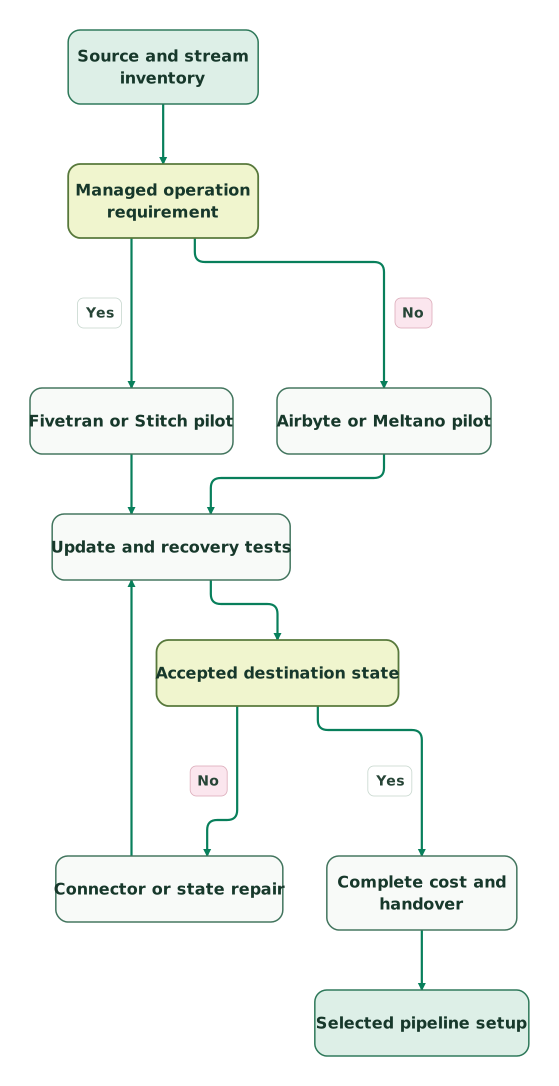
Read diagram as text
- Source and stream inventory to Managed operation requirement.
- Managed operation requirement to Fivetran or Stitch pilot: Yes.
- Managed operation requirement to Airbyte or Meltano pilot: No.
- Fivetran or Stitch pilot to Update and recovery tests.
- Airbyte or Meltano pilot to Update and recovery tests.
- Update and recovery tests to Accepted destination state.
- Accepted destination state to Connector or state repair: No.
- Connector or state repair to Update and recovery tests.
- Accepted destination state to Complete cost and handover: Yes.
- Complete cost and handover to Selected pipeline setup
Airbyte replacement checklist
- A named replacement reason and a bounded in-place repair option.
- Required source objects, fields, keys and historical coverage.
- Known insert, update, delete and old-period correction cases.
- A restart test with preserved state and reconciled destination results.
- Schema-change behavior and downstream model ownership.
- An end-to-end freshness target rather than a schedule alone.
- Correct billing units for each proposed connection and plan.
- Infrastructure, backfill, warehouse and maintenance costs separated.
- A handover owner able to investigate the next failed sync.
The marketing data audit skill helps organize the source and reconciliation evidence. Keep the accepted fixtures with the pipeline documentation so upgrades can repeat the same tests after the original migration is complete.
Keep reading
Browse all Data Warehouse guides
 Data Warehouse
Fivetran vs Airbyte: Compare the Workload, the Bill and the Maintenance
Compare Fivetran and Airbyte with current billing rules, worked costs, HubSpot connector checks and a practical pilot for small marketing data teams.
Jafrin Akter AloLast updated 11 min read
 Data Warehouse
Airbyte Implementation Mistakes: Syncs, Schemas and Recovery
Diagnose Airbyte duplicates, missing updates, partial backfills and unsafe Clear or Refresh recovery, with a SQL fixture and stream-level acceptance checks.
Jafrin Akter AloLast updated 12 min read
 Data Warehouse
How to Set a Useful Marketing Data Freshness SLA
Set a marketing data freshness agreement around real decisions. Define cutoffs, coverage, deadlines, alerts and recovery, with a runnable readiness fixture.
Jafrin Akter AloLast updated 14 min read
Data warehouse & CDP
See the implementation scope, deliverables and acceptance checks.
Questions people ask
Can a successful first load prove an Airbyte alternative is production-ready?
A successful first load does not prove the connector is ready for ongoing production work. Test changed records, deletions, older-period corrections and a restart after partial failure. Reconcile the destination's business keys and values after each case. A green job status is useful operational evidence, while the accepted data result is the actual requirement.
Are Fivetran MAR and Stitch replicated rows the same quantity?
Fivetran MAR and Stitch replicated rows are different quantities. MAR generally counts distinct active keys within documented boundaries, while Stitch can count repeated updates, copies and de-nested rows. Match the source and configuration to each definition before estimating cost. See Fivetran usage and Stitch row accounting.
Does moving from Airbyte Core to Meltano Open remove hosting work?
Moving from Airbyte Core to Meltano Open does not remove self-hosted operating work. The team still needs infrastructure, monitoring, credentials, state persistence and recovery ownership. The value of the move must come from the desired code and connector workflow. Meltano's deployment comparison distinguishes Open from its managed Cloud offering.
Can an unchanged source row count predict the monthly ingestion bill?
An unchanged source row count cannot by itself predict an ingestion bill. Existing rows can update repeatedly, full replication can copy them again and nested data can expand into additional destination rows. Build the estimate from actual change and replication behavior, then apply the selected vendor's unit definition and source-specific rules.
Should a fifteen-minute sync schedule be treated as a fifteen-minute freshness guarantee?
A fifteen-minute sync schedule should not be treated as an end-to-end freshness guarantee. Source API availability, extraction duration, load time and downstream transformations can add delay. Define the acceptable age of the business result and record the stage timestamps during the pilot. The operating owner should know which stage to investigate when the report is late.
Sources

Written by
Jafrin Akter AloData Engineer and Co-founder at Martechdevs and Growth and Analytics Partners
Jafrin writes practical guides to marketing technology, customer data, analytics and AI workflows. Martechdevs is a Growth and Analytics Partners company.