
Gorgias vs Zendesk for ecommerce support and ticket costs
Pick Gorgias if ecommerce order context and shopper actions define the support team's daily work; pick Zendesk if the organization needs a broader ticket operation across products, teams and channels. Gorgias vs Zendesk also compares ticket-volume billing with agent-based subscriptions. Model the actual request mix, AI outcomes and order permissions before choosing from a headline price or an automation rate.
On this page
Gorgias vs Zendesk comparison
Prices are public USD before tax; Gorgias entry figures use monthly Helpdesk-only billing, while Zendesk figures are paid annually.
| Decision | Gorgias | Zendesk |
|---|---|---|
| Core billing basis | Starter $10/month for 50 tickets and 3 seats; Basic $60/month for 300 tickets | Support Team $19/agent/month; Suite Team $55 |
| Broader configuration | Selected Helpdesk tier plus required AI, Voice and SMS scope | Suite Professional $115/agent/month; Enterprise + Copilot quoted |
| Main shortlist job | Shopper requests connected to store and order context | A common ticket operation across service needs |
| Key cost driver | Billable tickets, automated outcomes and channel add-ons | Licensed agents, plan, AI usage and channel costs |
| Free evaluation | 7-day trial without a credit card | 14-day trial; paid plan afterward |
Sources: Gorgias pricing, Gorgias billing rules, Gorgias trial, Zendesk pricing and Zendesk trial. Gorgias Helpdesk-only and Helpdesk plus AI are separate selected configurations; the budget below states the ticket tier, AI package and billing term.
At Martechdevs, we connect support requests to customer and order data through customer support automation. We would begin a Gorgias pilot with an order-status question, a requested order change and a return or refund case. We would begin a Zendesk pilot with the organization's shared ticket lifecycle and the routes between its service teams.
Both candidates need a defined resolution. A message sent, a ticket closed and an accepted customer outcome are different things. Keep those distinctions visible in the operational report and in the commercial usage model.
Tool decisions
Gorgias
- Best for: Ecommerce support teams whose work regularly depends on customer profiles, order history and actions in the store platform.
- Pros: The Shopify connection exposes customer and order context and supports actions such as cancellations and refunds, subject to the relevant permissions. Shopify integration scope.
- Cons: Ticket-based pricing depends on the actual billable interactions. AI outcome charges can apply alongside helpdesk ticket usage, and channel add-ons have separate meters.
- Free plan and startup offer: Gorgias advertises a seven-day trial without a credit card. Its production pricing uses ticket-volume plans; no permanent free plan or startup concession is assumed. Trial, pricing.
- Choose it if: The team can resolve representative shopper requests from the integrated order context with clear action permissions and escalation.
- Skip it if: Most requests concern a broader service operation with limited ecommerce context, or the budget omits billable automation and channel usage.
The pilot should show the difference between reading an order and changing it. An agent may need to view shipping information without being allowed to issue a refund. Gorgias distinguishes roles with conversation access from roles allowed to perform integration actions. User permissions.
Test a request whose answer depends on a recent change in the store. Confirm that the agent sees the intended customer and current order, then verify what happens if the integration cannot retrieve that information. A confident answer from stale context is a service failure even if the ticket is closed quickly.
Zendesk
- Best for: Organizations managing a shared support process across several request types, products, teams or channels.
- Pros: The product provides ticket routing, triggers and automations, with broader channels and advanced routing in relevant Suite plans. Zendesk plan features.
- Cons: The lowest Support price is insufficient for a Suite-dependent workflow. Ecommerce context and actions also need a qualified integration design rather than an assumption that ticketing alone supplies them.
- Free plan and startup offer: Zendesk provides a fourteen-day trial and requires a paid plan afterward. The budget uses standard rates without a startup concession. Trial terms.
- Choose it if: The support organization can define its common ticket lifecycle, routing and reporting, then connect the required customer context.
- Skip it if: The main need is a narrow shopper workflow and the proposed broader configuration adds administration without a useful operating benefit.
A Zendesk pilot should include movement between teams. Start with an ordinary order question, then escalate a technical or billing issue to its responsible group. The customer-facing owner should remain clear, and the new group should receive the context needed to continue.
Use the support customer-context guide to specify the accepted customer and order fields. The Front vs Zendesk comparison covers another option when cross-team conversation collaboration is the central requirement.
Shopper requests and order actions
An ecommerce support workflow is more than a reply template. It combines identity, order state, permitted actions and a customer-visible result.
| Request | Required context | Action boundary | Acceptance evidence |
|---|---|---|---|
| Order status | Correct customer, order and fulfilment state | Read-only lookup | The reply reflects the accepted order state |
| Address change | Order identity and change eligibility | Permitted edit or escalation | The change is confirmed in the store |
| Cancellation | Current fulfilment and cancellation status | Authorized action | The store and ticket agree on the outcome |
| Refund | Order, payment and approved policy | Authorized refund or review | Accepted amount and status are recorded |
| Product question | Current product information | Advice within approved knowledge | The answer matches the intended product |
The helpdesk should make those boundaries visible. Avoid treating an integration connection as permission for every agent or automation to perform every supported action. Test the actual user role and the application's response when the action is unavailable.
Gorgias's current role guide says Observer users can view and leave internal notes, Lite users can reply and update tickets, and Basic adds integration actions such as Shopify refunds or cancellations. Gorgias roles. Use those documented distinctions to design the pilot, then confirm the selected account configuration.
For Zendesk, map the corresponding user, integration and action permissions in the proposed implementation. Validate the action with a safe representative case and a case that should be escalated. The relevant outcome is a correct store operation and customer response, rather than an attractive order panel.
Billable tickets and automated outcomes
Gorgias counts a helpdesk ticket as billable when at least one message is sent from the helpdesk, including a human reply, an AI reply or a rule-based automatic response. Additional messages in that same ticket do not each become another helpdesk ticket. Internal notes or assignment changes alone do not create that message-based charge. Gorgias ticket definitions.
AI outcome billing adds another boundary. Under the current documented model, a ticket fully resolved by AI Agent can count toward helpdesk tickets and incur an additional automation fee. A handoff to a human changes the treatment. The guide also describes a 72-hour period without human involvement for an automated interaction. Automation billing.
Do not subtract every automated interaction from the helpdesk volume when budgeting the current model. That would understate the applicable ticket count. Equally, do not assume every AI reply becomes a billable automated outcome: a reply, a handoff and a successful resolution have different definitions.
Legacy accounts can differ. Gorgias describes a separate treatment for eligible accounts created before May 28, 2025 that have not moved to the specified newer subscription scope. Check the account's applicable agreement before using the current dual-fee model for a renewal calculation. Legacy qualification.
Zendesk measures AI-agent usage through automated resolutions, with plan-based allowances and additional purchases where required. Zendesk AI-agent usage. Its unit should be evaluated under its own definition rather than imported from Gorgias's interaction rule.
Ticket-volume and seat-budget examples
Gorgias's selected Helpdesk-only prices separate monthly subscriptions from annual commitments. The table excludes AI packages, ticket overages, Voice, SMS and tax. Gorgias pricing.
| Helpdesk plan | Included tickets/month | Monthly billing, USD/month | Annual billing equivalent, USD/month |
|---|---|---|---|
| Starter | 50 | $10 | Monthly billing only |
| Basic | 300 | $60 | $50 |
| Pro | 2,000 | $360 | $300 |
| Advanced | 5,000 | $900 | $750 |
Starter includes three seats, so ticket-volume pricing should not be interpreted as unlimited user access on every plan. Confirm the applicable seat allowance alongside traffic and features. Annual Basic, Pro and Advanced Helpdesk-only totals are $600, $3,600 and $9,000 respectively. Plan scope.
The following hypothetical monthly calculations use Basic Helpdesk-only at $60 for 300 included tickets, with $0.40 per extra ticket. They exclude AI and all other charges. The pricing card and the vendor's billing example support that selected basis. Current pricing, billing example.
| Monthly billable tickets | Included tickets | Additional tickets | Basic helpdesk amount, USD |
|---|---|---|---|
| 300 | 300 | 0 | $60 |
| 500 | 300 | 200 | $140 |
| 1,000 | 300 | 700 | $340 |
For 500 billable tickets, the calculation is $60 + 200 × $0.40 = $140. A different selected tier or agreement needs its own base, allowance and overage rate. A higher tier can be more suitable than recurring overages, so compare the production order rather than extrapolating Basic indefinitely.
Zendesk's corresponding base subscription follows licensed agents and plan. The following hypothetical examples use annual USD rates and exclude AI, telephony, messaging usage, add-ons and tax.
| Licensed configuration | Monthly equivalent, USD | Annual subscription, USD | Calculation |
|---|---|---|---|
| 5 Support Team agents | $95 | $1,140 | 5 × $19 × 12 annually |
| 5 Suite Team agents | $275 | $3,300 | 5 × $55 × 12 annually |
| 10 Suite Team agents | $550 | $6,600 | 10 × $55 × 12 annually |
| 10 Suite Professional agents | $1,150 | $13,800 | 10 × $115 × 12 annually |
Inputs come from Zendesk pricing. The Gorgias and Zendesk tables are billing illustrations, with no claim of feature or service equivalence. Ticket volume and licensed headcount need to describe the same real support operation before a purchase comparison is meaningful.
For a concrete AI package example, Gorgias's monthly Basic configuration with AI shows $90 total: $60 Helpdesk with 300 tickets, plus $30 for 30 automated interactions. The selected card lists $1.50 per extra automated interaction. If a hypothetical month contains 500 billable helpdesk tickets and 100 chargeable automated interactions, the calculation is $90 + 200 × $0.40 + 70 × $1.50 = $275. Gorgias selected package.
Those 100 automated outcomes are part of the assumed 500 helpdesk tickets where the current dual-fee rule applies. They are not added as another 100 helpdesk tickets. The same selected Basic AI package is $77 per month equivalent on annual billing, or $924 billed for the year, before overages and exclusions. Use the selected package and overage terms rather than applying a single flat AI price to every plan.
Use the software pricing tool to combine base subscriptions, overages, AI outcomes, Voice, SMS, integration work and support administration. The support AI pricing guide helps separate an agent assistant from a system that completes the customer request.
Peak demand and staffing
A ticket-volume model and a seat model respond differently to a seasonal campaign. The store may receive more requests without adding agents, or add temporary agents while each handles fewer requests. Model both changes rather than treating average monthly volume as the only input.
In a hypothetical ordinary month, six agents handle 1,200 billable requests. A promotion produces 2,400 requests and the team adds four temporary agents. Ticket volume doubles, while licensed headcount rises from six to ten. Those are different growth rates and should be separate budget lines.
The same plan must also support the peak operational workload. Test routing, queue visibility and the response for an unavailable order integration. A low bill is insufficient if requests remain unowned during the period the store most needs support.
Define the escalation owner before the campaign. The agent should know where to send an order action that requires approval, and the receiving team should know the required response. Include that handoff in the staffing plan rather than assuming automation handles every exception.
Reporting and migration validation
Compare outcomes using a defined population. A closed-ticket count may include solved issues, duplicate requests or automatically closed conversations. A successful order action needs its own evidence in the store system. Keep these measures distinct.
Gorgias notes that an existing conversation can split into a new ticket after channel-specific inactivity periods, and merged tickets can still retain billable events. Conversation and merge billing. A visually consolidated conversation is therefore not sufficient evidence that all associated usage disappeared.
For migration, validate a customer with several orders and several support interactions. Confirm the accepted customer identity, linked order, active owner, status, internal notes and relevant attachments. A matching count of imported tickets does not establish that an agent can continue an unresolved case.
Keep a bounded overlap and a documented retirement condition for the old system. Run a representative request from each important channel, a reopened issue and an unavailable integration. The support manager should be able to find unowned and overdue work before accepting cutover.
Best fit by support model
| Company size or operating model | Best fit | Runner-up | Decision reason |
|---|---|---|---|
| Shopify store with order-driven support | Gorgias | Zendesk with qualified commerce integration | Order context and permitted actions define daily work |
| Multi-product service organization | Zendesk | Gorgias for a separate commerce scope | A shared ticket process spans more request types |
| Seasonal ecommerce team | A volume-and-seat model of both | The other qualified setup | Peak tickets and temporary staffing affect different meters |
| B2B team requiring extensive conversation collaboration | Front shortlist | Zendesk | The collaboration requirement can change the candidates |
| Existing platform with unclear AI outcome counts | Billing-definition review | Either tool after reconciliation | A reported automation rate is insufficient for a budget |
Support selection workflow
Both routes must prove that the customer context and order action are correct before the usage model is accepted.
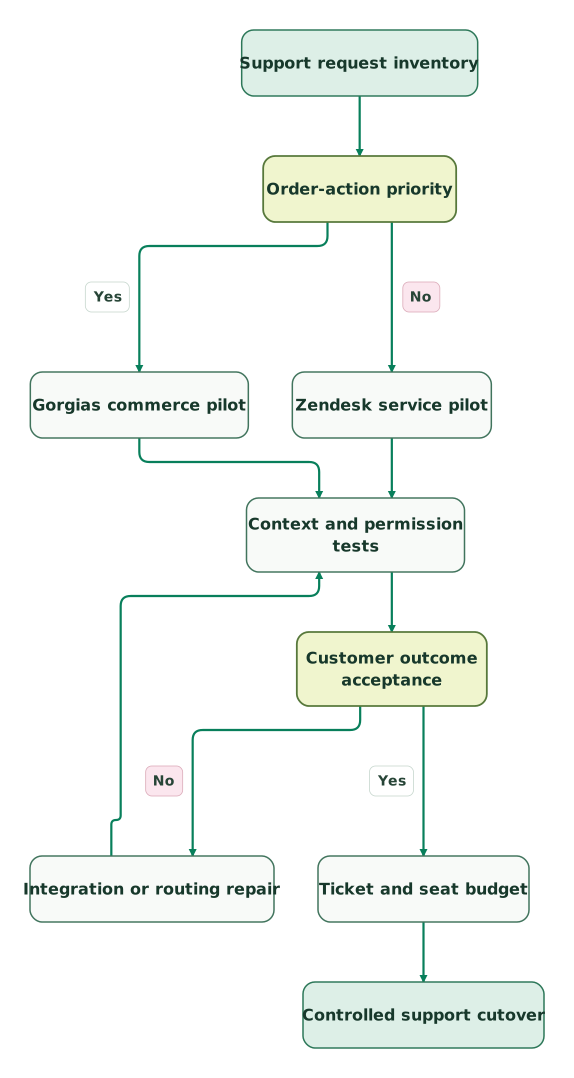
Read diagram as text
- Support request inventory to Order-action priority.
- Order-action priority to Gorgias commerce pilot: Yes.
- Order-action priority to Zendesk service pilot: No.
- Gorgias commerce pilot to Context and permission tests.
- Zendesk service pilot to Context and permission tests.
- Context and permission tests to Customer outcome acceptance.
- Customer outcome acceptance to Integration or routing repair: No.
- Integration or routing repair to Context and permission tests.
- Customer outcome acceptance to Ticket and seat budget: Yes.
- Ticket and seat budget to Controlled support cutover
A repaired integration or route repeats the context and permission tests. Confirm the successful action in its authoritative system and the customer-facing message in the helpdesk. One side can succeed while the other remains incomplete.
Support evaluation checklist
- Inventory request types, channels and order-dependent actions.
- Define the accepted customer outcome and authoritative order state.
- Map agent roles separately from integration permissions.
- Test read-only lookups, permitted changes and required escalation.
- Confirm billable ticket, AI outcome and legacy-contract definitions.
- Model seasonal ticket volume and temporary staffing separately.
- Reconcile active cases, context and attachments after migration repairs.
- Approve the complete subscription, usage and administration budget.
Use the CRM audit skill to organize customer identity and ownership before connecting the support platform. The Zendesk implementation mistakes guide adds useful checks for the ticket configuration and operational handover.
Keep reading
Browse all CRM & Lifecycle guides
 CRM & Lifecycle
Front vs Zendesk for collaborative service and support operations
Choose Front or Zendesk by conversation collaboration, ticket operations and channels. Compare seat costs, trial limits, automation and migration checks.
Jafrin Akter AloLast updated 11 min read
 CRM & Lifecycle
Gorgias Alternatives: Five Competitors for Ecommerce Support
Compare Gorgias alternatives on Shopify actions, seats, AI usage and migration. Review Re:amaze, Help Scout, Freshdesk, Zendesk and Richpanel with worked budgets.
Jafrin Akter AloLast updated 12 min read
 CRM & Lifecycle
Zendesk vs Freshdesk: Compare the Right Plans, AI Bill and Renewal Cost
Zendesk vs Freshdesk pricing: both start at $19 per agent, but Freshdesk tops out at $89 and Zendesk Suite Professional at $115. Compare plans, AI and costs.
Jafrin Akter AloLast updated 23 min read
Customer support automation
See the implementation scope, deliverables and acceptance checks.
Questions people ask
Can one Gorgias AI resolution count toward both helpdesk and automation usage?
One fully AI-resolved Gorgias ticket can count toward helpdesk usage and an additional automation fee under the current documented model. A handoff to a human changes the treatment, and eligible legacy subscriptions can use different rules. Reconcile the account's applicable billing definition before subtracting automated work from the helpdesk volume. Gorgias billing rules.
Does every message in a Gorgias conversation create another billable ticket?
Every message in the same Gorgias ticket does not create another helpdesk ticket charge. Its billing guide counts a ticket with at least one message sent from the helpdesk as one billable ticket, regardless of the number of messages exchanged. Separate ticket creation, channel add-ons and automated outcomes can still affect usage. Ticket definition.
Can a Gorgias user who replies also issue Shopify refunds automatically?
The ability to reply in Gorgias does not automatically establish permission to perform Shopify refunds. Gorgias's role guide distinguishes Lite conversation access from Basic access that adds integration actions. Validate both the helpdesk role and the connected store's permissions, then test an action that should succeed and one that should be escalated. User permissions.
Does Gorgias ticket-volume pricing mean unlimited seats on Starter?
Gorgias ticket-volume pricing does not mean unlimited seats on Starter. The selected Starter offer includes three seats and fifty monthly tickets for $10 on monthly billing. Check the chosen tier's user allowance, features and usage terms together. A support team that needs more access should compare the appropriate production configuration. Gorgias plan scope.
Should an ecommerce support team compare average traffic with permanent agents only?
An ecommerce support team should model campaign peaks and temporary agents as well as its ordinary month. Ticket-volume and seat-based subscriptions respond to different inputs. Record the expected requests, licensed agents, automation outcomes and channel usage for the busy period, then test whether routing and escalation work at that operating scale before approving the purchase.
Sources

Written by
Jafrin Akter AloData Engineer and Co-founder at Martechdevs and Growth and Analytics Partners
Jafrin writes practical guides to marketing technology, customer data, analytics and AI workflows. Martechdevs is a Growth and Analytics Partners company.