
Fullstory vs Mixpanel: Event Analysis, Replay and Product Decisions
Pick Mixpanel when recurring event funnels, retention and cohort questions lead the product team's work; pick Fullstory when detailed interaction investigation is the first priority. Fullstory vs Mixpanel has substantial feature overlap, including analytics and session replay. Choose from the evidence-to-decision workflow, the measurement design and the complete commercial scope, rather than assuming one tool only supplies charts and the other only recordings.
On this page
Fullstory vs Mixpanel comparison
Free allowances and paid terms below use current public offers; Fullstory paid pricing requires a scoped quote.
| Decision | Fullstory | Mixpanel |
|---|---|---|
| Free analytics and replay scope | 30,000 sessions/month, ten seats, one-year replay and analytics retention | Up to 1 million events/month, 10,000 replays/month and unlimited seats |
| Paid commercial basis | Business, Advanced and Enterprise packages, requested pricing | Growth usage selection; Enterprise custom scope |
| Displayed paid example | Written quote for required capture and features | Growth calculator: $1,200/year for the displayed 18-million-event annual setting; monthly option $140/month |
| First evaluation job | Investigate an interaction and produce useful repair evidence | Define and analyze a conversion or retention population |
| Scope trap | Free excludes advanced features such as Dashboards and mobile-app capture | Event and replay allowances are separate units |
See Fullstory plans, FullstoryFree scope and Mixpanel pricing. The Mixpanel calculator example is a specific displayed selection, not a universal Growth minimum. Its free allowance and Growth maximum are different figures.
We would first ask the team to describe its weekly product decision. If the team needs to compare activation across cohorts and monitor a defined conversion path, Mixpanel belongs early in the trial. If the team starts with a confusing or broken interaction and needs contextual evidence for a repair, Fullstory deserves the first evaluation.
At Martechdevs, we build the event definitions and identity rules behind that decision through our product analytics implementation service. A useful pilot begins with a known business population and ends with an action the team can explain and verify.

Fullstory and Mixpanel decision blocks
Fullstory
- Best for: Product, engineering and support teams using interaction evidence to investigate friction and prioritize a specific repair.
- Pros: Session replay provides behavioral context, and the paid plan matrix includes product analytics capabilities such as funnels and segmentation.
- Cons: Recording volume alone does not establish useful analysis. The selected plan must cover the required reporting, mobile and capture controls, while the team owns review and classification.
- Free plan and startup offer: Free includes 30,000 sessions/month and ten users, with one-year replay and analytics retention. Advanced features and the stated anonymized-data terms differ from paid scope. No startup concession is assumed. See Free details.
- Choose it if: The trial can connect an important product problem to interpretable evidence, a repair owner and a measurable follow-up.
- Skip it if: The team would accumulate sessions without a defined investigation process or cannot qualify the required plan and capture scope.
Mixpanel
- Best for: Product and growth teams with recurring questions about event conversion, retention and meaningful user cohorts.
- Pros: Funnels measure conversion through defined event sequences and time windows. The current offer also includes session replay, rather than requiring a purely numerical investigation.
- Cons: A clear event and identity model remains essential. A plausible chart can reflect duplicate users, inconsistent event definitions or an unintended conversion window.
- Free plan and startup offer: Free includes 1 million events and 10,000 replays monthly. The startup program offers an eligible first year free for companies founded less than five years ago, with up to $8 million funding and no previously redeemed offer. See Mixpanel plans.
- Choose it if: The team can define the population and events, validate the result and use the analysis to choose a product action.
- Skip it if: Instrumentation has no owner or the decision depends on a specific replay investigation that the proposed capture setup has not demonstrated.
Overlapping tools and different starting questions
Both products include analytics and replay capabilities, so the buying question should be more specific than quantitative versus qualitative. Fullstory's plan matrix includes funnels, segmentation and analytics; Mixpanel's pricing lists replay alongside analytics. Compare the actual feature and allowance scope in the selected offer. See Fullstory plans and Mixpanel plans.
A recurring metric workflow starts with a defined population, event sequence and reporting period. An analyst compares segments, identifies a change and decides which part of the journey deserves investigation. The tool should make that analysis maintainable for another person after the original author moves on.
An interaction investigation often begins with a specific failure or complaint. The reviewer finds the relevant session, reconstructs the observed behavior and determines whether the problem is reproducible. The tool should make the evidence useful to the person who can fix the issue, while avoiding assumptions about what the customer was thinking.
In a mature workflow, these paths meet. A funnel identifies a stage with a problem; session evidence helps explain a plausible mechanism; a release changes the product; the same metric checks the result. The valuable comparison is the effort and reliability of that whole sequence.
For guidance and adoption interventions, Fullstory vs Pendo addresses a different next action. For a technical team's analytics and release workflow, PostHog vs Pendo helps broaden the shortlist without treating every product as interchangeable.
Funnel populations and a worked example
Mixpanel defines a funnel as conversion through a sequence of events within a selected time window. The event order, population and allowed interval are therefore part of the result. A report labeled activation is incomplete without those definitions. See Mixpanel funnel behavior.
Use a business event that represents completed work, not simply a button click. A checkout button can be clicked while payment fails. A setup button can be clicked while a connection is rejected. Reconcile the event with the application's accepted result and keep the failure event separate.
Consider a hypothetical cohort of 1,000 new users. Within an agreed seven-day window, 400 complete activation. Of those activated users, 160 return and complete the defined valuable action in the following measurement period. The periods and activity definition are planning assumptions for this example.
| Measure | Calculation | Rate | Interpretation |
|---|---|---|---|
| Activation | 400 ÷ 1,000 | 40% | Share of the original cohort reaching activation |
| Return among activated users | 160 ÷ 400 | 40% | Conditional return rate for activated users |
| Return across the original cohort | 160 ÷ 1,000 | 16% | Share of all new users reaching the later outcome |
Mixpanel distinguishes rolling and calendar retention windows, which can place the same return visit in different reporting buckets. Choose the window that matches the product question and use it consistently. See the retention guide.
The two 40% values have different meanings. The 16% figure uses the original cohort as its denominator. Keep those definitions beside the chart, particularly when a stakeholder compares a retention report with an onboarding funnel.
Now inspect representative sessions from the non-activating population. The review can identify interface failures or confusing steps, but the chosen recordings do not establish how common each cause is. Define a classification rule and apply it to an appropriate sample or instrumented population before assigning a frequency.
Our cohort retention guide explains the population choice. The SaaS activation metrics guide helps select an activation milestone connected to product value.
Event identity and the replay link
A user can arrive anonymously, sign in on another device and return through a different browser. The analytics design needs a stable rule for those transitions. A replay and a funnel can appear to disagree simply because their identity or session boundaries differ.
Build a test account that follows the complete journey. Record expected event names, timestamps, user identity and account relationship before inspecting either tool. Include a refresh, a failed action and a repeated successful action. The test should reveal accidental duplicate capture as well as missing events.
Separate user and account questions for B2B products. A workspace can activate after one administrator completes setup, while most invited members remain inactive. Decide whether the product decision concerns people, accounts or both, and use the same level when comparing candidates.
Keep a small tracking contract that a second maintainer can read. It should define the event's business meaning, required properties, identity, source and owner. The identity merge guide is useful before interpreting a change in conversion as a real change in behavior.
Mixpanel vs Fullstory usage budgets
Sessions and events measure different activity. A hypothetical product with 2,000 users, five sessions per user and twenty captured events per session produces 10,000 sessions and 200,000 events in a month. The same audience can therefore sit at different points within each vendor's allowances.
| Hypothetical demand | Calculation | Result | Budget use |
|---|---|---|---|
| Monthly sessions | 2,000 × 5 | 10,000 | Replay capture planning |
| Monthly events | 10,000 × 20 | 200,000 | Event analytics planning |
| Events after expanded capture | 10,000 × 120 | 1,200,000 | Same sessions, different event bill |
The expanded-capture case changes only events per session. It exceeds Mixpanel Free's 1-million-event allowance while leaving the session count unchanged. It illustrates why a new tracking rule can change costs even if the audience does not grow. See Mixpanel pricing.
Mixpanel's displayed Growth calculator example shows an 18-million-event annual selection at $1,200/year, expressed as $100/month, alongside $140/month for monthly billing. Twelve unchanged monthly payments would total $1,680, a $480 difference. Use the chosen billing term and event scope in the order; this example does not establish that unused monthly capacity rolls over. See the current calculator.
Fullstory's paid package should be quoted for the same required audience, capture policy, retention, mobile scope and reporting features. Its Free plan provides a concrete evaluation route, but excludes several advanced capabilities. A quote-only paid plan should remain a written quote in the comparison rather than an invented annual estimate.
For both products, distinguish a business-event plan from indiscriminate capture. Collect the evidence needed for the product decision and maintain an owner for changes that expand volume. Also include time spent reviewing data, repairing definitions and supporting analysts.
Use the Mixpanel pricing guide and software pricing tool to organize the complete cost. If a startup offer applies, record the approved term and ordinary renewal separately; a first-year concession does not remove ongoing instrumentation work.
Capture quality, masking and limited visibility
Fullstory provides masking and exclusion controls, applied on the user's device before protected content is transmitted. The difference matters: excluding an element can also remove its interaction events, while masking preserves some interaction evidence. The capture design must support both the intended privacy boundary and the analytical question. See Fullstory Private by Default.
Use synthetic values to test the actual application. Inspect input fields, displayed account text, error messages and expanded panels. A useful replay should preserve the interaction needed to investigate the issue while avoiding content the team does not need to collect. Recheck after a component or capture-rule change.
FullstoryFree also has stated terms for anonymized non-PII data that differ from its paid-plan ownership description. Treat that as part of selecting the evaluation route. The vendor's Free page explains the distinction.
A capture limit can create a misleading analytical gap. Fullstory says that exceeding Free's session limit stops new session capture until reset or upgrade, while existing sessions remain accessible. That absence should not be interpreted as fewer failures. Confirm the available population before comparing periods. See FullstoryFree limits.
Best fit by product decision
| Company or operating model | Best fit | Runner-up | Decision reason |
|---|---|---|---|
| Growth team monitoring event conversion and cohorts | Mixpanel | Fullstory | Repeated population-level analysis leads the work |
| Support and engineering team investigating interaction failures | Fullstory | Mixpanel | Contextual evidence and repair handoff are central |
| Small product with a defined event contract | Mixpanel Free pilot | FullstoryFree pilot | Required analysis and capture terms decide fit |
| Product needing replay and analytical reports together | Complete-workflow pilot | The other qualified platform | Both products overlap across those capabilities |
| B2B application with unclear person and account identity | Identity design first | Either platform after validation | Invalid populations undermine both candidates |
Product evidence decision workflow
The graph routes the first pilot by the team's recurring question. Both routes require matching identity, metric and session evidence. Repairs repeat validation before the complete usage and ownership review.
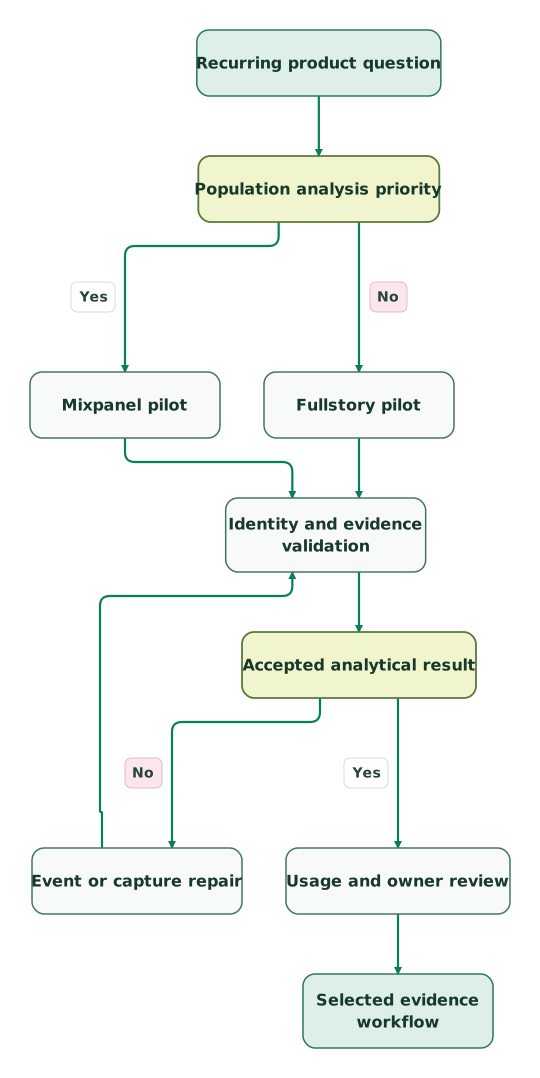
Read diagram as text
- Recurring product question to Population analysis priority.
- Population analysis priority to Mixpanel pilot: Yes.
- Population analysis priority to Fullstory pilot: No.
- Mixpanel pilot to Identity and evidence validation.
- Fullstory pilot to Identity and evidence validation.
- Identity and evidence validation to Accepted analytical result.
- Accepted analytical result to Event or capture repair: No.
- Event or capture repair to Identity and evidence validation.
- Accepted analytical result to Usage and owner review: Yes.
- Usage and owner review to Selected evidence workflow
Fullstory and Mixpanel evaluation checklist
- A recurring product decision and an agreed action owner.
- A stable user identity and explicit account-level scope.
- Business-event definitions with conversion and retention windows.
- A reconciled test journey including failure and duplicate actions.
- A population measure linked to representative session evidence.
- Capture and masking checks using synthetic application data.
- Separate event, session, retention and feature requirements in the quote.
- An ordinary renewal budget after any approved startup offer.
- A repair loop that repeats both the metric and capture checks.
The marketing data audit skill helps organize identity and event evidence. Keep the accepted test journey with the tracking plan so the next release can repeat the same measurement checks.
Keep reading
Browse all Product Analytics guides
 Product Analytics
PostHog vs Pendo: Product Analytics, Guidance and Cost
Choose Pendo for maintained product guidance or PostHog for technical analytics and release workflows. Compare limits, identity, usage costs and evaluation cases.
Jafrin Akter AloLast updated 10 min read
 Product Analytics
Fullstory vs Pendo: Session Evidence, Product Guidance and Cost
Compare Fullstory and Pendo for investigation and product adoption. Review current replay and guidance scope, free limits, useful metrics and complete quote requirements.
Jafrin Akter AloLast updated 11 min read
 Product Analytics
Best Product Analytics Tools for Startups: 7 Options Compared by the Job They Do
Compare GA4, Mixpanel, Amplitude, PostHog, Heap, Pendo and Statsig on free tiers, experiments, server-side events, raw data export and warehouse options.
Jafrin Akter AloLast updated 27 min read
Product analytics
See the implementation scope, deliverables and acceptance checks.
Questions people ask
Does Mixpanel require Fullstory to provide any session replay?
Mixpanel does not require Fullstory simply to provide session replay; its current plans include replay with plan-specific allowances. The selection should compare the actual investigation workflow and capture requirements rather than assume the feature is absent. If both tools remain, define the distinct job each performs and include the extra maintenance and identity reconciliation. See Mixpanel plans.
Can Fullstory answer product funnel questions as well as replay sessions?
Fullstory can support product funnel analysis as well as session investigation within the relevant paid scope. Its plan matrix lists funnels, segmentation and product analytics. Validate the required report and package directly, because the Free feature set is narrower. A replay-only description would miss the current offering. See Fullstory plans.
Can event volume rise while the number of users and sessions stays unchanged?
Event volume can rise while users and sessions stay unchanged if the tracking configuration captures more events during each session. Adding automatic interactions or repeated component events can increase the captured count. Estimate the intended capture and inspect actual volume after release. Keep event-based billing separate from the audience and replay-session measures.
Is a forty-percent return rate always the same as sixteen-percent cohort retention?
A forty-percent return rate can describe a different population from sixteen-percent retention across the original cohort. In the article's example, 160 returning users are forty percent of 400 activated users and sixteen percent of 1,000 new users. Name the denominator and measurement window beside the result so both rates remain interpretable.
Should a startup choose solely from the largest free replay allowance?
A startup should evaluate the required workflow and terms alongside the free replay allowance. Check event volume, retention, reporting features, capture controls, data terms and the ordinary paid arrangement after growth. A larger free session count is useful only if the team can investigate the relevant problem and maintain the measurement design it needs.
Sources

Written by
Jafrin Akter AloData Engineer and Co-founder at Martechdevs and Growth and Analytics Partners
Jafrin writes practical guides to marketing technology, customer data, analytics and AI workflows. Martechdevs is a Growth and Analytics Partners company.