
Cognism Alternatives for Phone Data, Prospecting and Enrichment
Choose Apollo.io for a smaller team combining data and outreach, Lusha for a bounded contact-data workflow, or ZoomInfo for a broader account and enrichment requirement. Cognism alternatives should preserve the phone coverage and data delivery that your team actually uses. Compare a matched market sample and the full operating cost before replacing a tailored contract with a lower headline price.
On this page
Cognism competitors compared
Public entry amounts below are US prices in USD; quote-based packages require the same workload specification.
| Tool | Starting price and billing basis | Best fit | Main tradeoff |
|---|---|---|---|
| Apollo.io | Basic $49/seat/month billed annually or $65 monthly | Data and outreach in one workflow | Phone reveals and other actions consume credits separately |
| Lusha | Starter $49.90/month billed monthly, 400 credits and 1 seat | A focused data role in an existing stack | A credit allowance is not a complete-contact allowance |
| ZoomInfo | Custom package quote | Account context and enrichment across destinations | Broad scope needs an explicit operating owner |
| Cognism, retained baseline | Standard or Pro quote, 5 seats included | Phone-led prospecting and CRM enrichment | Credit volume and the exact package need review |
Sources: Apollo pricing, Lusha pricing, ZoomInfo pricing and Cognism pricing. These entry offers have different capabilities, units and commitments. They should not be presented as equally sized replacements.
Start with the current Cognism job. One team may mainly reveal mobile numbers for a selected account list. Another may maintain CRM data or prioritize accounts using the selected package's signals. A replacement that covers the first job can still leave the other jobs without a destination or an owner.
At Martechdevs, we scope sales-data and enrichment implementation around the accepted CRM output and the sales action it supports. That creates a meaningful comparison between a complete Cognism arrangement, a narrower alternative and a second provider used only for a specific gap.
Tool decision blocks
Apollo.io
- Best for: A small sales team that wants to combine discovery, sequencing and related execution.
- Pros: Basic includes sequencing and core integrations, so the data evaluation can also test whether the team can retire another workflow handoff.
- Cons: All seats use one account plan level. Verified phone reveals cost eight credits each in the displayed schedule, while emails cost one; other actions have separate charges.
- Free plan and startup offer: Free supplies 75 credits per seat monthly. The 14-day trial limits phone access to 20 numbers. Eligible approved startups can receive 50% off for one year, up to five Basic or Professional seats.
- Choose it if: The sample covers the required market and the combined workflow produces a useful reduction in operating work.
- Skip it if: A low subscription price is the only advantage and the phone segment that matters fails the acceptance test.
Lusha
- Best for: A business unit with a narrow prospecting requirement and an existing CRM or engagement process.
- Pros: The published credit rules let the team estimate standard email, phone and delivery actions explicitly.
- Cons: API, waterfall and CRM actions can change consumption. Replacing a tailored package with a small entry tier requires a new capacity model.
- Free plan and startup offer: Free includes 40 credits/month and one seat without a credit card. No universal startup concession is assumed.
- Choose it if: The required records and fields arrive correctly in the existing process with a manageable credit budget.
- Skip it if: The proposed plan lacks an important enrichment or account requirement and the missing work is being hidden in a manual spreadsheet.
ZoomInfo
- Best for: A team evaluating a broader account-data, enrichment and delivery scope across several systems.
- Pros: Its enrichment offering describes entity resolution, hierarchy context and activation into sales and data destinations.
- Cons: The custom package needs a clear workload and owner. Additional product breadth has little value without a plan to use it.
- Free plan and startup offer: The trial is typically seven days without a credit card and ends automatically; terms and usage can vary. No standard startup price or permanent free allowance is assumed here.
- Choose it if: The wider account and delivery trial demonstrates required value beyond the contact methods supplied by the current arrangement.
- Skip it if: The team needs only a small phone list and the proposal adds scope without solving another accepted requirement.
Cognism
- Best for: A phone-led team whose current target coverage and CRM integration already support the sales routine.
- Pros: The verification process and Pro's on-demand mobile verification provide concrete capabilities to evaluate against a phone-led requirement.
- Cons: The current credit model needs a budget for reveals and enrichment. Retaining Cognism should still include a review of actual usage and package value.
- Free plan and startup offer: The public pricing route offers a demonstration and tailored quote without a permanent free allocation or universal startup discount. Request evaluation terms for the specific requirement.
- Choose it if: Its accepted coverage remains valuable and a smaller scope or workflow repair resolves the commercial concern.
- Skip it if: A matched alternative supplies the required records and delivery with a materially better complete cost or operating fit.
Contract scope and the work being replaced
Cognism's current pricing describes Standard and Pro packages with five seats included. A credit is used to reveal a contact; previously revealed contacts can be viewed without another charge, while a job change can require a new credit. CRM enrichment can be a standalone product or an add-on. Cognism commercial model.
Inventory the actual contract before building a replacement budget. Record the people who use it, the data fields required, the export destinations, recurring enrichment and any verification workflow. A team paying for a wide package may be able to reduce scope. Another team may use more of the arrangement than the renewal discussion initially suggests.
| Current Cognism job | Replacement requirement | Acceptance evidence |
|---|---|---|
| Priority account phone research | Current relevant contacts with the required number type | Matched target and phone review |
| Email-led prospecting | Relevant current work addresses | Identity, employer and email acceptance |
| Recurring CRM enrichment | Updates to the correct existing records | Destination IDs and permitted field changes |
| Account prioritization | Agreed signals and timing | A usable reason to prioritize the account |
| Multi-team data delivery | Defined destinations and permissions | Each receiving team accepts the same record |
Use Apollo vs Cognism for the combined-outreach decision and Lusha alternatives for smaller contact-credit options. The Cognism vs ZoomInfo guide is relevant when the proposed replacement remains a broader enterprise-data arrangement.
A matched regional and role sample
Choose the sample from the sales plan. Define company location, person location, role, seniority and company size separately where they matter. A person working for a multinational is not necessarily located at the employer's headquarters. A broad country filter can conceal that distinction.
Ask every provider to work from the same verified company domains and role definitions. Include accounts with no known contact so the test measures discovery as well as confirmation. Retain no matches and unrelated people in the results, rather than reporting only the returned contacts.
Keep the sample representative of the purchase. If the team sells to several regions, review each region rather than relying on one aggregate coverage score. If only one senior role is commercially useful, additional junior contacts do not compensate for missing that role.
A vendor's verification process is relevant evidence about its method. It is not an automatic prediction of your call outcome. Cognism describes calling numbers to confirm the intended person in its phone-verification explanation. Separate wrong person, correct voicemail, no answer and actual conversation in the trial record.
Hypothetical coverage and accepted-output calculation
Assume a hypothetical evaluation contains 200 required person-role targets. A provider returns 160 matching records. After checking current employer, role and the required phone method, the team accepts 120. These are invented evaluation results used to explain the calculation, not measured results for any vendor.
| Hypothetical measure | Calculation | Result | Interpretation |
|---|---|---|---|
| Returned matching records | 160 ÷ 200 | 80% | Initial match coverage |
| Accepted required records | 120 ÷ 200 | 60% | Useful coverage of the original targets |
| Acceptance among returned records | 120 ÷ 160 | 75% | Quality within the returned set |
| Rejected returned records | 160 minus 120 | 40 | Separate review reasons required |
Reporting only the 75% acceptance among returned records hides the 40 targets with no matching record. Reporting only the 80% initial coverage overstates useful output. Keep both the original target denominator and the accepted-record count in the buying decision.
For a separate hypothetical annual budget, assume the complete replacement costs $12,000 and produces 6,000 unique accepted records during the year. The cost is $2 per accepted record. If the same spend produces only 4,000 accepted records, the cost becomes $3. These assumed totals include the required data workflow; they are not vendor list prices.
Now suppose the incumbent costs an assumed $18,000/year and the replacement costs $12,000/year at equivalent accepted scope. The saving is $6,000/year, or $500/month. A hypothetical $7,500 transition cost takes 15 months of that saving to recover, excluding parallel subscriptions and any additional costs. The complete comparison should add those items before approval.
Use the software pricing tool to keep the assumptions visible. The ZoomInfo pricing guide and Apollo pricing guide help qualify the other proposals. A cheaper package can still be poor value if accepted output falls below the sales team's requirement.
Renewal, data rights and retention
Check the contract period and ordinary renewal before switching. Apollo's annual pricing is a twelve-month commitment paid upfront; a monthly-equivalent amount is not a month-to-month subscription. Lusha's monthly credits can roll over within its stated cap while annual credits reset at the yearly boundary. Apollo billing terms, Lusha renewal rules.
Also confirm the permitted use of data already exported after the contract ends. The answer can depend on the agreement, delivery method and intended downstream use. Put the required retention, refresh and deletion obligations in the commercial review rather than assuming every exported record has identical continuing rights.
If the business serves clients, verify whether the selected agreement permits that use. Apollo's public pricing FAQ distinguishes standard internal use from customer-facing products, sharing and resale that require another agreement. Keep that boundary visible before building a service around the subscription.
This review should be proportionate to the actual work. A single internal sales team needs a clear internal-use arrangement; a provider supplying several customer products needs a different scope. The article's operational recommendation does not replace the terms attached to the approved contract.
Best fit by purchasing scenario
| Company size or operating model | Best fit | Runner-up | Decision reason |
|---|---|---|---|
| Small team consolidating data and outreach | Apollo | Lusha | The combined daily workflow may reduce manual transfers |
| Business unit with a bounded contact requirement | Lusha | Apollo | A narrow data role can fit a smaller commitment |
| Phone-led team with strong existing Cognism coverage | Cognism scope review | Apollo matched trial | Preserve useful coverage unless another setup proves equivalent value |
| RevOps team supplying CRM and warehouse destinations | ZoomInfo evaluation | Cognism enrichment | Account context and maintained delivery need a wider test |
| Team entering a new regional market | Matched local segment trial | Best accepted runner-up | The actual target roles and geography decide coverage |
Replacement and repair workflow
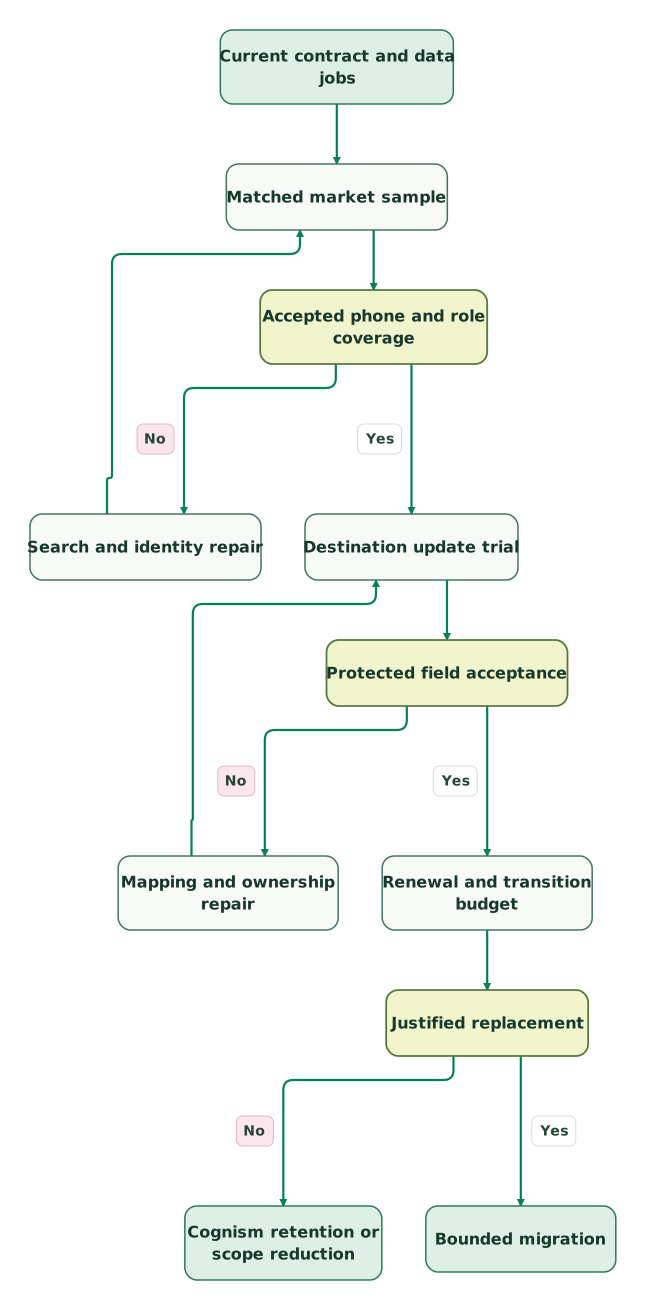
Read diagram as text
- Current contract and data jobs to Matched market sample.
- Matched market sample to Accepted phone and role coverage.
- Accepted phone and role coverage to Search and identity repair: No.
- Search and identity repair to Matched market sample.
- Accepted phone and role coverage to Destination update trial: Yes.
- Destination update trial to Protected field acceptance.
- Protected field acceptance to Mapping and ownership repair: No.
- Mapping and ownership repair to Destination update trial.
- Protected field acceptance to Renewal and transition budget: Yes.
- Renewal and transition budget to Justified replacement.
- Justified replacement to Bounded migration: Yes.
- Justified replacement to Cognism retention or scope reduction: No
The destination test includes a current customer, a suppressed person, a duplicate and a contact who changed jobs. Confirm the new provider updates the intended fields while preserving internal ownership and exclusions. Then repeat the same input to inspect create-versus-update behavior.
Keep the old arrangement available for the agreed comparison period. Move a bounded segment first and reconcile accepted records, chargeable actions and the sales team's actual work. A broad import before that review can make it difficult to separate source-data problems from new mapping errors.
A second-source role may be enough when the gap is regional or field-specific. The waterfall enrichment guide explains how to invoke another provider only after a defined failure. Measure its incremental accepted output and keep the same CRM matching and suppression policy across suppliers.
Cognism alternatives checklist
- Inventory the current prospecting, enrichment and delivery jobs.
- Identify the contract term, included seats and actual credit use.
- Define target roles and person geography separately from company geography.
- Keep no matches and rejected records in the original sample denominator.
- Separate correct identity from call response and commercial interest.
- Test the actual destination update and a repeated input.
- Protect customer status, exclusions and confirmed field ownership.
- Confirm continuing data-use requirements and ordinary renewal terms.
- Re-run affected validation after search or mapping repairs.
- Compare scope reduction and a second-source role with complete replacement.
Use the CRM data hygiene audit skill to prepare the accepted-record and overwrite rules. The strongest replacement case shows a clear improvement in the required workflow while preserving the data quality the sales team already depends on.
Keep reading
Browse all GTM Engineering guides
 GTM Engineering
Apollo vs Cognism for Prospecting, Phone Data and CRM Workflows
Compare Apollo and Cognism by phone-data coverage, credits, CRM handoff and complete workflow cost, with a usable-record budget and a controlled trial plan.
Jafrin Akter AloLast updated 12 min read
 GTM Engineering
Lusha Alternatives for Contact Data, Credits and Outbound Work
Compare Lusha alternatives including Apollo, UpLead and Cognism by current prices, credit units, usable coverage and CRM delivery, with a checked workload.
Jafrin Akter AloLast updated 11 min read
 GTM Engineering
Waterfall Enrichment: How to Get More Usable Contact Data
Build a useful enrichment waterfall in Clay or Apollo. Compare cost per accepted contact, verify results, preserve provenance and protect CRM data.
Jafrin Akter AloLast updated 12 min read
GTM engineering & outbound
See the implementation scope, deliverables and acceptance checks.
Questions people ask
Is Cognism's current offer an unlimited-contact subscription?
Cognism's current public pricing describes a credit-based model, so an unlimited-contact assumption is not a safe basis for a new purchase. The page lists credits for contact reveals and describes additional treatment for job changes and enrichment. Confirm the exact allowance and terms of the proposed contract, particularly if the team is comparing it with an older agreement.
Can an alternative's returned-record count overstate useful coverage?
An alternative's returned-record count can overstate useful coverage when records have the wrong role, employer or required contact method. Keep the original target list as the denominator and count accepted records after those checks. Report no matches and rejected returns separately. A large export is not the same as a usable list for the sales team's intended market.
Should a Cognism replacement test company country or person country?
A Cognism replacement should test the location that the sales requirement actually uses, and often both. A multinational's headquarters can differ from the location of the person being contacted. Keep company and person geography in separate fields, define the intended filter and use the same rule for every provider so the regional comparison measures a consistent audience.
Can contract savings disappear after a provider change?
Contract savings can disappear if the replacement requires extra tools, more manual repair or a higher tier to cover the accepted workflow. Include implementation, parallel operation and recurring administration in the budget. Also compare accepted output, because a cheaper contract producing fewer usable records can cost more per required result even before the transition expense is considered.
Is retaining Cognism with a narrower scope a valid alternative?
Retaining Cognism with a narrower scope is valid when the useful coverage remains strong and the problem is an oversized package or inefficient workflow. Review actual users, reveals, enrichment and destinations before renewing. Compare the revised arrangement with the same representative alternative trial, so the choice reflects accepted work and complete cost rather than an assumed need to switch.
Sources
- Cognism current pricing and credits
- Cognism phone verification
- Apollo pricing, credits and commercial terms
- Apollo trial limits
- Apollo startup program
- Lusha pricing and renewal rules
- Lusha Free plan and billing FAQ
- Lusha credit rules
- ZoomInfo pricing
- ZoomInfo trial conditions
- ZoomInfo enrichment and orchestration

Written by
Jafrin Akter AloData Engineer and Co-founder at Martechdevs and Growth and Analytics Partners
Jafrin writes practical guides to marketing technology, customer data, analytics and AI workflows. Martechdevs is a Growth and Analytics Partners company.