
Lusha Alternatives for Contact Data, Credits and Outbound Work
Choose Apollo.io for prospect data and outreach in one workflow, UpLead for a contact-credit model with a public entry price, or Cognism for a phone-led evaluation with a tailored package. Lusha alternatives should solve the specific gap in your current process. Compare relevant people, required contact methods and accepted CRM records before treating a larger credit allowance as better value.
On this page
Lusha competitors compared
Prices are US amounts in USD; the billing basis and credit unit are shown separately.
| Tool | Starting price and billing basis | Best fit | Main tradeoff |
|---|---|---|---|
| Apollo.io | Basic $49/seat/month billed annually, or $65 monthly | Prospecting connected with outreach | Email and phone reveals use different credits |
| UpLead | Essentials $99/month, billed monthly, 170 contact credits | A defined contact-download workload | Available fields and target coverage still need a sample |
| Cognism | Tailored Standard or Pro quote, 5 seats included | Phone-led teams with a scoped data requirement | Package and usage need a full commercial review |
| Lusha, retained baseline | Starter $49.90/month billed monthly, 400 credits and 1 seat | A bounded data workflow already working | Reveal and delivery actions can consume separate credits |
Sources: Apollo pricing, UpLead pricing, Cognism pricing and Lusha pricing. The numbers are starting packages, not equivalent amounts of usable contact data.
Replacing Lusha makes sense when another setup improves a required segment, removes an unnecessary workflow handoff or changes the complete cost of accepted records. A disappointing campaign can also come from poor targeting, duplicate contacts or a weak offer. Separate those issues before making the provider responsible for every downstream result.
At Martechdevs, we define the target record and destination rules before a sales-data and outbound implementation. That gives the shortlist a testable job: find the relevant person, supply the required contact method and write the right CRM record without changing protected customer information.

Tool decision blocks
Apollo.io
- Best for: A small team that wants prospect discovery and outreach in one daily workspace.
- Pros: Basic includes sequencing and core integrations, so the evaluation can cover both the data and the next sales action. Apollo plans.
- Cons: Every account seat uses the same plan level. The shared credit pool must cover the selected actions, with verified emails at one credit and verified phones at eight.
- Free plan and startup offer: Free provides 75 credits per seat monthly. A 14-day trial has separate limits; the startup program offers eligible approved businesses 50% off Basic or Professional for one year, up to five seats.
- Choose it if: Reps can run the full approved prospecting and outreach path with fewer manual transfers.
- Skip it if: The required data segment fails the sample and the combined workflow does not offset that gap.
UpLead
- Best for: A buyer who wants to evaluate a defined contact-credit allowance and export workflow.
- Pros: The pricing page defines one credit as a contact available for download or CRM export, with access to its email and mobile direct dial.
- Cons: Access to a contact's fields does not guarantee that every target has every field or that the returned person fits your audience.
- Free plan and startup offer: The public trial lasts seven days and includes five credits. It is a limited trial, not an ongoing free subscription. No universal startup discount is assumed.
- Choose it if: The sample supplies the required contact methods and the contact-based allowance matches a predictable research workload.
- Skip it if: Your production need is a broader enrichment or integration setup that requires another plan or a separate scoped arrangement.
Cognism
- Best for: A phone-led team evaluating mobile data for priority accounts and an existing sales process.
- Pros: Cognism describes a phone-verification process, while its Pro package includes on-demand mobile verification.
- Cons: Standard and Pro are tailored packages with credit allocations. A small team's exact needs can be narrower than the proposed commercial scope.
- Free plan and startup offer: The pricing page provides a demonstration and quote route without a public permanent free allocation or standard startup price. Agree the sample and evaluation terms before relying on them.
- Choose it if: Relevant phone coverage improves in the matched sample and the approved package fits the team's capacity to work those records.
- Skip it if: The proposal adds cost without a demonstrated advantage for the specific roles and countries being targeted.
Lusha
- Best for: A team whose existing Lusha segment and CRM delivery already produce reliable accepted records.
- Pros: Retaining a working integration avoids another migration. The credit guide makes standard email, phone and delivery actions explicit.
- Cons: A nominal credit count can overstate complete-contact capacity if the process needs phone numbers, CRM writes or API work.
- Free plan and startup offer: Free provides 40 credits/month for one seat without a credit card. No standard startup concession is assumed in the comparison.
- Choose it if: A targeting or mapping repair resolves the current problem at a lower complete cost than switching.
- Skip it if: A repeated matched test shows a material coverage or workflow gap that another provider solves.
The replacement reason
Write the specific failure that triggered the search. Missing phone numbers in one country require a different test from a credit bill that grew after CRM exports were enabled. Slow prospect preparation may be a workflow problem even when the data itself is acceptable.
| Current problem | Useful alternative test | Evidence to compare |
|---|---|---|
| Missing contacts at target accounts | Same company and role sample in another provider | Relevant current contacts per requested account |
| Phone costs exceed the budget | Required method mix using each action schedule | Complete credit consumption for accepted records |
| Several tools need manual transfers | Discovery through approved outreach or CRM action | Work remaining outside the selected platform |
| Enrichment creates duplicates | Existing-contact update and repeated-write trial | Correct destination IDs and unchanged protected fields |
| Campaign performance disappoints | Separate targeting, data and message review | Identity errors apart from no response or poor fit |
Do not select the sample from the provider's strongest demonstration list. Use a bounded set of accounts the team actually wants to pursue and include difficult but representative cases. Retain no-match results in the denominator so the report does not quietly exclude the failures.
For a direct pair, Apollo vs Lusha covers the combined-workflow choice. The Cognism alternatives guide is useful when a larger phone-data package enters the discussion. ZoomInfo vs Lusha addresses wider account and enrichment requirements.
Credit-unit comparison and hypothetical workload
Lusha's published standard charges include one credit for an email, five for a phone and one per new CRM write. Apollo's displayed reveal schedule uses one credit for an email and eight for a phone. UpLead defines one credit as one contact available for download or CRM export, including access to email and mobile direct dial. Lusha actions, Apollo pricing, UpLead credit definition.
Assume a hypothetical list of 100 distinct target contacts. Every contact needs an email and phone. All required data is available, every contact is new, and no waterfall, API, AI or other action is used. This deliberately simple scenario compares units, not real coverage or complete vendor equivalence.
| Hypothetical action scope | Calculation | Credit amount | Boundary |
|---|---|---|---|
| Lusha standard email and phone reveals | 100 × (1 + 5) | 600 | Excludes delivery |
| Lusha new CRM writes | 100 × 1 | 100 | Additional to the reveal amount |
| Lusha combined stated actions | 600 + 100 | 700 | Standard reveal plus new writes |
| Apollo email and phone reveals | 100 × (1 + 8) | 900 | Excludes other chargeable work |
| UpLead contact downloads or CRM exports | 100 × 1 | 100 | Assumes required fields exist for each contact |
The lower numerical credit total is not automatically cheaper. A credit has a different price and meaning in each system. Compare the selected package's cash cost, accepted output and remaining allowance after the workload. A contact with no usable number should not count as meeting a phone-led requirement merely because it was revealed successfully.
For an UpLead Essentials illustration, 100 contacts would use 100 of the 170 monthly credits, leaving 70. At its $99 monthly package price, dividing the entire subscription by those 100 accepted contacts gives $0.99 per contact. If only 70 contacts meet your requirements, the same $99 costs about $1.41 per accepted contact. These are hypothetical accepted-output scenarios, not measured vendor accuracy.
Use the software pricing tool to include retained engagement tools, extra usage and implementation. The Apollo pricing guide explains the seat and credit scope for a shortlisted Apollo configuration. Keep the ordinary renewal beside any approved startup concession.
Coverage and phone quality
A phone number can be missing, belong to the wrong person, be valid but unanswered or lead to a useful conversation. Keep those results separate. A no-answer result does not prove the data is wrong, and a reached switchboard does not establish a direct mobile match.
Cognism says its phone-verification process calls numbers to confirm the intended person. Verification method. Use that as a reason to evaluate the relevant segment, without adopting a vendor's headline connect-rate claim as the expected result for your team.
For email, distinguish a current work address from a contact who has moved to another employer. An address can appear valid while the record's company relationship is stale. Check both identity and employer before counting the record as accepted for an account-based campaign.
Keep the commercial test consistent with the operating test. If the team plans to use a CRM connector, evaluate that route rather than only downloading a CSV. Record whether the expected company association and owner survive the write. A correct spreadsheet can still create an incorrect destination record.
Best fit by team requirement
| Company size or operating model | Best fit | Runner-up | Decision reason |
|---|---|---|---|
| Founder-led outbound with few existing tools | Apollo | Lusha | Data and outreach can share a daily workflow |
| Individual researcher with predictable contact downloads | UpLead | Lusha | The contact-credit definition is easy to test against the workload |
| Phone-led team with priority accounts | Cognism trial | Apollo | The matched phone sample should decide the package value |
| Existing Lusha user with a narrow mapping failure | Lusha repair | UpLead | A data-transfer fix can avoid replacing a suitable provider |
| Team with broader account-enrichment requirements | A scoped enterprise shortlist | Cognism | Delivery and governance may exceed the small entry packages |
Those are evaluation priorities, not guarantees of coverage. A small team can have a demanding regional requirement. A larger business unit can need only a small, stable list. Use the relevant segment and required output to choose the trial, then review the budget at the actual usage level.
Migration and data ownership
Inventory saved lists, filters, source identifiers, accepted contact values and existing CRM associations before replacing the provider. The new tool should not erase internal knowledge merely because it returns a newer field. Keep a distinction between data that fills an empty field and data allowed to replace a confirmed value.
Preserve exclusion and customer status independently of enrichment. A new email or employer update should not reopen a suppressed prospect or turn an existing customer into a new lead. Define those rules in the CRM or the authoritative system, then test the integration against them.
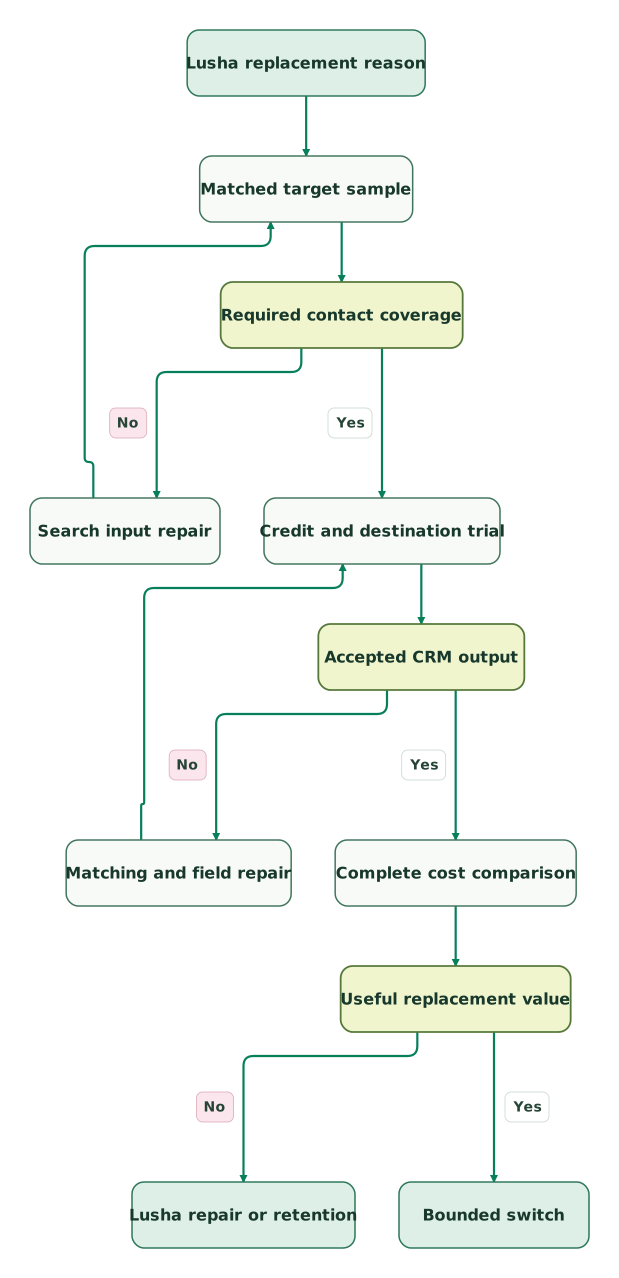
Read diagram as text
- Lusha replacement reason to Matched target sample.
- Matched target sample to Required contact coverage.
- Required contact coverage to Search input repair: No.
- Search input repair to Matched target sample.
- Required contact coverage to Credit and destination trial: Yes.
- Credit and destination trial to Accepted CRM output.
- Accepted CRM output to Matching and field repair: No.
- Matching and field repair to Credit and destination trial.
- Accepted CRM output to Complete cost comparison: Yes.
- Complete cost comparison to Useful replacement value.
- Useful replacement value to Bounded switch: Yes.
- Useful replacement value to Lusha repair or retention: No
Repeat the destination trial after a field or matching repair. A correction can change the number of records created, updated or rejected, which can also change cost. Keep the accepted sample and its expected IDs available for later provider or connector changes.
A second provider can be a smaller intervention than replacement. Define the missing field or failed result that triggers the second lookup, then measure its incremental accepted output. The waterfall enrichment guide explains that approach. Calling every provider for every contact creates more expense and conflicting values without proving additional value.
Lusha alternatives checklist
- Name the specific coverage, cost or workflow failure behind the search.
- Define the required person, employer and contact methods.
- Give each provider the same representative target sample.
- Keep no matches and incorrect identities in the evaluation record.
- Translate the planned actions into each vendor's own credit units.
- Test the actual delivery route and repeated writes to existing records.
- Protect customer status, exclusions and confirmed field values.
- Re-run destination and credit checks after repairs.
- Compare a bounded second-source role with a complete replacement.
- Approve the paid scope and ordinary renewal before switching.
Use the CRM data hygiene audit skill to prepare the matching and overwrite policy. The best alternative is the one that solves the defined gap while leaving the team with a maintainable prospecting process.
Keep reading
Browse all GTM Engineering guides
 GTM Engineering
Apollo vs Lusha for Prospecting, Credits and CRM Enrichment
Compare Apollo and Lusha by usable contact coverage, paid workflow scope, credit charges, renewal rules and CRM updates, with a reproducible credit example.
Jafrin Akter AloLast updated 11 min read
 GTM Engineering
Cognism Alternatives for Phone Data, Prospecting and Enrichment
Compare Cognism alternatives by phone and role coverage, current credit models, CRM enrichment and contract cost, with a reproducible evaluation method.
Jafrin Akter AloLast updated 11 min read
 GTM Engineering
Waterfall Enrichment: How to Get More Usable Contact Data
Build a useful enrichment waterfall in Clay or Apollo. Compare cost per accepted contact, verify results, preserve provenance and protect CRM data.
Jafrin Akter AloLast updated 12 min read
GTM engineering & outbound
See the implementation scope, deliverables and acceptance checks.
Questions people ask
Is an UpLead credit equivalent to a Lusha email credit?
An UpLead credit is not equivalent to a Lusha email credit. UpLead describes a credit as one contact available for download or CRM export with access to email and mobile direct dial, while Lusha charges separately for standard email and phone reveals. Required field availability still needs testing. Compare accepted records and cash cost after applying each provider's own unit definition.
Can a Lusha replacement reduce costs without changing the data provider?
The team can sometimes reduce costs by repairing the workflow while retaining Lusha. Unnecessary phone reveals, repeated paid actions or an unsuitable delivery route can inflate consumption. Inspect usage against the required output and remove work that has no owner or purpose. Compare that corrected process with the alternative before attributing every excess charge to the supplier.
Is a five-credit trial enough to approve a data-provider switch?
A five-credit trial is enough to inspect basic workflow and a few known records, but it is too small to establish broad coverage across several markets. Use it to identify obvious mismatches and confirm the credit definition. If the purchase depends on regional or role coverage, agree a larger representative evaluation before making a substantial commitment.
Should a Lusha alternative replace confirmed CRM values automatically?
A Lusha alternative should replace confirmed CRM values only under an agreed field-ownership rule. New data can be useful without being authoritative for every field. Preserve customer status, owner assignments and exclusions, then test updates to an existing person. Keep source information and the prior accepted value where the business needs to investigate a disputed change.
Can Lusha remain useful alongside a larger data platform?
Lusha can remain useful if it fills a specific coverage gap at an acceptable incremental cost. Define the condition that triggers its lookup, such as a missing required contact method after the primary provider's result. Deduplicate the output and preserve common suppression rules. Measure additional accepted records so the second subscription has a clear, limited purpose.
Sources

Written by
Jafrin Akter AloData Engineer and Co-founder at Martechdevs and Growth and Analytics Partners
Jafrin writes practical guides to marketing technology, customer data, analytics and AI workflows. Martechdevs is a Growth and Analytics Partners company.