
ZoomInfo vs Cognism: Data Coverage, Credits and Buyer Fit
Pick Cognism if verified mobile coverage and a focused prospecting workflow solve the main problem in your target markets. Pick ZoomInfo if its data, account signals and broader sales workflows fit your operating model. In a ZoomInfo vs Cognism decision, compare the same accounts, roles and permitted channels, then price the configuration that produces usable records and a reliable CRM handoff.
On this page
ZoomInfo and Cognism comparison
Both vendors require a tailored quote for current subscription amounts; compare the specified products and usage rights.
| Decision | Cognism | ZoomInfo |
|---|---|---|
| Public subscription price | Quote-based Standard and Pro; both list five included seats | Quote-based packages built from licences, features and credit usage |
| Data usage | Credits for contact access; one revealed contact uses one credit | Main pricing FAQ describes one credit per exported contact or company profile |
| Starting fit | Prospecting with verified mobile data and targeted account research | Contact and company data connected to signals and sales workflows |
| Higher-package example | Pro adds intent and on-demand mobile verification | Copilot Advanced adds account prioritization, buying signals and workflows |
| Integration scope | Current Standard card lists MCP and API access; entitlements govern the connection | CRM integrations and API-related access need the quoted configuration |
| Additional operating layer | CRM Enrichment is an add-on or standalone product | GTM Studio has its own early-access offering and managed-record model |
Sources: Cognism pricing, Cognism connection scope, ZoomInfo pricing, and ZoomInfo GTM Studio.
We would decide the data purchase with a matched sample from your actual market, then test the route into the CRM. A database-wide contact count cannot establish coverage of the roles you need in the countries you sell into. Our sales-data and GTM implementation service connects that selection to deduplication, routing and responsible activation.
Target-market coverage and mobile verification
Start with a fixed list of target accounts and the job roles needed inside each one. Split the sample by country, company size and industry. Include accounts the team finds difficult, alongside straightforward examples. Both vendors should receive the same input and the same acceptance rules.
Cognism's verified-mobile feature marks numbers that have passed its verification process. On-demand verification is a premium feature and can return Verified, Improved or No Improvement. Improved means additional or newer information was found without fully verifying the mobile number. Keep those outcomes separate in the evaluation. Cognism verification guide.
ZoomInfo's sales packages include mobile numbers, business emails and company profiles, with additional account signals and workflow features in higher packages. Evaluate whether those records match the intended person and current employer. A returned phone field and a verified connection to the intended person are different observations. ZoomInfo package scope.
Use the business's accepted definition of a usable record. For a call-led team, that might require the correct person, current company, relevant role and a number eligible for the planned call. For an email-led team, it might require a current business address and the necessary permission and suppression checks. Record completeness alone is a weaker measure.
| Evaluation measure | Numerator | Denominator | Decision value |
|---|---|---|---|
| Target-account coverage | Target accounts with at least one relevant person | All requested accounts | Market coverage for this segment |
| Current-role accuracy | Matched people whose role and employer pass the agreed check | Matched people inspected | Stale job and company risk |
| Usable contact coverage | Requested people passing every required field and policy check | All requested people | Data ready for the intended workflow |
| CRM acceptance | Records written or matched correctly with ownership preserved | Records submitted to the CRM test | Implementation readiness |
Report the counts beside each rate. A vendor producing 30 records from a 200-person request may have a high accuracy rate within those 30 and still leave most of the market uncovered. A wider result set may need more filtering. The purchase should reflect the combination your team can use.
Cognism and ZoomInfo fit
Cognism for targeted prospecting and phone data
- Best for: A sales team prioritizing verified mobile data and a focused prospecting process in its selected territories.
- Pros: The current packages support account research, contact discovery and credit-based access; Pro adds on-demand verification and intent. Cognism packages.
- Cons: A verification request can fail to improve the record. Confirm which contacts and territories produce usable outcomes in your sample.
- Free plan and startup offer: The public purchase path is a tailored proposal. Request the evaluation allowance and any offered discount in writing rather than assuming a permanent free entitlement.
- Choose it if: The matched sample supports your priority channel and the required CRM or API workflow fits the quote.
- Skip it if: The purchase depends on data or operating features that the selected package cannot demonstrate.
For a team expanding into another country, keep results for that country separate. A strong overall average can hide a weak new-market result. Ask for the verification outcome, freshness and job-change handling that explain the usable population rather than a single global accuracy percentage.
ZoomInfo for a broader data and sales workflow
- Best for: Teams needing a combined account-data, signal and seller-workflow configuration.
- Pros: Professional includes contact and company search; Copilot Advanced lists buying signals, hierarchy data and automated workflows. Enterprise extends the operating scope. ZoomInfo plans.
- Cons: A broader package can include functions the team will not use. Seats, data access, integrations and add-ons all belong in the comparison.
- Free plan and startup offer: ZoomInfo advertises evaluation routes; confirm the particular trial's data and export rights before using it as the acceptance environment.
- Choose it if: The required accounts, signals and handoffs work together in the quoted configuration.
- Skip it if: The business only needs a narrow contact-data job and the extra scope adds cost without a useful operating benefit.
For a broader shortlist, use the ZoomInfo alternatives guide. The Apollo versus ZoomInfo comparison addresses another buying decision: data combined with an outreach workflow.
Credits, repeat access and the complete quote
Cognism's pricing FAQ says a revealed contact can be reused during the contract without another credit, with a new credit used after a job change. Its CRM Enrichment product has its own maintenance explanation. Ask the vendor to specify the allocation, expiry, sharing and refresh rules for the exact products in your order. Cognism credit rules.
The same contact can create several downstream activities: discovery, export, CRM enrichment and later refresh. Map those activities to the applicable meter before estimating usage. An annual contact requirement is different from a count of every system operation touching those contacts.
ZoomInfo's main pricing FAQ describes exported contact and company profiles as credit consumption. GTM Studio separately describes Records Under Management: a paid record can be re-pulled or re-enriched for up to a year. Keep those rules attached to the purchased product. A Studio entitlement should not be assumed for an ordinary Sales quote. ZoomInfo export credits, Studio managed-record scope.
Request a quote containing these fields:
- Products: Named prospecting, enrichment, intent and workflow packages.
- Users: Included seats, additional users and administrator access.
- Data units: Contact versus company records, reveal/export rules and permitted refreshes.
- Connections: CRM, API and bulk-delivery entitlements, with applicable limits.
- Additional charges: Implementation, optional services, added credits and any platform component.
- Commercial term: Payment schedule, renewal, notice, quantity changes and permitted use after expiry.
Use the ZoomInfo pricing guide for the wider quote review and the software pricing directory for adjacent subscriptions. Compare the normal renewal case separately from an introductory offer.
Worked coverage and cost example
Consider an illustrative evaluation of 200 requested people across the same target-account set. These are invented test outcomes for explaining the method, rather than results attributed to either vendor.
| Check | Candidate A | Candidate B | Interpretation |
|---|---|---|---|
| Requested people | 200 | 200 | Same target population |
| Returned records | 160 | 170 | A match still needs validation |
| Current role and company accepted | 135 | 145 | Subset of returned records |
| All required data and policy checks passed | 120 | 130 | Usable records for the defined workflow |
| Usable coverage | 60% | 65% | Five percentage points on this sample |
The correct denominator for usable coverage is the original 200 requests. Candidate A's 120 ÷ 160 = 75% describes acceptance among returned records; 120 ÷ 200 = 60% describes coverage of the requested population. Both measures can be useful if labelled correctly.
Next, use a separate annual planning example. Assume Offer A costs $24,000 for the full configuration and supplies 6,000 usable new contacts over the year. Assume Offer B costs $30,000 and supplies 9,000. Average cost is $4.00 versus $3.33 per usable new contact. The extra $6,000 buys 3,000 additional usable records in this model, or $2.00 per additional record.
These prices and quantities are hypothetical. Replace them with accepted quotes and a defensible demand forecast. Do not multiply a small sample's result across every country or industry without checking those segments. More usable data creates value only if the sales team can work it responsibly and follow up effectively.
For an existing customer, count net new value after CRM matching. A second vendor returning mostly records you already have may improve freshness, but its contribution differs from finding missing buyers. Measure overlap and incremental coverage separately.
CRM enrichment and API acceptance
Build the test around the destination's rules. Select a small set containing an existing contact, a changed employer, a duplicate name, a missing email and a record already suppressed. Confirm the destination field ownership before enabling bulk updates.
Cognism's current connection page says MCP and Connect API follow existing account permissions, territories, exclusions and credit controls. Its Standard pricing card now lists MCP and API access. Use current entitlements in the test rather than assuming all API work requires an older premium package or that a visible connection grants every field. Connection governance.
For either vendor, retain the source, retrieval time and matching basis for imported fields. Decide whether a provider may fill an empty value, replace a stale value or only propose a change. Protect customer-entered information, lifecycle stage, owner and suppression state from a blanket overwrite.
| Test record | Required result | Failure to resolve |
|---|---|---|
| Existing CRM person | Match to the intended record | Duplicate contact creation |
| Person with a job change | Agreed employment update and account association | Old and new employers merged incorrectly |
| Missing enrichment field | Existing accepted value preserved | A useful field replaced with blank data |
| Suppressed contact | Suppression retained through refresh | Record reactivated by enrichment |
| Interrupted batch | Recoverable progress and counted usage | Unexplained duplicates or repeated credit spend |
If your requirement is an orchestrated process across several providers, compare Clay versus ZoomInfo. That choice includes workflow ownership and provider subscriptions, alongside the quality of any individual dataset.
Outreach eligibility and suppression
Cognism describes screening telephone data against multiple national Do Not Call registers. That is one input to your activation controls. Verify the territories covered, the relevant account settings and how suppression changes reach connected systems. Cognism compliance information.
For UK business outreach, the ICO says the channel and type of business affect the applicable rules, and using identifiable business-contact data brings UK GDPR obligations. Its live-call guidance requires checking relevant TPS/CTPS registrations and the business's own suppression list. A purchased record does not erase an existing objection. ICO business-to-business guidance.
Keep the operational rule explicit: a data refresh must never silently reactivate a suppressed person. Route uncertain records to review, preserve the reason and apply the approved territory/channel policy before any sending or calling system receives the audience.
Best fit by scenario
| Situation | First candidate | Runner-up | Deciding evidence |
|---|---|---|---|
| Phone-led team with a focused territory list | Cognism | ZoomInfo | Verified usable numbers in the matched sample |
| Team combining account signals and seller workflows | ZoomInfo | Cognism plus existing workflow tools | Required signal, action and complete cost |
| Existing CRM with poor contact freshness | Scoped enrichment product | Prospecting package with a tested sync | Safe field ownership and incremental improvement |
| Multi-country expansion | Parallel segmented evaluation | Current provider repair | Country-level coverage and permitted activation |
| Multi-provider data operation | Clay-based workflow evaluation | ZoomInfo GTM Studio evaluation | Data rights, orchestration and continuing owner |
Selection and rollout checklist
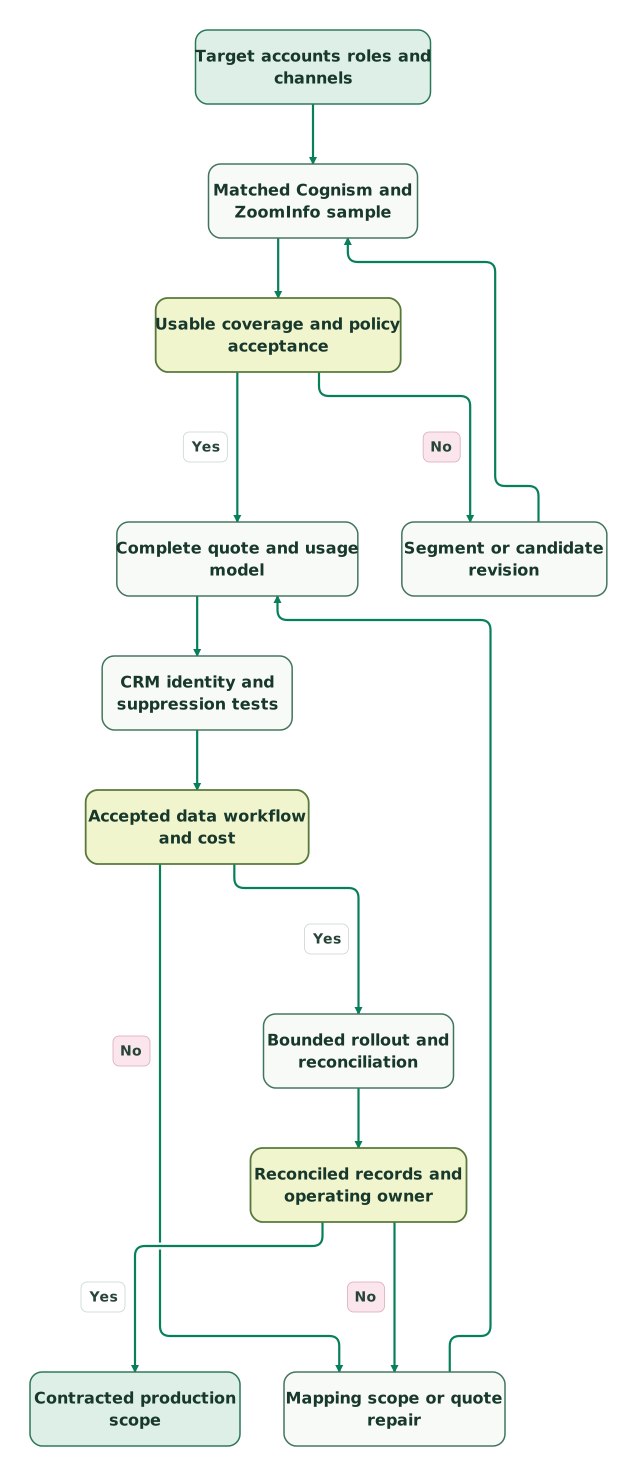
Read diagram as text
- Target accounts roles and channels to Matched Cognism and ZoomInfo sample.
- Matched Cognism and ZoomInfo sample to Usable coverage and policy acceptance.
- Usable coverage and policy acceptance to Segment or candidate revision: No.
- Segment or candidate revision to Matched Cognism and ZoomInfo sample.
- Usable coverage and policy acceptance to Complete quote and usage model: Yes.
- Complete quote and usage model to CRM identity and suppression tests.
- CRM identity and suppression tests to Accepted data workflow and cost.
- Accepted data workflow and cost to Mapping scope or quote repair: No.
- Mapping scope or quote repair to Complete quote and usage model.
- Accepted data workflow and cost to Bounded rollout and reconciliation: Yes.
- Bounded rollout and reconciliation to Reconciled records and operating owner.
- Reconciled records and operating owner to Mapping scope or quote repair: No.
- Reconciled records and operating owner to Contracted production scope: Yes
Checklist
- Both vendors receive the same target-account and role sample.
- Coverage rates use labelled denominators and country-level results.
- Verification outcomes and ordinary returned phone fields remain distinct.
- The quote includes all seats, products, credits and connection rights.
- Existing CRM overlap and incremental data value are measured separately.
- Job changes, blank fields and interrupted batches pass the mapping tests.
- Suppression remains effective through enrichment and activation.
- Contract, renewal and retained-data rights have been reviewed before purchase.
Use the CRM audit skill to document identity, ownership and routing. At Martechdevs, we implement the data connections and validation that turn a sales-data purchase into a usable operating process. Discuss the GTM implementation scope with the audience, systems and acceptance cases your team needs.
Keep reading
Browse all GTM Engineering guides
 GTM Engineering
Clay vs ZoomInfo: Data Workflows, Credits and Complete Cost
Compare Clay and ZoomInfo by data workflow, usage units and CRM fit. Includes BYOK costs, refund rules, GTM Studio and a reproducible enrichment budget.
Jafrin Akter AloLast updated 11 min read
 GTM Engineering
ZoomInfo Pricing: Plans, Credits, Add-ons and What Buyers Pay
ZoomInfo pricing depends on your quote. Compare plans, credit rules, add-ons and renewal terms, then use the checklist to evaluate the full cost.
Jafrin Akter AloLast updated 14 min read
 GTM Engineering
Apollo vs ZoomInfo for Startups: Choose on Coverage and Cost
Compare Apollo and ZoomInfo using current pricing, usable contact coverage, CRM workflows and total cost. See when Clay or Lusha belongs on your shortlist.
Jafrin Akter AloLast updated 12 min read
GTM engineering & outbound
See the implementation scope, deliverables and acceptance checks.
Questions people ask
Does Cognism's Improved verification result mean the number is verified?
No. Cognism distinguishes Verified from Improved. Improved means it found newer or additional contact information without fully verifying the mobile number. Keep those outcomes separate in the sample and the CRM. A verified-phone filter, an ordinary phone field and an on-demand verification request represent different evidence for the sales team. Verification outcomes.
Can the same Cognism contact consume another credit after a job change?
Cognism's pricing FAQ says a redeemed contact can be used throughout the contract, with another credit used if that person changes jobs. Confirm the allocation and refresh rules for the exact prospecting or enrichment product being bought. Include expected job changes in the usage model rather than assuming every repeated lookup is either always free or always charged. Credit rules.
Does ZoomInfo's managed-record model apply to every package?
The published Records Under Management description belongs to GTM Studio, which has its own purchasing scope. Confirm that entitlement and the eligible records in the order before applying its repeat-access rules to another ZoomInfo product. The main pricing FAQ separately describes export credits, so a Sales quote needs its own usage explanation. GTM Studio.
Is database size enough to choose between ZoomInfo and Cognism?
No. The useful population is the set of relevant people in your target accounts who pass the required data and policy checks. Evaluate that population by country, role and company segment. Then test the CRM handoff and cost per usable record. A large headline database can still leave the specific market your team needs poorly covered.
Should a second data provider be judged only by its returned records?
A second provider should also be measured by incremental coverage and useful updates after matching against the existing CRM. Separate genuinely new target contacts, refreshed fields and unchanged duplicates. That distinction makes the budget more meaningful and prevents the team from paying for apparent volume that adds little to the accounts or people it can already work.
Sources

Written by
Jafrin Akter AloData Engineer and Co-founder at Martechdevs and Growth and Analytics Partners
Jafrin writes practical guides to marketing technology, customer data, analytics and AI workflows. Martechdevs is a Growth and Analytics Partners company.