
Braze vs Iterable for Cross-Channel Journeys and Customer Identity
Pick Braze if app identity and mobile experiences are the centre of your evaluation; pick Iterable if its project model and journey workflow fit the campaign team that will own the program. Braze vs Iterable has no useful universal winner. Both deserve the same customer-state trial, with identity, exit behavior, operator effort and complete contract scope deciding the purchase.
On this page
Braze and Iterable comparison
Both require a scoped commercial review; request US quotes in USD for the same audience, channels and support needs.
| Decision criterion | Braze | Iterable | Acceptance priority |
|---|---|---|---|
| Public commercial route | Quote covering edition, MAUs and profiles, action credits and services | Sales consultation and tailored scope | Written definitions for every billable unit |
| Identity decision | Identified and unidentified user handling | UserID-based or hybrid project, with limited legacy email-based availability | Stable identity and intended uniqueness rules |
| Journey control | Cross-channel orchestration and frequency controls | Journey entry, exit rules and event tracking | The correct customer stops or continues |
| Free entry | No permanent free plan; trial and startup arrangements | No public self-service free allocation stated on sales page | Agree trial scope and implementation responsibilities |
| Operating test | App and cross-channel customer case | Project identity and campaign-team workflow | Full case plus a maintenance task |
Sources: Braze pricing, Braze identification reference, Iterable sales, Iterable project types and Iterable journey exits.
The two platforms overlap enough that a generic channel checklist can leave the buyer with little guidance. A useful comparison begins with the cases that are difficult in the current program: a person changes email, becomes known after anonymous activity, qualifies for competing journeys or cancels during a delay. Those cases reveal whether the proposed implementation fits the business.
At Martechdevs, we prepare a lifecycle platform trial and migration scope around those customer states. The campaign owner and engineering owner review the same acceptance evidence. That keeps the selection from becoming a campaign-editor preference on one side and an integration preference on the other.
Tool decision blocks
Braze
- Best for: A business whose evaluation centres on app behavior, mobile surfaces and coordinated cross-channel customer experiences.
- Pros: The platform offer includes orchestration, frequency controls and a broad set of channels; the trial can cover the app and message decisions together.
- Cons: A complete quote combines edition, active audience, stored profiles, action credits and services. The implementation needs a clear owner for identity and event quality.
- Free plan and startup offer: Braze states that it has no free plan, while trials and tailored entry options are available. The startup offering is sales-assisted, so model only an approved concession.
- Choose it if: The app and cross-channel cases pass with a configuration the team can maintain and a quote that covers the required workload.
- Skip it if: The recommendation depends mainly on brand recognition and the trial has not proved the difficult identity or message-priority cases.
Iterable
- Best for: A lifecycle team whose project identity rules and journey operating workflow fit Iterable after a representative trial.
- Pros: Its journey exit controls provide explicit conditions and exit reasons that can be incorporated into acceptance and monitoring.
- Cons: The unique identifier setting cannot be changed on an existing project. The project-type decision therefore needs engineering and data-owner input before setup.
- Free plan and startup offer: The public sales route offers a consultation without a standard self-service free allowance or published universal startup price. Ask for the agreed trial and migration terms.
- Choose it if: Its identity model covers the required customers and the campaign team can build, inspect and repair its core journeys clearly.
- Skip it if: The proposed project forces an unwanted uniqueness rule or the team cannot explain how important historical and waiting-customer states will move.
If the decisive workload is store data, Braze vs Klaviyo is a more focused comparison. Brevo vs Klaviyo is useful for a smaller sending and commerce budget. A broader shortlist appears in Iterable alternatives.
Identity architecture and project selection
Iterable's project type determines whether email, userId or both are unique identifiers. Hybrid projects enforce uniqueness for both; userID-based projects enforce userId uniqueness while allowing the same email on more than one user. Email-based projects have limited availability for existing accounts. The setting is chosen at project creation and cannot later be changed in place. Iterable identifier rules.
That matters for a business with shared email addresses, multiple accounts or identities that exist before an email is known. Write the real customer cases before choosing a project type. A team can otherwise discover that a convenient initial setting conflicts with its membership or account structure after campaigns already depend on it.
Braze's identification endpoint supports identifying alias-only, email-only or phone-only users with an external ID. The business still needs to define that ID and its lifecycle. A successful identification call is a technical event; the acceptance test is the resulting customer history and eligibility.
| Identity case | Business rule to define | Evidence in the trial |
|---|---|---|
| Person changes email | Same customer with updated address and retained preferences | Earlier history and current eligibility on intended profile |
| Shared email across accounts | One person or several business identities, explicitly chosen | No unintended merge or rejected identity |
| Anonymous activity before signup | Approved connection to the later known customer | Intended earlier events remain usable |
| Member of several accounts | Correct account context for each message | Message uses the relevant account rather than a stale global value |
| Deleted or suppressed customer | Agreed retention and exclusion outcome | Later data replay does not restore unwanted communication |
Avoid building a person identity from a field that the business expects to change. Keep the primary identifier, email, account relationship and device information distinct in the mapping. The campaign team should be able to explain the resulting customer record without reverse-engineering the integration.
Journey exit behavior and observability
Iterable can record a journeyExit event with an exitReason when journey exit tracking is configured. Its exit documentation distinguishes expected reasons, such as matching an exit rule, from unexpected outcomes. Use those reasons to verify customer movement and investigate missing messages.
A journey that sends the first message correctly can still fail later. Test a customer who reaches the goal before the next step, changes a relevant property or loses channel eligibility during a delay. Record whether the person exits, skips an action or remains waiting, according to the intended design.
For Braze, require the same business evidence from the proposed Canvas or campaign configuration. Its pricing description includes campaigns, Canvases and frequency controls, but the configuration determines the outcome. Ask the operator to trace one customer from trigger to final decision and explain why the other path did not occur.
Monitoring should expose both missing events and incorrect rules. If a purchase never arrives, a correctly configured reminder can still send. If the purchase arrives on the wrong identity, the intended customer may remain eligible. Separate those failures in the investigation process so the repair reaches the right owner.
Operator ownership and change control
Include a maintenance exercise in the trial. Ask the future campaign owner to change an exclusion, preview the affected audience and explain the result for a saved test customer. Then ask the engineer to trace a missing or delayed event. The comparison should show how the two people work together during an ordinary problem.
Define an approval boundary for identity, eligibility and message content. A copy change may need a marketing review. A change to the customer key or purchase event requires a broader test because it can affect many journeys. Keep the distinction visible in the release process.
Reusable templates need a clear owner. Record which values may vary by campaign and which exclusions must remain fixed. A copied journey can preserve an old audience or omit a new customer-state rule. Review the assembled journey rather than assuming reuse makes it correct automatically.
The customer preference centre guide helps define preferences across channels. The preference system should have an agreed authority and update path before the team relies on cross-channel orchestration.
Commercial normalization and hypothetical transition cost
Give both vendors a workload sheet with stored audience, monthly active users, email volume, mobile-channel volume, required operators, data exports, support and services. Ask Iterable to define its contracted units explicitly. Ask Braze to separate edition, MAUs and profiles, action credits and CX services. Iterable commercial consultation, Braze contract components.
A monthly-equivalent number is incomplete without the commitment period and growth terms. Request the next usage tier, overage treatment, renewal basis and the point at which additional services become necessary. If the team plans to add another channel, include that workload in a second scenario before signing.
The following migration example is hypothetical. Assume the current complete running cost is $7,000/month, the replacement is $5,800/month, implementation costs $18,000 and three months of additional replacement subscription are needed during parallel operation. These are assumed planning amounts, not Braze or Iterable quotes.
| Hypothetical component | Calculation | Amount | Unit |
|---|---|---|---|
| Steady-state saving | $7,000 minus $5,800 | $1,200 | USD/month |
| Additional parallel operation | 3 × $5,800 | $17,400 | USD |
| Total transition investment | $18,000 + $17,400 | $35,400 | USD |
| Payback after retirement | $35,400 ÷ $1,200 | 29.5 | Months |
| Net first-year position after a three-month transition | 9 × $1,200 minus $35,400 | -$24,600 | USD |
The example makes a narrow point: a lower recurring bill can take a long time to recover a complex transition. It assumes the old platform is retired after three months, savings begin then and no other penalties or growth charges apply. An actual model should replace those assumptions and include the cost of keeping necessary historical data accessible.
Use the software pricing tool to organize complete costs. The Braze pricing guide and Iterable pricing guide help prepare the two commercial conversations. Staying with the current platform remains a valid outcome when a targeted repair is cheaper and meets the requirement.
Best fit by operating model
| Company size or operating model | Best fit | Runner-up | Decision reason |
|---|---|---|---|
| App company with a dedicated mobile and lifecycle team | Braze pilot | Iterable | Begin with the app identity and surface requirements |
| Campaign team evaluating event-driven cross-channel journeys | Iterable pilot | Braze | Project identity and operator investigation deserve a direct test |
| Business with shared emails across distinct user identities | Iterable userID-model review | Braze identity review | The uniqueness rule is a purchase prerequisite |
| Existing customer of either platform with a repairable data issue | Current platform repair | Other platform | A migration should outperform the bounded repair case |
| Multi-brand organization with complex ownership | Matched governance trial | Either candidate by result | Access, preference authority and reporting determine fit |
These are starting routes for evaluation. They do not imply that the other platform lacks a listed use case. Record the reason the first candidate fails or passes, then use the same customer and operator cases to assess the runner-up.
Acceptance and repair workflow
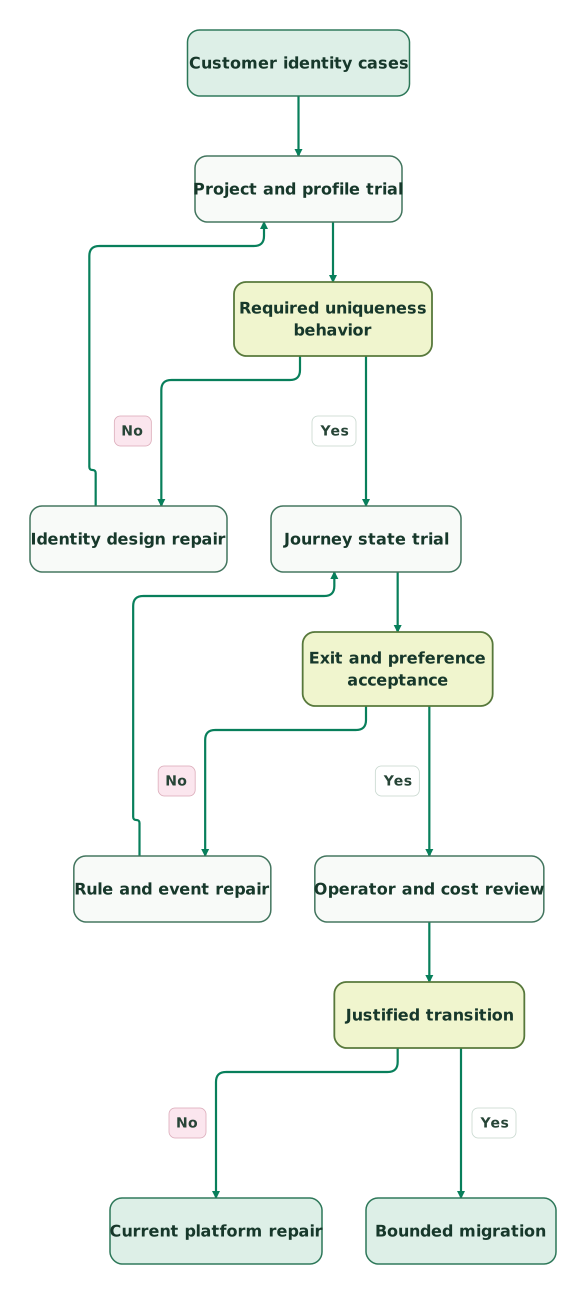
Read diagram as text
- Customer identity cases to Project and profile trial.
- Project and profile trial to Required uniqueness behavior.
- Required uniqueness behavior to Identity design repair: No.
- Identity design repair to Project and profile trial.
- Required uniqueness behavior to Journey state trial: Yes.
- Journey state trial to Exit and preference acceptance.
- Exit and preference acceptance to Rule and event repair: No.
- Rule and event repair to Journey state trial.
- Exit and preference acceptance to Operator and cost review: Yes.
- Operator and cost review to Justified transition.
- Justified transition to Bounded migration: Yes.
- Justified transition to Current platform repair: No
The identity and journey stages have their own repair paths. If an identity change affects journey eligibility, repeat both stages. Keep the saved cases under version control or another shared review process so later campaign changes can reuse the same acceptance evidence.
During migration, decide how customers already waiting in journeys will be handled. Finishing them in the old platform may be simpler than recreating their exact state. If they move, preserve the remaining delay, current eligibility and send history needed to avoid duplicate messages.
Backfilled events need a separate plan. A historical import can change segmentation or enter a live journey if the destination rules allow it. Keep live sending disabled for the import scope until the intended effects are confirmed, then activate a bounded cohort with one sender responsible for each message.
Braze vs Iterable checklist
- Define the stable customer key and required uniqueness rules.
- Test shared emails, email changes and anonymous-to-known transitions.
- Validate preferences, goal completion and exits during waiting periods.
- Ask the campaign owner to inspect and repair a representative journey.
- Assign ownership of identity, event, eligibility and content changes.
- Request equivalent workload quotes with contract units and growth terms.
- Include migration, parallel operation and historical access in the budget.
- Repeat affected identity and journey checks after each repair.
- Plan waiting-customer treatment and event backfills before cutover.
- Approve the first cohort with one live sender per message.
The lifecycle marketing audit skill can turn the customer cases into a practical evaluation brief. The decision is strongest when both the operator and the engineer can explain the accepted customer outcome and the complete cost of maintaining it.
Keep reading
Browse all CRM & Lifecycle guides
 CRM & Lifecycle
Braze vs Klaviyo for App and Commerce Lifecycle Programs
Compare Braze and Klaviyo by app identity, store journeys, message priority and billing units, with a workload worksheet and migration acceptance tests.
Jafrin Akter AloLast updated 10 min read
 CRM & Lifecycle
Brevo vs Klaviyo for Email Budgets and Commerce Journeys
Compare Brevo and Klaviyo by contact storage, daily and monthly sends, Shopify setup and purchase-state behavior, with explicit entry-price calculations.
Jafrin Akter AloLast updated 10 min read
 CRM & Lifecycle
How to Build a Customer Preference Centre That Works
Build a preference centre that controls real messages. Define topics and channels, prevent stale resubscriptions, record changes and test every sender.
Jafrin Akter AloLast updated 9 min read
Lifecycle marketing
See the implementation scope, deliverables and acceptance checks.
Questions people ask
Can an Iterable project's unique identifier be changed after launch?
An Iterable project's unique identifier setting cannot be changed in place after the project is created, according to its project-type documentation. Define the required email and userId uniqueness before setup. Include shared addresses, anonymous users and email changes in the design review so the selected project type fits the real customer identities before journeys depend on it.
Does an Iterable userID-based project require unique email addresses?
An Iterable userID-based project requires unique userId values but does not enforce email uniqueness. Hybrid projects enforce both email and userId uniqueness. That difference matters if several business identities legitimately share one email address. Decide whether those records represent one customer or separate identities, then test the resulting preference and message behavior rather than selecting a type only for import convenience.
Can a Braze identification request replace a full identity acceptance test?
A Braze identification request cannot replace the acceptance test for the resulting customer record. The request may identify an alias-only, email-only or phone-only user with an external ID, but the business still needs to verify history, preferences and journey eligibility. Inspect the intended profile and downstream message decisions using a known test customer before expanding the integration.
Should every waiting customer restart a journey during a Braze or Iterable migration?
Waiting customers should not automatically restart at the beginning. Decide whether they finish in the old platform or resume at a defined destination state. Preserve remaining delays, eligibility and relevant send history, then test a representative waiting cohort. A clean import that causes repeat welcome or purchase messages is not an acceptable migration outcome.
Is a lower Braze or Iterable renewal quote enough to justify switching?
A lower renewal quote is enough only when the complete saving justifies transition and operating costs while preserving the required program. Include implementation, parallel subscriptions, historical access and ongoing ownership. Compare a targeted repair of the current setup with the migration. A smaller monthly bill can still leave the business spending more during the first year.
Sources

Written by
Jafrin Akter AloData Engineer and Co-founder at Martechdevs and Growth and Analytics Partners
Jafrin writes practical guides to marketing technology, customer data, analytics and AI workflows. Martechdevs is a Growth and Analytics Partners company.