
Iterable Pricing: Build the Quote, Check Usage and Control Renewal Cost
Iterable pricing requires a scoped quote covering the platform, contracted capacity, messaging channels and services. Build the budget from those units rather than applying a generic price per monthly active user. Iterable's usage reporting includes stored-user and custom-event high-water marks, which can stay above the current total after cleanup. Lower usage and lower committed spend are separate outcomes.
On this page
The useful buying question is not “what did another company pay?” It is “what will our workload consume, which limits will we cross, and what can change during the contract?” A quote with an attractive base fee can become difficult to operate if storage, channels, integration capacity or renewal conditions are unclear.
This guide builds that commercial and usage model. Use Customer.io versus Iterable for the wider platform decision, including data-model, warehouse and API fit. Martechdevs' lifecycle messaging implementation is a separate scope from the vendor's subscription and usage charges.
How much does Iterable cost?
Use a written proposal for the actual workload; Iterable's public buying route does not provide a universal self-serve price to apply to every account. Its Enterprise Order defines the purchased services and allowances. Iterable buying route, public Master Services Agreement.
Do not turn a third-party contract median into a price for your company. It may combine different volumes, channels, services, commitments and negotiated rights. A useful proposal should let another person reproduce the bill from the selected usage measures.
Request two versions: the expected workload and a credible peak or growth scenario. Ask the vendor to show what happens when each included allowance is exceeded. Keep the billing period, measurement window and unit beside every rate.
The public buying route offers a demo. Any free evaluation, startup concession or onboarding waiver needs written confirmation in your offer. A free integration allowance is not the same as a free messaging subscription.
Which usage units belong in the quote?
List storage, message usage and integration capacity separately. The number of people who opened the product this month is not a substitute for every one of those measures.
| Quote component | Unit to establish | Question that prevents a surprise |
|---|---|---|
| Platform commitment | Fee, term and included capabilities | Which products, environments and support services are included? |
| User capacity | Contracted stored-user measure and allowance | Is the limit based on a period peak, and which projects contribute? |
| Custom-event capacity | Stored-event measure and allowance | Which history must remain in Iterable and for how long? |
| Email and other channels | Billable sends, segments or the contracted channel unit | Which attempted, bounced, delivered or received messages count? |
| Smart Ingest and related data movement | Included sync capacity and required services | Is the allowance for configured syncs or executions? |
| Onboarding and ongoing support | Defined deliverables and charges | What is one-time, recurring or separately scoped? |
Iterable's Usage and Billing screen shows organization-level metrics and contract-specific allowance windows. Its user and custom-event high-water marks record the highest stored total reached during the selected billing period. These are distinct from active-user counts and from a month's newly ingested events. Usage and Billing.
Write the metric definition into the quote worksheet. “One million events” is incomplete without saying whether it means events received, events retained at a point in time, a period peak or a cumulative contract allowance. Two offers using different definitions cannot be compared by unit price alone.
For each channel, ask which provider is involved and who invoices its usage. Preserve country, sender type and any applicable pass-through costs in the estimate. A single blended rate can hide the country or message type that dominates the actual bill.
Why can the bill stay high after users or events are deleted?
Deleting records can reduce the current stored total while leaving the billing period's recorded high-water mark unchanged. Cleanup should therefore be planned around future data needs and periods, not presented as an automatic credit against usage already recorded.
Iterable explicitly preserves a period's user and custom-event peaks after deletion. A new billing period starts a new high-water mark. High-water behaviour.
Consider this original normalized daily-snapshot example for two projects in one organization. Counts are stored users, not people active that day.
| Snapshot | Project A | Project B | Organization total |
|---|---|---|---|
| First recorded day | 90,000 | 10,000 | 100,000 |
| Second recorded day | 70,000 | 40,000 | 110,000 |
| After approved cleanup | 60,000 | 20,000 | 80,000 |
The organization peak is 110,000. Adding each project's separate maximum produces 90,000 + 40,000 = 130,000, even though those maxima did not occur together. Using the final stored total produces 80,000 and misses the earlier peak. Both shortcuts answer the wrong question.
For a local audit, this Python helper requires a complete project set for every supplied snapshot day. It calculates the peak of the organization totals. It does not reconstruct an invoice or infer missing vendor snapshots.
def organization_peak(rows, expected_projects):
    if (not isinstance(expected_projects, frozenset)
            or not expected_projects
            or any(not isinstance(p, str) or not p or p != p.strip()
                   for p in expected_projects)):
        raise ValueError("provide the complete nonempty project set")
    if not isinstance(rows, list) or not rows:
        raise ValueError("provide complete daily snapshot rows")
    days = {}
    for row in rows:
        if not isinstance(row, dict):
            raise ValueError("each row must be an object")
        day, project, count = row.get("day"), row.get("project"), row.get("users")
        if type(day) is not int or day < 1:
            raise ValueError("day must be a positive snapshot ordinal")
        if not isinstance(project, str) or project not in expected_projects:
            raise ValueError("unexpected project")
        if type(count) is not int or count < 0:
            raise ValueError("users must be a nonnegative integer")
        observed = days.setdefault(day, {})
        if project in observed:
            raise ValueError("duplicate project in one snapshot")
        observed[project] = count
    if any(set(values) != expected_projects for values in days.values()):
        raise ValueError("a snapshot is missing a required project")
    totals = {day: sum(values.values()) for day, values in days.items()}
    return max(totals.values()), totals[max(totals)]
The returns are the maximum observed organization total and the total on the latest supplied day. For the table, they are 110000 and 80000. Use the real billing-period boundary and complete available snapshots when adapting the method. Missing days can conceal an earlier peak, so reconcile against the vendor's recorded high-water mark before treating a local result as complete.
Also inspect how identities are created. Loading the same business audience into another project can create additional stored records even when the marketing team thinks of them as the same people. Use an explicit project inventory and the reported project breakdown instead of deduplicating across projects by email without a contractual basis.
Why do campaign reports and billing totals disagree?
Align scope, time zone, record lifecycle and the measured event before calling a difference an error. Campaign reports and billing reports can legitimately count different things.
| Difference to investigate | Evidence to compare | Practical interpretation |
|---|---|---|
| Organization versus one project | Selected projects and billing scope | A campaign export can omit other projects' consumption |
| Pacific Time billing snapshots versus another reporting time zone | Period boundaries and source timestamps | Activity near midnight may belong to a different displayed date |
| Current records versus earlier period history | Deletions, archived projects and recorded peaks | A cleaned-up segment does not erase prior usage |
| SMS messages versus segments | Provider receipts and final rendered content | One personalized message can consume several billable segments |
Iterable calculates relevant storage snapshots daily using Pacific Time. Current campaign and segmentation views can exclude deleted data that remains reflected in billing history. SMS length, encoding and personalization can change segment counts; delayed provider status can also shift usage between periods. Usage-metric reconciliation.
Build a reconciliation record with the invoice line, contracted definition, report period, organization/project scope, raw quantity and source export. Keep unresolved differences separate from confirmed errors. A screenshot of a smaller current total does not explain the period's maximum.
Ask the billing owner to review discrepancies promptly under the agreement's dispute procedure. Preserve the evidence needed for the specific line item instead of sending a bundle of unrelated campaign screenshots.
How should you price Smart Ingest and data retention?
Count the warehouse sync definitions the operating design needs, then keep only the event history required for decisions and approved retention. Both choices affect cost and maintainability.
Iterable's default Smart Ingest allowance is five production syncs across the organization. A sync used and then deleted still counts until the next calendar month; approved test-project treatment is separate. This measures sync configurations rather than five executions. Confirm any purchased capacity with the account owner. Smart Ingest limits.
Avoid creating a new sync for every temporary campaign if a maintained model can serve the same purpose. Equally, do not merge unrelated data flows merely to reduce the count when they need different identities, schedules or recovery controls. Include warehouse query costs and the person maintaining the model in the operating budget.
Custom events are retained indefinitely by default unless a retention policy removes them. Changing retention schedules qualifying data for permanent deletion immediately; increasing the retention window afterward may not rescue data already queued for deletion. Event age uses Iterable's internal document-creation time. Custom-event retention.
Before shortening history, list the segments, journeys, personalization and analysis that depend on it. Test the longest relevant lookback and preserve required history outside the messaging system where appropriate. A lower storage number is not a success if a necessary suppression or eligibility rule stops working.
An event's status is another separate control. Discarded events can still trigger an Event Occurs entry and provide their fields in that journey, but new occurrences are not stored for broader historical use. Earlier saved occurrences remain until their retention policy deletes them. Deactivated events have different behaviour. Custom-event states.
Choose the event's purpose before its state. A transient trigger, a thirty-day eligibility fact and a long-term reporting record do not necessarily need the same storage arrangement.
What does a reproducible Iterable quote model look like?
Use the quoted base, allowances and rates, with an explicit rule for every overage. The following example demonstrates the calculation only. Every price, allowance and fee in this table is a hypothetical contract assumption, not an Iterable published rate or a reported customer contract.
Assume an annual platform commitment shown as a monthly equivalent, monthly metered overages, unchanged usage within each example year and a one-time implementation fee in year one. Tax, SMS, other channels, warehouse compute and internal operating labour are excluded.
| Hypothetical quote input | Year one | Year two | Unit or assumption |
|---|---|---|---|
| Annual platform commitment | USD 24,000 | USD 30,000 | A first-year concession expires in this example |
| Included user high-water allowance | 100,000 | 100,000 | Per monthly period |
| Observed user high-water quantity | 110,000 | 125,000 | Example usage |
| Extra-user rate | USD 0.02 | USD 0.02 | Per excess user per period |
| Included custom-event storage peak | 5,000,000 | 5,000,000 | Per monthly period |
| Observed custom-event storage peak | 6,000,000 | 7,000,000 | Example usage |
| Extra-event rate | USD 0.20 | USD 0.20 | Per thousand excess stored events |
| Included monthly email sends | 1,000,000 | 1,000,000 | Assumed billable-send allowance |
| Observed monthly email sends | 1,200,000 | 1,500,000 | Example usage |
| Extra-email rate | USD 0.10 | USD 0.10 | Per thousand excess sends |
| One-time implementation fee | USD 6,000 | USD 0 | Assumed scoped work |
For year one, user overage is (110,000 − 100,000) × 0.02 = USD 200/month. Event overage is 1,000,000 ÷ 1,000 × 0.20 = USD 200/month, and email overage is 200,000 ÷ 1,000 × 0.10 = USD 20/month.
| Calculated result | Year one | Year two | Interpretation |
|---|---|---|---|
| Monthly-equivalent base | USD 2,000 | USD 2,500 | Annual commitment divided by twelve |
| Monthly overages | USD 420 | USD 950 | Users, stored events and email combined |
| Annual recurring cost | USD 29,040 | USD 41,400 | Twelve unchanged example months |
| Annual total including implementation | USD 35,040 | USD 41,400 | Includes only the listed cost categories |
The recurring increase is USD 12,360, while the year-to-year total increase is USD 6,360 because the one-time implementation fee does not recur. Looking only at the total change hides how much the operating commitment grew.
Replace every hypothetical input with the actual quote before using the result. If the contract sells capacity blocks, annual allowances or a different rate structure, change the formula rather than forcing it into a linear monthly model. A monthly-equivalent figure also does not establish a monthly cancellation right.
Which changes can lower avoidable spend without breaking journeys?
Reduce data and features that do not support a maintained customer decision, then negotiate the commercial scope needed to realize the saving. Cleaning a dashboard and reducing a committed invoice are different steps.
Start with these operational levers:
- Remove redundant producers that create duplicate users or repeated event history.
- Stop sending unused custom-event types, after checking their references.
- Apply an approved retention policy that preserves necessary journey lookbacks.
- Consolidate truly duplicate sync definitions while retaining clear ownership and recovery.
- Compare purchased channel and support scope with actual recurring use.
- Forecast the next period before importing a large historical audience or dataset.
Do not treat record deletion as a substitute for consent or suppression management. A removed record that an upstream job recreates can restore operational risk and increase usage again. Fix the producer and lifecycle policy alongside the destination cleanup.
For a commercial discussion, bring a baseline, the proposed change and its effect on the measured unit. “We expect to retain two million fewer custom events after the approved policy takes effect” is a better negotiation input than “we have fewer active users.” Ask how that change affects future capacity and the committed fee.
Separate a requested onboarding waiver, a negotiated capacity band and a renewal cap. Each changes a different part of the purchase. Do not assume a discount because a deal happens near quarter-end or because another company obtained one.
What should you check before renewal or expansion?
Read the signed order, amendments and incorporated terms before treating a lower usage forecast as a right to reduce spend. Agree the notice deadline and method with the person responsible for the contract.
Iterable's public MSA describes same-length renewal and at least thirty days' notice in its renewal language. It also describes contracted services as non-cancellable during the term, with increased capacity charged for the current period and remaining term. The Enterprise Order takes precedence where it conflicts with the MSA. Notice formalities matter as well as the date. Iterable MSA, sections 2, 5 and 12.
Use that as a review checklist, not a replacement for your actual agreement. Capture the term end, notice deadline, required recipients, delivery method and proof of receipt. Start the commercial review early enough to evaluate alternatives and preserve a safe migration path before the notice window closes.
| Commercial request | Evidence to bring | Term to make explicit |
|---|---|---|
| Smaller future capacity | Reconciled peaks and approved retention plan | When the lower allowance and fee can take effect |
| Controlled growth cost | Baseline and peak-volume forecast | Overage unit, rate and any price protection |
| One-time implementation concession | Defined deliverables and internal capacity | Exactly which fee is waived and what still remains |
| Multi-year commitment | Credible usage and capability forecast | Annual fees, uplift limits and permitted changes |
| Exit or replacement | Data, templates and journey-dependency inventory | Export access, notice process and transition responsibilities |
When does Iterable fit the budget better than a smaller arrangement?
Iterable fits when the required cross-channel programme, operating controls and implementation capacity justify the complete quote. A smaller subscription is only a better choice when it also covers the necessary customer workflows.
| Team situation | First arrangement to evaluate | Runner-up | Decision evidence |
|---|---|---|---|
| Established lifecycle team with several channels and owned data operations | Scoped Iterable proposal | Customer.io | Same journey tests, commercial units and operating effort |
| Small SaaS team mainly building a few product-triggered journeys | Customer.io | Iterable if required capability warrants it | Published entry economics versus the actual Iterable scope |
| Existing platform already performs the necessary journeys | Retain and right-size the current arrangement | Controlled Iterable evaluation | Benefit must cover migration and maintenance |
Use the platform comparison for capability details and the martech stack-cost model for retained tools and internal labour. Do not count a subscription as a saving unless its work is covered and the team can actually retire it.
What should approve the final quote or cost change?
Approve only after the usage definitions reconcile, the proposed journey changes pass and the contract makes the financial effect explicit.
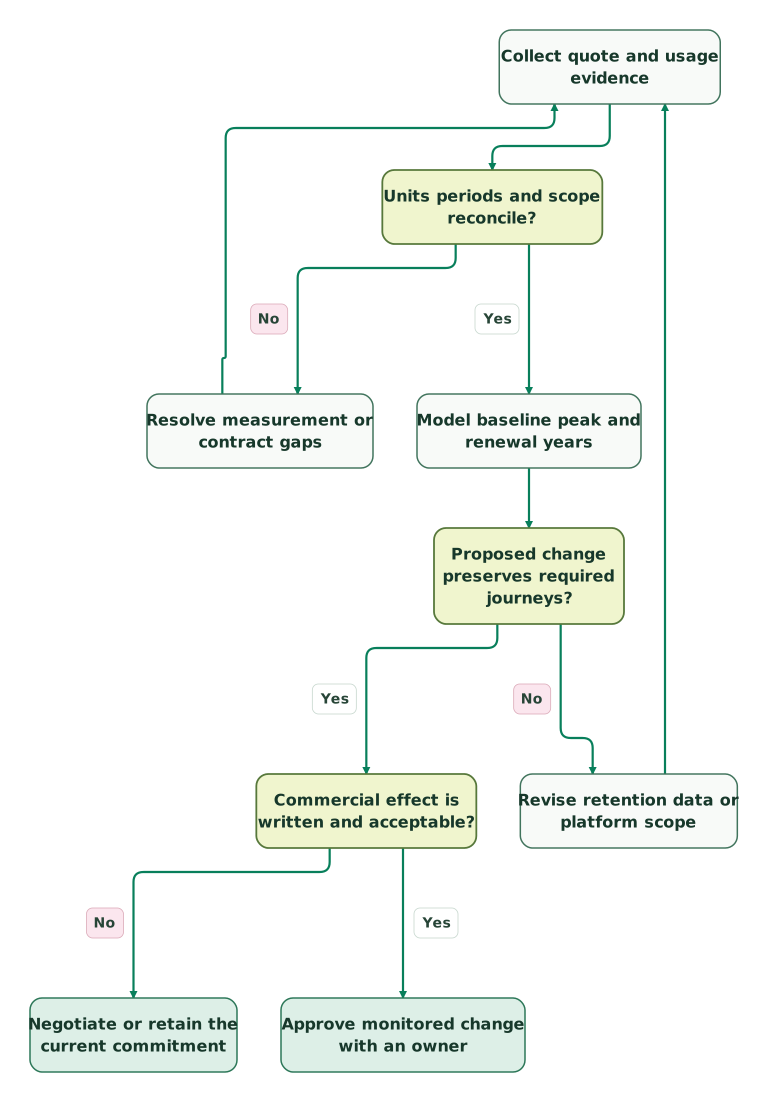
Read diagram as text
- Collect quote and usage evidence to Units periods and scope reconcile?.
- Units periods and scope reconcile? to Resolve measurement or contract gaps: No.
- Resolve measurement or contract gaps to Collect quote and usage evidence.
- Units periods and scope reconcile? to Model baseline peak and renewal years: Yes.
- Model baseline peak and renewal years to Proposed change preserves required journeys?.
- Proposed change preserves required journeys? to Revise retention data or platform scope: No.
- Revise retention data or platform scope to Collect quote and usage evidence.
- Proposed change preserves required journeys? to Commercial effect is written and acceptable?: Yes.
- Commercial effect is written and acceptable? to Negotiate or retain the current commitment: No.
- Commercial effect is written and acceptable? to Approve monitored change with an owner: Yes
Checklist
- Every fee has a unit, allowance, measurement period and owner.
- Stored-user and event peaks are reconciled at the correct organization scope.
- Campaign and billing differences have explanations tied to time and counting rules.
- Retention changes preserve required history and approved recovery evidence.
- Smart Ingest capacity is counted by the actual applicable configuration rule.
- Baseline, peak and second-year costs use the proposed contract.
- One-time work is separated from recurring operating spend.
- Notice dates, recipients and methods are recorded from the applicable agreement.
- A lower usage forecast has an explicit commercial path to any claimed saving.
For an unclear invoice or a renewal tied to integration cleanup, start with the $99 martech audit. A scoped lifecycle implementation should identify the data producers, retained history and customer journeys that make the cost controllable after the project ends.
Keep reading
Browse all CRM & Lifecycle guides
 CRM & Lifecycle
Braze vs Reteno for Subscription Apps: Pricing, RevenueCat and Migration
Compare Braze and Reteno for subscription apps: billing units, RevenueCat event formats, entitlement checks, duplicate messages and a safe migration plan.
Jafrin Akter AloLast updated 14 min read
 CRM & Lifecycle
6 CleverTap Implementation Mistakes: Fix Identity, Push and Profile Updates
Fix CleverTap identity merges, login misuse, profile mappings, FCM credentials and missing push. Reconcile partial API uploads with a tested response checker.
Jafrin Akter AloLast updated 12 min read
 CRM & Lifecycle
CleverTap Pricing: Work Out the Real Cost Before You Buy
Calculate CleverTap costs beyond the starting price: Core billing, add-ons, AI usage, overages and startup discounts, with clear budget examples.
Jafrin Akter AloLast updated 11 min read
Lifecycle marketing
See the implementation scope, deliverables and acceptance checks.
Questions people ask
Should the Iterable budget use our product's monthly active-user number?
Use the contract's actual metric. A product's monthly active-user count can be much smaller than the users stored in the messaging organization, and it says nothing about retained custom events or channel consumption. Reconcile the quoted unit with Usage and Billing and document any negotiated alternative. Do not substitute a familiar analytics denominator simply because it produces a more comfortable estimate.
Can we reduce the current period's peak by merging duplicate users?
Merging can reduce the current user total, but it does not undo a high-water mark already recorded for the billing period. Evaluate the identity and consent consequences before changing profiles, then verify the resulting total and next period's usage. Fix duplicate creation upstream as well; otherwise a temporary cleanup can be reversed by the next import or synchronization run.
Does turning a custom event into a discarded event remove its history?
No. Changing the status affects how new occurrences are handled; previously saved occurrences remain subject to their retention policy. A discarded event can serve a limited journey-trigger purpose without becoming broadly available historical data. Review every segment, journey and personalization reference before changing the status, and use the correct retention control for history you are authorized to delete.
Is a Smart Ingest allowance a reason to assume the entire integration is free?
No. Included sync capacity is one component of an operating integration. The messaging subscription, warehouse queries, data model, monitoring and maintenance still need a budget. Confirm the number of production syncs, any additional capacity and test-project treatment. Then evaluate whether the pipeline delivers current, correctly identified data to the required journey rather than judging it solely by the connector charge.
What evidence should we retain when disputing a usage line?
Keep the invoice line, applicable order definition, billing period, organization and project scope, reported peak or send quantity and the underlying exports. Explain any deletions, delayed provider receipts or time-zone differences that affect the comparison. Use the agreement's dispute process promptly and track the outcome. A current segment count alone is rarely enough to explain a historical billing measure.
Sources

Written by
Jafrin Akter AloData Engineer and Co-founder at Martechdevs and Growth and Analytics Partners
Jafrin writes practical guides to marketing technology, customer data, analytics and AI workflows. Martechdevs is a Growth and Analytics Partners company.