
Iterable Alternatives for Product, App and Store Journeys
Choose Customer.io for product-led journeys with a smaller starting commitment, Braze for a mobile program with broad channel needs, and Klaviyo for a store-led lifecycle. The best Iterable alternatives preserve your customer identities, message exclusions and reporting history. Compare that operating fit before treating a lower platform quote as a reason to migrate.
On this page
Iterable competitors at a glance
Prices below are US list prices in USD, with billing periods and entry allowances shown.
| Tool | Starting price and billing basis | Best fit | Main tradeoff |
|---|---|---|---|
| Iterable | Sales quote for the required scope | An established cross-channel program | A move can cost more than repairing the current setup |
| Customer.io | Essentials from $100/month, billed monthly; 5,000 people plus objects | Product and account-based lifecycle journeys | Data modelling and integrations need an owner |
| Braze | Sales quote covering edition, MAUs, profiles, action credits and services | App and mobile engagement | The quote needs a complete usage model |
| Klaviyo | Email from $20/month for 500 active profiles and 5,000 emails | Commerce lifecycle marketing | A small store tier cannot price a large app audience |
Iterable directs buyers to a sales consultation. The public Customer.io plans, Braze pricing structure and Klaviyo plans use different commercial units. Treat the table as a shortlist, then request the same audience and channel volumes from each vendor.
The first decision is the job you are replacing. A retailer with a repeat-purchase program needs product and order context. A software business may need one customer attached to several workspaces. An app team needs reliable device identity and channel permissions. All can send a welcome message, but that common action says little about the difficult parts of migration.
At Martechdevs, we start a lifecycle platform migration assessment with the active journeys, identity rules and suppression paths. That produces a concrete scope for a trial and a quote. It also reveals whether staying on Iterable with a smaller, better-maintained program is the better decision.
The replacement boundary
Separate the reason for leaving from the functions that must survive. An expensive renewal is a commercial problem. Missing events are a data problem. Campaign delays caused by unclear approvals are an ownership problem. A new platform can change the first problem directly; the others follow the team unless the migration fixes them.
Build an inventory that records the entry event, audience, waiting period, exit condition, message channel and business owner for each live journey. Include scheduled campaigns and transactional messages sent outside the journey builder. A feature list that misses those senders understates both the work and the risk.
Preserve the reason a customer must stop receiving a message. Iterable supports journey exit rules and records exit reasons when journey exit tracking is configured. Its journey exit documentation distinguishes normal exits from unexpected conditions. Use those current rules as test cases rather than assuming a diagram copied into another platform behaves identically.
A trial should also expose the fields that campaigns quietly depend on. An email address can change. A workspace can have several members. An order can be refunded after a customer enters a follow-up journey. Assign one stable identifier and a documented owner to each business fact before selecting the destination.
Tool decision blocks
Iterable
- Best for: A team whose existing cross-channel journeys already fit its business and need targeted repair.
- Pros: Keeping the platform preserves working integrations and avoids rebuilding every campaign at once.
- Cons: Existing complexity remains unless someone removes unused journeys and resolves unclear data ownership.
- Free plan and startup offer: The sales entry point offers a consultation, without a public self-service free allowance or standard startup price. Request any evaluation terms in writing.
- Choose it if: The main failures have identifiable owners and the renewal cost remains acceptable after a scoped repair plan.
- Skip it if: A representative journey still requires unwanted workarounds after the proposed repair has been tested.
Customer.io
- Best for: Product teams that need messages tied to account, subscription or other non-person records.
- Pros: Its objects model represents non-person data and relationships rather than forcing every business fact onto a person.
- Cons: Someone must maintain those relationships and decide which account context applies to each message.
- Free plan and startup offer: Essentials is paid. The startup program offers eligible new customers up to 12 free months and 30,000 people plus objects; eligibility includes less than $10 million raised and no purchased lists.
- Choose it if: Your team can supply clean events and wants to control the logic of onboarding, activation and renewal messages.
- Skip it if: You want a store connector to supply nearly all campaign data and have no owner for custom product events.
Braze
- Best for: An app business evaluating email alongside push, in-app messages and other mobile channels.
- Pros: The platform plan includes cross-channel messaging, orchestration and frequency controls, with editions for different operating requirements.
- Cons: MAUs, stored profiles, action credits, services and add-ons need separate attention in a quote.
- Free plan and startup offer: Braze states that it has no free plan; trials and tailored entry arrangements are available. Its startup offering requires a conversation, so budget only an approved offer.
- Choose it if: Mobile engagement is central enough to justify SDK ownership and a broader operational rollout.
- Skip it if: Your replacement scope is a small email program and the full quoted arrangement adds work without solving a current need.
Klaviyo
- Best for: A store where orders, products and repeat purchases determine most lifecycle messages.
- Pros: The Shopify setup provides a direct commerce integration; flows can use customer activity to drive messages.
- Cons: A commerce fit does not establish parity with every account-based or app journey in an Iterable installation.
- Free plan and startup offer: The free plan covers 250 active profiles and 500 emails/month. Use that concrete allowance for evaluation; the page does not promise a universal startup discount.
- Choose it if: Your decisive test is an order or product journey and the store data passes that test with little custom handling.
- Skip it if: Most messages depend on several account relationships, bespoke product states or an app architecture that the proposed setup has not demonstrated.
Best fit by operating model
| Company size or operating model | Best fit | Runner-up | Decision reason |
|---|---|---|---|
| Small product team with engineering support | Customer.io | Iterable | Account context and event ownership matter more than a large channel catalogue |
| App business with a dedicated lifecycle team | Braze | Iterable | Mobile channels justify a deeper SDK and orchestration evaluation |
| Store with a lean retention team | Klaviyo | Customer.io | Order-driven campaigns reduce the need for custom product modelling |
| Established Iterable program near renewal | Iterable repair | Customer.io | A bounded repair can preserve a valuable integration investment |
| Retailer with a substantial app experience | Braze | Klaviyo | Choose from the app and commerce journeys that drive the actual requirement |
These are starting recommendations, not company-size limits imposed by vendors. A small app with a complex identity problem may need more implementation work than a much larger store with standard events. Run the representative journey before using headcount to choose a platform.
For a broader B2B marketing handoff, the Marketo alternatives guide addresses CRM campaign and qualification needs. For smaller commerce and service businesses, ActiveCampaign vs Klaviyo narrows the choice to two different operating models. Those are different decisions from replacing a mature Iterable program feature for feature.
Cost normalization and a hypothetical migration
Use one worksheet for all vendors. Record stored people, active users, objects, channel messages, required users, support, implementation and overlap. Keep email volume separate from SMS or other paid channel activity. A vendor should confirm the precise billing definition before finance compares totals.
Customer.io includes people and objects in its profile allowance. Braze describes a contract made up of platform edition, MAUs and profiles, action credits and services. Klaviyo calls an active profile a contact you can market to. Those definitions come from the Customer.io pricing page, Braze pricing page and Klaviyo pricing page. They cannot be replaced with one spreadsheet column labelled contacts.
The following example is hypothetical. Assume the current complete running cost is $4,800/month, the selected replacement is $3,100/month, migration work is $12,000, and two months of additional replacement fees are needed during overlap. These are planning inputs, not vendor quotes or Martechdevs package prices.
| Hypothetical input | Calculation | Result | Unit |
|---|---|---|---|
| Monthly steady-state saving | $4,800 minus $3,100 | $1,700 | USD/month |
| Additional overlap expense | 2 months × $3,100 | $6,200 | USD |
| Migration plus overlap | $12,000 + $6,200 | $18,200 | USD |
| Payback after old platform retirement | $18,200 ÷ $1,700 | 10.71 | Months |
| First-year net saving after a two-month transition | 10 × $1,700 minus $18,200 | -$1,200 | USD |
This example distinguishes a lower running bill from a first-year saving. It assumes the old platform is retired after two months, savings start then, and there are no additional renewal penalties or growth charges. A delay changes the result. Reducing migration scope may matter more than negotiating a small discount.
Use the software pricing comparison tool to keep recurring subscriptions visible and the Iterable pricing guide for the incumbent quote discussion. Replace every assumed input with an approved commercial number before presenting a savings claim.
Journey acceptance and repair
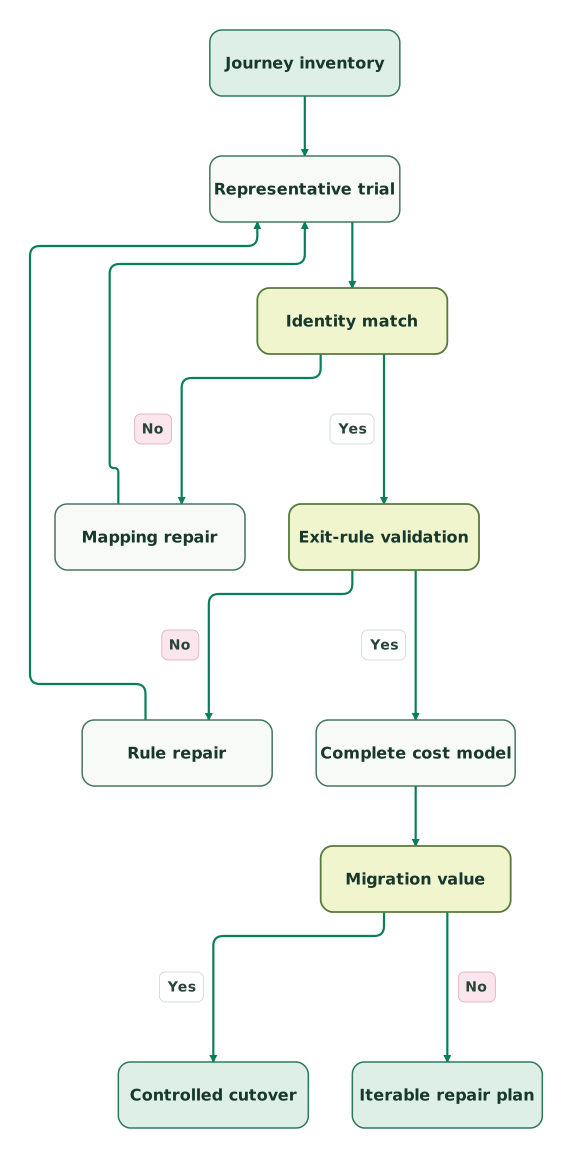
Test the same business outcome in each shortlisted platform. A complete test starts with a known record, sends the trigger event, waits through the configured delay, changes the customer's state and checks the final message decision. Looking only at an email preview misses identity and timing failures.
Read diagram as text
- Journey inventory to Representative trial.
- Representative trial to Identity match.
- Identity match to Mapping repair: No.
- Mapping repair to Representative trial.
- Identity match to Exit-rule validation: Yes.
- Exit-rule validation to Rule repair: No.
- Rule repair to Representative trial.
- Exit-rule validation to Complete cost model: Yes.
- Complete cost model to Migration value.
- Migration value to Controlled cutover: Yes.
- Migration value to Iterable repair plan: No
The loop deliberately repeats the trial after a mapping or rule repair. A corrected identity can change eligibility, and a corrected exit can change which profile reaches a message. Rechecking only the failed screen misses those connected effects.
Use a refund after a purchase, a cancellation during a delay, an email-address change and a second device as trial cases where relevant. Include a person who should receive nothing. Record the expected result before running each case, then retain the observed event and message history with the pass or failure.
Klaviyo's flow filter documentation provides a specific example of semantics that can change in a migration: profile filters are checked again before actions, and a skipped action does not necessarily end the person's whole flow. Translate the intended business exclusion explicitly instead of treating all exit controls as synonyms.
Keep one platform responsible for each live message during cutover. The other can receive data for comparison, with sending disabled for that scope. A historical backfill should not unexpectedly enter a live welcome or purchase journey. Check those entry rules before replaying events, then move a bounded cohort whose outcome can be reconciled.
Iterable replacement checklist
- Record the commercial or operational reason for replacing Iterable.
- Inventory every sender, journey owner, trigger, delay and exit condition.
- Match source identities to destination identities with known test records.
- Preserve channel preferences and historical suppressions.
- Test the normal path and the customer who must receive no message.
- Re-run the full affected journey after every mapping or rule repair.
- Obtain comparable quotes with explicit audience and message definitions.
- Include migration, parallel operation and renewal timing in the budget.
- Assign one sender to each live message and document a rollback decision.
- Reconcile the first cohort before expanding the migration.
The lifecycle marketing audit skill helps turn that inventory into a reviewable brief. Use the customer preference centre guide when the difficult part is preserving permissions across channels. A completed feature matrix is useful only after the messages that must be suppressed have passed the same scrutiny as the messages you want to send.
Keep reading
Browse all CRM & Lifecycle guides
 CRM & Lifecycle
Marketo Alternatives for CRM, Lead Nurture and Product Journeys
Compare Marketo alternatives for CRM, lead nurture and product journeys, including current plan costs, handoff tests and a full first-year budget example.
Jafrin Akter AloLast updated 11 min read
 CRM & Lifecycle
ActiveCampaign vs Klaviyo for Service and Store Automation
Choose ActiveCampaign for lead nurture or Klaviyo for store journeys. Compare entry costs, Shopify plan limits, flow behavior and a practical migration test.
Jafrin Akter AloLast updated 10 min read
 CRM & Lifecycle
Iterable Pricing: Build the Quote, Check Usage and Control Renewal Cost
Build an Iterable budget from stored-user and event peaks, channel usage, integration capacity and contract terms. Reconcile billing and model year-two cost.
Jafrin Akter AloLast updated 14 min read
Lifecycle marketing
See the implementation scope, deliverables and acceptance checks.
Questions people ask
Can an Iterable alternative preserve customers already waiting in journeys?
It can preserve the intended next action, but waiting customers need an explicit migration rule. Export or reconstruct their current state, remaining delay and eligibility, then decide whether to finish them in Iterable or resume them in the replacement. Do not restart every customer at the beginning. Test one representative waiting cohort before moving the rest.
Is a cheaper email platform a full replacement for Iterable?
A cheaper email platform is a full replacement only if email covers the required program and the other dependencies are accounted for. Inventory mobile messages, webhooks, preferences, event history and external senders before deciding. A small advertised email tier may be useful for a trial while remaining far below the audience or channel scope of the production program.
Does a Customer.io startup offer settle an Iterable migration decision?
No, the startup offer changes the initial cost rather than the suitability of the data model or the cost after the offer ends. Eligible businesses must meet the program's conditions. Model the paid period separately and test the account relationships, exclusions and maintenance workload that your team will still own after the discounted period.
Should an Iterable migration retain every historical event?
An Iterable migration should retain the history required for targeting, suppression, reporting and operational support. Keep a separate archive where older events are useful for analysis but unnecessary for live messaging. Define the lookback needed by each journey before importing history, and test whether the import can trigger new activity or change customer eligibility.
Can a store and an app choose different Iterable replacements?
A store and an app can use different platforms if identity, preferences and send ownership are shared deliberately. The arrangement creates another integration to maintain and can produce overlapping messages. Start with a single-platform trial, then justify a split with a specific requirement that one tool cannot meet within the accepted cost and operating scope.
Sources

Written by
Jafrin Akter AloData Engineer and Co-founder at Martechdevs and Growth and Analytics Partners
Jafrin writes practical guides to marketing technology, customer data, analytics and AI workflows. Martechdevs is a Growth and Analytics Partners company.