
Marketo vs ActiveCampaign for Lead Nurture and Marketing Operations
Pick ActiveCampaign for a smaller nurture program that a lean team can own; pick Adobe Marketo Engage when qualification, program reuse and CRM coordination require a dedicated marketing operations setup. Marketo vs ActiveCampaign is a comparison of operating scope. Price the workflow that passes the trial, including its integration and administration, before assuming an entry email plan can replace the larger program.
On this page
ActiveCampaign and Marketo comparison
The ActiveCampaign entry offer is in USD on annual billing; Marketo uses a scoped sales quote.
| Decision criterion | ActiveCampaign | Adobe Marketo Engage | Selection consequence |
|---|---|---|---|
| Paid starting point | Starter $15/month for 1,000 contacts, billed yearly | Quote for the selected package | Starting prices represent different operating scope |
| Entry automation | Starter allows 5 actions per automation | Engagement programs organize content and cadence | Test the longest required nurture and its exceptions |
| Sales capability | CRM options are paid add-ons above Starter | Native CRM integration listed across packages | Include the selected integration and sales handoff |
| Evaluation | 14 days, up to 100 contacts and 100 emails | Sales demonstration and agreed evaluation | A trial's features may exceed the purchased plan |
| Operating emphasis | Lean-team automation and follow-up | Managed qualification and reusable marketing programs | Name the administrator before purchase |
Sources: ActiveCampaign's entry offer, ActiveCampaign feature comparison, ActiveCampaign trial, Marketo packages and Marketo engagement programs.
A small team can need sophisticated logic without needing a large campaign organization. A larger team can need standardization more than another automation feature. Separate the complexity of an individual journey from the work of operating many programs, assigning permissions and coordinating sales.
At Martechdevs, we use a CRM and lifecycle implementation review to define the handoff before choosing the tool. The review names the qualifying event, the record owner, the message exclusion and the evidence sales receives. Those conditions make a trial useful and keep the comparison tied to a real business process.
Tool decision blocks
ActiveCampaign
- Best for: A lean marketing team running a bounded set of nurture and follow-up automations.
- Pros: Its plan structure supports marketing automation from the entry tier, with a larger action scope and optional CRM capabilities above Starter.
- Cons: Five actions per Starter automation can be insufficient, and separately sold capabilities change the total. A small entry bill should not stand in for a qualified production quote.
- Free plan and startup offer: The 14-day trial covers up to 100 contacts and 100 emails and uses Professional-level features. It is not a permanent free subscription; no universal startup concession is assumed.
- Choose it if: The selected paid edition covers the required nurture, ownership and handoff with a process the team can maintain.
- Skip it if: The replacement relies on manual exceptions to preserve a larger Marketo program or assumes trial capabilities are included in Starter.
Adobe Marketo Engage
- Best for: A business with a maintained marketing operations function and explicit requirements for qualification, CRM coordination and program standards.
- Pros: Engagement streams organize prioritized nurture content and cadence, while the package supports the surrounding marketing program.
- Cons: Program design and administration remain an ongoing responsibility. A team without an operator can buy more complexity than it can reliably maintain.
- Free plan and startup offer: Adobe's package page offers a sales quote and does not publish a self-service free allocation or standard startup discount. Agree evaluation access and scope directly.
- Choose it if: The team can demonstrate requirements that justify the larger operating structure and fund the people who will own it.
- Skip it if: A simple set of campaigns and follow-ups covers the business and the wider program machinery adds no necessary work.
If publication and straightforward campaigns dominate the requirement, Mailchimp vs Marketo may be the closer comparison. The Marketo alternatives guide adds CRM consolidation and product-led lifecycle options when this pair leaves a clear gap.
Nurture logic and program operations
Write an individual nurture path first. Include the event that starts it, the data needed to personalize it, the waiting periods and the customer changes that should stop it. Then list how many teams will copy or adapt that path and how changes will be approved.
Those are separate requirements. A single complicated automation can be manageable for an experienced owner. A collection of individually simple automations can become difficult when several regions use different meanings for the same score or lifecycle state. The selection should address the complexity your team actually has.
| Operating requirement | Evidence from the trial | Ownership decision |
|---|---|---|
| Qualification | Known contacts reach the agreed threshold for the right reasons | Marketing and sales approve the definition |
| Nurture timing | The next message follows the intended event or cadence | Campaign owner approves delays and exclusions |
| Program reuse | A copied program preserves required fields and changes only the intended scope | Marketing operations owns the template |
| Sales handoff | The correct owner receives a usable record and next action | RevOps owns routing and acceptance |
| Change control | A revised rule passes the same saved cases | Named administrator approves release |
Avoid evaluating only the happy path. Include a person who changes employer, an existing customer and a prospect already attached to an open opportunity. An automation should treat each according to the agreed process, even if all three share the same form submission.
The business also needs an exception path. A prospect who asks for a pause should not require someone to invent a score or remove important history to stop nurture. Record the explicit pause state, its owner and the conditions for re-entry. That makes the process understandable in either platform.
CRM synchronization and the sales boundary
Adobe's Salesforce sync documentation identifies bidirectional synchronization for leads, contacts and Salesforce campaigns; other supported objects synchronize from Salesforce to Marketo. Use that distinction when mapping ownership and expected updates. A two-way person record does not mean every related object can be edited from either side.
For ActiveCampaign, the current plan comparison places premium CRM integrations such as Salesforce on Enterprise and describes separate CRM add-ons above Starter. Confirm the exact connector and commercial scope needed for your process. Do not price an integration-heavy replacement from the entry email subscription.
Create a field ownership sheet for lifecycle status, qualification, sales owner, customer status and subscription preferences. For each field, name the source system and permitted update direction. If two systems can update the same state, define conflict handling before enabling broad synchronization.
A handoff is complete only when the receiving process accepts it. An alert sent successfully does not establish that the salesperson can see the required context or that the CRM record exists in the correct place. Include a destination check in the trial and retain the record identifier with the observed result.
The Marketo Salesforce sync guide helps isolate a current integration problem. A repair may solve the business issue without a platform migration, especially if the campaign structure remains useful.
Edition limits and trial interpretation
ActiveCampaign's Starter plan has a five-action automation limit. Higher editions expand the action scope, while other capabilities retain plan-specific rules. The trial FAQ says trial features match Professional, so a successful trial can still imply a paid upgrade from Starter.
Use a feature register beside the test cases. Record the selected production plan for every required action, integration, user and permission. When the test uses a capability outside that plan, update the budget before continuing. This makes the outcome a reviewable configuration rather than a general impression of the product.
Marketo's package comparison also distinguishes package scope. Request a quote for the users, database, integrations and governance the program actually requires. Avoid comparing an unqualified Marketo quote with an entry ActiveCampaign price as though they describe equal capacity.
A useful demo should include a maintenance task. Ask the future operator to change an exclusion, investigate one customer path and explain a failed handoff. The platform that appears easier during campaign creation can create more work during investigation. Both activities belong in the decision.
A hypothetical operating-cost comparison
Consider two hypothetical complete configurations with the same accepted business scope. Setup A has a $600/month software cost and requires 12 administration hours/month. Setup B has a $1,400/month software cost and requires six administration hours/month. Value internal administration at an assumed $75/hour. These are illustrative inputs, not ActiveCampaign or Marketo quotes or measured effort.
| Hypothetical setup | Monthly software | Monthly administration | Complete monthly planning cost |
|---|---|---|---|
| Setup A | $600 | 12 × $75 = $900 | $1,500 |
| Setup B | $1,400 | 6 × $75 = $450 | $1,850 |
| Difference | $800 | -$450 | $350 |
The complete annual difference is $350 × 12 = $4,200. The software-only difference would have been $800 × 12 = $9,600. Neither calculation establishes a winner because the assumed administration hours still need evidence and the configurations must pass the same scope tests.
At the assumed $75/hour, Setup B would need to save $800 ÷ $75 = 10.67 administration hours per month to offset its software difference fully. The example assumes a six-hour reduction, so it does not reach that threshold. Keep the arithmetic visible so the team can replace the assumptions without changing the method.
Migration creates a separate first-year line. If moving to Setup A requires an assumed $8,400 project and the complete saving is $350/month, payback is $8,400 ÷ $350 = 24 months after savings begin. This simplified case excludes parallel subscriptions and growth, which should be added to an actual purchase model.
Use the software pricing tool to organize software, people, integration and overlap costs. The ActiveCampaign pricing guide helps qualify the smaller platform's edition, and the Marketo managed services guide addresses the operating arrangement for the larger program.
Best fit by marketing organization
| Company size or operating model | Best fit | Runner-up | Decision reason |
|---|---|---|---|
| Lean team with a bounded nurture program | ActiveCampaign | Marketo | Daily ownership and suitable edition matter most |
| B2B company with dedicated marketing operations | Marketo | ActiveCampaign Enterprise evaluation | CRM coordination and program standards justify deeper testing |
| Service business with simple qualification and follow-up | ActiveCampaign | Marketo after scope review | A smaller process may avoid unnecessary administration |
| Existing Marketo program with repairable sync failures | Marketo repair | ActiveCampaign qualified configuration | Fix the dependency before replacing the platform |
| Company reducing regional or product complexity | ActiveCampaign pilot | Smaller Marketo scope | Confirm the retired requirements are deliberate |
A team should not choose a larger tool simply to look ready for growth. Document the requirement that will trigger a later upgrade and the data that must remain portable. A smaller configuration can be a sound choice when its boundaries are understood and its owner can maintain it.
Acceptance and repair workflow
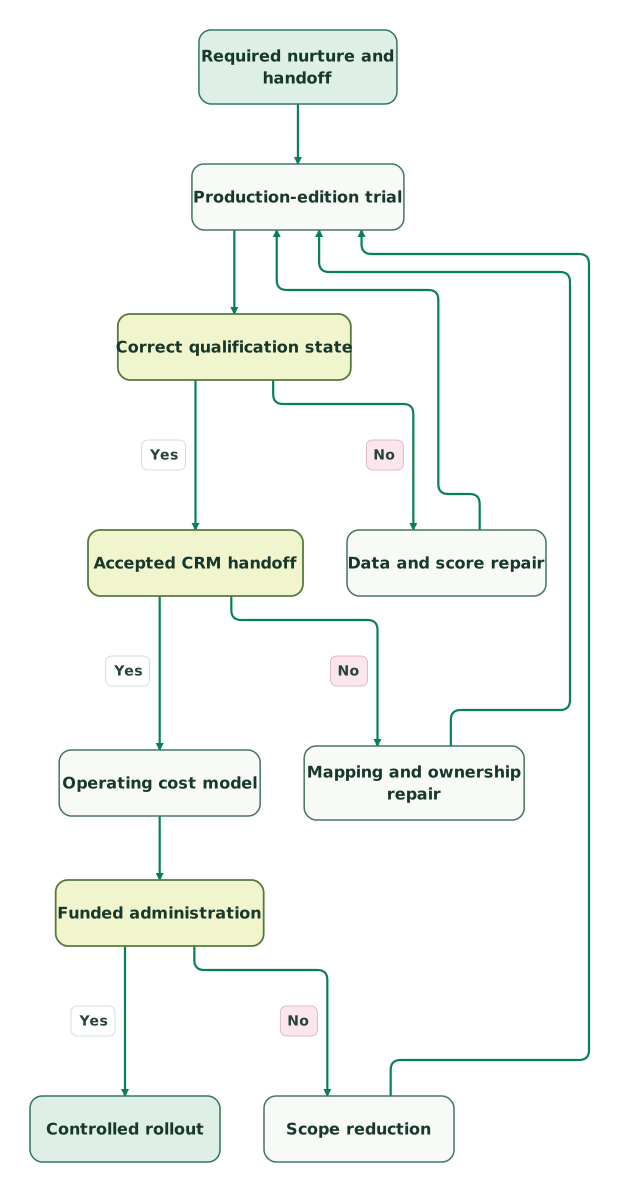
Read diagram as text
- Required nurture and handoff to Production-edition trial.
- Production-edition trial to Correct qualification state.
- Correct qualification state to Data and score repair: No.
- Data and score repair to Production-edition trial.
- Correct qualification state to Accepted CRM handoff: Yes.
- Accepted CRM handoff to Mapping and ownership repair: No.
- Mapping and ownership repair to Production-edition trial.
- Accepted CRM handoff to Operating cost model: Yes.
- Operating cost model to Funded administration.
- Funded administration to Controlled rollout: Yes.
- Funded administration to Scope reduction: No.
- Scope reduction to Production-edition trial
The scope-reduction path returns to the trial because removing a capability can change the business outcome. A cheaper edition is acceptable only when the reduced configuration still meets the approved requirement. That is a different decision from accepting a test failure to preserve a budget.
For migration, keep one system responsible for each live message while the replacement receives a limited data sample. Preserve suppression and important program history before adding customers to new nurture. Decide whether people already waiting in a journey finish in the old system or resume at a defined state in the new one.
Record acceptance by customer case and by destination record. A total count can match while the wrong people receive the messages. Reconcile expected recipients, exclusions, owners and failed updates, then approve the next cohort only after the reasons for every material difference are understood.
Marketo vs ActiveCampaign checklist
- Define the required qualification, message and sales-handoff outcomes.
- Separate individual journey complexity from multi-team program operations.
- Name the production edition behind each required capability.
- Assign field ownership and permitted CRM update directions.
- Test current customers, open opportunities, pauses and re-entry.
- Include an investigation and maintenance task in the operator trial.
- Model software, administration, migration and overlap separately.
- Re-run the full affected path after data, rule or scope repairs.
- Preserve waiting-customer state and assign one live sender per message.
- Fund the administrator and support arrangement before rollout.
The lifecycle marketing audit skill helps build the initial inventory. A useful selection leaves the team with a process it can explain, maintain and verify after the initial implementation is over.
Keep reading
Browse all CRM & Lifecycle guides
 CRM & Lifecycle
Mailchimp vs Marketo for Campaigns, Nurture and Sales Handoffs
Choose Mailchimp for a campaign-led program or Marketo for managed qualification and CRM handoff. Compare plan scope, audience costs and migration tests.
Jafrin Akter AloLast updated 10 min read
 CRM & Lifecycle
Marketo Alternatives for CRM, Lead Nurture and Product Journeys
Compare Marketo alternatives for CRM, lead nurture and product journeys, including current plan costs, handoff tests and a full first-year budget example.
Jafrin Akter AloLast updated 11 min read
 CRM & Lifecycle
Marketo Salesforce Sync: 9 Checks for Missing Records and Stale Fields
Diagnose Marketo Salesforce sync with nine checks for permissions, field conflicts, validation, backlog, conversion, campaign membership and deleted records.
Jafrin Akter AloLast updated 15 min read
CRM & marketing automation
See the implementation scope, deliverables and acceptance checks.
Questions people ask
Can ActiveCampaign Starter support the same automation used in its trial?
ActiveCampaign Starter can support a trial automation only if that automation fits Starter's actual entitlements, including its five-action limit. The trial exposes Professional-level features, so successful evaluation does not automatically establish Starter compatibility. Record the intended production edition and check every required action and integration before using the entry price in the budget.
Does a Salesforce connection make Marketo the automatic choice?
A Salesforce connection does not make Marketo the automatic choice. The correct decision depends on the required objects, update directions, qualification process and operator capacity. Marketo has documented synchronization behavior, while an ActiveCampaign evaluation must include the required plan and connector. Test the same existing records and handoff outcomes before treating the integration name as a verdict.
Should a smaller team retain Marketo after reducing its program?
A smaller team should retain Marketo when the remaining program still justifies its cost and the existing setup is easier to maintain than a migration. Compare a bounded repair or scope reduction with the complete replacement cost. A smaller headcount alone does not eliminate valuable CRM relationships, established program history or the work required to rebuild them.
Can fewer administration hours offset a more expensive marketing platform?
Fewer administration hours can offset a higher software bill if the reduction is measured, valued consistently and applies to the required workflow. Use the same task set in both pilots and include investigation, reporting and maintenance. Keep assumed hours separate from observed results, and avoid counting work as saved when it has merely moved to another team or subscription.
Is qualification-score parity enough to approve a Marketo migration?
Qualification-score parity is insufficient if the same number produces a different sales decision. Preserve the meaning of the threshold, the customer exclusions and the receiving owner. Test known prospects against the intended handoff, including an existing customer and an open opportunity. A migration passes when the business behavior is correct, even if the destination uses a different numerical model.
Sources

Written by
Jafrin Akter AloData Engineer and Co-founder at Martechdevs and Growth and Analytics Partners
Jafrin writes practical guides to marketing technology, customer data, analytics and AI workflows. Martechdevs is a Growth and Analytics Partners company.