
Mailchimp vs Marketo for Campaigns, Nurture and Sales Handoffs
Pick Mailchimp for a campaign-led business that needs manageable email and automation; pick Adobe Marketo Engage for a marketing operations program built around qualification, reusable programs and CRM handoff. Mailchimp vs Marketo is a scope decision before it is a price comparison. Match the customer states and sales responsibilities first, then budget the edition and support needed to operate them.
On this page
Mailchimp and Marketo comparison
Mailchimp's displayed US offers below are in USD; Marketo requires a scoped sales quote.
| Decision criterion | Mailchimp | Adobe Marketo Engage | Practical implication |
|---|---|---|---|
| Paid entry | Essentials displayed at $13/month for 12 months, starting at 500 contacts | Quote for Growth, Select, Prime or Ultimate | Confirm renewal and the required package |
| Deeper automation | Standard displayed at $20/month for 12 months; up to 200 flow steps | Engagement programs, streams and other program controls | Test the actual nurture process |
| Free evaluation | Free: 250 contacts, 500 sends/month, 250 sends/day | Sales demonstration; no published self-service free allowance | Trial capacity differs from production scope |
| CRM relationship | Scope the selected integration and handoff | Native CRM integration listed in packages | Validate record ownership and synchronization |
| Operating focus | Campaign and audience workflow | A maintained marketing operations program | Include administration in the purchase case |
Sources: Mailchimp plan comparison, Mailchimp plan allowances, Mailchimp automation flows and Marketo packaging. Mailchimp's displayed 12-month offer is a scoped starting offer, so use the order's renewal price for a later-year budget.
A newsletter and a sales-qualified lead are different outputs. A team can run excellent marketing with a limited set of campaigns and simple follow-up. Another team may need to coordinate an event response, account status, sales owner and long-running nurture. The larger process creates work that a low email subscription alone does not cover.
At Martechdevs, we map that process before a CRM and lifecycle platform implementation. The result is a list of required states, owners and messages that each candidate must demonstrate. It also gives the business a way to decide whether a smaller program is a sensible simplification or a loss of necessary capability.
Tool decision blocks
Mailchimp
- Best for: A small or growing business whose main work is campaigns, audience management and a defined set of automated follow-ups.
- Pros: The automation builder supports triggers and steps, with a larger scope on Standard and above.
- Cons: The correct paid tier depends on automation needs and the billable audience. A simple email list does not establish parity with a Marketo qualification and CRM process.
- Free plan and startup offer: The Free plan has 250 contacts, 500 monthly sends, 250 daily sends, one audience and one owner seat. Paid trial offers have separate terms; no universal startup discount is assumed.
- Choose it if: The marketing owner can run the required program and preserve the sales handoff without a growing collection of manual exceptions.
- Skip it if: The expected saving depends on removing essential account, qualification or campaign-history behavior without an agreed replacement.
Adobe Marketo Engage
- Best for: A marketing operations team with defined qualification rules, reusable programs and a maintained CRM relationship.
- Pros: Engagement programs organize prioritized content into streams with cadence controls, while the broader platform supports the marketing program around them.
- Cons: Administration, program standards and integration ownership need continuing capacity. The commercial package alone does not provide that operating model.
- Free plan and startup offer: The package page provides sales pricing rather than a public self-service free tier or standard startup concession. Request the evaluation scope as part of the sales process.
- Choose it if: The team has concrete qualification, CRM and campaign requirements and can assign people to maintain them.
- Skip it if: The actual program is a few campaigns and uncomplicated follow-up, with no need for the larger operating structure.
For a buyer between these two scopes, Marketo vs ActiveCampaign adds a smaller automation-oriented candidate. The Marketo alternatives guide is useful when retaining or consolidating the CRM is also part of the decision.
Campaign completion and sales acceptance
Define what happens after the email before comparing the editor. For a simple publication, success may mean an eligible audience receives the scheduled issue and responses reach the right person. For a B2B event, success may require an attendance state, campaign membership, a qualification decision and sales acceptance.
Those requirements should be explicit even if they are currently handled manually. A spreadsheet maintained by a campaign manager is part of the operating process. If Mailchimp remains the sender while another system owns qualification, budget the integration and the review work that keep those states aligned.
| Required outcome | Campaign-led implementation | Marketing operations implementation | Acceptance evidence |
|---|---|---|---|
| New enquiry | Correct audience and welcome path | Correct qualification and CRM route | A known contact reaches the agreed owner |
| Event registration | Confirmation and reminder eligibility | Registration, attendance and follow-up states | Cancelled registrants stop receiving reminders |
| Sales conversation | Marketing exclusion or adjusted follow-up | CRM state changes the nurture path | An open opportunity gets the intended treatment |
| Customer conversion | Post-sale audience or lifecycle change | Qualification and customer state reconcile | Acquisition nurture stops appropriately |
| Recycled lead | Explicit re-entry decision | Recycle state and owner-driven rules | The person enters once under the agreed conditions |
A trial should include the customer who should receive nothing. That case exposes whether the team has actually preserved the handoff boundary. A welcome message that sends successfully is easier to demonstrate than a message correctly suppressed after the CRM changes.
Marketo's Salesforce synchronization guide describes bidirectional synchronization for leads, contacts and Salesforce campaigns, while other synchronized objects move from Salesforce to Marketo. That object-specific behavior belongs in the design. Do not describe every CRM field as freely synchronized in both directions.
Automation structure and nurture timing
Mailchimp's automation documentation gives Essentials up to four steps and Standard or higher up to 200 steps. A step allowance describes the size of the flow, not proof that a particular business process works. Rebuild the required triggers, delays and branches in the intended paid plan. Mailchimp flow scope.
Marketo engagement programs use streams containing prioritized content, with a configured stream cadence. A person's cadence can be paused or normal. Adobe also says engagement programs are not intended for operational emails. These distinctions matter when a team has mixed newsletters, nurture and receipts in one informal program. Marketo engagement concepts.
Translate the intended timing into a small specification. Record whether a message should follow an individual's event, a shared campaign schedule or a recurring content cadence. Then state the condition that cancels or changes the next message. A similar-looking sequence can have a different result if those timing rules change during migration.
Keep transactional messages within their appropriate sending setup and ownership. An order receipt or password reset should not be accidentally moved into a marketing nurture simply because it is an email. Inventory the external systems that send those messages before approving a replacement scope.
Audience counts and a hypothetical sending model
Mailchimp includes subscribed, unsubscribed and non-subscribed contacts in its contact count. Cleaned and archived records have different treatment. Its contact-type guide distinguishes whether a record is billable from whether it can receive marketing. The two concepts must stay separate in the budget and audience rules.
Assume a hypothetical Mailchimp audience has 420 subscribed contacts, 50 unsubscribed contacts and 30 non-subscribed contacts, with no other billable records. The total is 500 contacts. If the campaign owner sends eight emails to each of the 420 eligible subscribers during a month, the demand is 3,360 emails. The other 80 contacts affect the count while remaining outside those marketing sends.
| Hypothetical input | Calculation | Result | Meaning |
|---|---|---|---|
| Billable audience in the example | 420 + 50 + 30 | 500 contacts | Counts the stated contact types |
| Marketing email demand | 420 × 8 | 3,360 emails/month | Assumes all 420 are eligible for every send |
| Essentials entry send allowance | 500 × 10 | 5,000 emails/month | Plan allowance at this contact tier |
| Remaining send capacity | 5,000 minus 3,360 | 1,640 emails/month | Excludes any other campaign or automation |
| Displayed first 12 months | 12 × $13 | $156 | Entry offer only, before extras and tax |
The Essentials allowance is ten times its contact limit, according to Mailchimp's plan guide. The $13 displayed offer comes from its plan comparison. This example says nothing about the Marketo quote needed for a larger process, and it assumes the entire workflow fits Essentials.
If the hypothetical flow needs more than four steps, use the appropriate higher tier rather than preserving the $156 figure. If contacts appear in multiple independent audiences, review the account's counting rules before assuming one unique-person total. Keep the accepted billing population and send estimate together in the Mailchimp cost calculator.
Administration and the complete business case
Include campaign production, integration monitoring, data repair, reporting and user support in the comparison. A team may prefer Marketo because reusable program standards reduce coordination across several operators. Another team may prefer Mailchimp because one owner can maintain the smaller scope with fewer dependencies. Those are operating hypotheses to validate through the pilot.
For a hypothetical administration sensitivity, assume one setup needs six additional hours per month at an internal planning value of $60/hour. That is 6 × $60 × 12 = $4,320/year. The hours and value are invented assumptions, not a claim about either product. Replace them with your observed process before treating them as a saving.
The Marketo managed services guide helps separate platform cost from the question of who operates it. If Marketo already works, a bounded maintenance improvement may cost less than rebuilding everything. If the larger process is being retired deliberately, document which tasks disappear and who owns the work that remains.
Best fit by marketing model
| Company size or operating model | Best fit | Runner-up | Decision reason |
|---|---|---|---|
| Small newsletter-led business | Mailchimp | Marketo only after scope review | Campaign ownership is the main requirement |
| B2B company with a dedicated marketing operations team | Marketo | Mailchimp plus a validated external process | Qualification and CRM state drive the decision |
| Lean team with a small number of defined nurture flows | Mailchimp Standard | Marketo | Test the flow and handoff before adding platform scope |
| Established Marketo customer with maintenance problems | Marketo repair | Mailchimp after program reduction | Separate administration debt from a product mismatch |
| Company deliberately simplifying its lead process | Mailchimp pilot | Marketo with a smaller scope | Confirm the retired requirements are no longer needed |
A smaller company can still require formal marketing operations. A large company can have a simple publication program. Use team size as context while allowing the actual customer and sales workflow to decide the shortlist.
Migration acceptance and repair
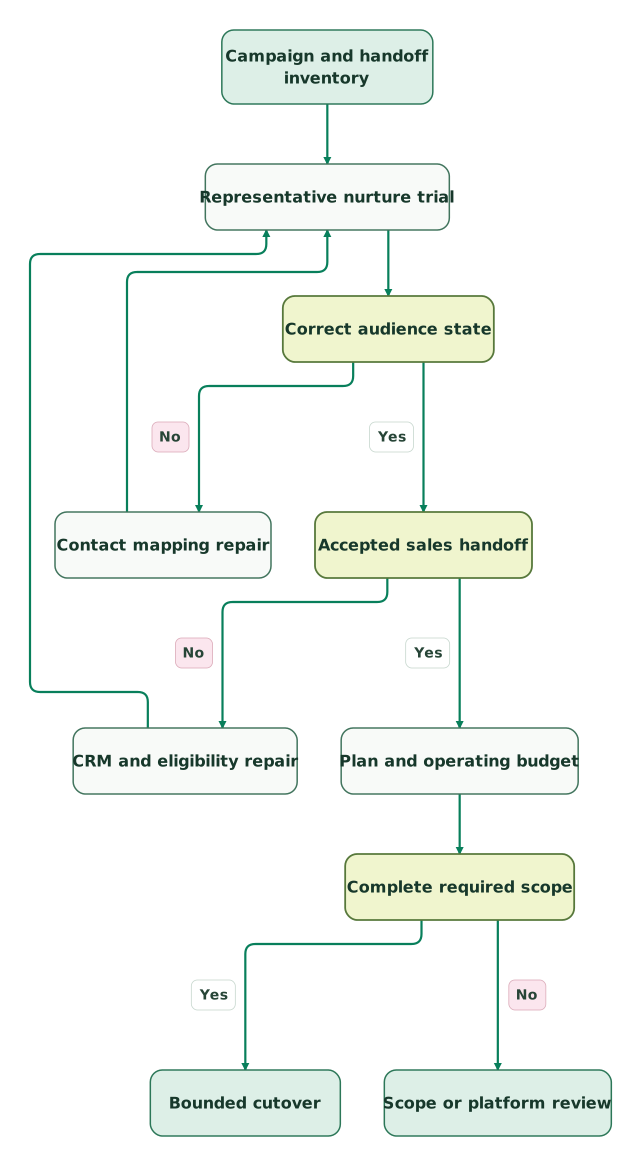
Read diagram as text
- Campaign and handoff inventory to Representative nurture trial.
- Representative nurture trial to Correct audience state.
- Correct audience state to Contact mapping repair: No.
- Contact mapping repair to Representative nurture trial.
- Correct audience state to Accepted sales handoff: Yes.
- Accepted sales handoff to CRM and eligibility repair: No.
- CRM and eligibility repair to Representative nurture trial.
- Accepted sales handoff to Plan and operating budget: Yes.
- Plan and operating budget to Complete required scope.
- Complete required scope to Bounded cutover: Yes.
- Complete required scope to Scope or platform review: No
Run the trial with a newly subscribed person, an unsubscribed person, an existing customer and a prospect with an open opportunity. Add an event cancellation or a changed sales owner if those states drive your program. Record the expected message and CRM result before execution.
Re-run the whole affected path after a repair. Correcting an audience mapping can change qualification, and correcting a CRM state can change later message eligibility. Keep one production sender responsible for each message while the replacement receives a controlled sample.
Retain historical campaign and consent information needed for reporting and support. Define the point at which new activity belongs to the replacement platform, and keep older exports readable. A successful contact import does not establish that every program status or historic attribution relationship survived.
Mailchimp vs Marketo checklist
- Define the business result after each campaign or nurture message.
- Inventory qualification rules, CRM states and external senders.
- Rebuild the required flow in the intended production edition.
- Separate billable contacts from marketing-eligible recipients.
- Test the person who must receive no message.
- Validate event cancellation, customer conversion and sales ownership changes.
- Include ordinary renewal, administration and transition overlap in the budget.
- Re-run audience and handoff validation after every relevant repair.
- Preserve necessary historical context and assign a cutover owner.
The lifecycle marketing audit skill can organize the inventory and test cases. The Marketo Salesforce sync guide is useful when a synchronization failure is driving the replacement discussion.
Keep reading
Browse all CRM & Lifecycle guides
 CRM & Lifecycle
Marketo vs ActiveCampaign for Lead Nurture and Marketing Operations
Compare Marketo and ActiveCampaign by nurture scope, CRM integration, trial limits and administration, with a reproducible operating-cost example.
Jafrin Akter AloLast updated 11 min read
 CRM & Lifecycle
Marketo Alternatives for CRM, Lead Nurture and Product Journeys
Compare Marketo alternatives for CRM, lead nurture and product journeys, including current plan costs, handoff tests and a full first-year budget example.
Jafrin Akter AloLast updated 11 min read
 CRM & Lifecycle
Marketo Salesforce Sync: 9 Checks for Missing Records and Stale Fields
Diagnose Marketo Salesforce sync with nine checks for permissions, field conflicts, validation, backlog, conversion, campaign membership and deleted records.
Jafrin Akter AloLast updated 15 min read
CRM & marketing automation
See the implementation scope, deliverables and acceptance checks.
Questions people ask
Can Mailchimp replace only the newsletter portion of a Marketo program?
Mailchimp can replace a newsletter portion if message ownership, subscription preferences and audience updates are deliberately separated. Keep the qualification and CRM work in the system that still owns it, and prevent both platforms from sending the same publication. Test a subscription change in both directions before moving the newsletter audience into production.
Does Mailchimp Standard's step allowance make it equivalent to Marketo?
Mailchimp Standard's step allowance does not establish equivalence with Marketo. The relevant comparison includes customer states, nurture timing, CRM relationships, program history and the people maintaining the work. A long flow can still miss a required sales handoff. Test the complete business path and its exceptions before comparing the number of available automation steps.
Can unsubscribed Mailchimp contacts affect a budget without receiving campaigns?
Yes, unsubscribed Mailchimp contacts can count toward the monthly contact limit while being ineligible for marketing email. That is why the billing population can exceed a campaign's recipient count. Keep those populations separate, preserve the preference state and review the appropriate retention or archive process instead of treating every stored contact as a person to email.
Should Marketo engagement streams send password resets or receipts?
Marketo engagement streams should not be used as the operating design for password resets or receipts. Adobe describes engagement programs as nurture and says they are not designed for operational emails. Inventory those messages separately and keep their trigger, delivery and ownership requirements explicit when evaluating or migrating the wider marketing program.
Is a Mailchimp introductory offer a reliable later-year budget?
A Mailchimp introductory offer is a reliable budget only for the stated offer period and eligible scope. Use the order's ordinary renewal price for later years, with the expected contact tier, send volume and add-ons. A small initial subscription does not price the cost of rebuilding qualification, reporting or CRM work that the business still needs.
Sources

Written by
Jafrin Akter AloData Engineer and Co-founder at Martechdevs and Growth and Analytics Partners
Jafrin writes practical guides to marketing technology, customer data, analytics and AI workflows. Martechdevs is a Growth and Analytics Partners company.