
Marketo Alternatives for CRM, Lead Nurture and Product Journeys
Choose HubSpot for a shared marketing and CRM workspace, Salesforce Account Engagement for a Salesforce-led sales process, ActiveCampaign for simpler nurture, and Customer.io for product-triggered lifecycle messages. The right Marketo alternative depends on the programs and data relationships you need to preserve. A cheaper email plan alone does not replace lead qualification, campaign history or sales handoff.
On this page
Marketo competitors and starting costs
Prices are US list prices in USD, with the relevant billing basis and entry scope shown.
| Tool | Starting price and billing basis | Best fit | Main tradeoff |
|---|---|---|---|
| Adobe Marketo Engage | Quote only | An established marketing operations program | Administration and program complexity need continued ownership |
| HubSpot Marketing Hub Professional | From $800/month paid annually, plus $3,000 required onboarding | Marketing tied to a shared CRM process | Contacts, seats and other hubs can increase the total |
| Salesforce Account Engagement Growth+ | $1,250/org/month, billed annually | A Salesforce-led B2B process | Edition limits and implementation work still matter |
| ActiveCampaign Starter | $15/month for 1,000 contacts, billed annually | A smaller, simpler email nurture program | Five actions per automation; CRM add-ons start above Starter |
| Customer.io Essentials | From $100/month billed monthly; 5,000 people plus objects | Product events and account-aware messaging | It needs a separate plan for sales pipeline ownership |
Sources: Marketo packages, HubSpot pricing, Account Engagement pricing, ActiveCampaign's published entry offer and Customer.io plans.
HubSpot Professional is the comparison point because a Marketo replacement usually needs more than a basic newsletter. Starter or a free CRM can help a small team begin, but a starting offer should not be mistaken for the workflow scope required by an established marketing department. HubSpot documents its workflow requirements in the workflow setup guide.
At Martechdevs, we map the sales handoff and customer lifecycle before a CRM and lifecycle migration. That makes the choice concrete: preserve the CRM and replace marketing, consolidate both, or separate product messaging from lead nurture. Each route has a different data migration and ownership burden.
The Marketo replacement scope
Start with the business processes currently represented in Marketo. Record lead capture, qualification, nurture, event attendance, sales alerts, account campaigns and customer communications. Then identify the system that owns each result. A marketing platform might calculate a score, while Salesforce owns the opportunity and a warehouse holds the final attribution model.
A common evaluation mistake is comparing the visible email editor while overlooking the relationship between a marketing person and the CRM record. Adobe describes its Salesforce synchronization across leads, contacts, accounts, opportunities and other supported records, with different synchronization behavior by object. Preserve the business effect of those relationships in your acceptance plan.
For example, a contact already attached to an open opportunity may need a different nurture path. A recycled lead may need to return to marketing without losing the sales owner's context. A merged record must retain its suppression state. These are useful test cases because they expose work that a clean new-contact demo hides.
Also distinguish platform shortcomings from maintenance debt. A long list of unused fields, inconsistent program names and undocumented qualification thresholds can be corrected in Marketo. Moving them unchanged makes the new platform harder to use. If the main complaint is campaign turnaround, compare a scoped operating repair with the migration proposal using the same expected outcomes.
Tool decision blocks
Adobe Marketo Engage
- Best for: A marketing operations team with valuable existing programs and a functioning CRM relationship.
- Pros: Retaining it avoids replacing established campaign assets and synchronization rules during a commercial review.
- Cons: Keeping the platform still requires named owners for administration, data quality and reusable program standards.
- Free plan and startup offer: The package page offers sales pricing for Growth, Select, Prime and Ultimate. It does not advertise a self-service free tier or a standard startup reduction.
- Choose it if: The platform supports the required process and the main gaps have a credible repair scope.
- Skip it if: The organization deliberately wants a simpler process and the migration removes enough ongoing work to justify the transition.
HubSpot Marketing Hub
- Best for: A team that wants marketing and CRM users to work from a shared customer record and agreed lifecycle stages.
- Pros: Workflows support structured automation across supported records; a consolidation can reduce the number of systems users reconcile.
- Cons: Consolidation also creates a broader migration, including sales adoption and the ownership of existing custom fields.
- Free plan and startup offer: Free tools support up to two users. HubSpot for Startups has an application program; use the approved offer and renewal terms rather than assuming every startup receives the same discount.
- Choose it if: Sales and marketing have agreed to share process definitions and can fund the relevant paid workflow edition.
- Skip it if: The CRM is staying highly customized elsewhere and a second operational workspace creates more reconciliation than it removes.
Salesforce Account Engagement
- Best for: A B2B team keeping Salesforce as the centre of its lead and opportunity process.
- Pros: The Account Engagement offer includes lead nurturing and scoring, with higher editions for broader requirements.
- Cons: A Salesforce relationship does not remove the need to design synchronization, campaign membership and permissions carefully.
- Free plan and startup offer: The public pricing page presents annual paid editions and a contact-sales route. It provides no permanent free Account Engagement tier or universal startup allocation.
- Choose it if: The sales organization already works in Salesforce and the proposed edition passes the actual qualification and campaign tests.
- Skip it if: Salesforce itself is part of the simplification project or the annual platform commitment exceeds the value of the required program.
ActiveCampaign
- Best for: A smaller team reducing its program to email nurture, straightforward segmentation and manageable sales follow-up.
- Pros: It provides a low starting commitment for a genuinely smaller operating scope.
- Cons: Starter limits and separately sold CRM capabilities mean the entry offer is a weak proxy for an entire Marketo replacement.
- Free plan and startup offer: The 14-day trial allows up to 100 contacts and 100 emails. The standard offer is a trial rather than a permanent free plan; no universal startup discount is stated there.
- Choose it if: The team can demonstrate its required nurture and handoff without recreating a complicated enterprise program through manual exceptions.
- Skip it if: Your selection depends on matching extensive account governance, reporting and CRM behavior without first proving those requirements.
Customer.io
- Best for: A product business whose important messages are driven by usage, account state, activation and renewal.
- Pros: Objects and relationships can represent non-person business records and their connections to people.
- Cons: Sales qualification, pipeline reporting and campaign operations need explicit ownership elsewhere if they remain required.
- Free plan and startup offer: The startup program offers eligible new customers up to 12 months free, including 30,000 people plus objects. Eligibility includes less than $10 million raised and lists obtained through standard methods rather than purchased.
- Choose it if: Product activity is the main source of message eligibility and an engineering owner can maintain the event contract.
- Skip it if: Your main need is a marketing-to-sales operating system and the product messaging requirement is minor.
Best fit by business scenario
| Company size or operating model | Best fit | Runner-up | Decision reason |
|---|---|---|---|
| Small B2B team simplifying a large legacy setup | ActiveCampaign | HubSpot | The smaller program can justify a smaller operating footprint |
| Growing company consolidating sales and marketing | HubSpot | Marketo | Shared lifecycle stages can be more valuable than a feature-for-feature replacement |
| Salesforce-led enterprise with dedicated administrators | Account Engagement | Marketo | The CRM process remains the evaluation centre |
| Product-led software business | Customer.io | HubSpot | Product events and account relationships drive the message decision |
| Established regional campaign team with reusable Marketo programs | Marketo repair | Account Engagement | A repair may preserve useful governance with less transition work |
For a business closer to retail or a consumer app, compare Iterable alternatives before treating the B2B shortlist as universal. For a leaner store-versus-service decision, ActiveCampaign vs Klaviyo makes the commerce differences clearer. The platform must fit the event that creates the message and the team responsible for acting on the response.
Commercial scope and a hypothetical first year
Keep the software subscription separate from migration, onboarding, support and the time your staff will spend rebuilding and validating programs. An annual commitment may be expressed as a monthly price. That display does not make the contract month to month.
HubSpot Marketing Hub Professional starts at $800/month when paid annually, with three Core Seats, 2,000 marketing contacts and required $3,000 onboarding. The page also displays an $890 monthly-payment option with annual commitment. Salesforce Account Engagement Growth+ starts at $1,250/org/month billed annually. These are scoped entry offers, not equal-capacity quotations. HubSpot commercial terms, Salesforce commercial terms.
Consider a hypothetical team evaluating HubSpot at its stated Professional entry scope. Assume $8,000 of separate migration work and $2,400 of additional legacy-system overlap. Those two amounts are illustrative planning inputs, not vendor fees or Martechdevs prices. Assume no additional contacts, seats, hubs, credits or tax for this simple calculation.
| Cost component | Calculation | First-year amount | Basis |
|---|---|---|---|
| Professional subscription | 12 × $800 | $9,600 | Public annual-payment entry price |
| Required onboarding | 1 × $3,000 | $3,000 | Public onboarding fee |
| Migration work | Assumed fixed scope | $8,000 | Hypothetical |
| Legacy-system overlap | Assumed additional cost | $2,400 | Hypothetical |
| Total | $9,600 + $3,000 + $8,000 + $2,400 | $23,000 | USD before tax and extras |
The same assumed scope would have a $9,600 recurring subscription in a later full year if prices and usage stayed unchanged. That arithmetic excludes continuing administration, so it is not the complete operating cost. A startup reduction should be modelled as its own time-limited adjustment with the regular future charge beside it.
Use the HubSpot cost calculator to make contact and seat changes visible. If keeping Marketo remains plausible, the Marketo managed services guide helps separate platform selection from the decision about who should operate the existing system.
Qualification and handoff acceptance
Give each shortlisted vendor a process description that begins with a real business condition: a prospect attends an event, reaches the agreed qualification threshold, already belongs to a customer account, or asks sales to pause contact. Define the expected record changes and messages before the trial.
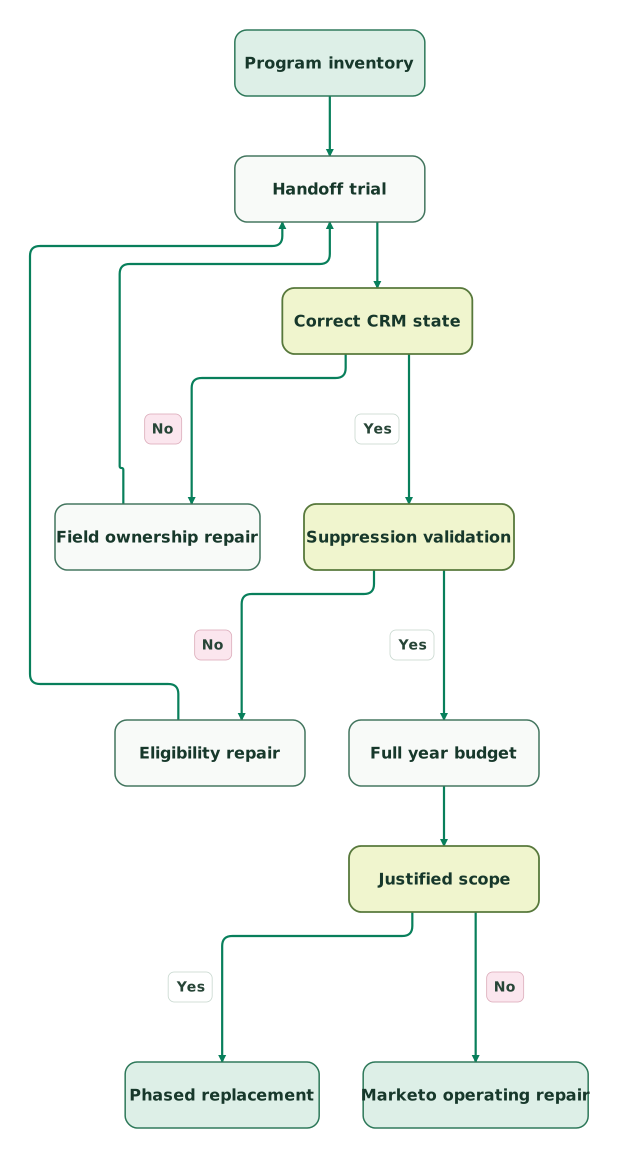
Read diagram as text
- Program inventory to Handoff trial.
- Handoff trial to Correct CRM state.
- Correct CRM state to Field ownership repair: No.
- Field ownership repair to Handoff trial.
- Correct CRM state to Suppression validation: Yes.
- Suppression validation to Eligibility repair: No.
- Eligibility repair to Handoff trial.
- Suppression validation to Full year budget: Yes.
- Full year budget to Justified scope.
- Justified scope to Phased replacement: Yes.
- Justified scope to Marketo operating repair: No
The first decision checks the sales record, including ownership and lifecycle state. The second checks whether the person receives the correct messages or remains suppressed. Both must pass again after a repair because an ownership change can affect eligibility and routing.
Do not move every program simply because it exists. Classify each as active, required for a known future event, retained for history, or ready for retirement. Rebuild the active programs first. Archive the minimum historical evidence needed for reporting and support, with a clear way for the team to retrieve it.
Keep qualification definitions visible to sales. If the new platform produces a different score, map it to the agreed business threshold and validate the resulting handoff. Matching an old numerical score without matching the underlying decision creates a reassuring but misleading migration metric.
A cutover needs a final comparison of source and destination eligibility counts. Reconcile differences by reason rather than accepting a small unexplained percentage. Once the bounded cohort passes, increase scope gradually and keep the rollback owner available until the old sender is fully retired.
Marketo alternatives evaluation checklist
- Write the business reason for a replacement and the scope of an in-place repair.
- Inventory active programs, CRM dependencies and historical reporting needs.
- Assign field ownership for lifecycle state, score, sales owner and preferences.
- Test an existing customer, an open opportunity and a recycled lead.
- Test suppression after record merging and after a state change during a delay.
- Obtain edition-specific quotes with contact, seat, onboarding and add-on details.
- Separate subscription, migration, overlap and continuing operations costs.
- Re-run CRM and message checks after every relevant repair.
- Retire unused programs instead of importing their complexity.
- Approve the first cohort and rollback criteria before expanding the cutover.
The lifecycle marketing audit skill can structure the initial inventory. Use the Marketo Salesforce sync guide to resolve a synchronization problem before assuming it requires replacement. A migration earns its cost when the new process is demonstrably easier to own and still produces the required customer and sales outcomes.
Keep reading
Browse all CRM & Lifecycle guides
 CRM & Lifecycle
Iterable Alternatives for Product, App and Store Journeys
Compare Iterable alternatives by product, app and store workflows, with current pricing units, migration costs, journey tests and a practical cutover checklist.
Jafrin Akter AloLast updated 10 min read
 CRM & Lifecycle
ActiveCampaign vs Klaviyo for Service and Store Automation
Choose ActiveCampaign for lead nurture or Klaviyo for store journeys. Compare entry costs, Shopify plan limits, flow behavior and a practical migration test.
Jafrin Akter AloLast updated 10 min read
 CRM & Lifecycle
Marketo Salesforce Sync: 9 Checks for Missing Records and Stale Fields
Diagnose Marketo Salesforce sync with nine checks for permissions, field conflicts, validation, backlog, conversion, campaign membership and deleted records.
Jafrin Akter AloLast updated 15 min read
CRM & marketing automation
See the implementation scope, deliverables and acceptance checks.
Questions people ask
Can a Marketo replacement keep Salesforce as the sales system?
Yes, a Marketo replacement can keep Salesforce if the proposed integration preserves the required lead, contact and opportunity behavior. Write down which system owns each shared field, then test an existing record as well as a new lead. Include merges, recycled leads and suppression changes so the evaluation covers the awkward cases that a clean demo skips.
Is HubSpot Starter enough for an established Marketo program?
HubSpot Starter is suitable only if the required program fits its actual features and limits. An established Marketo replacement often needs the workflow scope of a higher edition. Evaluate the longest nurture path, qualification rules and reporting requirements first, then price the edition that passes those tests instead of choosing from the lowest headline price.
Does Account Engagement remove the need for marketing operations staff?
No, Account Engagement still needs ownership of campaign design, qualification, synchronization, permissions and reporting. A closer fit with the Salesforce operating process can change the work, but it does not remove it. Include the administrator's responsibilities and ongoing support arrangement in the comparison so a software saving is not mistaken for a staffing saving.
Can Customer.io replace Marketo for product-led onboarding?
Customer.io can replace the product-led onboarding portion when product events and account relationships drive the messages. The remaining sales and campaign functions need their own destination or a deliberate retirement decision. Run a complete activation journey with a cancelled account and a member of multiple accounts before deciding whether the replacement covers the intended scope.
Should old Marketo scores be imported unchanged into another platform?
Old scores should be imported unchanged only if the team still needs their meaning and can explain the scoring rules. A numerical value without its original rules can mislead sales. Preserve historical scores where useful, define the new qualification threshold explicitly and compare the handoff decisions on known records before making the new score operational.
Sources
- Adobe Marketo Engage pricing and packaging
- Marketo Salesforce synchronization
- HubSpot Marketing Hub pricing
- HubSpot workflow creation
- HubSpot startup program
- Salesforce Account Engagement pricing
- ActiveCampaign campaign software guide and entry offer
- ActiveCampaign plans and feature limits
- ActiveCampaign trial terms
- Customer.io pricing and plans
- Customer.io objects and relationships
- Customer.io startup program

Written by
Jafrin Akter AloData Engineer and Co-founder at Martechdevs and Growth and Analytics Partners
Jafrin writes practical guides to marketing technology, customer data, analytics and AI workflows. Martechdevs is a Growth and Analytics Partners company.