
Salesforce Data Cloud: Data 360 Architecture, Pricing and Setup
Salesforce Data Cloud, now called Data 360, connects customer data to Salesforce profiles, segments and actions. Evaluate it around one useful workflow: the source records, identity rules, permitted destination and required freshness. A successful implementation produces the correct customer context at the point of action, with an explained operating cost and a way to repair incorrect matches.
On this page
Data 360 Scope
Define the business action before selecting sources or estimating profile volume.
| Use case | Required inputs | Intended output | Acceptance evidence |
|---|---|---|---|
| Customer service context | CRM identity, orders and support history | Relevant customer information | Correct person and source records |
| Lifecycle audience | Product events, customer state and preferences | Eligible destination members | Membership, contact point and suppression checks |
| Sales prioritization | Account identity and agreed product signals | Actionable account context | Matched account and current signal |
| Agent grounding | Approved customer or enterprise information | Context for an allowed task | Relevant retrieval and access checks |
Data 360 is the current name for Data Cloud. Salesforce describes it as a native data engine for activation across its applications and agents. Existing interfaces and references can still use Data Cloud terminology, so keep the product name separate from the actual license, connector and configuration being implemented. Salesforce Data 360 overview.
For a first release, select one source population and one destination. For example, combine known product users with CRM account identity to create an approved customer audience. Define the exclusion cases before adding more data: shared addresses, missing identifiers, stale product activity and customers who should not receive that communication.
Data warehouse and CDP implementation can help connect those source, identity and activation decisions. The work includes ownership and reconciliation after launch, when a source schema or business rule changes.
Data Model and Identity
Data 360 distinguishes raw ingested data lake objects, or DLOs, from standardized data model objects, or DMOs. Mapping connects source fields to that model. Identity resolution then uses match rules to link profiles and reconciliation rules to select among conflicting attribute values. Those are separate decisions. Data mapping and unification.
| Component | Job | Example | Review point |
|---|---|---|---|
| Source identifier | Preserve the original record identity | CRM contact ID | Stable value and source namespace |
| DLO | Hold ingested source data | Customer export rows | Expected records and freshness |
| DMO | Express the data in a common model | Individual and contact point | Correct field meaning and relationships |
| Identity ruleset | Link source profiles | Agreed customer identifier | False matches and missed matches |
| Reconciliation rule | Select a displayed attribute value | Preferred source for a name | Authority and stale-value handling |
| Activation | Deliver approved data to a target | Eligible email audience | Correct membership and destination |
A source key alone may not be unique across systems. Data 360's fully qualified key combines the source identifier with a qualifier identifying its source. This helps distinguish two records that both happen to use the value 42. Qualified keys.
Plan the namespace for primary and relationship keys together. If a product user references account 42, the account reference must point to the appropriate product account, not an unrelated CRM record with the same local value.
Unified profiles link source records without overwriting the original source data. Salesforce also notes that a unified individual's ID can change. Keep durable source identifiers and the linkage evidence available instead of making an exported unified ID the only permanent business key. Unified profile behavior.
A customer data platform does not remove the need to correct a bad CRM record or decide which system owns a contract date. Our CDP and data warehouse comparison explains the wider architecture choices. For a narrower requirement to write warehouse-computed account fields, inspect the reverse ETL to Salesforce workflow before adding a broader profile platform.
Identity Acceptance Example
Use a small fixture whose intended relationships are known. The following hypothetical records belong to a test population; the customer keys represent an agreed identity authority.
| Source record | Local ID | Customer key | Email label | Expected identity |
|---|---|---|---|---|
| CRM contact | 42 | C100 | Address A | C100 |
| Product user | 42 | C200 | Address B | C200 |
| Billing customer | 900 | C100 | Address A | C100 |
| Support requester | 77 | C300 | Shared address | C300 |
| CRM contact | 88 | C400 | Shared address | C400 |
There are five source records and four expected identities. The CRM and billing records for C100 should link. The two local 42 values must remain distinct because they belong to different sources and different customers. The shared address is deliberately insufficient to merge C300 and C400 under this example's policy.
Represent source identity as a pair such as (source, local_id). In the fixture, all five pairs are unique, while the local-ID-only set contains four values. That difference exposes a collision before an identity rule accidentally treats the shared number as a match.
For this sample, match on the approved customer key and compare the resulting groups with the expected membership. A higher match rate is not automatically better: merging C300 and C400 would reduce the profile count while making the result less accurate.
Keep a negative-case set beside every positive match. Add changes over time, including a new email address, a corrected customer key and a source deletion. Establish the intended downstream behavior before expanding the ruleset. Use the CRM data hygiene audit skill to organize source defects separately from identity-rule defects.
Implementation Sequence
Access and Source Contract
- Confirm Data 360 provisioning, the contracted license and the destination feature needed for the first use case.
- Assign the appropriate permissions and identify the data space used for the release.
- Document the source objects, key namespaces, update behavior and deletion requirements.
- Define the first accepted audience or customer-context result.
- Name the source, identity, activation and operating owners.
Salesforce's setup guidance covers permission assignments, Salesforce data bundles and streams, external connections, optional additional data spaces and ongoing maintenance. It directs teams to the current permission-set definitions for their license. Use the required roles for the selected implementation rather than granting every operator architect access. Data 360 setup.
The source contract should specify what a row means and what a missing row means. A full snapshot, an incremental change stream and a filtered export have different deletion semantics. Write that distinction down before treating an absent customer as inactive.
Connection and Mapping
- Connect the approved source and ingest or expose the limited pilot population.
- Reconcile source counts and sample identifiers.
- Map the required fields and relationships into the selected model.
- Check data types, timestamps and key qualifiers.
- Inspect unmatched or invalid records before running the identity workflow.
Keep source delivery time separate from business event time. An order placed yesterday may arrive today; a segment about recent orders should use the agreed business timestamp. A loading timestamp can be useful for monitoring while still being wrong for audience eligibility.
Map only the attributes needed for the first action. Adding every available field increases the amount of data whose meaning, access and lifecycle the team must maintain. Preserve the source reference so disputed values can be traced back to their owner.
Identity and Activation
- Configure the agreed match and reconciliation rules.
- Compare positive and negative identity cases with their expected groups.
- Build the segment using the correct population and time window.
- Select the target and the attributes needed there.
- Apply the appropriate contact-point and preference conditions.
- Publish the pilot and inspect the destination records.
Data 360 activation supports filtering and sorting contact points, including consent-related attributes. A person with several email addresses still needs a deliberate choice of address and permitted purpose. The activation step is where the segment becomes data delivered to a target. Activation contact-point filters.
For a hypothetical renewal audience, a customer can qualify by contract date while their marketing address remains ineligible. Keep qualification and contact eligibility as separate checks. The destination should also retain the appropriate suppression behavior when a preference changes after the audience was published.
Freshness and Destination Evidence
Write the freshness requirement from source event to destination availability. A frequent segment schedule cannot compensate for a source export that runs once a day. Record each stage's observed completion time during acceptance so the team knows where delay enters the process.
Salesforce exposes publishing status per activation target in Publish History or segment details. Success, Error, Publishing and Deferred represent different outcomes; an in-progress target can still expose the last published data. Inspect the target-specific result rather than treating a completed source load as a completed activation. Segment publishing.
Reconcile a sample through source records, unified identity, segment membership and destination output. For a hypothetical segment of 1,000 qualifying identities, suppose 120 lack an eligible contact point and 80 are suppressed by the agreed preference rule, with no overlap between those groups. The expected destination population is 800. If the target contains 790, investigate the ten-record difference by identifier.
That calculation depends on the stated non-overlap assumption. If some customers lack a contact point and are also suppressed, deduplicate the exclusion set before subtracting it. Keep the actual included and excluded IDs with the run evidence.
Use the dashboard templates to structure a monitoring view around source freshness, identity exceptions, eligible members and destination failures. A single total cannot explain which layer needs repair.
Data 360 Pricing
Salesforce publishes the following USD options. The profile rates are annual, while Flex Credits are a usage unit; they are not equivalent packages.
| Model | Published rate | Billing unit | Budget input |
|---|---|---|---|
| Flex Credits | $500 | 100,000 Flex Credits | Metered actions and their credit rates |
| Profiles | $240 | 1,000 profiles per year | Contracted billable profile count |
| Enterprise Profiles | $420 | 1,000 profiles per year | Profile count and required included features |
Profiles includes one Flex Credit per profile and Enterprise Profiles includes two. Salesforce lists batch ingestion and zero-copy integrations as free ingestion, while processing and use have their own charging treatment. Existing Data Services Credit customers are not forced to migrate to the newer models. Confirm the applicable contract and allocations. Data 360 pricing.
The billable profile count is not necessarily the number of CRM contacts. With active identity resolution, Salesforce counts known unified profiles across active rulesets, 4% of anonymous unified profiles and eligible source profiles outside identity resolution. Without active rulesets, mapped profile-source records follow a different counting basis, with specific exclusions. Profile billing calculations.
Consider a hypothetical billable population with 200,000 known unified profiles, 1,000,000 anonymous unified profiles and 10,000 eligible ununified source profiles. Assume those are the complete relevant counts under the selected license. The total is 200,000 + 40,000 + 10,000 = 250,000 billable profiles.
| Budget scenario | Calculation | Subtotal, USD | Scope |
|---|---|---|---|
| Profiles base | 250,000 / 1,000 × $240 | $60,000 per year | Profile subscription basis only |
| Enterprise Profiles base | 250,000 / 1,000 × $420 | $105,000 per year | Alternative profile subscription basis |
| Separate Flex example | 1,000,000 / 100,000 × $500 | $5,000 | Credit quantity only, no period assumed |
These examples do not establish that one million credits performs the same work as the profile packages. Build the usage estimate from actual action types, quantities and the applicable rate card. Include any additional storage, destination subscriptions, source-platform charges and implementation scope in the commercial review.
A zero-copy connection also does not eliminate the need to review the source warehouse's own charging and access model. Keep Salesforce charges and source-platform charges in separate budget lines so a free ingestion statement does not become an unsupported claim of a free end-to-end system.
Implementation Repair Flow
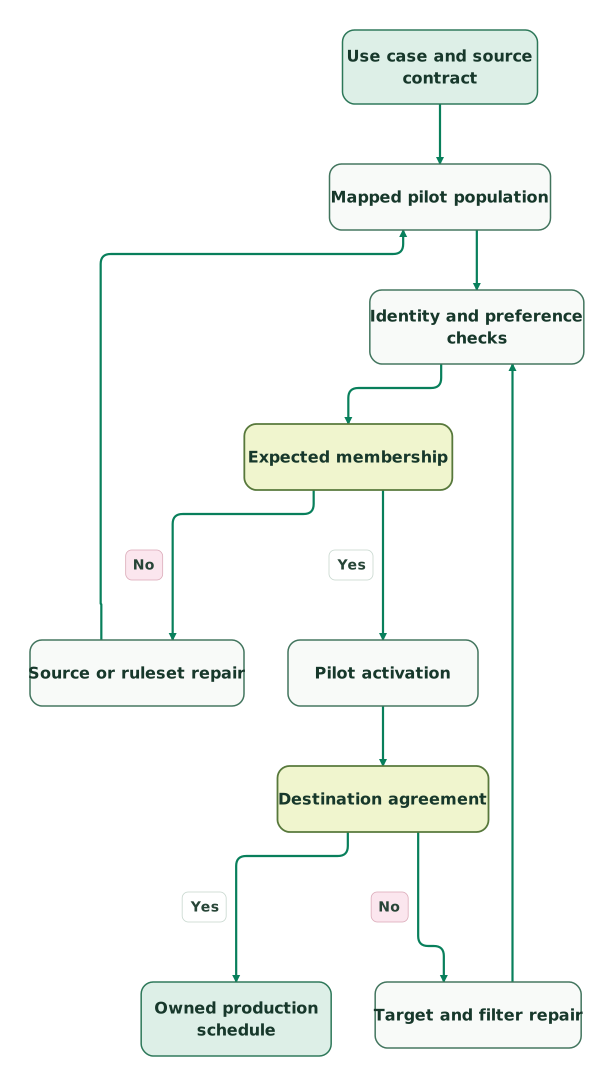
Read diagram as text
- Use case and source contract to Mapped pilot population.
- Mapped pilot population to Identity and preference checks.
- Identity and preference checks to Expected membership.
- Expected membership to Source or ruleset repair: No.
- Source or ruleset repair to Mapped pilot population.
- Expected membership to Pilot activation: Yes.
- Pilot activation to Destination agreement.
- Destination agreement to Target and filter repair: No.
- Target and filter repair to Identity and preference checks.
- Destination agreement to Owned production schedule: Yes
Identity repairs repeat mapping and membership validation. Destination repairs return through the preference and identity checks before another activation, preserving the same acceptance population throughout the investigation.
Data 360 Checklist
- The first customer action and its owner are explicit.
- Provisioning, license and destination entitlements match the intended use.
- Source and relationship keys retain their namespaces.
- Source counts, timestamps and deletion behavior are defined.
- Positive and negative identity cases produce the expected groups.
- Reconciled attributes have an approved source authority.
- Segment qualification and contact eligibility are checked separately.
- Target membership and freshness reconcile to the pilot population.
- Profile or credit estimates use the applicable billing definition.
- Repairs, monitoring and recurring review have named owners.
Keep reading
Browse all Data Warehouse guides
 Data Warehouse
CDP vs Data Warehouse: What Each Does and Whether You Need Both
A customer data platform (CDP) collects, unifies and activates customer data; a data warehouse stores and models it. Compare jobs, setups and costs.
Jafrin Akter AloLast updated 22 min read
 Data Warehouse
Reverse ETL to Salesforce: Match Accounts, Control Writes and Verify Results
Sync warehouse signals into Salesforce with unique external IDs, controlled writes and field access. Reconcile row results, retries, readback and automation.
Jafrin Akter AloLast updated 14 min read
 CRM & Lifecycle
CRM Property Ownership: Stop Integrations Overwriting Good Data
Stop CRM integrations overwriting useful data with property-level ownership, explicit blank rules and stable matching. Includes a renewal-field contract and tests.
Jafrin Akter AloLast updated 10 min read
Data warehouse & CDP
See the implementation scope, deliverables and acceptance checks.
Questions people ask
Is Salesforce Data Cloud a different product from Data 360?
Data 360 is the current name for Salesforce Data Cloud. You may still encounter Data Cloud in configuration labels and older implementation references. Confirm the actual license and enabled capabilities when following a procedure, particularly where pricing models or permissions differ. The name change alone does not specify which features an existing account has purchased. Salesforce overview.
Will a unified profile automatically merge duplicate Salesforce Contacts?
No. Data 360's unified profile links source records while retaining their independent data. A Salesforce Contact merge is a separate CRM operation with its own record and association consequences. Keep duplicate cleanup and identity resolution as distinct work items, and preserve source identifiers so the team can trace each unified profile back to its contributing records. Unified profiles.
Should Data 360 receive every available event before the first audience goes live?
Start with the events needed to define and verify the first audience. Each additional source needs a meaning, identity relationship, timestamp policy and operating owner. Expand after the pilot produces the expected destination members and exclusions. A smaller accepted model provides a clearer basis for diagnosing errors and estimating the effect of additional data and processing.
Can a smaller unified profile count indicate a worse implementation?
Yes. An overly broad match rule can join different people and reduce the profile count while damaging accuracy. Evaluate known positive matches and deliberate negative cases, including shared addresses and reused local identifiers. Track incorrect merges separately from missed matches. The goal is a correct customer relationship for the intended action, not the smallest possible profile total.
What should the first Data 360 handover include?
Provide the source contract, mappings, identity rules, preference logic, target configuration and accepted sample records. Include the expected freshness, cost assumptions, monitoring location and repair owner for each stage. Preserve negative cases for future regression checks. The next operator should be able to explain an included customer, an excluded customer and an unexpected destination difference without rebuilding the investigation.
Sources

Written by
Jafrin Akter AloData Engineer and Co-founder at Martechdevs and Growth and Analytics Partners
Jafrin writes practical guides to marketing technology, customer data, analytics and AI workflows. Martechdevs is a Growth and Analytics Partners company.