
Pendo Alternatives: Five Options for Onboarding, Analytics and Cost
Choose Userpilot for focused in-app onboarding, Appcues for a wider lifecycle engagement program, and Chameleon for controlled, customized product experiences. Choose Amplitude when behavioral analysis leads the decision, or PostHog when engineers own analytics and the onboarding implementation. The best Pendo alternative preserves the capabilities your team uses. Compare the complete replacement against repairing Pendo before moving guides, identities and historical reporting.
On this page
Pendo alternatives compared
USD public starting references below show the billing basis and included unit; additional scope and taxes are separate.
| Alternative | Published starting reference | Best fit | Main tradeoff |
|---|---|---|---|
| Userpilot | Starter $299/month billed annually; up to 2,000 MAUs | Focused onboarding and basic usage trends | Advanced analytics and resource center require Growth |
| Appcues | Grow from $9,000/year; price scales with MAUs | An engagement program with implementation support | Starting price does not cover every volume within the plan |
| Chameleon | Pro from $750/month; 5,000 tracked users, monthly billing | Customized in-product experiences | Live-experience allowance and governance affect scope |
| Amplitude | Free: 2 million events/month | Behavioral analysis with limited guidance included | Guide limits and event volume need separate checks |
| PostHog | Free: 1 million analytics events/month | Engineering-owned analytics and experimentation | Managed product tours have been retired |
Sources: Userpilot annual pricing, Appcues plans, Chameleon plans, Amplitude pricing, PostHog pricing, PostHog product-tours retirement.
At Martechdevs, we scope product analytics implementation around the decision and the action that follows it. A useful Pendo replacement must explain the activation problem, reach the correct users and measure whether the intervention helped. Buying only the measurement component leaves an incomplete replacement when the existing team also depends on guides.
The Pendo baseline and replacement scope
Pendo's paid Base, Core and Ultimate packages use custom pricing. The commercial model combines monthly active users with the selected functionality. Base includes analytics and in-app guides; Core adds session replay. The published free plan supports 500 MAUs. Pendo plans and billing model.
Free-plan limits have practical consequences. Pendo counts unique Visitor IDs over a thirty-day period. Above 500 MAUs, new guide, NPS and segment creation is restricted, and reports show sampled trends. Anonymous and identified visitor billing can vary with subscription settings. Pendo Free limits.
Inventory the actual replacement scope: tagged pages and features, tracked events, account definitions, guides, targeting rules, surveys, exports and recurring reports. Mark each item as required, obsolete or replaceable by an existing tool. A lower analytics price does not fund an equivalent adoption platform unless those other jobs have owners and budgets.
Keep Pendo when the main problem is a fixable identity or targeting rule. A new product can inherit the same mistakes if the installation still identifies every person with a changing value or sends the wrong account. The tracking-plan guide provides a useful starting point for agreeing the events and identities before a trial.
Onboarding and adoption alternatives
Userpilot
Userpilot is our first trial for a team whose requirement is publishing targeted onboarding and learning which features users adopt. Starter includes in-app engagement, basic usage trends and NPS for up to 2,000 MAUs. Advanced funnels, paths, retention and the resource center sit in Growth. Userpilot plan scope.
- Best for: a product team with an owned onboarding journey and a manageable set of audience segments.
- Pros: guidance and basic measurement can be evaluated together without purchasing a separate analytics tool immediately.
- Cons: Starter is a narrow comparison when the Pendo deployment already uses deeper behavioral analysis, replay or a resource center.
- Free plan and startup offer: a fourteen-day trial is advertised; any additional startup concession needs approved terms.
- Choose it if: the intended tier can publish the required experiences and measure their downstream outcome.
- Skip it if: replacing the full current workflow requires capabilities outside the quoted edition or unresolved integration scope.
The annual Starter commitment at the displayed rate is 12 × $299 = $3,588. Growth begins at $849 monthly equivalent on annual billing and scales with usage; the pricing matrix includes 2,000 MAUs at its entry configuration. A plan supporting a larger maximum range does not make that whole range part of its minimum price. Starter billing basis, current volume matrix, Userpilot Growth billing.
Appcues
Appcues is worth evaluating when onboarding belongs to a larger lifecycle engagement program. Grow starts at $9,000 annually, includes 25 published experiences and unlimited seats, and supports a MAU range up to 50,000 with price scaling. Its listed support includes a CX Manager and Technical Success Manager. Appcues Grow.
- Best for: a team coordinating several experiences with a named owner for launch and ongoing optimization.
- Pros: guided implementation and engagement capability are included in the commercial evaluation.
- Cons: the entry amount needs a volume-specific quote, and additional experiences or behavior-based email can add scope.
- Free plan and startup offer: the current pricing page offers a product tour and sales discussion; no free subscription or startup reduction is assumed here.
- Choose it if: the proposed package covers the active experience inventory and the support deliverables your team needs.
- Skip it if: the job is a small, occasional tooltip that cannot justify the annual commitment.
The $9,000 starting commitment is equivalent to $750 a month. Treat that as an annual purchase with its specified allowance. Confirm the MAU band, environments, mobile requirements and any add-ons on the offer. A large supported range is a capacity boundary, rather than a promise that every customer inside it pays the starting price.
Chameleon
Chameleon is a candidate when the product experience needs deliberate design and controlled targeting. Pro starts at $750 a month for 5,000 monthly tracked users, with monthly billing and up to twenty live experiences. Its published scope includes themes, custom CSS and A/B testing. Chameleon Pro.
- Best for: a team maintaining a designed set of onboarding, announcement and adoption experiences.
- Pros: experience styling and targeting have an explicit place in the product and purchasing conversation.
- Cons: an expanding live inventory or stronger governance can require another package or add-on.
- Free plan and startup offer: a trial is available. A Startup plan is advertised from $279 for 2,000 MTUs and ten live experiences; confirm eligibility and commitment separately.
- Choose it if: the owner can build, test and maintain the required experiences within the selected plan.
- Skip it if: the primary unmet need is deeper product analysis rather than in-product intervention.
Chameleon defines its MTUs as uniquely identified user profiles sent in the preceding thirty days. Count that population from the planned installation, rather than importing the MAU number from another dashboard. Pro and Growth also use different commitment structures: Growth starts at $1,250 monthly equivalent for 5,000 MTUs, billed annually. Counting and billing rules.
Analytics-led alternatives
Amplitude
Amplitude is the stronger starting point when the team needs to investigate activation, retention and behavioral cohorts, then act on the findings. Its current Free plan includes two million events monthly and limited Guides and Surveys. Plus adds capabilities and usage-based billing. Amplitude platform pricing.
- Best for: a product team that can define the important behavior and maintain useful analytical questions.
- Pros: behavioral analysis, replay and guidance can be considered within one platform.
- Cons: inclusion of a product category does not establish enough live guides, advanced permissions or replay volume for the replacement.
- Free plan and startup offer: qualifying startups can receive one year of Growth; standard eligibility includes less than $10 million funding and fewer than twenty employees.
- Choose it if: the required analytical decisions and guide inventory fit the exact configuration.
- Skip it if: a broad library of managed onboarding experiences is the main requirement and the quoted guidance scope is insufficient.
The pricing matrix lists one guide or survey on Free, with expanded capacity through the relevant paid configuration. Assess that allowance against simultaneously live experiences. Also check the actual billing model on an existing account: Amplitude documents both event-metered and MTU-metered arrangements. Plan and startup conditions.
Our Amplitude and FullStory comparison goes deeper into behavioral analysis versus session investigation. That is a separate decision from replacing the guides used to change behavior.
PostHog
PostHog fits an engineering-owned analytics stack that also needs experiments, flags and replay. Its free monthly allowances include one million analytics events, five thousand recordings and one million feature-flag requests, with separate product meters above the allowances. PostHog product allowances.
- Best for: a technical team that can maintain instrumentation and own the product changes prompted by analysis.
- Pros: analytics, investigation and experimentation can use a connected technical workflow.
- Cons: replacing Pendo guidance requires a separate supported implementation and a continuing owner.
- Free plan and startup offer: renewable product allowances cover small workloads; any approved startup credits should remain separate from the steady-state budget.
- Choose it if: engineering accepts responsibility for the complete measurement and intervention design.
- Skip it if: the purchase is primarily a managed guide builder for a team without that implementation capacity.
PostHog retired its managed product-tours feature. Its replacement agent skill helps create an implementation, but the generated code still needs ownership, testing and maintenance. Treat that as a different operating arrangement from buying a supported tour editor. Product-tours retirement and replacement route.
The PostHog pricing guide explains the separate meters. The Hotjar alternatives guide covers a narrower selection when replay and website investigation are the only Pendo capabilities you need to replace.
Cost by workload and replacement scope
Translate the same company into each vendor's billing unit before requesting prices. The following hypothetical product has 2,000 active people, each generating 300 captured events and eight sessions per month. Those assumptions produce 600,000 events and 16,000 sessions. They do not establish that any vendor counts the same identities or sessions automatically.
| Component | Model input | Monthly result | Purchasing consequence |
|---|---|---|---|
| Active people | 2,000 distinct eligible identities | 2,000 | Validate each vendor's active-user definition |
| Analytics events | 2,000 × 300 | 600,000 | Inside stated Amplitude and PostHog free analytics volumes |
| Replay sessions | 2,000 × 8 | 16,000 | Above PostHog's 5,000 free recordings |
| Live guidance | Twelve simultaneous experiences | 12 | Beyond Amplitude Free's single guide/survey allowance |
These are scope comparisons, not an assertion that the free versions replace the whole Pendo account. Recording every session is also a design choice. Set capture rules and privacy exclusions around the investigation requirement, then price the eligible recordings.
Userpilot Starter's $3,588 annual base, Chameleon Pro's $9,000 twelve-month run rate and Appcues Grow's $9,000 annual starting commitment purchase different scopes. Keep them on separate lines in the business case. Add any required analytics upgrade, guide migration, integrations and operator time before comparing a complete replacement.
For an illustrative business case, suppose the accepted replacement saves $500 monthly in software but adds $200 monthly in continuing work. Net savings are $300 monthly. An assumed $4,800 transition takes sixteen months to recover. If the replacement saves no operating money, justify the move through a tested improvement in the customer journey rather than a cheaper headline.
Identity, guide history and migration acceptance
Pendo's Visitor and Account IDs attach usage and guide history to the people and organizations using the product. Changing an ID creates a different record unless an appropriate migration is arranged. These identifiers are case-sensitive, and a person can be associated with multiple accounts. Pendo identity design.
Carry that design into the destination. A user who completed onboarding under one account should not automatically inherit the same state in another account with different permissions. Conversely, changing a person's email should not make the platform treat an established customer as an untouched new signup.
| Test case | Accepted behavior | Repair evidence |
|---|---|---|
| Existing completed onboarding | No unwanted first-run tour | Completion state or targeting rule reconciled |
| Account switch | Correct account role and eligibility | Identity and account mapping corrected |
| UI redesign | Guides target the intended controls | Selectors and placement retested |
| Duplicate capture | One intended event and outcome | Installation or retry source fixed |
| Declined capture or sensitive screen | Agreed collection restrictions respected | Privacy configuration verified before release |
Inventory guide completion and suppression separately from the guide copy. Rebuilding the visible tour without its eligibility logic can restart messages for established users. During a parallel run, use mutually exclusive delivery rules so two systems cannot show competing guides to the same person.
Measure downstream activation independently of guide completion. In a hypothetical cohort, 200 people finish a tour but only forty complete the product's meaningful activation event. Tour completion alone would conceal that gap. Use an agreed eligible population and a comparable untreated group where the evaluation design supports one.
Pendo competitors by product situation
| Situation | First candidate | Runner-up | Decision reason |
|---|---|---|---|
| Focused onboarding below 2,000 active users | Userpilot Starter | Pendo repair | Targeting and outcome coverage at accepted scope |
| Wider lifecycle engagement with launch support | Appcues | Chameleon Growth | Active experience inventory and delivery support |
| Designed in-product experiences | Chameleon | Userpilot | Customization, governance and maintenance |
| Retention and cohort analysis | Amplitude | PostHog | Analytical questions and actual guide allowance |
| Engineering-owned analytics and product changes | PostHog | Amplitude | Complete implementation ownership |
| Existing Pendo with identity errors | Repair Pendo | Replacement after reconciliation | Stable identities before moving the problem |
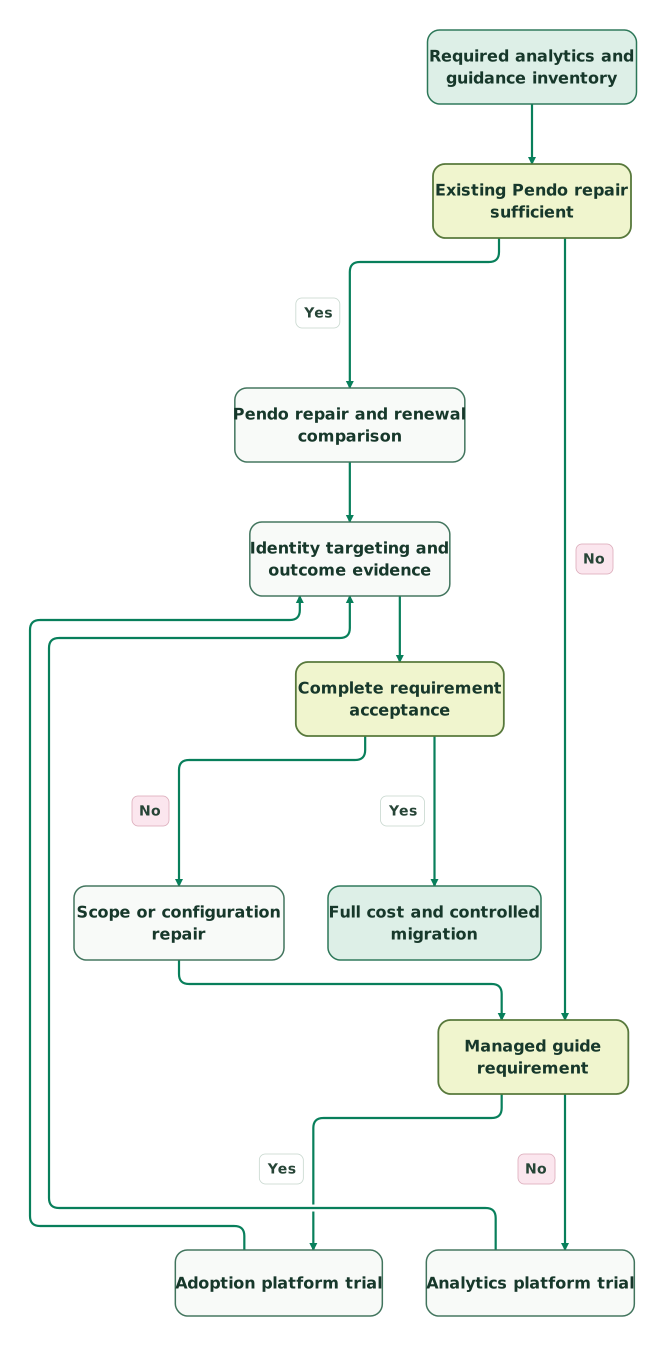
Replacement acceptance checklist
Read diagram as text
- Required analytics and guidance inventory to Existing Pendo repair sufficient.
- Existing Pendo repair sufficient to Pendo repair and renewal comparison: Yes.
- Existing Pendo repair sufficient to Managed guide requirement: No.
- Managed guide requirement to Adoption platform trial: Yes.
- Managed guide requirement to Analytics platform trial: No.
- Adoption platform trial to Identity targeting and outcome evidence.
- Analytics platform trial to Identity targeting and outcome evidence.
- Identity targeting and outcome evidence to Complete requirement acceptance.
- Complete requirement acceptance to Scope or configuration repair: No.
- Scope or configuration repair to Managed guide requirement.
- Complete requirement acceptance to Full cost and controlled migration: Yes.
- Pendo repair and renewal comparison to Identity targeting and outcome evidence
Checklist
- Every retained Pendo capability has a destination and an owner.
- Active users, events, sessions and live experiences are priced separately.
- Guide targeting survives email changes, account switches and completed onboarding.
- UI changes and integration retries have acceptance tests.
- Privacy rules apply before capture and guide delivery.
- The comparison includes transition work and continuing operation.
- Parallel operation prevents duplicate guides and conflicting customer messages.
- A meaningful product outcome defines success after release.
Use the analytics tool selector skill to record the buying requirements. Request a product analytics scope when the replacement depends on identity, instrumentation and usable activation reporting.
Keep reading
Browse all Product Analytics guides
 Product Analytics
FullStory vs Amplitude: Product Decisions, Session Evidence and Full Cost
Choose FullStory or Amplitude by the decision your team needs to make. Compare event and session billing, replay retention, identity and practical trial requirements.
Jafrin Akter AloLast updated 12 min read
 Product Analytics
Hotjar Alternatives: Four Tools for Replay, Friction and Product Analysis
Compare four Hotjar alternatives and the current Contentsquare baseline. Check free limits, replay retention, surveys, privacy and the full investigation workflow.
Jafrin Akter AloLast updated 12 min read
 Product Analytics
Intercom vs Pendo: Support, Product Tours, Analytics and Cost
Choose Intercom for customer support or Pendo for product adoption. Compare tours, analytics, pricing, mobile limits and how to run both without duplicate messages.
Jafrin Akter AloLast updated 14 min read
Product analytics
See the implementation scope, deliverables and acceptance checks.
Questions people ask
Can PostHog replace Pendo's managed product-tour editor?
PostHog has retired its managed product-tours feature, so plan a separate supported onboarding implementation if you choose it for analytics. Its replacement agent skill can help create code, but that code still needs testing, deployment and ownership. Include the work in the comparison before treating a low analytics bill as the cost of the entire Pendo replacement.
Does Appcues' starting price include all fifty thousand supported active users?
The published Grow price starts at $9,000 annually and scales with monthly active users within its supported range. Confirm your specific band and included scope in the offer. The plan's maximum supported audience and its entry price describe different purchasing facts. Additional experiences, communication channels and implementation requirements can also change the complete commitment.
Is Amplitude Free enough for a twelve-guide onboarding program?
Its pricing matrix lists one guide or survey on Free, so a twelve-guide program needs another eligible configuration or a separate guidance tool. Count the experiences that must remain live together and test their targeting. The free analytics event allowance cannot establish that the guidance allowance covers the same replacement workload.
Can a Pendo migration restart onboarding for established users?
Yes, if the destination loses completion state, changes identity or rebuilds targeting incorrectly. Include established customers, changed email addresses and account switches in the migration trial. Validate both the guides that should appear and those that should remain suppressed. During parallel operation, assign delivery ownership so the two platforms cannot independently restart the same onboarding journey.
Should guide completion be the main outcome in a Pendo replacement trial?
Guide completion is useful delivery evidence, but the business outcome should reflect the value the user reaches afterward. Define activation, successful setup or another meaningful behavior and measure it in the eligible population. A tour can receive many completions while the underlying product task remains unfinished. Keep those measures separate when judging the replacement.
Sources
- Pendo plans and pricing model
- Pendo Free usage and feature limits
- Pendo IDs and metadata
- Userpilot current plans and volume matrix
- Userpilot annual billing and plan explanation
- Userpilot Growth billing basis
- Appcues pricing and included scope
- Chameleon prices and tracked-user rules
- Amplitude current platform pricing
- Amplitude billing and startup conditions
- PostHog product allowances
- PostHog product-tours retirement

Written by
Jafrin Akter AloData Engineer and Co-founder at Martechdevs and Growth and Analytics Partners
Jafrin writes practical guides to marketing technology, customer data, analytics and AI workflows. Martechdevs is a Growth and Analytics Partners company.