
FullStory vs Amplitude: Product Decisions, Session Evidence and Full Cost
Choose FullStory when your main job is reconstructing customer friction and turning the session evidence into a fix. Choose Amplitude when activation, retention and behavioral cohorts drive the product decision. Both now cover analytics and replay, so this is a workflow and entitlement comparison. Trial the actual questions, required history and capture population before paying for a second platform or replacing the first.
On this page
FullStory and Amplitude compared
Free allowances below use different units; paid features, additional volume and implementation need separate pricing.
| Decision | FullStory | Amplitude |
|---|---|---|
| Free entry | 30,000 sessions monthly; up to ten users | 2 million events monthly; unlimited seats |
| Paid purchasing basis | Business, Advanced and Enterprise by quote | Plus usage-based; Growth and Enterprise custom |
| Free replay allowance | Within the 30,000-session plan | 10,000 monthly session replays |
| Free replay retention | Twelve months | Thirty days from ingestion by default |
| First workflow to test | A session-level failure and its wider impact | A behavioral question and the sessions behind it |
Sources: FullStory plans, FullStory Free, Amplitude pricing, Amplitude replay retention.
At Martechdevs, we scope product analytics implementation around decisions the team will repeat. The useful comparison is whether an ordinary operator can answer those questions using correct identities, definitions and available evidence. A convincing demonstration with someone else's events does not settle that requirement.

Product direction and session investigation
FullStory
FullStory is a strong first trial for investigating a failed checkout, an unresponsive interaction or an account-specific support incident. Its wider product analytics offering also includes funnels, journey mapping and retention charting. Treat it as a behavioral-analysis platform with a session-investigation workflow, rather than assuming it only plays recordings. FullStory product analytics.
- Best for: product, support and engineering teams connecting a customer problem with actionable session evidence.
- Pros: replay, debugging context and wider behavioral analysis can support the same investigation.
- Cons: paid capability, retained history and higher volume need an explicit package and quote.
- Free plan and startup offer: Free includes basic analytics and debugging for up to ten users; no additional startup reduction is assumed.
- Choose it if: the team can locate the relevant session, explain the failure and determine whether it affects other customers.
- Skip it if: the required analytical question remains awkward or unsupported in the proposed package despite a successful replay demonstration.
FullStory Free also grants the vendor rights to anonymized non-PII data, including model training and partner sharing, while its FAQ distinguishes paid-plan customer ownership; include that difference in the plan acceptance. Free-plan data rights.
A useful trial starts with a known failure and a known successful journey. Ask the operator to find both, explain the relevant difference and hand the issue to the person who will repair it. Then verify that the selected package supports the aggregate question behind prioritization. A free debugging workflow and an advanced dashboard subscription are different purchasing scopes. FullStory plan boundaries.
Amplitude
Amplitude is our first candidate when the recurring decision concerns activation, feature adoption, retention or a behavioral cohort. Its Retention Analysis chart explicitly relates a starting event to a return event and the selected population. Those choices establish what the result means. Amplitude retention analysis.
- Best for: product and growth teams maintaining a shared set of behavioral questions and metrics.
- Pros: analytics, replay and experimentation can connect population analysis with the individual experience.
- Cons: useful results depend on stable identities and definitions; advanced capabilities and replay needs can exceed a free plan.
- Free plan and startup offer: Free has a recurring event allowance. Approved startups can receive a Growth year, subject to eligibility and usage limits.
- Choose it if: the required cohorts, funnels and return behavior are reproducible from the agreed event model.
- Skip it if: the team mainly needs a bounded support investigation and would leave the analytical model unmaintained.
Amplitude also provides Session Replay, including navigation from analytics, user profiles or support context into recordings. Do not buy a second tool on the assumption that Amplitude lacks replay. Test the capture, error evidence and retention required for your particular investigation. Amplitude replay capabilities.
The Pendo alternatives guide covers the additional decision when the team needs managed onboarding. Inclusion of Guides and Surveys in a platform does not establish that its live-experience allowance covers an existing adoption program.
Billing units and the same-company example
Amplitude's current public entry offer is event-based: two million monthly events on Free, with Plus starting at zero for its first two million events and scaling by usage. Existing arrangements can still use monthly tracked users, so inspect the actual account's meter before applying a new-plan example. Current pricing, plan and billing arrangements.
FullStory's free allowance is measured in sessions. For web capture, its session ends after thirty minutes of inactivity or twenty-four hours of active capture. A returning person can therefore generate several sessions. Mobile lifecycle rules also affect session boundaries. FullStory session definition.
Consider a hypothetical product with 5,000 active people, ten sessions per person monthly and forty captured analytics events per session. It produces 50,000 sessions and two million events under those assumptions.
| Workload | Calculation | Result | Commercial implication |
|---|---|---|---|
| Monthly sessions | 5,000 × 10 | 50,000 | Exceeds FullStory Free's stated session allowance |
| Monthly analytics events | 50,000 × 40 | 2,000,000 | At Amplitude Free's event allowance |
| Amplitude replay at 20% capture | 50,000 × 20% | 10,000 | Expected volume matches the free replay quantity |
| Higher engagement | 5,000 × 30 × 40 | 6,000,000 events | Same people, larger event-metered workload |
A change in engagement can alter an event or session bill while the number of active people stays fixed. Forecast the behavior that creates consumption: routes, interactions, automated events, retries and capture configuration. Removing a duplicate event improves the implementation; removing a meaningful event just to fit a plan can damage the analysis.
The replay example is an expected volume under uniform sampling. It is not a promise that every support incident or device category will be represented. Amplitude supports manual and dynamic sampling, and its capture stops when the monthly replay quota is reached. Sampling and quota behavior.
Obtain an itemized quote for required paid scope: event or session volume, replay retention, mobile capture, advanced analysis, data export and identity or access controls. FullStory paid pricing is custom. Amplitude's Growth and Enterprise prices are also custom, while its Plus amount depends on the selected event tier. Use the actual calculator result or written quote for that tier instead of extending a free allowance into an invented paid rate.
Retention and the evidence still available
Analytics retention and replay retention answer different questions. The first preserves the data behind historical metrics; the second preserves the material needed to reconstruct an individual experience. A historical conversion chart can still work after its linked recording has expired.
FullStory lets paid customers specify separate analytics and replay windows. Its Free plan provides one year of both. FullStory retention.
Amplitude's default raw-replay retention is thirty days from ingestion. Extra retention depends on the SDK path and purchased scope: its guidance distinguishes browser and React Native configurations from native iOS, Android and Flutter paths. A retention change applies to subsequently ingested recordings, so extending a plan does not restore expired evidence. Amplitude replay lifecycle.
Write a concrete retention requirement. For example, a quarterly enterprise-account review may need sessions older than ninety days, while a weekly checkout investigation may be satisfied with a shorter window. Confirm retention for the actual web or mobile implementation and include the appropriate entitlement in the trial.
Also decide what evidence should be retained outside a replay interface. An issue record can preserve the diagnosis, affected release, approved reproduction steps and repair outcome without assuming the original recording remains available indefinitely. Apply the agreed handling policy to any downloaded or shared material.
A shared analytical acceptance test
Use the same business definitions in both trials. Imagine 1,000 new accounts eligible for onboarding, with 600 reaching a meaningful activation event within seven days. The account activation rate is 60%. Counting individual employees instead would answer a different question, particularly when larger accounts contribute more users.
| Question | Agreed definition | Required evidence |
|---|---|---|
| Activation | Eligible account reaches the specified outcome within seven days | 600 of 1,000 in the illustrative cohort |
| Retention | Same starting population returns to a defined meaningful behavior | A stable start event, return event and observation window |
| Friction | A specified failure on an eligible journey | Both individual sessions and an explained affected population |
| Improvement | Change in a predefined outcome under a suitable evaluation | Consistent denominator and no hidden capture change |
Do not substitute “any event” for meaningful return behavior without deciding what that includes. Background events, automatic page activity or a support login can create activity without the customer receiving product value. Amplitude allows the start and return events to be defined explicitly; use that control deliberately. Retention event choices.
Then inspect a failed and a successful account journey. Determine whether the recording explains a mechanism behind the aggregate pattern. The session can help form a hypothesis; it does not establish how frequent that mechanism is across unrecorded people or prove that a proposed fix will improve retention.
Our Amplitude implementation-mistakes guide covers the identity and funnel failures that can undermine this test. The tracking-plan guide turns the agreed definitions into an instrumentation requirement that survives a tool change.
Identity, privacy and access
Amplitude combines device IDs, user IDs and its own Amplitude IDs. A stable user ID after authentication connects relevant activity across devices; inconsistent identifiers across projects can split the same person. Shared devices and logout behavior deserve their own test cases. Amplitude identity rules.
For either platform, test a person who uses two devices, two people who share a device, an email-address change and a person switching between customer accounts. Decide which events belong to the person, which belong to the account and which should remain anonymous. A visually convincing replay cannot repair a mistaken ownership join in the analytical model.
FullStory distinguishes masked content from excluded content. Masking preserves relevant interactions while concealing text; exclusion omits the element and its interactions. Its guidance also says web images cannot be masked through text masking and need exclusion where appropriate. FullStory privacy controls.
Amplitude provides replay privacy and consent controls, with disclosures and capture behavior tied to the actual implementation. Amplitude replay consent guidance. Configure the agreed capture policy before collecting customer sessions and test sensitive text, images, URLs and changes in consent.
Access should match the job. An analyst may need aggregate outcomes without access to every customer's replay. A support operator may need a bounded incident investigation. Verify that the proposed plan and permissions implement those distinctions, rather than granting broad access simply because the account has available seats.
One platform, two platforms and transition cost
Start by testing the capabilities already included in the current platform. Add a second platform only when the unresolved job is meaningful enough to justify another installation, privacy configuration, identity mapping and operating owner.
If using both, define one authoritative metric specification and use stable identifiers to connect investigations. The tools may still report different session counts because of their session rules, consent state, sampling and capture exclusions. Reconcile the relevant population before treating a difference as a vendor defect.
For a hypothetical budget, assume candidate A costs $800 monthly plus $200 in ongoing work, while candidate B costs $1,100 monthly plus $100 in ongoing work. Their complete recurring costs are $1,000 and $1,200. A $4,800 migration from B to A takes twenty-four months to recover through the $200 monthly difference alone. These are planning inputs, not vendor quotes.
The transition can still be justified by a better decision or faster incident resolution, but define that result before committing. Measure the operator's ability to complete the actual task, preserve required history and maintain the installation. Avoid turning a migration budget into a promise of faster product growth.
For an existing analytical model, the analytics migration guide helps structure validation. Keep the prior system readable until the agreed cohort, event and history checks pass, and record the point at which reporting switches to the accepted destination.
Amplitude vs FullStory by team and decision
| Situation | First trial | Runner-up | Deciding evidence |
|---|---|---|---|
| Product team investigating activation and return behavior | Amplitude | FullStory paid analytics | Cohort definitions and repeatable analysis |
| Support and engineering reconstructing customer incidents | FullStory | Amplitude Replay | Relevant session coverage, technical context and history |
| Existing Amplitude customer with a new replay need | Existing Amplitude scope | FullStory after a measured gap | Required incident investigation in the actual plan |
| Existing FullStory customer needing more product analysis | Existing FullStory analytics | Amplitude after a measured gap | Accepted behavioral question and complete cost |
| Early-stage team within free limits | Either against its actual task | Current stack | Required features, capture and operating ownership |
| Team needing a wider onboarding program | Separate adoption evaluation | Appropriate platform add-on | Live guides, targeting and completion-state coverage |
The Hotjar alternatives guide covers a smaller website-investigation requirement. A broad product platform is a weaker fit when a simple, maintained workflow already answers the question.
Platform acceptance checklist
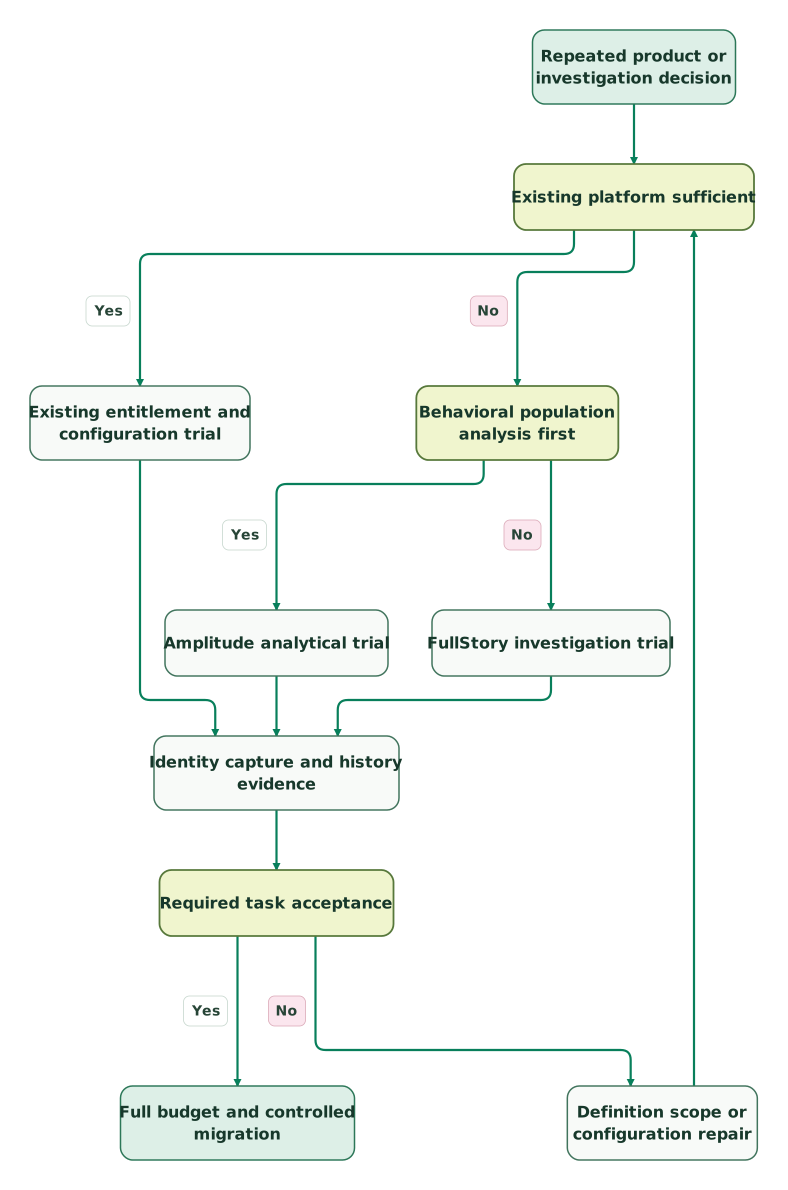
Read diagram as text
- Repeated product or investigation decision to Existing platform sufficient.
- Existing platform sufficient to Existing entitlement and configuration trial: Yes.
- Existing platform sufficient to Behavioral population analysis first: No.
- Behavioral population analysis first to Amplitude analytical trial: Yes.
- Behavioral population analysis first to FullStory investigation trial: No.
- Existing entitlement and configuration trial to Identity capture and history evidence.
- Amplitude analytical trial to Identity capture and history evidence.
- FullStory investigation trial to Identity capture and history evidence.
- Identity capture and history evidence to Required task acceptance.
- Required task acceptance to Definition scope or configuration repair: No.
- Definition scope or configuration repair to Existing platform sufficient.
- Required task acceptance to Full budget and controlled migration: Yes
Checklist
- The repeated business decision is written before the trial.
- Event, session, user and replay counts use their actual definitions.
- Both failed and successful journeys support the accepted analytical population.
- Replay retention covers the required web or mobile investigation window.
- Identities survive device changes, logout and account switching.
- Sensitive content and consent changes behave as required.
- Ordinary users have appropriate access and can complete the task.
- Full cost, history retention and cutover ownership are approved internally.
Use the analytics tool selector skill to capture the decision and acceptance evidence. Request a product analytics scope when identity, instrumentation and useful reporting need to be settled alongside the platform choice.
Keep reading
Browse all Product Analytics guides
 Product Analytics
Hotjar Alternatives: Four Tools for Replay, Friction and Product Analysis
Compare four Hotjar alternatives and the current Contentsquare baseline. Check free limits, replay retention, surveys, privacy and the full investigation workflow.
Jafrin Akter AloLast updated 12 min read
 Product Analytics
Pendo Alternatives: Five Options for Onboarding, Analytics and Cost
Compare five Pendo alternatives by guides, analytics, active users and full cost. Includes current pricing, workload examples and migration acceptance checks.
Jafrin Akter AloLast updated 12 min read
 Product Analytics
Amplitude Implementation Mistakes: Identity, Sessions and Funnels
Fix Amplitude identity, session and funnel mistakes with a server-event payload, known customer journeys and checks for event-time context.
Jafrin Akter AloLast updated 11 min read
Product analytics
See the implementation scope, deliverables and acceptance checks.
Questions people ask
Does FullStory only provide replay while Amplitude only provides charts?
Both products now cover analytics and replay. FullStory offers product analytics alongside session investigation, while Amplitude links behavioral analysis with recorded sessions. Compare the actual workflow, edition and capture requirements. A product-category label cannot establish whether an operator can answer your cohort question or reconstruct the particular customer incident that matters to the business.
Can two million Amplitude events be compared directly with thirty thousand FullStory sessions?
They measure different units. One person can generate several sessions, and each session can contain many events. Translate the same expected workload into both units using explicit session and event assumptions, then apply each vendor's counting rules. Also separate replay capture from analytics events, because fitting an analytics allowance does not establish that every session will be recorded.
Will longer Amplitude replay retention restore recordings that already expired?
Retention changes apply to subsequently ingested replay data under Amplitude's lifecycle guidance. They do not recover recordings that have already expired. Choose the necessary history window before the investigation period begins, and confirm the SDK-specific purchased entitlement. Keep the diagnosis and repair record under your agreed evidence policy instead of assuming a later upgrade can reconstruct missing sessions.
Can a free Amplitude organization use the same billing assumptions as an older paid account?
Check the actual account's plan and meter. The current public entry offer uses event volume, while Amplitude also documents existing MTU-based arrangements. Usage limits and overage calculations depend on that commercial basis. Apply the correct account terms before estimating an upgrade, rather than converting a new-plan allowance into an unsupported price for an existing contract.
Should every support recording be used as evidence of the most common product problem?
Support recordings represent the customers and incidents that reached that workflow, which may differ from the full product population. Use them to investigate mechanisms and form hypotheses, then measure prevalence using an appropriate analytical denominator and capture scope. Compare successful journeys as well. The most memorable recording can describe a real problem without establishing that it is the most frequent one.
Sources
- FullStory commercial plans
- FullStory Free allowances
- FullStory product analytics
- FullStory session boundaries
- FullStory replay and analytics retention
- FullStory Private by Default
- Amplitude current pricing
- Amplitude plans, billing and startup offer
- Amplitude retention analysis
- Amplitude Session Replay
- Amplitude replay retention lifecycle
- Amplitude sampling and quota rules
- Amplitude identity rules
- Amplitude replay consent guidance

Written by
Jafrin Akter AloData Engineer and Co-founder at Martechdevs and Growth and Analytics Partners
Jafrin writes practical guides to marketing technology, customer data, analytics and AI workflows. Martechdevs is a Growth and Analytics Partners company.