
ActiveCampaign vs Klaviyo for Service and Store Automation
Pick ActiveCampaign if your marketing centres on leads, appointments and a sales follow-up process; pick Klaviyo if orders, products and repeat purchases drive the work. ActiveCampaign vs Klaviyo is primarily a workflow decision. Compare the required integration, automation limits and billable audience before using a small difference in entry price to choose your platform.
On this page
ActiveCampaign and Klaviyo comparison
Prices are US list prices in USD; these entry plans have different contact allowances and billing commitments.
| Decision criterion | ActiveCampaign | Klaviyo | Practical implication |
|---|---|---|---|
| Paid email entry | Starter $15/month for 1,000 contacts, billed annually | Email $20/month for 500 active profiles and 5,000 emails | Compare your actual audience and required features |
| Free evaluation | 14-day trial, up to 100 contacts and 100 emails | Free plan, up to 250 active profiles and 500 emails/month | A trial is temporary; a free plan still has a capacity limit |
| Main evaluation focus | Nurture, appointments and sales follow-up | Store events and repeat purchases | Start with the event that should change the next message |
| Entry automation limit | Starter allows five actions per automation | Campaigns and flows included in the email offer | Rebuild the longest required journey before selecting a plan |
| Shopify integration | Pricing lists standard Shopify access on Starter; Deep Data help lists Plus and above | Direct Shopify integration | Confirm required order and product fields in the selected plan |
The entry prices come from ActiveCampaign's published offer and Klaviyo pricing. Trial limits are in the ActiveCampaign FAQ. Integration requirements are documented in ActiveCampaign's Shopify options and Klaviyo's Shopify guide.
A service business and a store can have the same contact count while requiring different systems. The service business may need to stop nurture after a meeting is booked and create a task for a salesperson. The store may need to stop an abandoned-checkout reminder after an order and use the purchased product in the next message. The trigger, exit and follow-up owner matter together.
At Martechdevs, we use a lifecycle messaging assessment to map those decisions before choosing the platform. A useful trial proves that the right customer receives the right message and that a changed customer state prevents the wrong one. A polished template alone does not answer either question.
Tool decision blocks
ActiveCampaign
- Best for: A service or smaller B2B team that needs email nurture connected to an explicit sales follow-up process.
- Pros: Marketing automations can become the common place to manage a practical sequence of customer conditions and actions.
- Cons: Starter's five-action limit and the separately sold CRM options mean a growing program can require a higher plan and add-ons. Check the feature table.
- Free plan and startup offer: The trial runs for 14 days with up to 100 contacts and 100 emails. The public offer is a temporary evaluation; it does not promise a permanent free tier or universal startup discount.
- Choose it if: Your required nurture and handoff can be owned by the marketing team, with the relevant integration and CRM scope priced explicitly.
- Skip it if: The required store fields, automation or reporting have not been confirmed in the selected plan and the purchase depends on the Starter headline price.
Klaviyo
- Best for: A commerce team whose lifecycle decisions follow browsing, checkout, orders and repeat purchases.
- Pros: The Shopify integration gives the team a direct route to store data, and flow filters can control eligibility as customer activity changes.
- Cons: A sales pipeline or appointment process still needs a clear owner and integration; a commerce fit does not make every service workflow automatic.
- Free plan and startup offer: The free plan includes 250 active profiles and 500 emails/month. Its concrete free allowance is the evaluation basis; the pricing page does not promise a universal startup discount.
- Choose it if: The product and order journey passes your store-data tests with little extra coordination.
- Skip it if: Sales opportunities and manual follow-up drive the business and you would build a second operating system around Klaviyo to manage them.
Contact counts and commercial scope
A marketing contact count and a store customer count can differ. Before requesting prices, count the records the chosen platform will actually bill and the messages the program will send. Keep the source count, suppression decisions and destination count in the same worksheet so finance can follow the change.
Klaviyo defines an active profile as a contact in the database that you can market to. Its displayed Email tier covers 500 active profiles and 5,000 emails/month. ActiveCampaign's Starter offer is $15/month for 1,000 contacts on annual billing, with plan details describing a send allowance of ten times the contact limit. Klaviyo plan definitions, ActiveCampaign entry offer, ActiveCampaign allowances.
Treat the software bill as a combination of audience size, sending needs, edition and extras. Ask for a written count definition for retained unsubscribed, bounced and otherwise inactive records in your ActiveCampaign account. Do not substitute the number of people in this month's campaign for the vendor's billable total.
ActiveCampaign's official pages differ on Shopify scope. Its pricing table lists standard Shopify integrations on every plan, including Starter, while the Deep Data integration guide lists Plus, Professional and Enterprise. Confirm the required order events, product fields and reporting in the selected edition before purchase.
Use the Klaviyo cost calculator and the ActiveCampaign pricing guide to organize the bill. Confirm the current selected offer at purchase, especially if a promotion appears beside the regular price. A promotional month should remain separate from the recurring budget.
A hypothetical small-audience budget
Assume a hypothetical business has 500 eligible marketing contacts and sends eight messages to each contact in a month. It needs only email and fits ActiveCampaign Starter's automation limits. Exclude SMS, CRM add-ons, taxes, implementation and any promotion. This is a capacity and cash-commitment illustration, not a claim that both tools suit every 500-contact business.
| Planning item | Calculation | Result | Interpretation |
|---|---|---|---|
| Monthly email volume | 500 contacts × 8 messages | 4,000 emails | Hypothetical demand |
| ActiveCampaign annual base | $15 × 12 months | $180 | Annual-payment entry subscription |
| Klaviyo annualized base | $20 × 12 months | $240 | Twelve monthly payments at the shown entry price |
| Annual base difference | $240 minus $180 | $60 | Excludes required higher plans and extras |
| Klaviyo entry email headroom | 5,000 minus 4,000 | 1,000 emails/month | Remaining allowance under the assumption |
The example shows a $60 annual base difference, which is too small to justify a materially harder daily process. It also shows different commitments: ActiveCampaign's stated rate is tied to annual billing, while Klaviyo's displayed rate is monthly. A team evaluating seasonal demand should keep payment timing and cancellation terms in the quote review.
Now change only the hypothetical frequency to 12 messages per contact per month. Demand becomes 500 × 12 = 6,000 emails/month, which is 1,000 above the displayed Klaviyo entry allowance. That requires a new plan or sending decision. Do not assume the same bill remains valid merely because the contact count stayed flat.
Workflow fit by scenario
| Company size or operating model | Best fit | Runner-up | Reason |
|---|---|---|---|
| Small consultancy with enquiries and booked calls | ActiveCampaign | Klaviyo | The handoff to a named salesperson is central |
| Shopify store with a lean retention team | Klaviyo | ActiveCampaign qualified configuration | Product and order context lead the requirements |
| Course business selling both consultations and products | ActiveCampaign | Klaviyo | Pick the tool that covers the dominant follow-up process |
| Commerce brand adding subscriptions | Klaviyo | ActiveCampaign | Test renewal, cancellation and order changes together |
| Product company with several account relationships | Broader shortlist | ActiveCampaign | Neither should win without an account-context trial |
In the last scenario, the runner-up is provisional because the requirement may belong outside this pair. The Iterable alternatives guide covers product and app journeys, while Marketo alternatives addresses a deeper B2B qualification and CRM process. Expanding the shortlist is useful when the current pair would require several exceptions to model the business.
For businesses that already operate one of these platforms, the cost of a move matters. Compare the time needed to repair the existing workflow with the time needed to rebuild, retrain and validate the replacement. An unfamiliar interface can make a simple issue look like a platform limitation. Write the failed business outcome first, then verify whether the proposed configuration fixes it.
Automation semantics and the stop condition
The most valuable trial case is often a customer whose state changes during a delay. For a store, that may be a checkout customer who buys before the reminder. For a service company, it may be a prospect who books a call while a nurture sequence is waiting. The subsequent message must reflect the latest state.
Klaviyo distinguishes trigger filters from profile filters. Metric-trigger filters are evaluated at entry; profile filters are checked at entry and before flow actions. If a person fails a profile filter at an action, that action is skipped and later steps can still be evaluated. This behavior is documented in Klaviyo's trigger and filter guide. An intended permanent exit therefore needs a deliberate design.
For ActiveCampaign, write the equivalent business rule before building the automation. Decide where the current customer state is checked, what updates it and which action follows a changed state. The plan comparison distinguishes the Starter action limit and the larger automation scope above it. Test the finished workflow in the purchased edition rather than assuming everything available during a trial will remain included.
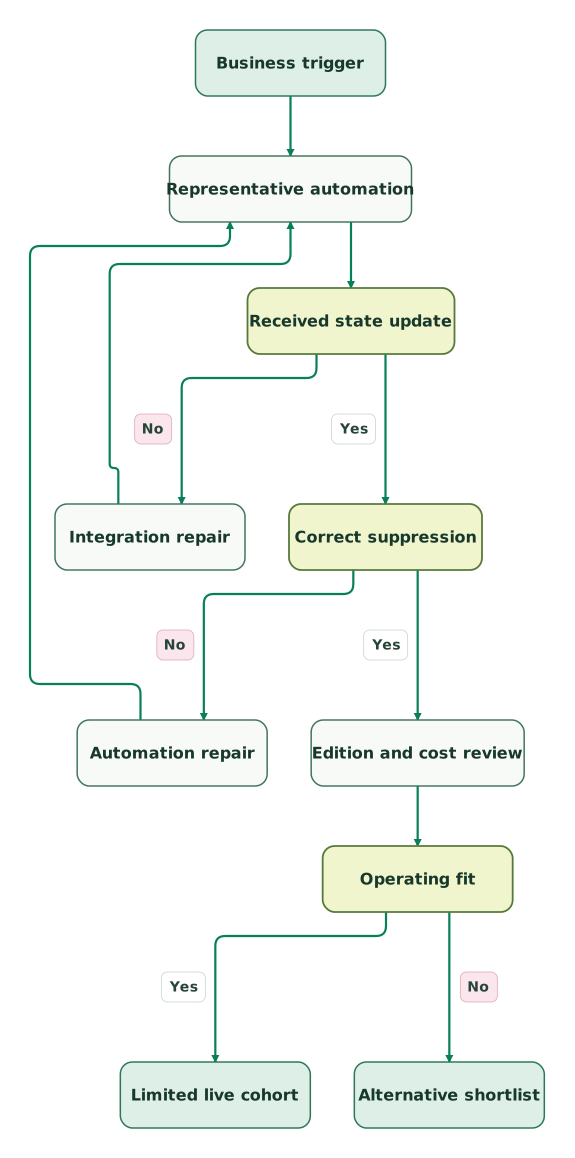
Read diagram as text
- Business trigger to Representative automation.
- Representative automation to Received state update.
- Received state update to Integration repair: No.
- Integration repair to Representative automation.
- Received state update to Correct suppression: Yes.
- Correct suppression to Automation repair: No.
- Automation repair to Representative automation.
- Correct suppression to Edition and cost review: Yes.
- Edition and cost review to Operating fit.
- Operating fit to Limited live cohort: Yes.
- Operating fit to Alternative shortlist: No
The diagram separates missing data from incorrect automation logic. A message can be wrong even when every configured rule ran correctly, because the system never received the purchase or appointment. Repair the right layer and repeat the entire case, including the message that should be suppressed.
Migration and measurement boundaries
A migration starts with a consent and identity map. Decide which record represents the customer, where subscription preferences are maintained and how an email change is handled. Import suppressions before enabling broad sends. Keep customer identifiers separate from campaign labels so renaming an audience does not create a new person.
Move a bounded set of automations first. Maintain a list of each message and the system allowed to send it. A store connector, an old automation and a new flow can all contain similar reminders. Counting only the new flow's activity will not reveal an unwanted message sent elsewhere.
Reconcile customer outcomes against source-system records. For commerce, use orders, cancellations and refunds. For services, use booked calls, qualified opportunities and completed sales actions. Platform-attributed revenue can be useful within a consistent method, but a change in attribution settings should not be described as a new business result.
Keep reporting continuity explicit. Save the old attribution windows and campaign identifiers before the transition. Mark the operational cutover in the reporting process and compare like periods with the same definitions. If the new reporting cannot reconstruct old history, retain the old export and document the boundary for the team that answers performance questions.
ActiveCampaign vs Klaviyo evaluation checklist
- Identify the dominant event: enquiry, appointment, checkout, order or product activity.
- Count the audience using the selected plan's billing definition.
- Estimate monthly messages separately from contact growth.
- Rebuild the longest required automation in the intended paid edition.
- Confirm direct integration availability and the data it must supply.
- Test a purchase or appointment that occurs during a message delay.
- Test a suppressed customer and an email-address change.
- Repeat the affected journey after integration or rule repairs.
- Assign one live sender to each customer message during transition.
- Compare orders or sales outcomes using consistent reporting definitions.
The lifecycle marketing audit skill can turn this checklist into an internal brief. For a store rollout, the Klaviyo implementation mistakes guide helps focus the trial on identity, event and flow failures that a template review does not reveal.
Keep reading
Browse all CRM & Lifecycle guides
 CRM & Lifecycle
Iterable Alternatives for Product, App and Store Journeys
Compare Iterable alternatives by product, app and store workflows, with current pricing units, migration costs, journey tests and a practical cutover checklist.
Jafrin Akter AloLast updated 10 min read
 CRM & Lifecycle
Marketo Alternatives for CRM, Lead Nurture and Product Journeys
Compare Marketo alternatives for CRM, lead nurture and product journeys, including current plan costs, handoff tests and a full first-year budget example.
Jafrin Akter AloLast updated 11 min read
 CRM & Lifecycle
Klaviyo Pricing: Email Plans, Active Profiles and Mobile Costs
Klaviyo Email starts at $20 a month. Compare costs at 500 to 100,000 profiles, the Marketing package, mobile spend, overages and safe ways to cut the bill.
Jafrin Akter AloLast updated 12 min read
Lifecycle marketing
See the implementation scope, deliverables and acceptance checks.
Questions people ask
Can ActiveCampaign Starter replace Klaviyo for a Shopify store?
ActiveCampaign Starter may fit a Shopify workflow, but its official pages differ on integration scope. The pricing table includes standard Shopify integration on Starter, while the Deep Data help page lists Plus and above. Confirm the required order events, product fields and reporting in your selected plan, then test those requirements before comparing the subscription with Klaviyo.
Is Klaviyo a sensible choice for an appointment-led service business?
Klaviyo can be evaluated for an appointment-led business, but the appointment source and sales follow-up still need a defined integration and owner. Test a booking, a cancellation and a reschedule before choosing it. If most daily work revolves around enquiries and sales tasks, ActiveCampaign deserves the first trial because the commerce focus may provide little operational benefit.
Does an ActiveCampaign trial prove that Starter supports the finished automation?
No, an ActiveCampaign trial can expose features beyond the Starter plan you intend to buy. Compare every required action, integration and user need with the target edition before committing. Re-run the finished automation under the proposed plan's constraints, especially if the workflow includes several branches, a CRM add-on or a direct store integration.
Can Klaviyo skip one message without removing the person from the whole flow?
Yes, Klaviyo can skip an action after a profile-filter failure while evaluating later steps again. That distinction matters if your business rule requires a permanent exit after purchase or cancellation. Review the trigger and profile conditions together, then test the customer through the later steps so a correct first skip does not hide an unwanted later message.
Should a hybrid store and consultancy run both platforms?
A hybrid business should run both only when the separate operating benefits justify maintaining shared identity, preferences and message ownership. Begin with the dominant revenue process and test whether one platform covers the smaller process adequately. If a split is justified, document which platform sends each message and how a customer preference change reaches both systems.
Sources

Written by
Jafrin Akter AloData Engineer and Co-founder at Martechdevs and Growth and Analytics Partners
Jafrin writes practical guides to marketing technology, customer data, analytics and AI workflows. Martechdevs is a Growth and Analytics Partners company.