
Gong Pricing: Seats, Platform Fees, AI Credits and Renewal Cost
Gong pricing combines user licences, a platform fee and the applications your team buys, with credits for selected AI workflows. Gong publishes the charging structure but requires a proposal for the dollar amounts. Build your budget from the exact seat mix, included credits and renewal terms; a single price per salesperson cannot describe the complete commitment.
On this page
Gong pricing components
Gong's public prices require a quote; USD worked budgets below use explicitly assumed rates.
| Cost component | Billing basis | Purchase check |
|---|---|---|
| Gong Foundation | Paid core seats | Required users and included capabilities |
| Platform fee | Supported user population | Amount, growth bands and renewal treatment |
| Applications | Selected product and assigned seats | Enable, Forecast, Engage and Data Cloud scope |
| Gong credits | Eligible AI processing beyond the included pool | Allocation, consumption and additional bundle quote |
| Implementation and adjacent tools | Agreed delivery and existing subscriptions | Included work, CRM dependencies and ongoing owner |
The official pricing page confirms per-user licences and a platform fee related to supported users. The plans and seats guide separates Foundation from applications, while the credits guide describes consumption for selected AI features.
At Martechdevs, we connect the purchase to the CRM and revenue workflow it must support. A recording tool, a forecasting process and an automated pipeline-enrichment service have different requirements. Begin with the job and the people doing it, then ask Gong to price that configuration.

User licences and application scope
A core seat and an application seat are separate purchasing decisions. Foundation is the base; Gong lists Enable Essentials, Forecast Essentials, Forecast, Engage and Data Cloud as additional applications. Team members without assigned seats can be free Collaborators with limited access. Gong seat types.
Create a role inventory before supplying a headcount. Identify sellers who need captured interactions, managers using coaching or forecasts, operations staff maintaining configuration, and colleagues who only need limited collaboration. Test each role's actual tasks in the proposed licence arrangement. An employee count alone says little about the paid population.
A practical quote request includes a matrix with one row per role and columns for core access, coaching, forecasting, outreach and export needs. Ask the salesperson to return the same matrix with product names and chargeable quantities. That makes it possible to spot a bundle containing more application seats than the workflow needs.
For an existing customer, compare entitlements across the renewal rather than assuming an old package name maps to one new licence. Gong's guide explains that functionality maintained at renewal can require both Foundation and an application; later additions need the relevant seats purchased separately. Renewal seat changes.
Public benchmarks and their limits
Gong does not publish a universal dollar rate card on its pricing page. Public procurement reports can provide a comparison point, but their product mix, period and commercial terms must stay attached to the figures.
For example, Tropic's 2025 Gong SaaS Savings Playbook reported a legacy Professional arrangement with a $10,000 annual platform fee and $1,600 per user annually. Its modular-model illustration listed a $50,000 platform fee, $1,600 Foundation seats, $300 Enable Essentials seats and $300 Forecast Essentials seats. Those are Tropic's historical published reference figures, not a current Gong offer or a promise that any buyer qualifies. Tropic's published pricing examples.
The useful lesson is the size of the fixed component and the effect of separate applications. A quote with a lower seat rate can still have a higher total because its platform fee or product scope differs. Compare the complete first-year and renewal amounts using the same requirements.
Avoid deriving a small-team quote by dividing a reported enterprise contract by its users. A fixed fee does not shrink automatically with the denominator. Equally, a historical list-price illustration cannot establish the discount, minimum purchase or implementation fee in a new agreement.
Worked budgets by company type
The following USD examples use assumed annual rates of $1,500 per core seat, $500 per application seat and a $12,000 platform fee. They are arithmetic models for replacing with a quote, not Gong list prices, typical bills or negotiated results. Credits, implementation, tax and other tools are excluded.
| Company situation | Assumed paid scope | Annual subtotal | Monthly equivalent |
|---|---|---|---|
| Five-person sales startup | 5 core seats; no application seats | $19,500 | $1,625.00 |
| Seed-stage SaaS sales team | 20 core and 20 application seats | $52,000 | $4,333.33 |
| Larger B2B sales organization | 75 core and 75 application seats | $162,000 | $13,500.00 |
| Mid-market revenue organization | 150 core and 150 application seats | $312,000 | $26,000.00 |
The twenty-user row is 20 × $1,500 + 20 × $500 + $12,000 = $52,000. Divide by twelve only to compare monthly economics; the contract may require a different payment schedule. The fixed platform assumption is deliberately held constant to expose the formula. Ask for the actual fee at every proposed user band.
If ten of those twenty people require the application, the assumed annual subtotal becomes $47,000. That saves $5,000 against assigning it to everyone. The next step is an entitlement test: confirm those ten omitted users can still complete their required work.
Suppose the same team budgets $8,000 for one-time delivery and $4,000 for additional credits. First-year cash cost becomes $64,000, or $5,333.33 monthly equivalent. In year two, removing the one-time delivery line produces $56,000 only if licence rates, fee, credit purchases and scope remain unchanged. A renewal model needs those assumptions written separately.
Use the martech stack cost guide to include the connected CRM, outreach and reporting tools. Replacing one overlapping subscription can change the business case, but count the saving only after the replacement passes its workflow tests and the old commitment can end.
Gong credits and AI consumption
A Gong credit is a unit of eligible AI processing. The included pool is shared across the account; the current help guide assigns 2,000 annual credits per paid core seat. Its listed processing rates are 0.1 credit per email, 0.3 per call up to ten minutes, one per longer call and ten per web search in a brief. Credit allocation and rates.
That schedule is not a universal cost for every action carrying an AI label. Gong distinguishes credit-consuming workflows from included everyday actions. Its credit FAQ also says application seats do not add their own allocation, and additional credits are purchased in prepaid bundles. Default credits expire at each contract-year end; purchased credits expire at the end of the full contract term. Gong credit mechanics.
A worked processing model for twenty paid core seats starts with 40,000 annual included credits. Assume one monthly workload processes 2,000 longer calls, 1,000 shorter calls, 10,000 emails and twenty web searches:
| Processing input | Calculation | Monthly credits |
|---|---|---|
| Longer calls | 2,000 × 1 | 2,000 |
| Shorter calls | 1,000 × 0.3 | 300 |
| Emails | 10,000 × 0.1 | 1,000 |
| Web searches | 20 × 10 | 200 |
| Total | Sum of the stated processing | 3,500 |
That workload consumes 42,000 over twelve equal months, creating a 2,000-credit gap before other eligible activity. This is a usage illustration, not a dollar quote. Request the applicable bundle size and price instead of inventing a monetary conversion.
Repeated processing matters. Direct call or email sections in an API-generated brief can consume credits each time the brief runs, while viewing existing processed results does not. The actual request structure therefore belongs in the estimate. Processing behavior.
For an automated workflow, record its trigger, data range, frequency and expected output. A daily brief that rereads a long history has a different operating pattern from one reading the recent changes needed for today's decision. Test the smaller scope against the actual sales question before expanding it.
Cost drivers and operating controls
Seat quantity, application coverage and the platform fee establish the fixed commitment. AI workflow scope adds a second dimension. A company can keep the same headcount and consume more credits by processing more history, increasing automation frequency or expanding the conversations included.
Gong's Admin center provides credit usage, balances and downloadable reports. The usage report includes feature, user, processed-data breakdown and request count. Use those fields to assign consumption to a workflow rather than treating the whole pool as one unexplained expense. Credit reporting.
Monthly credit profiles can set overall and feature limits for team members. Apply a deliberate default profile to new users, then give heavier workflows an approved allocation. Credit profiles. Company-wide background AI Trackers sit outside individual initiated-action limits, so a personal cap is not a complete company budget control. Profile scope.
Gong says it does not automatically charge for credit overages. Exhaustion pauses eligible processing rather than silently providing unlimited capacity. Keep a response owner and a replenishment decision in the runbook; an intact historical dashboard can still contain stale information after a feed stops. Credit depletion policy.
Review unused trackers, historical backfills and repeated API requests before purchasing more. Gong specifically recommends narrowing tracker filters and unpublishing trackers that no longer provide useful insight. Tracker cost controls. A test should show that the smaller scope preserves the decision the sales team needs.
Plan fit and evaluation scope
| Situation | First scope to evaluate | Alternative scope | Acceptance evidence |
|---|---|---|---|
| Small team needing conversation review | Foundation with the required access | Narrower conversation tool | Usable capture, retrieval and follow-up |
| Managers needing a repeatable coaching process | Foundation plus relevant enablement scope | Current coaching workflow | Review cadence and usable feedback |
| Revenue team improving forecasts | Required Forecast configuration | Existing CRM forecasting | Reconciled opportunity definitions and submissions |
| Outreach consolidation | Engage with required core seats | Current engagement tool | Sending workflow, ownership and measurable replacement coverage |
| Heavy automated analysis | Selected apps plus metered credit model | Narrower automation scope | Accepted output and measured consumption |
The published pricing path is a custom proposal. Free Collaborators are limited access inside an account, not a standalone free paid-feature plan. Evaluation services depend on the agreed evaluation arrangement. Do not include an assumed startup discount or trial duration in the purchase budget; request written eligibility and terms for any offered benefit. Pricing, evaluation terms.
Keep the pilot tied to a recurring decision. Examples include whether managers can inspect the relevant conversations, whether a forecast uses the agreed opportunity population, or whether a seller can complete a follow-up without duplicating records. Set the acceptance criteria before comparing a demonstration with the current process.
Contract and renewal conditions
Gong's standard terms provide for one-year automatic renewals unless the order changes that arrangement, with written non-renewal notice at least 60 days before term end. Promotional pricing can renew at the applicable list price, and reduced subscription volume or term length can trigger repricing. Fees are generally noncancelable and non-refundable under those terms. Read the order alongside them. Gong subscription terms.
That makes renewal preparation an operating task. Collect actual role needs, product use and the desired next-term scope early enough to meet the notice deadline. Ask for a flat-scope renewal and a revised-scope renewal separately. A smaller quantity with a new unit price can erase the expected saving.
The billing help guide says licence reductions require the Revenue Architect's assistance and are subject to eligibility and contract terms. Removing access is therefore not sufficient evidence of a lower invoice. Billing and seat adjustments.
Also agree the exit work. The standard terms describe a request window of thirty days after termination or expiry for data export availability. Arrange the required recordings, metadata and destination before ending the service. Data export terms. Test a representative export while the team can still resolve missing relationships or ownership.
Quote review and rollout
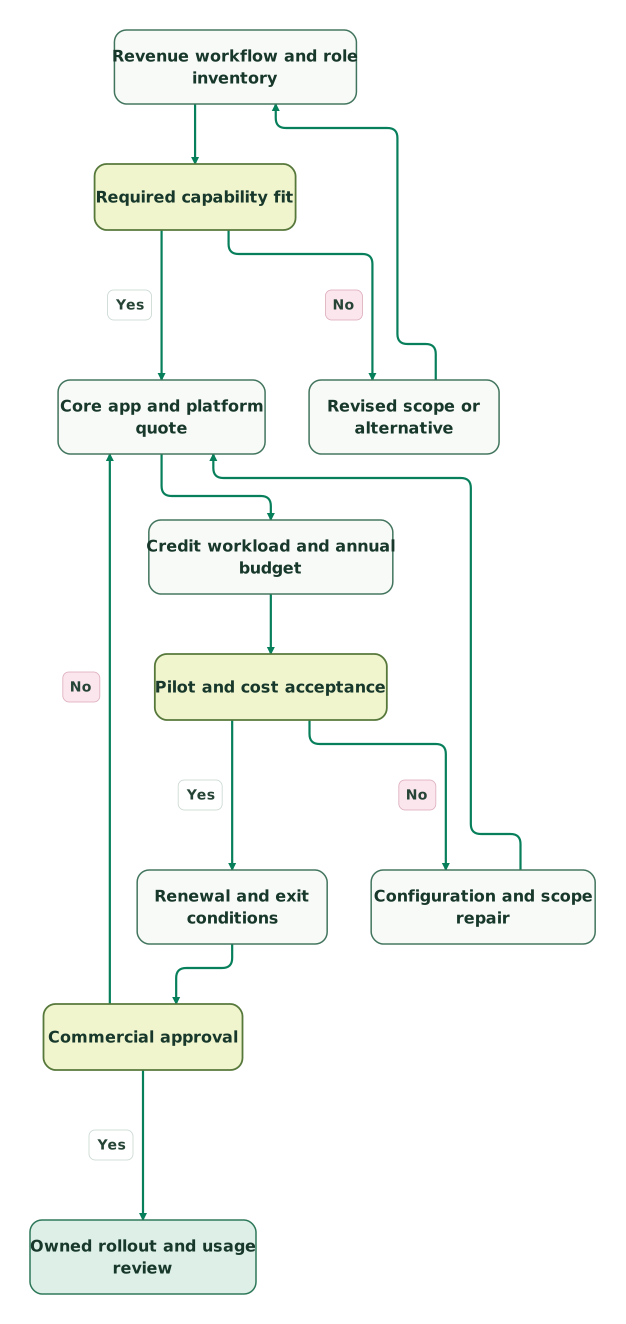
Read diagram as text
- Revenue workflow and role inventory to Required capability fit.
- Required capability fit to Revised scope or alternative: No.
- Revised scope or alternative to Revenue workflow and role inventory.
- Required capability fit to Core app and platform quote: Yes.
- Core app and platform quote to Credit workload and annual budget.
- Credit workload and annual budget to Pilot and cost acceptance.
- Pilot and cost acceptance to Configuration and scope repair: No.
- Configuration and scope repair to Core app and platform quote.
- Pilot and cost acceptance to Renewal and exit conditions: Yes.
- Renewal and exit conditions to Commercial approval.
- Commercial approval to Core app and platform quote: No.
- Commercial approval to Owned rollout and usage review: Yes
Checklist
- Required roles map to core seats, applications and limited collaboration.
- The quote names platform fees and their user bands.
- Monthly equivalents are separated from the actual payment schedule.
- Credit estimates include background work, API requests and historical processing.
- Credit expiry, bundle sizes and depletion behavior are recorded.
- Ordinary users complete the accepted workflow in the proposed configuration.
- Renewal notice, repricing and reduction conditions are in the commercial review.
- CRM mappings, access, exports and a continuing owner are part of delivery.
Use the CRM audit skill to map the process and data dependencies. Our Salesforce implementation checklist provides useful acceptance discipline for a connected CRM. Request a CRM and revenue-workflow scope when integration, permissions and adoption need delivery beyond the licence purchase.
Keep reading
Browse all CRM & Lifecycle guides
 CRM & Lifecycle
Salesforce Implementation Checklist: From Scope to a Working Release
Plan a Salesforce rollout with owners, migration rehearsals, permissions, integration tests, UAT, cutover and recovery gates before approving the release.
Jafrin Akter AloLast updated 14 min read
 CRM & Lifecycle
Salesforce pricing: cost per user for every edition and the full bill
Salesforce lists $0 to $550 per user per month. See what Starter, Pro, Core, Advanced and Max include, plus add-ons, renewal terms and worked budgets.
Jafrin Akter AloLast updated 16 min read
 CRM & Lifecycle
HubSpot Pricing: Seat Prices, Marketing Contacts, Credits and Onboarding
HubSpot is free for 2 users. Starter seats list at $20 and Professional at $50–$100. Add tiered marketing contacts and $1,500–$7,000 onboarding.
Jafrin Akter AloLast updated 26 min read
CRM & marketing automation
See the implementation scope, deliverables and acceptance checks.
Questions people ask
Can a Gong Collaborator replace every paid seller seat?
A Collaborator provides limited access, so it should be evaluated against the person's actual work. It does not establish entitlement to every paid recording, application or AI capability. List the required tasks for each role and test them before removing a paid seat from the proposed scope. Keep access changes separate from the contractual process for reducing purchased quantities. Seat guidance.
Does a Gong application seat add another annual credit allocation?
Gong's credit FAQ says application seats do not receive their own per-seat allocation. The account's included allocation is tied to core licences, and eligible activity draws on the shared balance. Price additional application access and additional credit requirements separately so the purchase model does not assume that every paid product line also expands the pool. Allocation rules.
Can Gong show an old result after credit-based processing stops?
Yes. Existing data remains available when eligible processing stops, so availability alone does not prove freshness. Give important downstream workflows a data-age check and a response owner. During a pilot, confirm the account's depletion and recovery behavior, including any restart steps needed after replenishment, before relying on automated analysis for a recurring revenue decision.
Is a quoted monthly equivalent the amount Gong will invoice monthly?
A monthly equivalent is the annual amount divided by twelve. It does not establish the payment schedule or cancellation rights. Read the order for billing timing, term and committed quantities, then show both cash payments and monthly economics in the budget. This avoids treating a manageable monthly comparison as evidence that the business can exit the commitment each month.
Does a lower Gong seat count guarantee a cheaper renewal?
A smaller seat count can change the unit price and platform fee offered at renewal. Gong's standard terms allow repricing when subscription volume or term length decreases, subject to the order. Compare the complete proposed commitment with the existing one, including applications and credits, before describing a reduction in access as a confirmed financial saving. Renewal conditions.
Sources

Written by
Jafrin Akter AloData Engineer and Co-founder at Martechdevs and Growth and Analytics Partners
Jafrin writes practical guides to marketing technology, customer data, analytics and AI workflows. Martechdevs is a Growth and Analytics Partners company.