
Data Warehouse vs Data Lake: Reporting, Storage and Operating Ownership
A data warehouse emphasizes maintained analytical models and business reporting; a data lake provides a broader storage foundation for data in different forms and stages of preparation. A data warehouse vs data lake decision should start with the required workload, users and accepted output. Modern platforms can combine both roles, so evaluate the complete design rather than assuming that one category has exclusive access to SQL or raw data.
On this page
Data warehouse and data lake comparison
These are common operating roles, with capabilities depending on the actual storage, table format and query engine.
| Criterion | Warehouse-oriented design | Lake-oriented design | Required decision |
|---|---|---|---|
| Main emphasis | Maintained analytical tables and business queries | Flexible retained data with selected processing engines | The first useful workload |
| Reader experience | Curated models and defined measures | Access through catalogs, tables, files or processing jobs | The approved interface for each user |
| Data preparation | Business-facing structure is central | Raw and prepared layers can coexist | Quality and ownership of each layer |
| SQL access | Common analytical interface | Available through suitable engines and table formats | Actual engine and supported operations |
| Operating scope | Ingestion, models, access and query capacity | Storage, catalog, formats, engines and models | Complete responsibility and cost |
AWS's comparison introduces warehouses, lakes and marts. Treat its category descriptions as a starting point: modern product capabilities overlap, and a useful proposal needs the actual components and responsibilities.
We would begin with the first report, analysis or application that must consume the data. A finance or marketing team needing reconciled metrics has different immediate requirements from an engineering team retaining varied source files for several future processing jobs.
At Martechdevs, data warehouse implementation connects source retention to accepted analytical results. We define who can use each layer and how the business numbers are checked before treating a storage decision as a completed data platform.
Storage and the analytical product
Storage preserves bytes. A usable analytical product also needs identity, schema, quality rules, access, documentation and a maintained query route. Copying source files into a bucket completes only part of that work.
A warehouse-oriented design often presents curated tables and measures as the main consumer interface. The business owner can ask for revenue by period or campaign performance without deciding which raw file version to read.
A lake-oriented design can retain source-like files and support different processing tools. That flexibility is useful when formats and workloads vary, but it creates responsibility for discovery, table definitions, quality and the way readers interpret the data.
Neither design removes the need for models. A raw order payload and an accepted order fact represent different quality states, even if they live in the same platform. The data warehouse examples guide shows the grain and aggregation work behind a business-facing table.
Structured data, JSON and SQL
Avoid the claim that a lake is only for unstructured data while a warehouse can accept only fixed relational tables. Structured files can live in a lake, and analytical warehouse products can support semi-structured values.
BigQuery, for example, has a JSON data type for semi-structured data without requiring a fixed STRUCT schema for every value. That does not eliminate the need to validate the fields used by a business model. It does show why a universal no-JSON warehouse rule is inaccurate. See BigQuery JSON support.
SQL is also not exclusive to a warehouse. Amazon Athena can query data in Amazon S3 using SQL. A useful lake design still needs a supported file or table arrangement and the appropriate metadata and access configuration. See Athena's query role.
Choose the interface from the consumer's task. A data engineer may need raw files and processing APIs, while an analyst needs a stable table with accepted dimensions and measures. Giving both users the same unrestricted storage location is not a substitute for designing those interfaces.
Table formats, catalogs and lakehouse designs
An object store, a table format, a catalog and a query engine are different components. The object store holds data files. The table format describes table organization and metadata. The catalog helps engines discover the table, and the engine executes the workload.
Apache Iceberg is an open table format used with engines such as Spark, Trino and Flink. Its documentation describes table behavior including schema evolution and version rollback. Iceberg is not itself a complete hosted warehouse or a business metric definition. See Apache Iceberg.
Lakehouse designs combine lake-style storage with maintained table and analytical capabilities. The label still requires a concrete architecture: which engine writes, which engine reads, how metadata is maintained and what consistency and access behavior those operations provide.
Databricks' medallion guidance illustrates raw, validated and business-facing layers within a lakehouse. Its bronze, silver and gold labels communicate data quality and purpose. Other designs can use different names while preserving the same need for accepted downstream models. See medallion layers.
Do not assume every engine supports every table operation in the same way. Qualify schema changes, updates, deletes and historical reads for the actual version and catalog arrangement before relying on them in a production process.
A synthetic raw-to-curated example
Assume a source delivers three JSON files. Two contain identical copies of accepted order O1 for USD 50; the third contains accepted order O2 for USD 100. This example treats the repeated O1 payload as a delivery duplicate, not a later order update.
| Source file | Order reference | Amount, USD | Intended treatment |
|---|---|---|---|
| receipt-1.json | O1 | $50 | Accepted order |
| receipt-1-retry.json | O1 | $50 | Identical retry retained as source evidence |
| receipt-2.json | O2 | $100 | Another accepted order |
The raw layer has three files and three delivered records. The curated order model has two business orders totaling USD 150. Adding every delivered amount would produce USD 200, which includes the retry twice.
This is a proposed model, not a behavior guaranteed by a lake or warehouse. Either architecture needs a stable order reference and an explicit duplicate policy to produce the accepted result. File storage and SQL query capability alone cannot determine which occurrence is a retry.
| Layer or measure | Expected result | Evidence |
|---|---|---|
| Retained source files | 3 | Every delivery traceable |
| Distinct accepted orders | 2 | O1 and O2 preserved |
| Curated amount | USD 150 | USD 50 plus USD 100 |
| Naive delivery sum | USD 200 | Demonstrated duplicate-count error |
If a later O1 payload changes the amount, the system needs an update or version rule. It should not discard every repeated order identifier as if all repetitions were identical retries. Keep that distinction with the source contract and the model.
The ETL pipeline guide demonstrates keyed loading and recoverable progress. The ETL versus ELT guide explains where transformation can occur relative to the selected destination.
Reporting requirements and reader access
A reporting team needs stable business definitions and predictable access to accepted data. It should not have to discover which source file is authoritative every time it builds a chart.
Define the curated model's grain, included population, time basis and measures. For the order example, state whether the amount includes tax, returns, discounts and currency conversion. A change to those rules can alter the report even when the storage technology remains unchanged.
Control raw and curated access separately where the organization requires it. A report can expose an aggregate without exposing every source field. Test the actual reader against the approved interface and underlying data permissions, rather than assuming a friendly dashboard hides all alternate access paths.
The marketing data quality guide supports the reconciliation work. Keep a known sample with the report definition so a future engine, schema or pipeline change can verify the same business result.
Exploration and future reuse
A lake can be useful when several workloads need the same retained source material in different forms. An engineering team may process logs, documents and application records with different tools, while the business consumes a curated subset.
Retain data because a defined purpose and policy justify it, rather than because storage appears inexpensive. Unowned files still require cataloging, access decisions, lifecycle management and an explanation of their source and quality.
Warehouse products can also retain source-like tables or semi-structured fields. The relevant comparison is the actual retention and processing design, not an assumption that raw history is impossible in one category.
Distinguish exploration from accepted reporting. An exploratory query can help discover a useful definition, but a recurring business metric needs an owner, stable rules and a change process. A notebook result should not become an unexplained reporting dependency merely because it ran successfully once.
Complete cost and workload ownership
Compare the same output, history and freshness requirement in both designs. Storage price alone leaves out the work needed to turn files into useful analytical results.
| Cost area | Warehouse-oriented questions | Lake-oriented questions |
|---|---|---|
| Storage and retention | Raw, curated and historical copies | Files, table versions and retention policy |
| Processing | Loading, models and analytical queries | Ingestion, preparation and selected query engines |
| Metadata | Schemas and catalog administration | Catalog, format and table-metadata maintenance |
| Movement | Source retrieval and cross-system transfer | Source retrieval and cross-engine or regional transfer |
| Operations | Models, access, capacity and incident response | Storage, catalog, engines, models and incident response |
Do not turn a low-cost storage line into a claim that the complete lake is cheaper. Similarly, do not assume a warehouse quote includes source connectors, modeling or every surrounding service. Use the actual workload and the responsibilities the team must maintain.
The data warehouse cost guide and software pricing tool help organize those lines. Keep vendor rates separate from clearly labeled internal monthly operating allowances.
Best fit by immediate requirement
| Requirement | Useful starting point | Main qualification |
|---|---|---|
| Recurring business reports from several known sources | Warehouse-oriented curated models | Agreed metrics, source quality and reader access |
| Varied files supporting several engineering workloads | Governed lake with qualified engines | Catalog, retention and processing ownership |
| Shared open tables used by several compatible engines | Table-format and catalog evaluation | Supported operations and consistency boundaries |
| Raw retention and curated reporting in one environment | A combined or lakehouse design | Clear layer responsibilities and complete cost |
| Small workload already served reliably by existing systems | Retained setup with bounded improvement | A new platform must solve a demonstrated constraint |
These are evaluation routes rather than guarantees about a product family. Test the actual users, queries and failure cases before choosing the final configuration.
Migration and acceptance sequence
- Define the first consumer workload and its accepted output.
- Inventory source formats, identities, update behavior and required history.
- Identify raw, validated and business-facing data responsibilities.
- Select the storage, table, catalog and engine components required by that design.
- Load a small sample with ordinary, repeated and changed records.
- Reconcile keys, values and query results through the intended reader interface.
- Test access, schema change, recovery and historical replay where required.
- Approve the complete operating scope before expanding sources or readers.
Preserve the reason for each component. A second engine can be useful for a distinct workload, but it also adds compatibility and ownership questions. A simpler design that meets the accepted requirements can be easier to explain and maintain.
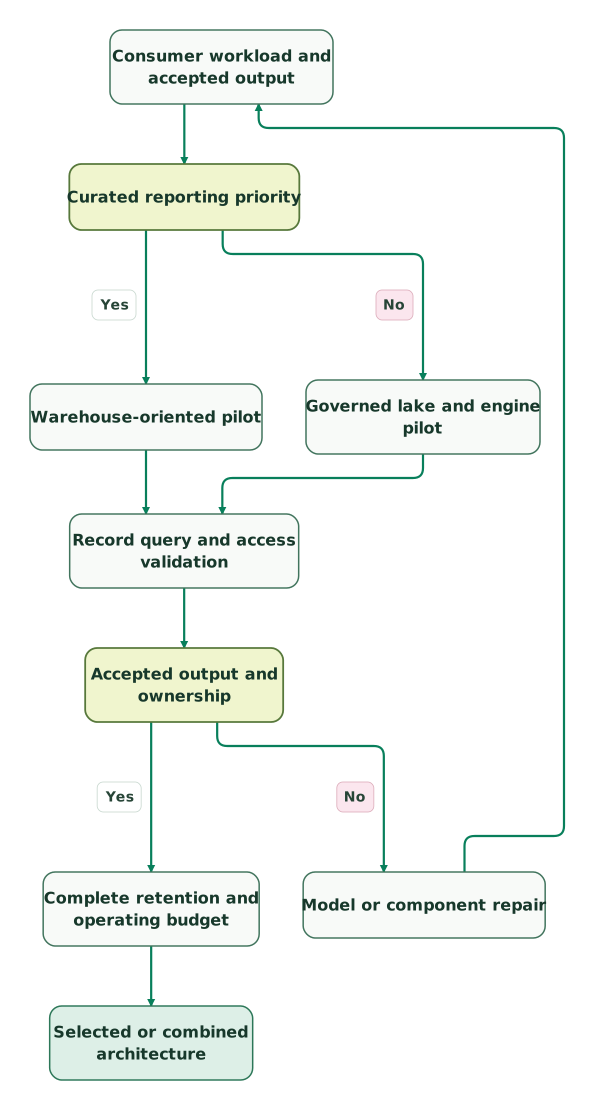
Warehouse and lake selection workflow
Read diagram as text
- Consumer workload and accepted output to Curated reporting priority.
- Curated reporting priority to Warehouse-oriented pilot: Yes.
- Curated reporting priority to Governed lake and engine pilot: No.
- Warehouse-oriented pilot to Record query and access validation.
- Governed lake and engine pilot to Record query and access validation.
- Record query and access validation to Accepted output and ownership.
- Accepted output and ownership to Model or component repair: No.
- Model or component repair to Consumer workload and accepted output.
- Accepted output and ownership to Complete retention and operating budget: Yes.
- Complete retention and operating budget to Selected or combined architecture
Data warehouse and lake checklist
- A first consumer workload and known accepted result.
- Source formats, business identifiers and update requirements.
- Clear raw, validated and business-facing quality states.
- A maintained catalog and intended query interface.
- Qualified table-format and engine operations where applicable.
- Explicit retention, access and data-movement requirements.
- Duplicate, update, schema-change and recovery fixtures.
- Reconciled business models rather than storage counts alone.
- Complete processing, storage and operating costs.
- Named owners for each component and the final analytical output.
Use the marketing data audit skill to keep those decisions and checks together. The warehouse and database comparison covers the related question of operational transactions versus analytical workloads.
Keep reading
Browse all Data Warehouse guides
 Data Warehouse
Data warehouse design for a small company: layers, models and rules that prevent rework
Design a marketing warehouse around clear record grain, identity and history. Includes model examples, metric definitions and a first-project checklist.
Jafrin Akter AloLast updated 11 min read
 Data Warehouse
Marketing Data Quality: How to Monitor, Alert and Fix What Breaks Over Time
Marketing data quality slips after launch. See what breaks, which checks catch it, how to route alerts to owners and repair data safely, with a checklist.
Jafrin Akter AloLast updated 16 min read
 Data Warehouse
 Cost for a Small Company: Platform, Pipelines, People and Activation
Estimate what a data warehouse costs a small company each month: storage, compute, connectors, dbt, BI, activation and upkeep, with a worked example.
Jafrin Akter AloLast updated 18 min read
Data warehouse & CDP
See the implementation scope, deliverables and acceptance checks.
Questions people ask
Does a data lake require analysts to avoid SQL?
A data lake does not require analysts to avoid SQL. Services such as Amazon Athena query data in object storage through SQL, and open table formats can work with several analytical engines. The design still needs suitable metadata, file or table structures and access controls. Qualify the actual query path instead of treating SQL as exclusive to warehouses. See Athena.
Can a data warehouse contain semi-structured JSON?
A data warehouse product can contain semi-structured JSON when it supports that capability. BigQuery provides a JSON data type and field-level querying without a fixed STRUCT schema for every value. Business-facing models still need accepted types, identities and interpretation. The capability removes a rigid category distinction; it does not remove modeling work. See BigQuery JSON.
Is Apache Iceberg itself a complete hosted data warehouse?
Apache Iceberg is a table format rather than a complete hosted warehouse. It provides table behavior used by compatible engines, while a working platform also needs storage, catalog configuration, processing, permissions and maintained business models. Evaluate those components together before calling a table-format choice a complete architecture. See Apache Iceberg's introduction.
Does retaining three source files mean the business has three orders?
Retaining three source files does not establish three distinct business orders. Files can contain retries, updates or overlapping extracts. Define the business identifier and version or duplicate rule, then reconcile the curated records against the source evidence. Storage counts, delivered-record counts and accepted-order counts describe different units and should remain separate in monitoring and reporting.
Does a lakehouse label eliminate the need for raw-to-curated validation?
A lakehouse label does not eliminate raw-to-curated validation. The platform still needs accepted keys, types, business definitions and access boundaries as data moves into reporting models. A named layer or supported table format is useful structure, but the expected records and totals must pass checks. Keep the model owner and recovery process explicit as the architecture expands.
Sources

Written by
Jafrin Akter AloData Engineer and Co-founder at Martechdevs and Growth and Analytics Partners
Jafrin writes practical guides to marketing technology, customer data, analytics and AI workflows. Martechdevs is a Growth and Analytics Partners company.