
ETL vs ELT: Transformation Location, Data Access and Recovery
ETL transforms data before loading the intended analytical destination; ELT loads data first and transforms it there. An ETL vs ELT decision depends on the accepted data boundary, processing environment and ownership of business models. Both approaches need validation, recoverable progress and reliable outputs. The order of three letters does not by itself establish that a pipeline is cheaper, faster or easier to maintain.
On this page
ETL and ELT comparison
The distinction concerns where the main transformation happens relative to the selected destination.
| Criterion | ETL | ELT | Decision consequence |
|---|---|---|---|
| Main sequence | Extract, transform, load | Extract, load, transform | Locate the accepted transformation boundary |
| Processing location | An upstream processing environment | The loaded data platform | Match compute and skills to the work |
| Initial destination content | Data after the defined transformation | Source-like data in a landing layer | Define access and interpretation before use |
| Model changes | Replay retained input or re-extract as designed | Reprocess retained destination input as designed | Retention and source history determine recovery |
| Operating risk | Transformation failure can delay loading | Raw landing can succeed before business models are ready | Monitor the complete accepted output |
AWS's comparison describes this order difference. The right implementation can also contain both patterns: some fields may be filtered before loading, while later analytical models are built inside the destination.
We would begin with the output a business team needs and the data it is permitted to use. Then identify which transformations must occur before a particular storage boundary and which can be maintained in the analytical platform.
At Martechdevs, data warehouse implementation makes those boundaries explicit. We define the source, landing data, business model and acceptance checks before deciding where each processing step should run.
Transformation location and the real boundary
ETL commonly uses an upstream process to change source records into a target structure. That process can normalize types, combine sources, calculate fields or remove information that the analytical destination should not receive. The target consumes the transformed output.
ELT separates loading from the later business transformation. A restricted landing area can retain the source-like records, while models turn those records into validated and useful datasets. Successful ingestion is therefore an intermediate state, not proof that the business report is ready.
For example, dbt SQL models are defined as select statements and are built in the connected data platform as tables or views. That is a concrete example of transformation after data is available in the destination. See dbt SQL models.
The label depends on the boundary being discussed. An upstream service can transform an API response before loading a warehouse, and the warehouse can then run additional models. Describe those stages directly rather than arguing that the whole architecture must have only one label.
The ETL pipeline guide provides a runnable example of keyed loading and recovery. The same questions about accepted records and progress apply when the transformation is moved into the warehouse.
Input contracts and business definitions
Both approaches need a source contract. Specify the business key, event or update time, field types, units, required history and deletion behavior. A destination cannot recover a field that the source never supplied, regardless of the transformation order.
Separate structural validation from business interpretation. A record can be valid JSON and still have an impossible amount, an unknown currency or a customer identifier that maps to the wrong account. A successfully loaded table can contain the wrong business population.
Write the model's grain before implementing joins. An order, order line, payment and customer are different units. Transforming outside a warehouse does not prevent relationship multiplication, and transforming inside one does not automatically choose the correct aggregation.
The data warehouse design guide covers the broader modeling process. Keep the ETL/ELT choice focused on where that agreed logic is executed and maintained.
A synthetic transformation-location example
Consider three hypothetical source orders. Each declares USD as its currency, but the third uses a currency symbol in the amount string. The first approved parser accepts only numeric strings with two decimal places. This example uses a row-level quarantine policy so valid records can form a clearly labeled partial result.
| Source order | Amount string | Currency | Initial transformation result |
|---|---|---|---|
| A | 12.00 | USD | 1,200 cents accepted |
| B | 8.00 | USD | 800 cents accepted |
| C | $5.00 | USD | Quarantined under the numeric-only rule |
The accepted total is USD 20 from two orders, with one quarantined record. The raw input contains three records. A report should not imply that the accepted subset is the complete source population unless the business has explicitly accepted that limitation.
In the ETL version, an upstream processor applies the rule and loads the two accepted orders into the curated destination. For this illustration, the original input and rejected row are retained in a separate controlled archive outside that destination.
In the ELT version, the three source-like rows first land in a restricted raw area of the analytical platform. A model then produces the same two accepted orders and a quarantine result. The curated outcome is identical; the location of the retained input and transformation differs.
| Synthetic result | ETL design in this example | ELT design in this example | Interpretation |
|---|---|---|---|
| Retained source records | 3 in upstream archive | 3 in platform landing area | Replay input preserved deliberately |
| Accepted curated orders | 2 | 2 | Same initial business rule |
| Quarantined orders | 1 | 1 | Same unsupported representation |
| Accepted amount | USD 20 | USD 20 | Neither order changes the arithmetic |
Now approve a new rule that permits one leading dollar sign when the separate currency field is USD. Reprocessing the retained input yields three accepted orders totaling USD 25 in either design. The additional USD 5 comes from the changed transformation rule and accepted record, not a newly created sale.
This is a hypothetical rule change, not a universal recommendation to strip symbols from monetary fields. Currency, separators, precision and source meaning need their own contract. The fixture demonstrates that replay depends on retained input and versioned rules in both approaches.
Raw, validated and business-facing data
Raw data is not automatically suitable for a dashboard. A landing table can preserve unexpected types, repeated deliveries or records that have not yet passed identity checks. Give readers a clearly defined curated layer for the decision they need to make.
Databricks' medallion guidance illustrates raw, validated and business-oriented layers through bronze, silver and gold. Its bronze layer retains source-like data, while later layers apply validation, cleaning and modeling. This is a documented design pattern, not a requirement that every project adopt those exact names. See medallion architecture.
Record where a rejected value lives and who may inspect it. A business user should not have to guess whether a table contains accepted customer facts or merely everything received from a source. The same separation is useful in an ETL design with an upstream archive.
Avoid overwriting retained input casually when a model changes. Preserve enough source and rule history to explain why a report changed, within the organization's approved retention design. Unlimited retention is not a prerequisite for either pattern.
Access boundaries and data minimization
If a field must not enter a particular platform, remove or transform it before that boundary. Loading it first and hiding it only in a downstream view does not satisfy a requirement that the platform never receive it.
If source-like data is allowed in a restricted landing area, define who can access it and which downstream models may use it. Raw and curated access should reflect their different purposes. A business reader may need an aggregate without needing every source attribute.
These are architecture decisions to implement against the organization's actual requirements. Neither ETL nor ELT is a blanket compliance label. Collection purpose, permissions, retention, identifiers and destination behavior remain responsibilities of the complete system.
Test the intended reader and an inappropriate access case. A model that removes a sensitive column from one report is insufficient evidence if the same reader can query the raw landing table directly.
Model development and change ownership
Choose a transformation environment the team can maintain. Upstream code can fit a process with established application engineering and a narrow output contract. Warehouse SQL can fit a team that already maintains analytical models and their dependencies.
The useful comparison is the actual change workflow. Ask a second maintainer to update a definition, run the relevant checks, inspect the output and explain the recovery plan. The software language alone does not establish maintainability.
dbt's documentation makes its execution boundary explicit: SQL models run in the connected warehouse using that database's dialect. A model error can stop dependent work, so the operating process still needs error investigation and accepted downstream output. See dbt model execution.
Keep a model owner and a source owner. A new API field, changed data type or source deletion can affect a warehouse model even if no analyst edits the SQL. Conversely, a revised business rule can change reports without any new source records arriving.
Incremental processing, updates and deletions
ETL and ELT can both process full loads or incremental changes. Transformation order does not determine whether a pipeline captures updates or deletes. Those capabilities depend on the source mechanism, connector and destination design.
Microsoft distinguishes watermark-based incremental loading from database change tracking that identifies inserts, updates and deletes. A last-updated timestamp and an incrementing key are possible watermarks, but they do not have identical semantics. See incremental-load mechanisms.
For either approach, verify a new record, an older record that changes, a repeated batch and a deletion where required. Confirm whether the target retains history or current state. A correct initial load cannot establish those later behaviors.
Backfills need their own acceptance conditions. Rebuilding a curated table from retained raw records can be convenient, but it still needs a known interval, rule version and protection against overwriting newer state incorrectly. An upstream ETL archive can also support replay if the original design retained suitable input.
Cost and workload comparison
Compare costs for the same accepted output, history and freshness target. An ETL estimate that omits its transformation runtime is incomplete. An ELT estimate that omits warehouse processing, retained raw storage or repeated model rebuilds is equally incomplete.
| Cost area | ETL questions | ELT questions | Evidence for the budget |
|---|---|---|---|
| Source retrieval | Full or incremental extraction | Full or incremental extraction | Measured source changes and requests |
| Transformation | Upstream runtime and retries | Destination compute and model rebuilds | Representative processing workload |
| Retention | Staging and archive policy | Raw and curated storage policy | Required history and retention period |
| Data movement | Transfer into the analytical destination | Transfer into landing storage | Region and source/destination arrangement |
| Operations | Code, schema and recovery ownership | Model, warehouse and recovery ownership | Named continuing responsibilities |
A larger raw landing area may support several later models, but that reuse needs an actual requirement. Loading every available field without an owner can increase storage and governance work without improving a business decision.
Use the software pricing tool to keep qualified services and usage lines visible. The ETL tools guide compares software choices after the source and transformation boundaries are established.
Best fit by operating requirement
| Requirement | Useful starting design | Main qualification |
|---|---|---|
| A field cannot enter the analytical platform | Upstream transformation before that boundary | Verify the source payload and permitted output |
| Several analytical models reuse retained source data | ELT with a governed landing area | Fund model ownership, processing and retention |
| Existing upstream code reliably supplies a narrow model | Retained ETL with explicit contracts | Confirm replay and future changes remain maintainable |
| A mature warehouse team maintains shared SQL models | Destination transformation | Preserve dependencies, tests and accepted business meaning |
| Some fields need preprocessing and others need later modeling | A combined design | Name each boundary rather than forcing one label |
These are starting points for evaluation, not universal product rankings. The strongest evidence is a representative change and recovery test performed by the team that will operate the design.
ETL and ELT decision workflow
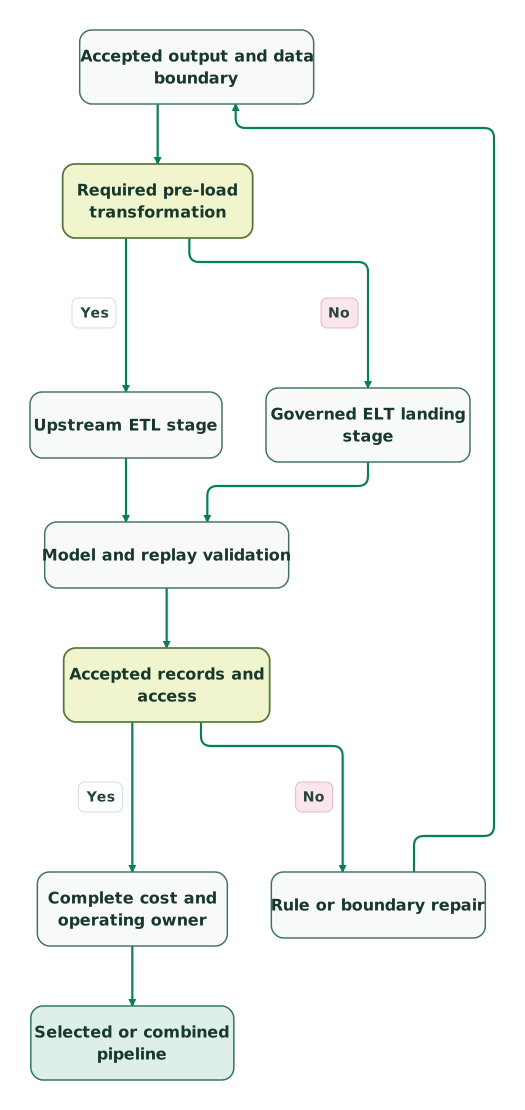
Read diagram as text
- Accepted output and data boundary to Required pre-load transformation.
- Required pre-load transformation to Upstream ETL stage: Yes.
- Required pre-load transformation to Governed ELT landing stage: No.
- Upstream ETL stage to Model and replay validation.
- Governed ELT landing stage to Model and replay validation.
- Model and replay validation to Accepted records and access.
- Accepted records and access to Rule or boundary repair: No.
- Rule or boundary repair to Accepted output and data boundary.
- Accepted records and access to Complete cost and operating owner: Yes.
- Complete cost and operating owner to Selected or combined pipeline
ETL and ELT checklist
- A named analytical destination and transformation boundary.
- Source keys, units, history and update/delete requirements.
- An approved rule for rejected and incomplete records.
- Clear separation of raw, validated and business-facing data.
- Explicit access and retention requirements at each boundary.
- A maintained transformation rule version and business definition.
- Suitable retained input or a qualified re-extraction route.
- Insert, update, retry, deletion and backfill acceptance cases.
- Complete processing, storage, movement and operating costs.
- A second maintainer able to explain and repair the workflow.
The marketing data audit skill helps organize the source and acceptance evidence. Preserve the fixture with the model so later changes can repeat the same meaningful checks.
Keep reading
Browse all Data Warehouse guides
 Data Warehouse
Data warehouse design for a small company: layers, models and rules that prevent rework
Design a marketing warehouse around clear record grain, identity and history. Includes model examples, metric definitions and a first-project checklist.
Jafrin Akter AloLast updated 11 min read
 Data Warehouse
Schema Drift in Marketing Pipelines: 7 Changes to Detect
Detect seven forms of schema drift in marketing pipelines. Compare contracts and alerts, catch new CRM values and repair reports without losing records.
Jafrin Akter AloLast updated 12 min read
 Data Warehouse
How to Set a Useful Marketing Data Freshness SLA
Set a marketing data freshness agreement around real decisions. Define cutoffs, coverage, deadlines, alerts and recovery, with a runnable readiness fixture.
Jafrin Akter AloLast updated 14 min read
Data warehouse & CDP
See the implementation scope, deliverables and acceptance checks.
Questions people ask
Does ELT remove the need to validate source data before business reporting?
ELT does not remove the need to validate source data before business reporting. It changes where the main transformation occurs. A raw landing table can contain repeated, incomplete or incorrectly typed records, so the curated output still needs accepted rules and reconciliation. Make the quality state of each dataset visible rather than treating successful ingestion as a completed analytical result.
Can an ETL design retain raw input for later replay?
An ETL design can retain raw input for later replay when its architecture includes an appropriate archive or staging area. Retention is a separate design choice from transformation order. Document the location, permissions, history and rule versions required for a replay. If suitable input was not retained, recovery may depend on what the original source can still provide.
Does transforming data inside a warehouse make every model a full rebuild?
Transforming data inside a warehouse does not make every model a full rebuild. The materialization and incremental strategy determine how work is processed. Qualify updates, late records and deletion behavior for the actual model, then test a repeated run and historical correction. The ETL or ELT label alone does not establish the amount of processing or the completeness of change capture.
Can hiding a column in an ELT reporting view satisfy a no-ingestion requirement?
Hiding a column in a reporting view does not satisfy a requirement that the analytical platform never receive that field. The data has already crossed the boundary if it exists in the landing area. Apply the necessary removal or transformation before that boundary, and verify the source and destination payloads. Access restrictions and data-minimization requirements are related but different controls.
Is a combined ETL and ELT architecture an inconsistent design?
A combined ETL and ELT architecture is not inherently inconsistent. Some information may need preprocessing before loading, while later business models are maintained in the destination. Name the responsibility and acceptance condition of each stage so the team can explain the full path. A useful design serves the data boundary, business output and operating team rather than one category label.
Sources

Written by
Jafrin Akter AloData Engineer and Co-founder at Martechdevs and Growth and Analytics Partners
Jafrin writes practical guides to marketing technology, customer data, analytics and AI workflows. Martechdevs is a Growth and Analytics Partners company.