
Data Warehouse vs Database: Operational Work, History and Reporting
A database is a broad category, while a data warehouse is an analytical environment built around maintained data and reporting workloads. The useful data warehouse vs database comparison usually means a warehouse versus an operational database. Choose from the application's transaction needs, analytical history and query workload. Both roles can coexist, and modern products can support capabilities beyond their traditional category.
On this page
Data warehouse and operational database comparison
The table describes workload priorities rather than absolute limits on what every product can do.
| Criterion | Operational database role | Data warehouse role | Acceptance priority |
|---|---|---|---|
| Main job | Maintain application state and transactions | Support analytical models and business queries | The workload that must succeed |
| Typical question | Current order, account or inventory state | Trends, cohorts and reconciled measures | Correct population and time meaning |
| Query pattern | Frequent bounded reads and writes | Broader joins, scans and aggregations | Representative performance and concurrency |
| History | Whatever the application explicitly retains | History needed by analytical definitions | Actual source and retention design |
| Ownership | Application and database operations | Data engineering and analytics | Clear source-of-truth and recovery roles |
AWS's OLTP and OLAP comparison distinguishes transaction processing from analytical work. Use those purposes to frame the decision, without assuming that warehouses cannot update rows or that operational databases cannot run reports.
We would identify the job that is failing first. A slow management report, a missing historical attribute and an application transaction that needs stronger consistency are different problems. They do not all justify the same new platform.
At Martechdevs, data warehouse implementation connects operational sources to accepted analytical outputs. We preserve the business identifiers, history and reconciliation needed for reporting while keeping the application owner responsible for its operational state.
Operational transactions and analytical questions
An operational transaction changes business state: an order is accepted, a stock quantity is reserved or a customer record is updated. The application needs the relevant operations to behave correctly under concurrent use and failure.
An analytical question examines a defined population: sales by month, customer retention or the relationship between campaign spend and accepted orders. It often needs several sources, historical values and repeated aggregations that differ from the application's immediate working screen.
The same data can support both jobs. An order's current state helps customer service act, while its history helps an analyst measure fulfillment. The analytical model should preserve the required meaning rather than treating every change record as another order.
The data warehouse examples guide shows transaction facts, snapshots and ratio aggregation. Those model choices remain necessary even when the query engine can read the source database directly.
Transaction support across platform categories
Operational database products commonly provide transaction and concurrency controls. PostgreSQL, for example, documents multiversion concurrency control, which gives statements a consistent snapshot under its transaction model. Its precise isolation and locking behavior belongs to the selected configuration. See PostgreSQL concurrency.
Analytical products can also support transactions. BigQuery documents multi-statement transactions that atomically commit or roll back supported changes across tables, with snapshot isolation and defined scope limits. That capability makes a universal warehouses-cannot-update claim incorrect. See BigQuery transactions.
Capability is different from workload fit. A platform supporting a transaction does not automatically make it the best choice for a latency-sensitive application path. Likewise, a database supporting an aggregate query does not establish that it can run the whole reporting workload alongside production traffic within the required limits.
Define the actual consistency, latency, concurrency and recovery requirements. Then test the selected engine and deployment against them. Avoid choosing from an outdated checklist of features that only one category supposedly possesses.
A current-state and history example
Assume two synthetic orders. Order O1 has a value of USD 100 and progresses from Created to Paid to Shipped. Order O2 has a value of USD 80 and progresses from Created to Paid. The amount remains unchanged across these status events.
| Order | Version | Recorded status | Order amount, USD |
|---|---|---|---|
| O1 | 1 | Created | $100 |
| O1 | 2 | Paid | $100 |
| O1 | 3 | Shipped | $100 |
| O2 | 1 | Created | $80 |
| O2 | 2 | Paid | $80 |
The history contains five records, but the business has two orders. Adding the repeated order amount across every status record gives USD 460. The current-order value at this loaded cutoff is USD 180, with one shipped order and one paid order.
The following self-contained SQLite query selects the latest version of each synthetic order before calculating the current-state result. It is a local modeling example, not a performance comparison between platforms.
WITH history(order_id, version, status, amount_cents) AS (
  VALUES ('O1', 1, 'Created', 10000),
         ('O1', 2, 'Paid', 10000),
         ('O1', 3, 'Shipped', 10000),
         ('O2', 1, 'Created', 8000),
         ('O2', 2, 'Paid', 8000)
), ranked AS (
  SELECT *, ROW_NUMBER() OVER (
    PARTITION BY order_id ORDER BY version DESC
  ) AS position
  FROM history
)
SELECT COUNT(*) AS orders,
       SUM(amount_cents) / 100.0 AS order_value_usd,
       SUM(CASE WHEN status = 'Shipped' THEN 1 ELSE 0 END) AS shipped_orders
FROM ranked
WHERE position = 1;
The result is two orders, USD 180 and one shipped order. The example assumes unique versions within each order and a complete loaded history for the stated cutoff. A production model needs a deterministic rule for ties, corrections, deletions and events that arrive late.
Keeping only current state can answer an operational status question while losing the earlier transitions needed by analytics. Retaining history can answer those transitions while requiring a deliberate current-state model. The database or warehouse label does not choose that policy on the team's behalf.
Historical attributes and source-of-truth boundaries
Decide which questions require historical state. A customer may have a different plan, region or owner today from the one associated with a past purchase. A report can intentionally use current attributes or preserve event-time attributes, but the choice needs to be explicit.
An operational application can retain an audit or event history when designed to do so. A warehouse cannot recreate history that was never captured and is no longer available from the source. Purchasing analytical storage does not repair that missing evidence.
The late-arriving marketing data guide covers corrections and delayed records. The marketing metric contracts guide helps define the time meaning of each measure before the implementation chooses a historical model.
Keep authority clear. The operational system may remain authoritative for accepted orders, while the warehouse owns the maintained analytical representation. A discrepancy should lead to source and model reconciliation rather than an unexplained edit to whichever table makes the dashboard look right.
Reporting on a production database
A small, bounded report can fit an existing operational database. The decision should reflect its query plan, frequency, concurrency and effect on the application's service requirements. A new warehouse is not a universal prerequisite for every business query.
As reporting expands, broad scans and complex joins can compete for resources with application work. This is not the same as claiming that every read query directly locks every write. PostgreSQL's MVCC documentation describes a more specific concurrency model. Measure the actual resource and transaction behavior instead of using a blanket blocking claim. See PostgreSQL concurrency control.
Record the report's accepted response time and freshness separately. A query that runs quickly over yesterday's copy can still fail a use case needing current order status. A fresh query can also fail if it disrupts the application's required work.
When considering separation, include source extraction, analytical transformations, retained history and the reporting interface. Moving a query to another system without maintaining those responsibilities can replace one performance issue with unexplained data differences.
Read replicas and analytical separation
A read replica can move some query execution away from the primary application database. It does not automatically create a warehouse model or eliminate all operating tradeoffs.
PostgreSQL hot-standby documentation describes read-only queries over replicated data, possible delay behind the primary and conflicts that can cancel queries or delay replay. Those details matter when the same standby serves availability and reporting goals. See PostgreSQL hot standby.
A replica usually preserves the source's schema and data meaning. If the analytical requirement needs several business systems, historical dimensions or reconciled metrics, additional modeling and integration may still be necessary.
Evaluate the simplest design that meets the actual workload. A tuned query, an appropriate replica or a separate analytical platform can each be reasonable in a different context. The choice needs measured requirements and an operating owner, not a universal data-volume threshold.
Freshness, change capture and deletions
An analytical copy is useful only when its freshness and completeness fit the decision. Define how new records, changes and deletions move from the source into the model, and which timestamps establish the accepted cutoff.
Microsoft's incremental-loading guidance distinguishes watermark-based copying from change tracking that can identify inserts, updates and deletes. A primary-key increment and a last-updated timestamp do not automatically provide the same historical coverage. See incremental-loading approaches.
Test an older order that changes after its original creation period. Confirm that the analytical result updates under the approved rule and that the change does not create another business order. Include deletion or deactivation behavior where it matters.
The ETL pipeline guide shows a bounded recovery example. For live architecture, retain the source position and accepted destination evidence so an interrupted copy can resume without silently skipping changes.
Complete cost and ongoing work
Compare the complete accepted workload rather than two storage prices. An operational database budget includes application availability and transactional requirements. A warehouse budget includes ingestion, analytical processing, history, modeling and access for its consumers.
| Cost or responsibility | Operational database questions | Warehouse questions |
|---|---|---|
| Availability | Application recovery and continuity | Reporting and analytical recovery targets |
| Processing | Transaction and query concurrency | Loading, transformation and analytical query demand |
| Retention | Current state and required application history | Analytical history and source evidence |
| Integration | Application and connector access | Source movement and change capture |
| Ownership | Database and application operators | Data, model and reporting owners |
Do not assume the warehouse replaces the application database. Many implementations retain the operational source and add an analytical environment, so the budget must include both and the maintained connection between them.
Use the data warehouse cost guide and software pricing tool to organize the qualified services and usage. Any internal operating allowance should be clearly labeled and kept separate from the vendor's metered charges.
Best fit by business workload
| Workload | Useful starting point | Main acceptance test |
|---|---|---|
| Customer-facing order or account changes | Operational database design | Correct transaction behavior under expected concurrency |
| A small bounded report on one application | Existing database or qualified replica | Required performance and freshness without unacceptable application impact |
| Repeated reporting across billing, CRM and product sources | Maintained warehouse model | Reconciled identities, history and business totals |
| Historical cohort or dimension analysis | Explicit historical analytical design | Correct event-time or snapshot interpretation |
| Mixed transactional and analytical platform proposal | Workload-specific evaluation | Actual engine capabilities, limits and operating responsibilities |
The warehouse and data lake comparison covers the storage and query-engine side of the analytical choice. It should follow the workload decision rather than replace it.
Workload evaluation sequence
- Name the application transaction or analytical decision that must succeed.
- Define consistency, response time, freshness and recovery requirements.
- Inventory current-state, historical and cross-system data needs.
- Prepare representative queries and known records with expected outcomes.
- Test the selected configuration under realistic concurrent work.
- Reconcile source and analytical values at an explicit cutoff.
- Verify update, deletion, interruption and replay cases.
- Approve the complete operating scope and responsible owners.
Keep measured results specific to the tested workload. One fast query does not establish every dashboard's performance, and one successful transaction does not prove the required peak concurrency. Preserve the sample, configuration and limits with the decision.
Operational and analytical workload decision
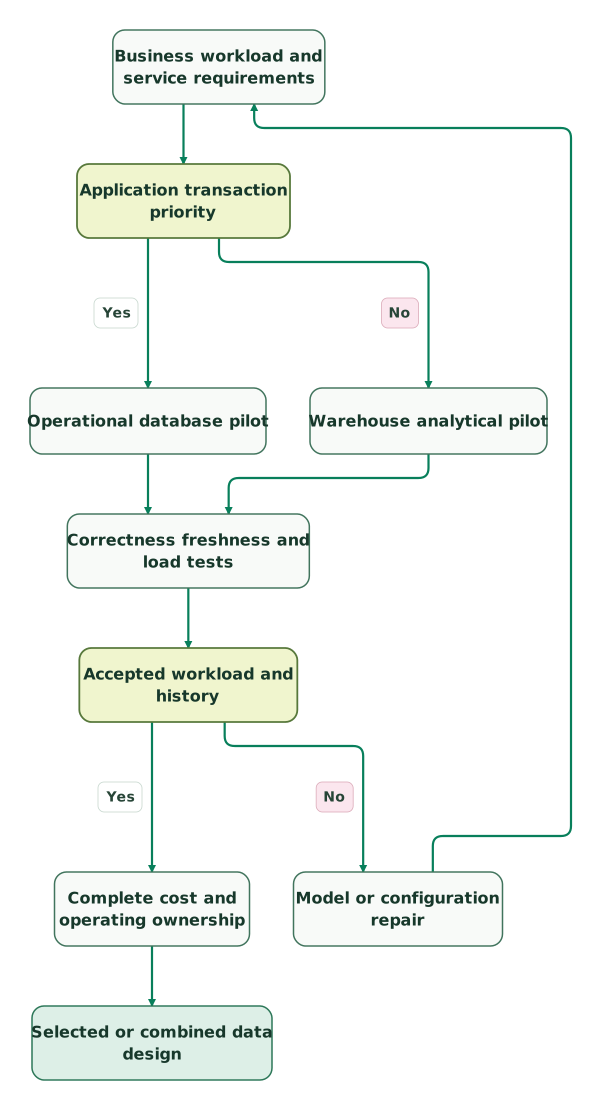
Read diagram as text
- Business workload and service requirements to Application transaction priority.
- Application transaction priority to Operational database pilot: Yes.
- Application transaction priority to Warehouse analytical pilot: No.
- Operational database pilot to Correctness freshness and load tests.
- Warehouse analytical pilot to Correctness freshness and load tests.
- Correctness freshness and load tests to Accepted workload and history.
- Accepted workload and history to Model or configuration repair: No.
- Model or configuration repair to Business workload and service requirements.
- Accepted workload and history to Complete cost and operating ownership: Yes.
- Complete cost and operating ownership to Selected or combined data design
Warehouse and database checklist
- A workload-based distinction rather than mutually exclusive category labels.
- Explicit consistency, response-time and freshness requirements.
- A current-state and historical-data policy.
- Stable source keys and deterministic version rules.
- Known records and totals at an accepted cutoff.
- Actual query and transaction behavior under representative concurrency.
- Qualified replica lag or analytical change-capture behavior.
- Update, deletion, failure and replay acceptance cases.
- Complete source, analytical and integration costs.
- Named application, database, model and reporting owners.
The marketing data audit skill helps retain the source and reconciliation evidence. A useful architecture lets the team explain both the current business state and the historical result it reports.
Keep reading
Browse all Data Warehouse guides
 Data Warehouse
 Cost for a Small Company: Platform, Pipelines, People and Activation
Estimate what a data warehouse costs a small company each month: storage, compute, connectors, dbt, BI, activation and upkeep, with a worked example.
Jafrin Akter AloLast updated 18 min read
 Data Warehouse
Marketing Metric Contracts: Make the Definition as Reliable as the Dashboard
Define reliable marketing metrics with clear grain, denominators, time windows, dimensions and tests. Includes an activation contract and worked examples.
Jafrin Akter AloLast updated 12 min read
 Data Warehouse
How to Handle Late-Arriving Marketing Data and Retroactive Corrections
Handle late events and retroactive corrections across GA4, Google Ads, Mixpanel and Stripe, with a versioned ledger, source limits and safe backfills.
Jafrin Akter AloLast updated 15 min read
Data warehouse & CDP
See the implementation scope, deliverables and acceptance checks.
Questions people ask
Is a data warehouse completely separate from the category of databases?
A data warehouse is not completely separate from the broader database category. The useful comparison usually concerns an analytical warehouse role versus an operational database role. Both can store and query data, while their design priorities and operating workloads differ. Define the transaction, reporting and historical requirements before using the labels to choose a platform or rule out a capability.
Does transaction support make an analytical warehouse suitable for every application write?
Transaction support does not make an analytical warehouse suitable for every application write. It establishes a capability within documented scope, while latency, concurrency, operational behavior and cost still need qualification. BigQuery, for example, supports atomic multi-statement transactions, but a particular application workload requires its own evaluation. See BigQuery's transaction documentation.
Can a read replica replace all warehouse modeling work?
A read replica does not replace all warehouse modeling work. It can provide a separate query destination, but the copied source schema may still lack cross-system relationships, analytical history and agreed business definitions. Replication delay and recovery behavior also need qualification. PostgreSQL's hot-standby documentation describes specific query and replay tradeoffs rather than a universal reporting guarantee.
Do five order-status history rows necessarily represent five orders?
Five order-status history rows do not necessarily represent five orders. Several rows can describe successive states of the same business order. Define whether the question concerns orders, transitions or current state, then aggregate at the appropriate grain. A current-order value should not sum the same unchanged order amount again merely because the status changed several times.
Can a new warehouse reconstruct customer history that the source never retained?
A new warehouse cannot reconstruct customer history that was never captured and is no longer available from a source. It can retain changes from an accepted starting point and combine available historical evidence, but that boundary must be explicit. Define the earliest reliable period, the source limitations and the treatment of missing history before presenting a continuous historical report.
Sources

Written by
Jafrin Akter AloData Engineer and Co-founder at Martechdevs and Growth and Analytics Partners
Jafrin writes practical guides to marketing technology, customer data, analytics and AI workflows. Martechdevs is a Growth and Analytics Partners company.