
CleverTap Pricing: Work Out the Real Cost Before You Buy
CleverTap Core starts at USD 85 per month for 5,000 monthly active users, while Pro and Ultimate require a quote. Your usable budget also needs the applicable usage meter, add-ons, channel charges, AI allowances and implementation work. Price the journeys you intend to operate, then test the same workload at normal, growth and peak volumes before choosing a package. Core starting offer, CleverTap pricing.
On this page
The expensive mistake is comparing a starting subscription with another vendor's complete operating proposal. A lower platform fee can still require extra channel services, a paid capability or more work from your own team. A bigger package can also be wasteful when the team has no immediate use for its additional capacity.
Build the comparison around one decision: what will it cost to run your required customer journeys reliably, with the people and data you have? Our lifecycle messaging implementation starts with that operating requirement because the contract and the implementation need to describe the same system.
What does CleverTap cost?
CleverTap sells Core, Pro and Ultimate. Core has a 30-day trial; taxes and add-ons are extra. Contracts can use monthly active users or data points. Plans and pricing.
| Buying situation | Starting point | What the quote must establish |
|---|---|---|
| A small programme with a defined first set of journeys | Evaluate Core against the actual workload | Purchased audience tier, required features and channel costs |
| A programme needing additional orchestration or decisioning | Request a scoped Pro proposal | Exact entitlement, capacity and operational support |
| A larger or more demanding organisation | Compare the proposed Pro or Ultimate configuration | Governance, integrations, support and peak-volume commitments |
| An existing CleverTap account | Start from the signed order and current usage report | Applicable package, meter and renewal changes |
These are evaluation routes, not thresholds that automatically place a company into a plan. Ask the vendor to demonstrate your required work in the proposed package. “We need three operators to maintain onboarding and renewal messages” is more useful than “we want the advanced plan.”
Do not combine numbers from different package pages. The Plans and Programs page still describes a USD 75 Core starting price and one-year retention, whereas the current offer and billing page show different terms. Put the selected price and retention period in the order form. An old label in a help article is not a contractual entitlement. Plans and Programs, Core billing.
Compare the resulting configuration with other lifecycle platforms. Keep the same required journeys, channels and operating responsibilities in every proposal.
Which usage meter belongs in your budget?
Use the meter and counting rules attached to your proposed contract. A product analytics report labelled “active users” is not automatically a billing report. Record the project scope, identity rule and calendar window before transferring a number into a spreadsheet.
Core MAUs generate an event during the calendar month, including imported or engagement activity. One identity across web and mobile counts once per project, but separately across projects. Monthly billable users, or MBUs, use the higher of the purchased tier and actual usage, with weighted treatment for anonymous web users. Reconcile against the account's billing view. Core usage definitions.
Create a short reconciliation sheet before requesting a quote:
| Input | Record | Question it resolves |
|---|---|---|
| Project inventory | Production, regional, brand and test projects | Where can the same customer be counted again? |
| Customer identity | Stable identifier and permitted cross-device matching | Are different devices correctly recognised? |
| Activity population | App, web and imported activity separately | Which activity is absent from the product dashboard? |
| Data workload | Events, properties, updates and planned backfills | Does the purchased allowance fit the implementation? |
| Commercial evidence | Applicable meter, billing report and order terms | Which number actually controls the invoice? |
Core provides 10,000 data points per purchased MAU-tier unit each month. Events, event properties and profile updates contribute; a single update containing several profile properties counts as one data point. Historical uploads also consume the allocation. Data-point rules.
For a hypothetical 20,000-user tier, that allocation is 20,000 × 10,000 = 200,000,000 data points. A planned 150 million-point history upload plus 70 million points of ordinary activity would total 220 million, exceeding that allocation by 20 million. Those workload numbers are an example, not a recommended tracking volume or a promised overage price.
Ask how your agreement treats excess data points. Do not assume a data-point overrun converts into a particular number of additional users or uses the MAU overage formula below. The same question applies when sales proposes a different commercial model.
Identity cleanup should correct the representation of real people. It should never merge separate customers to reduce a counter. Before changing identifiers, use the single customer view guide to define the person and account boundaries the journeys require.
What does Core overage cost?
The published Core overage schedule uses USD 1.25 per 100 additional MAUs, multiplied by 1.2, plus a surcharge of 10% of that calculated overage for each add-on. This is a Core rule, not a universal rate for every CleverTap agreement. The schedule does not specify how to round an incomplete 100-user unit; confirm that rule before using arbitrary counts in an invoice forecast. Payments and Overages.
Here is a calculation using an exact multiple of 100 users, so no rounding assumption is needed. Assume a purchased tier of 20,000, billable usage of 24,000 and two add-ons. All amounts below are USD; regular subscription and add-on fees are excluded.
| Calculation | Working | Amount |
|---|---|---|
| Additional usage | 24,000 − 20,000 | 4,000 users |
| Usage overage | 4,000 ÷ 100 × 1.25 × 1.2 | 60.00 |
| Add-on overage surcharge | 60.00 × 10% × 2 | 12.00 |
| Incremental overage | 60.00 + 12.00 | 72.00 |
The surcharge does not replace the normal add-on subscription. It also does not mean “10% of the entire bill per add-on.” Keep the base package, recurring add-on fees and excess-usage charges on separate rows.
Use that result to compare options. If a higher audience tier would add USD 50 to the otherwise equivalent monthly package, its incremental cost is lower than this USD 72 overage example. If it would add USD 100, it is higher. Those two upgrade amounts are hypothetical decision inputs, not CleverTap tier prices. Confirm whether the upgrade changes add-on fees, commitments or other allowances before making the decision.
CleverTap allows Core tier upgrades and describes immediate, prorated charging for a change, including paid add-ons. Obtain the effective-date calculation for your account rather than applying a full-month comparison to a mid-month amendment. Account and Data Management.
Run the comparison before a predictable launch or seasonal peak. Paying a larger recurring commitment to avoid one small spike can cost more across the year. Conversely, repeated overages may indicate that the purchased tier no longer represents normal operations.
Which add-ons and AI usage need separate approval?
Ask for a line-item entitlement schedule before accepting the total price. CleverTap lists capabilities such as Email Direct, WhatsApp Connect/Direct, Notify and Zero Copy Segments as add-ons. CleverAI uses Tokens for certain AI responses and Blocks for capacity in capabilities such as predictions and recommendations. Confirm the specific conversion and capacity rules in the proposed package. Feature and AI packaging.
Use an entitlement register with four fields: required task, included allowance, additional charge and accountable owner. Translate each product name into a job. “Export delivery outcomes to our reporting system” is a requirement; “analytics included” is not enough to prove it will work.
Questions worth pricing explicitly include:
- Which sending service and channel-provider charges are included?
- Which data exports, integrations and retention settings does the operating design require?
- Which AI features will the team actually enable, and what counts as usage?
- Which allowance is recurring, which is promotional and which needs a further purchase?
- Which administrative controls and support commitments will the team use?
The public pricing page shows inconsistent promotional Token figures for Pro. Request the actual included quantity and its terms in the proposal instead of budgeting from whichever number is larger. Promotional AI allowances.
Budget AI consumption by workflow. For example, count the number of content variations or other billable operations you expect to request, apply the vendor's applicable conversion rate, and separate experimentation from recurring production activity. A large starting pool says little about how quickly the planned workflow consumes it.
CleverAI Agent Hub provides account-level admin controls. Disabling an agent stops new activity, but does not stop jobs already running or existing journey nodes. Treat that as an operational boundary when investigating unexpected use; turning off a toggle is not evidence that every in-progress operation has stopped. CleverAI Agent Hub.
How do startup discounts change renewal cost?
CleverTap Leap offers eligible startups a discount on Core and add-ons. Its application checks for a new Core account, new-customer status and no previous CleverTap discounts or credits. The discount applies to the base plan and add-ons, while overages remain outside it. Obtain your approved amount and duration before forecasting savings; the public offer does not establish a universal percentage. Leap eligibility and discount terms.
Build the renewal forecast at full expected usage, not just the introductory rate. A discount can end in the same period that a growing app crosses a larger usage tier. Those are separate changes and should appear separately in the forecast.
The following is a hypothetical planning example, not a CleverTap price quote or a promised Leap offer. Assume a signed package of USD 400 per month, an approved 25% first-year discount on that package only, USD 50 per month of nondiscounted charges, and USD 3,000 of one-time implementation work. Hold volume and rates constant to isolate the discount's effect.
| Cost | First year | Renewal year |
|---|---|---|
| Package | 400 × 75% × 12 = 3,600 | 400 × 12 = 4,800 |
| Nondiscounted charges | 50 × 12 = 600 | 50 × 12 = 600 |
| One-time implementation | 3,000 | 0 |
| Total cash requirement | 7,200 | 5,400 |
The annual cash total falls because setup does not repeat, yet the monthly run cost rises from USD 350 to USD 450. Reporting only the total would hide the renewal increase. If activity also grows, add a third column for the renewed package at that higher workload rather than burying growth inside the discount calculation.
Keep internal operating time separate from supplier invoices. Martech stack total cost explains how to avoid counting the same labour or shared subscription twice. Startup programme comparisons help evaluate the offer alongside its post-discount commitment.
How can you lower spend without damaging journeys?
Remove work that has no customer or operating purpose, then check whether the reduction changes a payable charge. A lower event count is not automatically a lower invoice when the contract has a fixed commitment or included capacity.
| Suspected waste | Investigation | Acceptance evidence |
|---|---|---|
| Duplicate customer identities | Trace how the same person is identified across devices | Intended profile and channel remain correct |
| Repeated property writes | Compare unchanged source values with repeated updates | Necessary changes still reach active journeys |
| An oversized history upload | Identify the lookback each journey actually needs | Required eligibility and reporting still work |
| An unused add-on | Find its owner, recent use and dependent workflows | Retiring it leaves required work intact |
| Uncontrolled AI experimentation | Separate trial use from approved production workflows | Owners can explain consumption and stop conditions |
Prioritise by removable annual cost and repair effort. An unused paid capability may be easier to remove than a large volume of valid customer events. A duplicated integration may consume both platform capacity and engineering time, making it valuable to fix even when the current subscription does not change.
Do not suppress important events or consent updates solely to protect a usage target. Describe what each data element enables, its destination and its owner in the tracking plan. Then retire unnecessary data through a controlled change instead of silently breaking the conditions that determine who receives a message.
Use the following buying gate to keep unresolved assumptions visible:
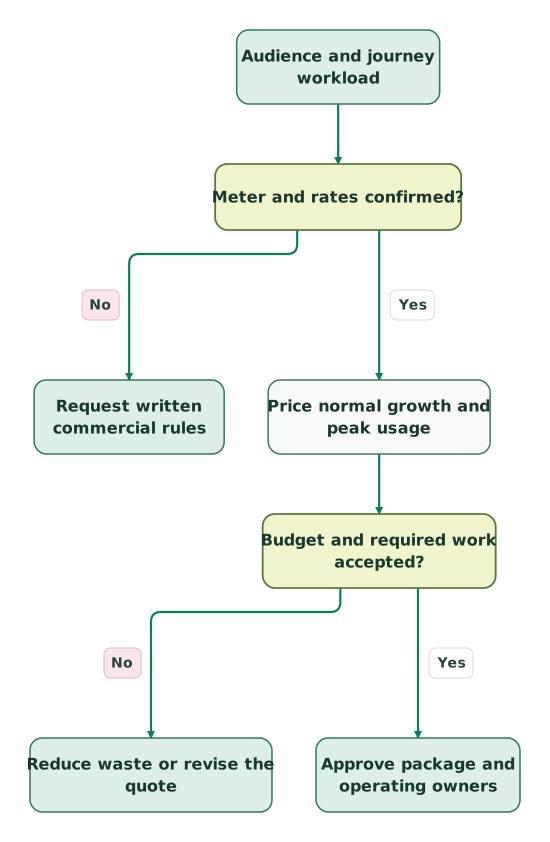
Read diagram as text
- Audience and journey workload to Meter and rates confirmed?.
- Meter and rates confirmed? to Request written commercial rules: No.
- Meter and rates confirmed? to Price normal growth and peak usage: Yes.
- Price normal growth and peak usage to Budget and required work accepted?.
- Budget and required work accepted? to Reduce waste or revise the quote: No.
- Budget and required work accepted? to Approve package and operating owners: Yes
What should you confirm before signing?
Approve the package only when the commercial and implementation owners agree on its scope. Attach the forecast to the buying decision so the team can later explain whether a cost increase came from more usage, a changed rate or additional work.
Checklist
- The order identifies the applicable plan, currency and billing unit.
- Audience counts reconcile to the relevant projects and identity rules.
- Normal, growth and peak scenarios use the same required journeys.
- Imports and planned history loads are included in the capacity estimate.
- Add-on fees, channel costs and AI allowances are itemised.
- Excess usage, rounding, upgrades and payment timing have written rules.
- Startup-offer eligibility, duration and renewal terms are confirmed.
- Retention, exports and operating support meet the actual requirement.
- The implementation owner has a launch and recovery scope.
- Finance can see recurring cash, one-time work and internal effort separately.
If the uncertainty is in your data flow rather than the price list, get the $99 martech audit. Bring the usage export, proposed order and two important journeys. The useful outcome is a smaller set of explicit decisions: which package to buy, which CleverTap implementation defects to fix and which recurring costs the team will own.
Keep reading
Browse all CRM & Lifecycle guides
 CRM & Lifecycle
6 CleverTap Implementation Mistakes: Fix Identity, Push and Profile Updates
Fix CleverTap identity merges, login misuse, profile mappings, FCM credentials and missing push. Reconcile partial API uploads with a tested response checker.
Jafrin Akter AloLast updated 12 min read
 CRM & Lifecycle
Braze vs Reteno for Subscription Apps: Pricing, RevenueCat and Migration
Compare Braze and Reteno for subscription apps: billing units, RevenueCat event formats, entitlement checks, duplicate messages and a safe migration plan.
Jafrin Akter AloLast updated 14 min read
 CRM & Lifecycle
HIPAA-Compliant Email Marketing: Choose the Right CRM and Sending Route
Compare healthcare email and CRM options by BAA scope, patient-data restrictions and sending rules, with a practical setup and release checklist.
Jafrin Akter AloLast updated 14 min read
CleverTap implementation
See the setup scope, acceptance checks and handover.
Questions people ask
Can a test project affect a CleverTap cost estimate?
Keep test projects visible in the project inventory and reconcile their treatment with the applicable agreement. A sandbox that produces frequent automated activity can have a very different usage pattern from a production audience. Separate its purpose and workload before negotiating an exclusion or allowance. Do not remove test coverage simply to make the forecast smaller; obtain a suitable operating arrangement.
Should a CleverTap quote use registered users or active users?
Supply both counts, with definitions, rather than guessing which population the proposal needs. Registered records describe your stored customer base; activity describes who generated qualifying events in a stated period. Also provide reachable audiences by channel. The commercial owner must map these populations to the proposed meter, while the implementation owner checks that the identity model can reproduce the agreed count.
Can we compare CleverTap with another platform using cost per user?
Only after aligning the billing definitions and required work. A stored profile, an active person and a reachable subscriber are different denominators. Compare the complete workload at normal and peak volume, including add-ons, channel costs and operating effort. Cost per user can then be a useful summary, but it should not replace the entitlement and usage schedule behind the total.
What should we do when an invoice differs from the forecast?
Keep the invoice, usage export and contract for the same period together. Reconcile audience scope, extra activity, add-ons, rates and effective dates one at a time. Mark the unexplained difference rather than spreading it across invented categories. Ask the vendor to identify the billing line and calculation, then update the forecast only after the cause is understood and accepted.
Is a yearly commitment always cheaper than monthly billing?
A lower unit rate can still create a larger total commitment if usage falls or the platform no longer fits. Compare cash timing, cancellation rights, volume changes and renewal terms as well as the discount. Price a conservative workload and a credible growth case. Choose the commitment your business can support without assuming every planned journey or acquisition target will materialise.
Sources

Written by
Jafrin Akter AloData Engineer and Co-founder at Martechdevs and Growth and Analytics Partners
Jafrin writes practical guides to marketing technology, customer data, analytics and AI workflows. Martechdevs is a Growth and Analytics Partners company.