
VWO Alternatives for Website Experiments, Migration and Cost
Choose Convert for a focused website-testing program with a published entry price, Optimizely for a broader experimentation scope, or GrowthBook when technical ownership and warehouse-connected measurement fit the team. VWO alternatives should preserve the experiment's audience, delivery and outcome definition. A cheaper subscription is useful only after the replacement can reproduce the intended experience and measure the right customers.
On this page
VWO competitors compared
The public USD entry terms below cover different features, tested-user allowances and operating responsibilities.
| Tool | Starting price and billing basis | Best fit | Main tradeoff |
|---|---|---|---|
| Convert Experiences | Growth $399/month for 100,000 tested users/month, or $3,588/year with an annual tested-user pool | A focused website experimentation program | Production features and traffic rules depend on plan and billing basis |
| Optimizely | Individually packaged offer through sales | Broader web, feature and server-side requirements | Required products and operating work need a complete scope |
| GrowthBook | Cloud Starter free for three users and one project; Pro $40/seat/month | Technical teams maintaining experiment delivery and measurement | Delivery, data and ownership require an explicit setup |
| VWO, current Wingify platform offer | Scope and commercial terms through the current pricing route | A working program with a repairable problem | Recheck the actual product bundle rather than a historical plan name |
See Convert pricing, Optimizely plans, GrowthBook pricing and Wingify pricing. VWO documentation and commercial routes now lead into the Wingify platform; existing account terms still need their own review.
We would first list the VWO jobs being replaced: visual page changes, redirects, feature delivery, personalization, behavioral evidence and experiment analysis. A candidate that covers page variants can still leave the research or delivery workflow incomplete.
At Martechdevs, we connect those experiments to reliable identity and outcome events through our product analytics implementation service. The pilot should establish the intended variation, eligible population and accepted business result before comparing which dashboard declares a winner.
VWO and alternative decisions
VWO and Wingify
- Best for: A team with working campaigns, trained operators and a specific issue that may be resolved without a platform migration.
- Pros: SmartCode connects a website to experimentation and related platform capabilities. Existing working campaigns and configuration have practical replacement value. See SmartCode behavior.
- Cons: A bundle can include more than the replacement shortlist covers. Old plan names and retained tracking code can also obscure the actual production scope.
- Free plan and startup offer: The current Wingify pricing route advertises a thirty-day trial without a credit card. Confirm which products and limits the evaluation includes; no historical permanent-free VWO allowance or startup discount is assumed. See trial terms.
- Choose it if: A bounded change to campaign setup, measurement or commercial scope resolves the documented problem.
- Skip it if: The required delivery or operating workflow remains unsuitable after qualification and another setup demonstrates the accepted result.
Convert Experiences
- Best for: Website experimentation teams seeking a published subscription basis for A/B and split-URL tests.
- Pros: Growth lists A/B testing, redirects, targeting, goals, a QA workflow and sample-ratio checks. The current pricing page makes the tested-user allowance visible. See Convert plans.
- Cons: The entry plan is not the budget for every capability shown in a full-feature trial. The pricing page places full-stack flags, multivariate testing and sequential testing in Pro's added scope.
- Free plan and startup offer: Convert offers a fifteen-day trial without a card. It is an evaluation with a limited tested-user allowance, not a permanent free production plan. No startup concession is included in the budget. See pricing and trial FAQ.
- Choose it if: Its qualified plan supports the live page changes, target audiences and goal definitions the team actually maintains.
- Skip it if: A required feature belongs to Pro or a custom arrangement while the business case assumes Growth pricing.
Optimizely
- Best for: Organizations comparing a broader web, feature and server-side experimentation requirement with an owned operating process.
- Pros: The current experimentation offer includes several delivery modes, personalization and warehouse-native analytics scope. That supports a wider evaluation than a visual-editor-only replacement. See Optimizely product plans.
- Cons: The package is individually scoped. The buying team needs to identify which products, traffic and services are included before treating the proposal as a like-for-like replacement.
- Free plan and startup offer: The current page offers an individually packaged plan and a demo request. Agree evaluation access and duration in the proposal; no permanent production free allowance or universal startup credit is assumed. See commercial options.
- Choose it if: The wider scope serves real experiments and the organization can own implementation, approvals and measurement.
- Skip it if: The team only needs a modest web-testing workflow and cannot justify the added scope or administration.
GrowthBook
- Best for: Teams that can own feature or website delivery and maintain trusted experiment data in a warehouse or the selected managed setup.
- Pros: GrowthBook supports feature-flag experiments, visual testing and analysis of externally assigned experiments. Teams can separate how a variation is delivered from where its result is measured. See experiment types.
- Cons: A free flag allowance does not by itself deliver the complete VWO replacement. Visual editing, data processing, permissions and delivery infrastructure need explicit plan checks.
- Free plan and startup offer: Cloud Starter includes three users and one project. Pro is $40/seat/month and adds the AI Visual Editor; managed-warehouse and delivery usage have separate limits. No startup discount is assumed. See GrowthBook pricing.
- Choose it if: The team wants technical ownership and can keep assignment, exposure and outcome definitions consistent.
- Skip it if: Marketers expect an independently operated replacement but the proposed workflow depends on unavailable engineering time.
Existing VWO campaigns and replacement scope
Inventory each active experiment before exporting anything. Record its URL rules, audience, allocation, variation behavior, goals, exclusions, owners and current decision status. Include personalization campaigns that continue running after the original experiment ends.
| Existing job | Replacement requirement | Acceptance evidence |
|---|---|---|
| Visual page variation | Correct element and behavior on supported layouts | Preview plus actual rendered page |
| Redirect experiment | Intended destination and retained business context | Complete entry-to-outcome journey |
| Feature variation | Stable assignment at the application decision point | Known identifier and exposure record |
| Purchase goal | Correct accepted order and amount | Reconciliation with order records |
| Persistent personalization | Approved eligibility and exit behavior | Customer-state transition cases |
Retire unused tests before migrating them. A campaign that no longer informs a decision should not become a mandatory feature in the replacement quote. Conversely, a frequently used capability should have a named destination in the new workflow rather than disappear under a generic testing label.
Keep the evidence from completed tests with its original population and metric definition. Historical results do not become directly comparable merely because the new tool uses the same goal name. Preserve exclusions, analysis settings and material implementation changes in the record.
Page delivery and the loading boundary
Changing a browser experimentation tool changes the page-loading path. Confirm when the replacement downloads configuration, decides eligibility and applies a variation. A delayed change can expose the original page first, while an overly broad hiding rule can leave important content invisible longer than intended.
Wingify documents synchronous and asynchronous SmartCode approaches. Its explanation describes different loading behavior and a fallback to the original experience when the asynchronous setup cannot complete. Treat that as configuration to evaluate on the actual site, rather than a performance guarantee for every page. See SmartCode loading.
Convert similarly describes synchronous and asynchronous snippet choices and warns that tag-manager deployment can produce content flicker. The appropriate route depends on the implementation. Test normal loading, slow configuration retrieval and failure behavior instead of assuming that replacing the snippet preserves timing. See Convert installation guidance.
A single-page application needs route-change cases as well as the initial page load. Confirm the experiment appears once at the intended point and stops applying where it is no longer eligible. Include back navigation, returning visitors and any checkout route where business outcomes are recorded.
The page should remain usable when an experiment service is unavailable. Record the intended fallback, the content-hiding boundary and the owner who can disable a problematic campaign. These are acceptance conditions, not comparative performance claims about the vendors.
Tested users and traffic budgeting
Convert defines a tested user as a unique visitor exposed to at least one experiment or personalization in the monthly billing cycle. A visitor entering several experiments in that month is counted once toward the monthly tested-user allowance. That differs from counting every assignment or every visit. See Convert tested-user definitions.
Assume a hypothetical month has 60,000 tested visitors in one experiment and 50,000 in another, with 30,000 appearing in both. The distinct tested population is 60,000 + 50,000 minus 30,000 = 80,000. Adding the experiment populations without removing overlap would produce 110,000 assignments, which is a different quantity.
| Hypothetical quantity | Calculation | Result | Budget meaning |
|---|---|---|---|
| Experiment memberships | 60,000 + 50,000 | 110,000 | Includes overlap |
| Distinct monthly tested visitors | 110,000 minus 30,000 | 80,000 | Assumed stable visitor identities |
| Remaining monthly allowance at 100,000 | 100,000 minus 80,000 | 20,000 | Monthly-plan illustration |
| Twelve identical monthly populations | 80,000 × 12 | 960,000 | Planning demand across monthly cycles |
The identity assumption matters. A visitor whose identifier changes may not behave like one continuously identified person in the tool. Use the platform's actual usage report and treatment of identifiers when estimating a live account.
Convert's annual entry offer provides 1.2 million tested users available as an annual pool, while the monthly entry offer lists 100,000 per month. An annual pool should not be silently described as twelve isolated monthly caps. Confirm the account's traffic schedule and overuse controls against the selected contract. See annual and monthly allowances.
VWO alternative subscription examples
At Convert Growth's displayed entry rates, annual billing is $299/month equivalent and $3,588 charged for the year. Twelve unchanged $399 monthly payments total $4,788, a $1,200 difference in base subscription arithmetic. The allowances and commitment also differ, so the annual figure should not be presented as a cancel-anytime monthly price. See Convert billing.
GrowthBook Pro at eight hypothetical seats is 8 × $40 = $320/month. If the selected managed-warehouse use is three million events in a month, its two-million included allowance leaves one million at $30, producing a $350 subtotal for those two stated lines. Delivery infrastructure and other optional usage can add costs. See GrowthBook seat and data pricing.
Those are scoped configurations, not equal-capacity quotes. Convert tested visitors and GrowthBook data events measure different work. A person can generate several events, and an experiment can rely on existing warehouse data without using the same ingestion route.
For VWO/Wingify and Optimizely, request the actual package with products, traffic units, support, implementation and renewal terms specified. Preserve the existing contract's unused period and any parallel-running expense in the transition estimate.
As a separate hypothetical example, $4,500 of migration work divided by a complete recurring saving of $300/month gives a fifteen-month simple payback after savings begin. A missing analytics or personalization product can eliminate that saving. The software pricing tool helps keep those lines visible.
Goal definitions and statistical continuity
Start reconciliation with the population and events. Identify the experiment, variation, exposed visitor, outcome timestamp and transaction identifier. A successful purchase goal should represent the agreed business event, rather than a button click that sometimes precedes a failed checkout.
Decide whether the metric counts users with a purchase, total purchases or revenue. A customer with three orders contributes differently to those measures. Match the event and denominator before comparing rates between the old and new systems.
Different analysis methods need not produce identical significance readouts. Preserve each method's assumptions, stopping rules and multiplicity treatment. A matching raw count is a useful data check, but it does not make a fixed-horizon p-value interchangeable with a sequential or Bayesian result.
Use an A/A validation plan when the assignment or measurement implementation changes. Identical intended experiences can help inspect exposure and metric flow, while a nonsignificant result alone does not certify the replacement. Keep the sample ratio mismatch check separate from the outcome comparison.
Best fit by experimentation team
| Company or operating model | Best fit | Runner-up | Decision reason |
|---|---|---|---|
| Small website team running qualified A/B and redirect tests | Convert Growth evaluation | Retained VWO/Wingify scope | Published entry terms make a bounded pilot possible |
| Product organization needing several delivery modes | Optimizely scope | GrowthBook | Application ownership and complete product coverage matter |
| Technical team with trusted warehouse experiment data | GrowthBook | Optimizely | Measurement and delivery ownership can be explicit |
| Existing VWO program with one misconfigured goal | Current-platform repair | Qualified alternative | Correcting the event may avoid migration |
| Team needing full-stack flags or multivariate testing | A plan explicitly including those capabilities | Another qualified package | A trial's full feature set is not an entry-plan entitlement |
The Optimizely alternatives guide covers the wider platform shortlist. Here, the deciding evidence remains the VWO campaign and measurement workflow the team needs to preserve.
Experiment replacement workflow
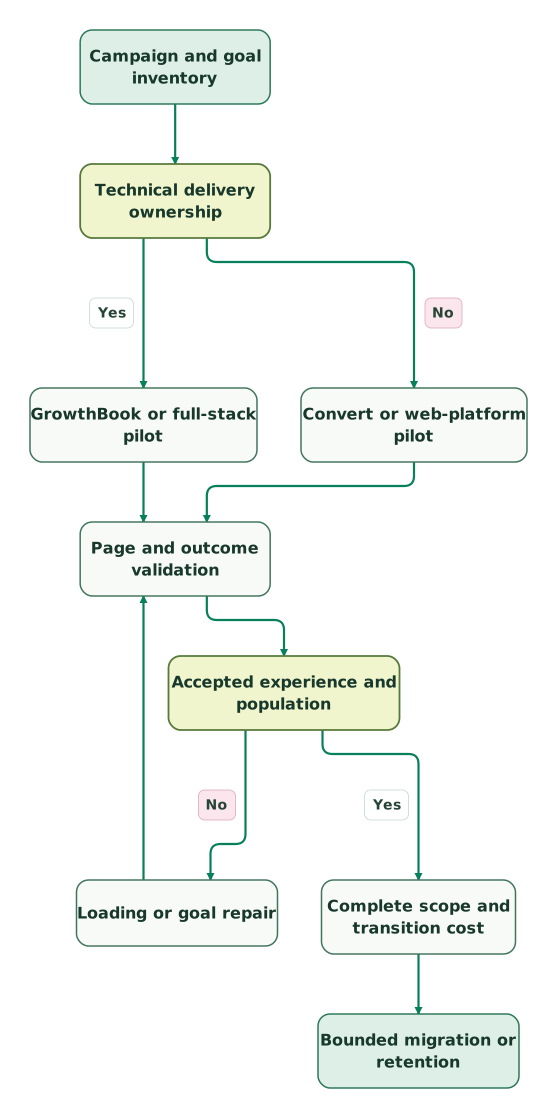
Read diagram as text
- Campaign and goal inventory to Technical delivery ownership.
- Technical delivery ownership to GrowthBook or full-stack pilot: Yes.
- Technical delivery ownership to Convert or web-platform pilot: No.
- GrowthBook or full-stack pilot to Page and outcome validation.
- Convert or web-platform pilot to Page and outcome validation.
- Page and outcome validation to Accepted experience and population.
- Accepted experience and population to Loading or goal repair: No.
- Loading or goal repair to Page and outcome validation.
- Accepted experience and population to Complete scope and transition cost: Yes.
- Complete scope and transition cost to Bounded migration or retention
VWO replacement checklist
- A named reason for replacement and an in-place repair option.
- Active campaigns, goals and personalization rules inventoried.
- Production-plan features distinguished from evaluation access.
- Tested-user, seat and event units kept separate.
- Initial load, route changes and service-failure cases checked.
- Stable identity, exposure and outcome definitions retained.
- Known orders reconciled with the intended goal metric.
- Analysis methods and stopping rules preserved explicitly.
- Historical decisions retained with their original context.
- One controlled route for each live experiment during cutover.
Use the tracking plan audit skill to retain the event and identity evidence. A migration is ready when the team can reproduce the intended experience, explain the result and recover from a failed campaign.
Keep reading
Browse all Product Analytics guides
 Product Analytics
Optimizely Alternatives for Web Tests, Product Experiments and Costs
Compare Optimizely alternatives by delivery, measurement and cost. Review GrowthBook, Statsig, PostHog and Wingify with billing examples and migration checks.
Jafrin Akter AloLast updated 12 min read
 Product Analytics
Sample Ratio Mismatch: Diagnose an A/B Test Before Reading Lift
Diagnose sample ratio mismatch across assignment, exposures and analysis filters, with a checked Python example, missing-user scenario and recovery criteria.
Jafrin Akter AloLast updated 9 min read
 Product Analytics
Experimentation Platforms in 2026: 15 Tools Compared by Price, Stats and Team Fit
Pick an experimentation platform by who runs tests and where metrics live. 15 tools compared on price, free limits and stats, plus cost at 3 traffic levels.
Jafrin Akter AloLast updated 54 min read
Product analytics
See the implementation scope, deliverables and acceptance checks.
Questions people ask
Does a Convert annual entry price mean the same traffic rules as monthly billing?
A Convert annual entry price does not imply identical traffic rules to monthly billing. The current entry offer lists a 1.2-million annual tested-user pool, available together, while monthly billing lists 100,000 tested users per month. Check the selected allowance and overuse rules alongside the commitment before comparing amounts. See Convert pricing.
Does one visitor entering several Convert tests consume several monthly tested users?
One visitor entering several Convert tests in the same billing month is counted once toward its monthly tested-user quota under the published definition. That is different from adding all experiment memberships or page visits. Preserve the platform's visitor identity rules when estimating the live account, particularly across devices or identifier resets. See Convert's usage FAQ.
Can a full-feature trial establish that an entry plan replaces every VWO capability?
A full-feature trial cannot establish that an entry plan includes every required VWO capability. Map each accepted test to the production edition on the order. For example, Convert's current pricing page lists several capabilities in Pro beyond Growth. A successful trial is technical evidence; the purchased feature entitlement still needs confirmation. See Convert plan scope.
Should a VWO migration require identical significance numbers in both platforms?
A VWO migration should first require reconciled populations, assignments and business outcomes. Identical significance numbers are not a universal requirement because analysis methods, stopping rules and corrections may differ. Document those settings and assess each result under its own method. A difference in inference deserves explanation, while matching a dashboard percentage alone does not validate the data.
Is replacing the VWO snippet sufficient for a safe experiment cutover?
Replacing the VWO snippet is not sufficient for a safe experiment cutover. Campaign eligibility, identifiers, goals, personalization and fallback behavior also need accepted replacements. Check page loading and route changes, prevent competing live variations and preserve historical decisions with their definitions. Retire the old route only after the bounded migration produces the intended experience and measured outcomes.
Sources

Written by
Jafrin Akter AloData Engineer and Co-founder at Martechdevs and Growth and Analytics Partners
Jafrin writes practical guides to marketing technology, customer data, analytics and AI workflows. Martechdevs is a Growth and Analytics Partners company.