
Personalization ROI: Measure the Profit Behind the Lift
Personalization ROI measures the extra contribution a personalized experience creates after its full delivery cost. Compare eligible customers assigned to the new experience with a credible control, retain customers who produce no revenue, and reconcile refunds and variable costs. Then decide whether the incremental return justifies the work. More attributed revenue, clicks or orders can still leave the business worse off.
On this page
The useful question is specific: should we keep this recovery offer, contextual onboarding step or recommendation? A company-wide promise that personalization increases revenue cannot answer it. Neither can a dashboard that gives an email credit for a purchase the customer would have made anyway.
For a small team, begin with one meaningful customer state and one change you can maintain. An accurate reminder after a genuine failure is often a better first project than generating dozens of audience-specific headlines. The examples below are hypothetical; their purpose is to make the decision reproducible.
What does personalization research actually tell you?
Research supports investigating personalization, but the headline figures mix company comparisons, attributed outcomes and customer opinions. They do not provide a ready-made return assumption for your business.
Read these findings according to the evidence behind them.
| Evidence | Finding | What it can support | What it cannot establish |
|---|---|---|---|
| BCG’s earlier company research | Personalization leaders reported revenue increases of 6%–10%; its program survey covered more than 50 companies | A reason to examine the capability and execution burden | A causal 6%–10% forecast for your next journey |
| Klaviyo’s email benchmarks | Automated flows produced nearly 41% of email revenue from 5.3% of sends | Prioritizing investigation of timely lifecycle messages | The extra revenue those flows caused versus withholding them |
| Braze’s customer engagement research | 93% of surveyed marketing leaders thought AI helped them understand needs; 53% of surveyed consumers felt brands predicted their wants successfully | Testing usefulness from the customer’s perspective | Proof that adding AI or another channel increases profit |
BCG’s source is its 2017 research, with many surveyed programs operating at substantial scale. Its company-level findings should not become a small business’s guaranteed uplift. BCG personalization research
Klaviyo’s figures describe performance in its customer data, not a randomized comparison. Someone who has just abandoned a checkout differs from someone receiving a general newsletter. Better flow performance can reflect that existing intent as well as the message. Klaviyo email benchmarks
Braze surveyed 2,200 senior marketers at B2C businesses with at least USD 10 million in annual revenue and 4,000 consumers in the US and UK. Its survey also found 43% of consumers said they would stop engaging with a brand after misuse of their data. These are reported attitudes, not measured churn rates. Braze customer engagement research and methodology
Our implementation recommendation is to earn the next level of complexity. Prove that one decision uses trustworthy customer context, improves an outcome and can be operated reliably before buying a broader personalization platform. If product, billing and messaging systems disagree about that context, CRM and lifecycle implementation should fix the decision inputs first.
Which personalization use case should you test first?
Choose a use case with a recognizable customer problem, an authoritative state and a measurable outcome. Start where relevance changes what you should do, including deciding to send nothing.
These are candidate designs to adapt to your product, not claims about client results.
| Customer situation | Useful change | Required evidence before action | Outcome and failure check |
|---|---|---|---|
| Trial account has not completed its essential setup | Offer help for the missing step | Current account state and the responsible user | Completed setup; avoid reminders after completion |
| Payment failed but remains recoverable | Explain the actual recovery action | Current invoice and payment state | Recovered contribution; stop after payment or cancellation |
| Shopper already bought the item in a cart reminder | Suppress the stale reminder | Reconciled order and customer identity | Fewer irrelevant contacts; preserve legitimate new-cart eligibility |
| Customer is close to a real usage limit | Explain options before service is affected | Current usage, plan and policy | Appropriate plan choice; avoid false urgency |
| Buyer requests fewer messages | Apply that preference across journeys | Current channel and category preferences | Preference respected; no competing journey bypass |
A first-name token does not resolve any of those problems. A predictive score is also unhelpful if the action still uses yesterday’s invoice state. Work backward from the customer journeys that matter, then define the smallest information set that changes the next action.
For every rule, write the cancellation condition beside the entry condition. “Invoice failed” admits a customer; “invoice paid, cancelled or no longer eligible” must remove them from the pending action. Decide what happens when an upstream field is missing or stale. A safe fallback can be the ordinary experience or no promotional send, depending on the workflow.
Prioritize one high-cost mistake over ten decorative variations. If existing customers receive acquisition discounts, fixing eligibility may protect contribution before any new recommendation model earns an extra sale. Measure that repair under the appropriate evidence standard; correcting a known harmful behavior does not require continuing it solely to preserve an experiment.
What exactly should the control group receive?
The control should receive the existing acceptable experience, with the proposed change withheld. Define that baseline precisely enough that engineering, lifecycle and analytics implement the same comparison.
Three different questions require different controls.
| Decision | Control | Treatment | Interpretation |
|---|---|---|---|
| Does a contextual message beat our standard message? | Standard message | Contextual message | Additional value of the personalization change |
| Does this optional journey earn its cost? | No optional journey | Proposed journey | Additional value of that journey, including its messaging |
| Does the combined optional program earn its cost? | Defined program baseline with recorded exceptions | Combined program | Net effect of the program and its interactions |
Do not withhold required receipts, security notices or essential service information merely to make a control “pure.” Preserve necessary communications and describe the actual baseline. If a standard recovery notice is essential, compare the proposed optional enhancement against that notice.
Persist assignment at the unit where the change operates. A B2B account-wide onboarding change generally needs an account-level design so teammates do not receive conflicting conditions. A consumer lifecycle test may use a stable customer ID. Device or cookie assignment is a different design when one person can appear on several devices. The underlying experimental literature explains why randomization and analysis units must fit the metric and customer experience. Online controlled experiments and A/B tests
Keep the primary analysis on the predefined eligible assigned population, including customers who never open, click or purchase. Comparing only message openers selects behavior affected by the treatment. If you use an exposure-triggered analysis, define a trigger detectable equivalently in both variants before the treatment can change it; do not quietly replace the original population after viewing results.
Freeze the primary outcome, observation window, practical minimum effect and stopping rule before launch. For contribution, allow the agreed refund window to mature. Keep a separate operational stop for broken eligibility, personal-data exposure or a serious customer-harm signal. An emergency stop protects customers; it is not statistical evidence that a revenue result is conclusive.
Which holdout features do Klaviyo and Braze actually provide?
A platform’s global holdout is useful only when its eligibility, exceptions and measured population match your question. A “control group” label does not guarantee that nobody in it receives marketing.
Klaviyo’s global holdout requires at least 400,000 total profiles. It withholds marketing across supported campaign and flow channels, while transactional flow messages and configured overrides can still reach the holdout. Only one global holdout can be active. Its recommendation to run for three months is product guidance, not proof that your metric has enough statistical power. Klaviyo global holdout requirements
Braze’s Global Control Group covers campaigns and Canvases with documented exceptions. API campaigns can still reach it; the exception does not extend to API-triggered Content Cards. Tagged exclusions can also bypass the control. Duplicate profiles sharing an email can contaminate the comparison when the other profile is eligible for a send. Braze Global Control Group
Before interpreting either result, inventory the messages that actually reached each group, including sends outside the platform. Export or preserve assignment evidence when your analysis needs it. Check whether the platform’s reporting uses all eligible customers, a reporting sample or a narrower marketable population, and reconcile that denominator with your own outcome table.
A smaller business that does not qualify for a vendor’s global feature can still design a bounded journey-level experiment using supported assignment and exclusion controls. Verify those controls in its actual account. A manually maintained list that silently changes membership is not a substitute for stable assignment and delivery checks.
How do you calculate personalization ROI without hiding the costs?
Calculate the difference in contribution per eligible assigned unit, then subtract the incremental cost of delivering the tested change. Keep realized experiment results separate from a proposed rollout forecast.
Contribution per assigned customer = net customer receipts minus relevant variable product and service costs, divided by assigned customers.
Here, receipts are already adjusted for discounts, refunds and the agreed treatment of taxes. Variable costs include the agreed fulfillment or service costs. The personalization program cost is deducted later, once. Finance can use an accounting revenue measure instead, but both groups must use the same recognized basis and horizon.
Incremental contribution per customer = treatment contribution per customer − control contribution per customer.
For the customers actually assigned to treatment, multiply that difference by the treatment population. For a future rollout, multiply by a separately justified forecast population and label the result a forecast. Then calculate:
Personalization ROI = (estimated incremental contribution − incremental program cost) ÷ incremental program cost.
If program cost is zero, the ROI ratio is undefined; report incremental contribution instead. The broader marketing ROI guide explains other cost conventions. Do not compare two published percentages until their denominators match.
How can more orders still produce a disappointing return?
Consider a hypothetical recovery-offer experiment with 5,000 eligible customers per group and the same completed outcome window. Each customer is assigned once. Both groups include nonbuyers.
All monetary inputs below are illustrative USD totals for the experiment window, before the incremental program cost.
| Measure | Control | Personalized offer | Difference |
|---|---|---|---|
| Assigned customers | 5,000 | 5,000 | 0 |
| Customers purchasing | 500 | 600 | +100 |
| Purchase rate | 10% | 12% | +2 percentage points |
| Net customer receipts | 40,000 | 44,000 | +4,000 |
| Variable product and service costs | 24,000 | 27,000 | +3,000 |
| Contribution | 16,000 | 17,000 | +1,000 |
| Contribution per assigned customer | 3.20 | 3.40 | +0.20 |
Purchase rate improved by 20% relatively, but contribution per assigned customer improved by only 6.25%. Discounting and the cost of the additional orders matter. If discounts are already reflected in net receipts, subtracting them again understates the result.
The point estimate of incremental contribution for the 5,000 treated customers is USD 1,000. If this bounded pilot incurred USD 1,100 of incremental delivery cost, its estimated net return is minus USD 100, or minus 9.09% ROI. Those totals do not establish statistical significance: a valid uncertainty estimate also needs customer-level outcome variation and the experiment design.
Now consider a separate, hypothetical rollout budget: 50,000 comparable eligible customers over the proposed program period, with the same per-customer outcome window. At USD 0.20 additional contribution each, the forecast benefit is USD 10,000. Against USD 11,000 of rollout cost, forecast ROI is again minus 9.09%. This is an extrapolation, not another observed result.
For that rollout, break-even is USD 0.22 additional contribution per eligible customer: USD 11,000 divided by 50,000. If a defensible interval for the effect crosses that threshold, the commercial decision remains uncertain. Changing the offer, cost or target population requires a revised forecast and potentially a new test, not merely relabeling the original win.
How should you join assignment and revenue data?
Start from assignment records and left join eligible outcomes. Starting from purchases drops zero-revenue customers and can turn a weak treatment into a misleading winner.
The following SQL calculates point estimates from two prepared tables. It does not randomize customers or perform a statistical test. experiment_assignment must contain exactly one row per experiment and customer, only the variants control and treatment, and non-null UTC window boundaries. order_margin must contain one reconciled row per order, a customer ID, a timestamp and non-null integer USD-cent receipt and variable-cost amounts. Resolve duplicate orders, missing costs and currency conversion before running it.
The outcome window is inclusive at its start and exclusive at its end. Each order’s amount reflects your agreed refund cutoff. Customers without an order contribute zero.
WITH customer_outcomes AS (
  SELECT
    a.customer_id,
    a.variant,
    COUNT(o.order_id) AS order_count,
    COALESCE(SUM(o.net_receipts_usd_cents), 0) AS receipts_cents,
    COALESCE(SUM(o.variable_cost_usd_cents), 0) AS costs_cents
  FROM experiment_assignment AS a
  LEFT JOIN order_margin AS o
    ON o.customer_id = a.customer_id
   AND o.occurred_at >= a.eligible_at
   AND o.occurred_at < a.outcome_until
  WHERE a.experiment_id = 'recovery_offer_v1'
  GROUP BY a.customer_id, a.variant
)
SELECT
  variant,
  COUNT(*) AS assigned_customers,
  SUM(CASE WHEN order_count > 0 THEN 1 ELSE 0 END) AS buyers,
  SUM(receipts_cents) / 100.0 AS net_receipts_usd,
  SUM(costs_cents) / 100.0 AS variable_costs_usd,
  SUM(receipts_cents - costs_cents) / 100.0 AS contribution_usd,
  SUM(receipts_cents - costs_cents) / (100.0 * COUNT(*))
    AS contribution_usd_per_assigned_customer
FROM customer_outcomes
GROUP BY variant;
The COALESCE here represents a customer with no matched order. It must not conceal an order with an unknown receipt or cost: the table prerequisites must reject those nulls first. Likewise, an order with multiple partial refunds must be reconciled into its canonical order row rather than multiplied by a join to refund events.
For B2B, change both assignment and outcome mapping to the agreed account unit; do not simply divide account revenue by a count of employees. Retain the assignment version and eligibility snapshot so a later identity merge cannot silently move a customer between groups. Use identity resolution rules to settle that behavior before reporting.
Which operating costs and customer risks belong in the decision?
Include the work and charges caused by the proposed change, and report existing capacity separately from cash spending. A free feature still consumes time to design, validate and maintain.
Use this cost boundary for the specific pilot or rollout period.
| Cost or risk | What to record | How it changes the decision |
|---|---|---|
| Data and eligibility work | Integration, reconciliation and failure handling | May be reusable; allocate it consistently instead of charging it to every journey in full |
| Content and product delivery | Design, implementation, localization and approval | More variants increase the work even if send volume is unchanged |
| Running cost | Incremental messages, tools, support and monitoring | Compare the proposed volume with actual billing units |
| Internal time | Named owner, hours and loaded planning rate | Show resource cost separately from a new cash invoice |
| Customer guardrails | Complaints, preference violations, refunds and support burden | A short-term purchase lift can fail the release decision |
Do not count the same avoided support case both as a reduction in variable service cost and a separate monetary benefit. Do not count released staff hours as payroll savings unless spending actually falls. Keep those capacity benefits visible without inflating cash return.
Check message collisions before testing. A customer assigned to the ordinary experience may still see the same discount in paid media, another email or a support conversation. Either define that as part of the shared baseline or redesign the test. The result should describe the actual difference customers experienced.
When should you scale, repair or stop personalization?
Scale when the customer-state checks pass, the experiment is interpretable, and the return clears your commercial threshold without unacceptable harm. A valid experiment can conclude that the change is not worth shipping.
Check sample ratio mismatch before explaining a surprising win. Microsoft’s research shows that unexpected allocation ratios can reveal failures that reverse the apparent decision. A mismatch needs a cause, not an arbitrary adjustment that makes the chart look balanced. Microsoft research on sample ratio mismatch
Follow this decision path for the specific change under review.
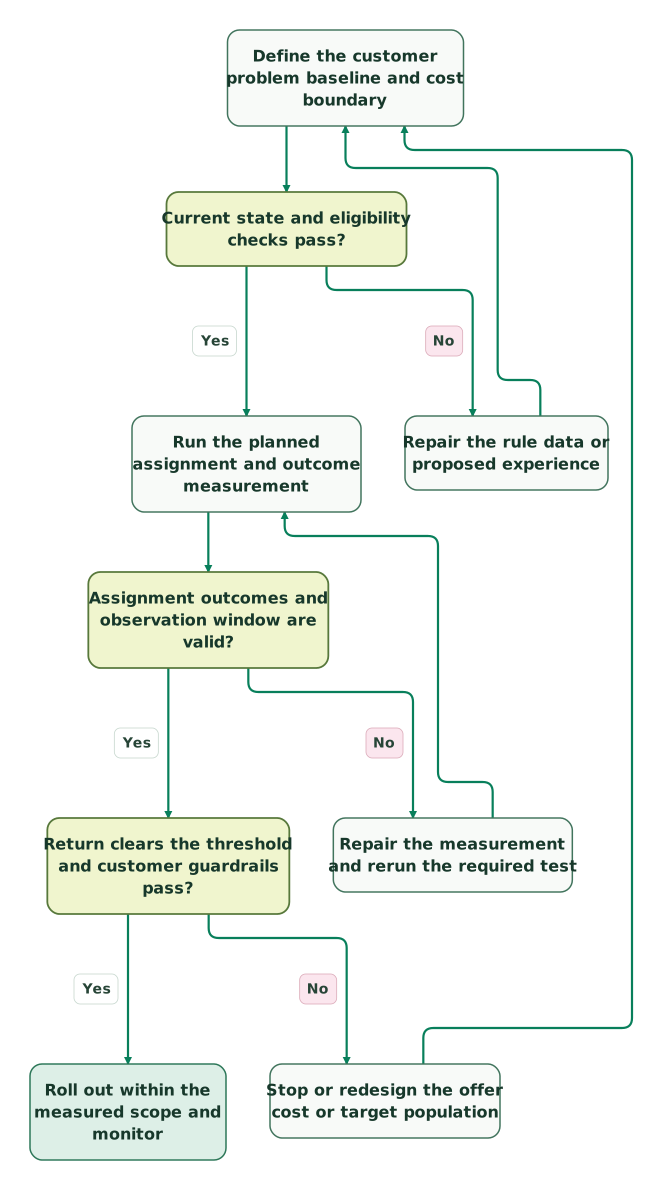
Read diagram as text
- Define the customer problem baseline and cost boundary to Current state and eligibility checks pass?.
- Current state and eligibility checks pass? to Repair the rule data or proposed experience: No.
- Repair the rule data or proposed experience to Define the customer problem baseline and cost boundary.
- Current state and eligibility checks pass? to Run the planned assignment and outcome measurement: Yes.
- Run the planned assignment and outcome measurement to Assignment outcomes and observation window are valid?.
- Assignment outcomes and observation window are valid? to Repair the measurement and rerun the required test: No.
- Repair the measurement and rerun the required test to Run the planned assignment and outcome measurement.
- Assignment outcomes and observation window are valid? to Return clears the threshold and customer guardrails pass?: Yes.
- Return clears the threshold and customer guardrails pass? to Roll out within the measured scope and monitor: Yes.
- Return clears the threshold and customer guardrails pass? to Stop or redesign the offer cost or target population: No.
- Stop or redesign the offer cost or target population to Define the customer problem baseline and cost boundary
An inconclusive test is not evidence of zero effect. It may leave both meaningful benefit and meaningful harm plausible. Report the interval, the practical threshold and what additional evidence would change the decision. Repeatedly opening new segments until one looks positive creates new hypotheses; confirm them through a planned follow-up rather than presenting the best slice as the original result.
After rollout, monitor whether the prerequisite still holds. A new billing system, discount policy or identity rule can invalidate an otherwise good journey. Track eligibility failures, stale-state suppression, delivery errors and mature contribution alongside the campaign dashboard. Reopen the decision when the cost or customer population changes materially.
What should pass before you approve the investment?
Approve a defined change with traceable inputs and an owner, not a general personalization ambition.
Checklist
- The customer problem and acceptable baseline are explicit.
- Entry, cancellation, preference and stale-data rules pass.
- Assignment uses the agreed customer or account unit.
- The outcome model retains assigned customers with no purchase.
- Refunds, variable costs and currency are reconciled once.
- Tool exceptions and other channels cannot silently change the comparison.
- The experiment’s observation window, stopping rule and uncertainty are respected.
- Cash costs, internal capacity and reusable build costs are separated.
- The result clears the practical return threshold and customer guardrails.
- A named owner can pause the journey and investigate a regression.
If you need to establish whether the missing piece is identity, billing state or measurement, start with the $99 martech audit. For a defined journey and holdout build, request a detailed lifecycle scope. Bring the customer problem, current rule and business outcome; those determine the useful implementation.
Keep reading
Browse all Martech Strategy guides
 Martech Strategy
Attribution ROI: What Fixing Tracking Is Actually Worth
Calculate tracking-project ROI without confusing recovered conversions with new sales. Model costs, contribution, break-even and a defensible impact test.
Jafrin Akter AloLast updated 12 min read
 Martech Strategy
The Cost of Bad Data in Marketing: Calculate Your Actual Loss
Check the Gartner, IBM and MIT data-quality figures, then calculate actual cash waste, staff effort and repair ROI without double counting uncertain losses.
Jafrin Akter AloLast updated 12 min read
 Martech Strategy
Data Warehouse ROI: Build a Three-Year Business Case You Can Defend
Build a data warehouse ROI model with cash savings, staff capacity, complete costs, rollout delays, NPV and payback. Includes a worked small-company example.
Jafrin Akter AloLast updated 15 min read
CRM & marketing automation
See the implementation scope, deliverables and acceptance checks.
Questions people ask
Is personalization worth it for a small company?
It can be when a small amount of reliable context changes a meaningful action, such as stopping a paid customer’s recovery reminder. Start with a rule your team can maintain and measure its effect against an acceptable baseline. Buying a platform before resolving identity and state can increase cost without improving relevance. Prioritize the operating problem over the number of variants.
Is a higher conversion rate enough to prove positive ROI?
No. Additional orders may carry discounts, fulfillment costs or support demand that consume the extra receipts. Compare contribution per eligible assigned customer, then deduct incremental program cost. Also account for uncertainty in the experiment. A statistically credible conversion lift can coexist with a negative commercial return, especially when the intervention changes the mix of products or customers.
How large should a personalization holdout be?
Size it for the baseline outcome, minimum meaningful effect, assignment unit, variability and available observation window. A vendor’s permitted percentage or recommended duration does not establish that your test has enough information. When traffic is limited, consider a larger meaningful change or a narrower operational question. Do not present an underpowered result as proof that personalization has no effect.
Can we add the uplift from several journeys together?
Not safely without accounting for overlap. The same customer may receive several interventions, and one journey may move a purchase that another would have produced. Use individual tests to improve each decision and a suitably designed combined comparison to estimate the program’s net effect. Reconcile costs once and preserve any essential-message exceptions in the definition of that comparison.
Do we need AI to personalize customer journeys?
No. Rules using verified product state, billing state and preferences can deliver useful context without a predictive model. Add AI when it improves a defined decision beyond that baseline and you can evaluate the change. Preserve eligibility, privacy and stopping controls outside persuasive generated copy. A model’s confidence about the next message does not prove that the message creates value.
Sources

Written by
Jafrin Akter AloData Engineer and Co-founder at Martechdevs and Growth and Analytics Partners
Jafrin writes practical guides to marketing technology, customer data, analytics and AI workflows. Martechdevs is a Growth and Analytics Partners company.