
OneTrust Competitors: Five Alternatives by Consent and Privacy Scope
Choose a OneTrust competitor by the work you need to replace. Cookiebot fits a focused website-consent requirement; Didomi fits consent across properties and devices; Osano, Ketch and TrustArc deserve evaluation for broader privacy operations. First inventory your OneTrust modules, evidence and integrations. A cookie banner replacement can leave rights requests, preference synchronization and privacy records without a working home.
On this page
OneTrust competitor shortlist
Published subscription amounts below exclude tax and implementation; currencies and billing bases are kept separate.
| Alternative | Useful starting scope | Public price basis | Main qualification |
|---|---|---|---|
| Cookiebot | Website cookie consent | EUR €7/month Premium Lite; higher tiers by domain and subpages | Lite is one domain with fewer than 50 subpages; broader privacy work needs separate scope |
| Didomi | Consent across properties and devices | Quote; CMP offer uses monthly unique visitors | Confirm devices, exports and synchronization in the package |
| Osano | Consent with an expansion path to privacy operations | Self-service Plus $199/month in USD | Two users, three domains and 30,000 monthly visitors; broader scope is quoted |
| Ketch | Consent and connected privacy controls | Starter $150/month; Plus from $499/month billed annually | Rights workflows are an add-on at Plus; broader capabilities sit in quoted Pro |
| TrustArc | Consent, rights and privacy-program management | Quote by required products | Cookie consent, preferences and rights management are distinct products |
Sources: Cookiebot pricing, Didomi offers, Osano self-service plans, Ketch pricing, and TrustArc product scope.
OneTrust replacement scope
OneTrust's current packaging spans consent, privacy automation, AI governance, technology risk and third-party management. CMP Base and CMP Suite use average daily visitors aggregated across channels and properties; other products have different commercial units. Identify the actual order-form line you want to replace before comparing prices. OneTrust packaging.
Our OneTrust pricing guide covers the incumbent's buying model. This shortlist focuses on replacement fit and the work that must survive a move.
| Current responsibility | Required replacement evidence | Likely owner |
|---|---|---|
| Website and app consent | Correct notice, stored choice and permitted tag or SDK behavior | Engineering and privacy |
| Marketing preferences | Correct identity, purpose and downstream suppression | Marketing operations and privacy |
| Rights requests | Intake, verification, system tasks, exceptions and completion evidence | Privacy operations |
| Data maps and assessments | Preserved records, owners, approvals and useful history | Privacy and data owners |
| Vendor or AI governance | Equivalent required workflow and evidence retention | Risk, procurement and technology owners |
A marketing team can replace only the CMP while retaining other OneTrust modules. That can be a sensible scope when each boundary has a clear owner. Price the remaining OneTrust contract, replacement subscription and integration work together. Our analytics and tracking implementation service can cover the tag, consent-state and measurement changes within that technical scope.
Five OneTrust alternatives
Cookiebot
Cookiebot is a focused candidate for a website-consent project. Pricing depends on domains and scanned subpages, with no traffic limit on the published Premium tiers. Domains and subdomains are billed separately. A multilingual site using language folders can therefore have a different commercial footprint from separate country subdomains. Cookiebot pricing rules.
The low entry price has a narrow boundary. Free and Premium Lite apply to one small domain. Premium Small eligibility requires at least four domains; small domains in accounts with one to three domains otherwise fall into Medium, subject to the Lite conditions. Scan the actual property list before approving a budget.
- Best for: A team replacing a website CMP while retaining other privacy processes elsewhere.
- Pros: Public domain-based pricing and a focused consent implementation.
- Cons: Domain structure and page counts can change the tier; a banner project does not cover every privacy workflow.
- Free plan and startup offer: Free is limited to one domain and up to fifty subpages. A fourteen-day Premium trial is available.
- Choose it if: The agreed scope is website consent and the site's technical tests pass.
- Skip it if: The purchase is expected to replace data mapping, rights fulfilment and enterprise risk workflows without separately provisioned tools.
Use our Cookiebot implementation mistakes guide for the practical tag and deployment checks.
Didomi
Didomi is a candidate for consent across websites, apps and connected devices. Its CMP offer uses monthly unique visitors across unlimited domains, with a quote for the intended configuration. The offer identifies some capabilities, including cross-device consent and analytics exports, as available upon request. Confirm those in the contract if they are dependencies. Didomi CMP offer, Didomi platform scope.
The implementation question is how a choice travels across properties. A returning signed-in user, an anonymous visitor and a person using another device do not necessarily have the same available identity. Define the permitted matching mechanism and the expected behavior when the identity is unknown.
- Best for: Multi-property teams with a defined consent and preference experience.
- Pros: Consent scope extends beyond a single website banner.
- Cons: Requested capabilities and identity-dependent synchronization need explicit acceptance criteria.
- Free plan and startup offer: Obtain trial or startup terms for the CMP itself. The free server-side tagging offer shown on the offers page is a separate product scope.
- Choose it if: The required devices, domains and downstream consent signals are included and demonstrable.
- Skip it if: A general promise of cross-device synchronization is being treated as proof that every visitor can be identified everywhere.
Osano
Osano offers consent as well as subject-rights, assessment, vendor-risk and other privacy capabilities. Its self-service Plus consent plan is $199/month for two users, three domains and 30,000 monthly visitors. Free lists one user, one domain and 5,000 monthly visitors. Broader privacy requirements need a scoped quote. Osano consent plans, Osano platform plans.
Be precise about the traffic unit. Osano's contracted consent-pricing explanation defines traffic around delivery of its script to a visitor within a twenty-four-hour period and uses a three-month rolling average. The self-service page displays monthly-visitor allowances. Ask which meter governs your actual order; do not silently convert one into the other. Osano traffic definition.
- Best for: A team that wants consent plus a path to managed privacy workflows.
- Pros: Published self-service allowances and broader product options.
- Cons: The selected commercial plan, traffic definition and module scope need reconciliation.
- Free plan and startup offer: Free has a small-site allowance. Osano says startup and nonprofit discounts are available by request; no universal percentage is assumed here.
- Choose it if: The required privacy tasks and their owners fit the quoted configuration.
- Skip it if: The budget uses a free banner or narrow consent plan as the price of a full privacy program.
Ketch
Ketch offers a free consent tier for up to 5,000 monthly unique visitors, Starter at $150/month for up to 30,000 and Plus from $499/month billed annually for up to 100,000. These tiers include two data-system integrations. Plus can add rights workflows; quoted Pro covers broader areas including data mapping, rights automation, risk assessments and marketing preferences. Ketch plan boundaries.
Ketch also documents a OneTrust Cookie Consent migrator. It can read the existing consent cookie, listen to consent events during transition and handle scripts using OneTrust category tags through mapping. Its stated scope is the Cookie Consent script; other OneTrust modules need separate migration design. Ketch OneTrust migrator.
- Best for: Teams that want consent connected to downstream data controls.
- Pros: Public entry tiers and a specifically described OneTrust cookie-consent transition mechanism.
- Cons: Integration allowances and broader privacy requirements can move the purchase beyond entry pricing.
- Free plan and startup offer: Free provides the published 5,000-visitor consent allowance; validate the required integrations within its limits.
- Choose it if: The target purpose mapping and downstream enforcement can be proved in a representative transition.
- Skip it if: A cookie-consent migrator is being treated as a migration tool for every OneTrust product.
TrustArc
TrustArc is a candidate when the buying decision spans a privacy program. Its product families include cookie consent, consent and preference management, individual rights, data mapping and assessments. Obtain a quote for the required combination, including the ongoing operating work. TrustArc platform and product families.
The integration test should go beyond a connector logo. TrustArc states that available actions, timing and direction vary by connector. A preference update only becomes useful when the destination applies the mapped change to the correct customer and purpose. TrustArc consent and preference integrations.
- Best for: Privacy teams with multiple operational responsibilities and designated process owners.
- Pros: Separate products cover consent, rights and wider governance needs.
- Cons: Product selection, evidence migration and connector behavior require a detailed scope.
- Free plan and startup offer: Request a demonstration and evaluation terms for the actual product set; use the negotiated recurring quote for the budget.
- Choose it if: Required workflows and evidence can be operated and maintained by the team.
- Skip it if: A small website-banner project is the only requirement and the wider operating model adds unnecessary complexity.
Best fit by organizational scenario
| Situation | First candidate | Runner-up | Decisive evidence |
|---|---|---|---|
| Two marketing websites with privacy operations retained elsewhere | Cookiebot | Ketch | Domain pricing, consent defaults and tag behavior |
| Websites, mobile apps and connected-device experiences | Didomi | OneTrust retention | Device coverage, identity boundaries and choice propagation |
| Lean privacy team adding rights workflows | Osano | Ketch Pro | Intake-to-completion workflow and complete module quote |
| Several systems requiring synchronized preferences | Ketch | TrustArc | Identity matching, failed-delivery handling and destination suppression |
| Broad privacy-program replacement | TrustArc | Osano | Record migration, workflow ownership, access and evidence history |
These are starting points for a trial. The target capability and operating owner decide the final choice, rather than the number of features in a comparison table.
Pricing units and worked budgets
A visitor-based quote cannot be compared directly with a domain-based quote using one traffic number. Prepare a property list, subpage counts, monthly unique visitors, average daily visitors, apps, jurisdictions and required integrations. Record where each number came from and how the vendor will measure it.
For a hypothetical website-only scope with two domains containing 800 scanned subpages each, Cookiebot's published Medium rate of €30 per domain/month produces €60 monthly and €720 across twelve months. This excludes tax, add-ons and implementation. It is a website CMP budget. Cookiebot tier pricing.
Keep USD offers separate:
| Published entry scope | Monthly amount | Twelve-month base | Boundary |
|---|---|---|---|
| Osano self-service Plus | $199 | $2,388 | Two users, three domains, 30,000 monthly visitors |
| Ketch Starter | $150 | $1,800 | Up to 30,000 monthly unique visitors and two integrations |
| Ketch Plus starting rate | $499 | $5,988 | Annual commitment; broader requirements and add-ons separately priced |
These rows show commercial units and arithmetic, not feature equivalence. Neither a lower visitor allowance nor a lower subscription establishes whether the privacy workflow is covered.
For a broader replacement, use a transparent hypothetical model. Suppose the incumbent contract is $18,000/year, the scoped replacement is $12,000/year, additional maintenance is $150/month and migration costs $6,000. Net annual savings are $4,200 and simple payback is about 17.1 months. A missing rights-workflow module priced at an additional $400/month would remove those savings. Obtain the complete scope before using the model to justify a switch.
Consent behavior and downstream acceptance
A functioning banner must produce the agreed system behavior. The privacy owner should specify applicable regional requirements and permitted processing; engineering should prove the configured behavior, including after a refusal or withdrawal.
For UK advertising cookies, the ICO's enforcement checks include pre-choice storage, equally easy rejection and continued storage after refusal. For businesses covered by California's CCPA, the Attorney General says Global Privacy Control must be honored as a sale-or-sharing opt-out. Keep these scoped requirements distinct in the test matrix. ICO cookie checks, California GPC guidance.
Google Consent Mode also has two different behaviors. Basic mode blocks Google tags before consent; advanced mode loads them with the configured state and can send cookieless measurements while consent is denied. Select the mode through the company's approved privacy design. A denied storage state alone does not mean zero network traffic. Google consent-mode behavior.
Google's implementation guidance requires default consent before measurement commands and updates on the page where the choice occurs. GTM's Consent Initialization trigger and consent APIs support this ordering. Tags outside GTM need their own enforcement review. Google consent setup, GTM consent controls.
| Test state | Required evidence | Common defect |
|---|---|---|
| First visit | Correct regional default and permitted network behavior | Measurement begins before defaults |
| Rejection | Disallowed tags, cookies and downstream uses suppressed | Banner changes while tags continue |
| Partial choice | Only the selected purposes enabled | One acceptance flag enables every destination |
| Withdrawal | Updated state reaches connected systems | Old audience or email preference remains active |
| Return visit | Valid prior choice applied consistently | New CMP ignores or misreads the prior state |
| Integration failure | Retry, alert and accountable owner | Preference update disappears silently |
Use our Consent Mode v2 guide for implementation detail and the country-specific banner guide for measurement planning.
Migration evidence and control continuity
Export each OneTrust module separately and preserve its meaningful relationships. OneTrust publishes different export instructions for different product records. A banner configuration, a consent receipt and an assessment are different evidence types. OneTrust export instructions.
For Universal Consent and Preference Management, the receipt API also has historical retrieval and pagination rules. Its normal date-window queries have a twenty-four-hour limit, and older receipts require the relevant archive retrieval route. Sample a recent receipt, an older receipt and a withdrawal before approving completeness. OneTrust receipt API.
Preserve the original purpose, notice version, timestamp, identity basis and withdrawal state. Map those meanings to the new system; do not convert an old broad category into newly granted permissions. Have the privacy owner decide whether the existing evidence remains suitable or a new choice is needed.
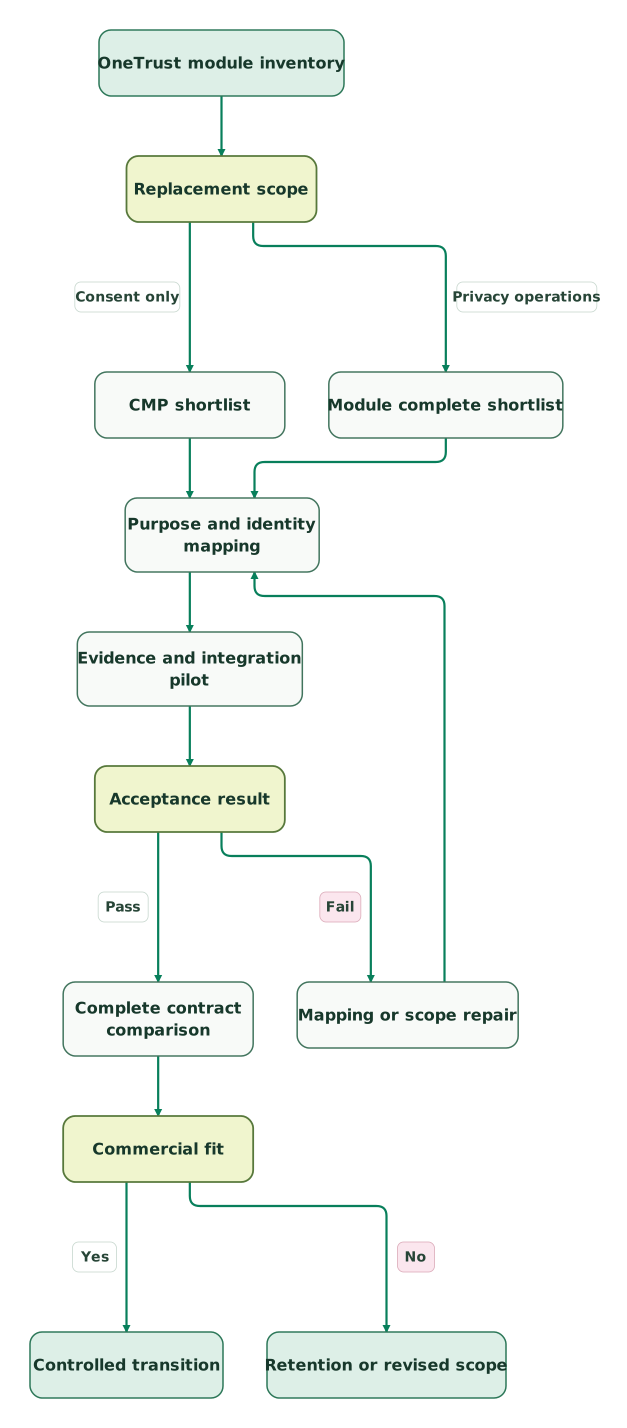
Read diagram as text
- OneTrust module inventory to Replacement scope.
- Replacement scope to CMP shortlist: Consent only.
- Replacement scope to Module complete shortlist: Privacy operations.
- CMP shortlist to Purpose and identity mapping.
- Module complete shortlist to Purpose and identity mapping.
- Purpose and identity mapping to Evidence and integration pilot.
- Evidence and integration pilot to Acceptance result.
- Acceptance result to Mapping or scope repair: Fail.
- Mapping or scope repair to Purpose and identity mapping.
- Acceptance result to Complete contract comparison: Pass.
- Complete contract comparison to Commercial fit.
- Commercial fit to Retention or revised scope: No.
- Commercial fit to Controlled transition: Yes
Replacement checklist
- Current modules, contracts and retained OneTrust responsibilities listed.
- Domains, subdomains, apps and usage meters reconciled with the quote.
- Privacy owner approval of purposes, regional behavior and withdrawal rules.
- Target editions, integrations and rights-workflow allowances confirmed.
- Recent, historical and withdrawn consent records sampled after transfer.
- First visit, refusal, partial consent and return visit tested.
- Browser tags, app SDKs and server-side destinations included in scope.
- Failed preference delivery visible to a named owner.
- Rights-request and assessment records preserved where those modules move.
- Rollback, historical access and old-script removal assigned to an owner.
Use the consent debugging skill to inspect defaults, choices and destination behavior. For implementation across tags, consent state and measurement, tracking and analytics engineering can establish the technical acceptance checks. Legal applicability and approved purposes remain with the organization's privacy owner and counsel.
Keep reading
Browse all Tracking & Attribution guides
 Tracking & Attribution
OneTrust Pricing: Compare the Quote, Usage and Renewal
Compare OneTrust CMP quotes by package, visitor usage, implementation and renewal. Includes a cost worksheet, contract checks and clear budget examples.
Jafrin Akter AloLast updated 15 min read
 Tracking & Attribution
Cookiebot vs OneTrust vs Usercentrics: costs, tag and SDK governance, and setup
Compare Cookiebot, OneTrust and Usercentrics on billing units, real site costs and governance of tags and app SDKs, then test consent before you choose a CMP.
Jafrin Akter AloLast updated 15 min read
 Tracking & Attribution
Cookiebot Pricing: Free Plan, Premium Tiers and Cost per Domain
Cookiebot costs €7 to €90 per domain a month. See the USD invoice changes from 30 November, Small eligibility, annual budgets and extra costs.
Jafrin Akter AloLast updated 14 min read
Analytics & tracking
See the implementation scope, deliverables and acceptance checks.
Questions people ask
Can Cookiebot replace every OneTrust module?
Cookiebot can be a candidate for the website cookie-consent portion of a OneTrust deployment. A broader OneTrust installation may also contain rights requests, preference management, data maps, assessments and governance records. Inventory those responsibilities before selecting a replacement. Keep them in OneTrust or assign another suitable system and owner so a cheaper banner does not create an operational gap.
Which OneTrust competitors publish useful starting prices?
Cookiebot publishes domain-and-subpage pricing, while Ketch and Osano publish entry consent plans with visitor and integration or user limits. Didomi's relevant CMP offer and broader enterprise configurations require quotes. Compare the required scope and commercial unit rather than turning these different prices into a universal ranking. Keep implementation, retained modules and renewal conditions in the same budget.
Can existing OneTrust consent survive a platform migration?
Existing consent may be transferable when its identity, purpose, notice and withdrawal meaning remain valid in the new implementation. Ketch documents a specific migrator for the OneTrust Cookie Consent script, including existing-cookie reading and category mapping. That technical mechanism does not resolve every legal or product-scope question. Validate representative records and have the privacy owner approve the treatment before cutover.
Does Consent Mode v2 make a replacement CMP compliant?
Consent Mode communicates choices to supported Google tags and changes their behavior. It does not decide the organization's legal basis, configure every non-Google destination or prove that the notice and choice are valid. Basic and advanced implementations also send different traffic before consent. Select the approved behavior, then test the banner, tags, cookies and downstream systems together.
What causes an unexpected OneTrust replacement bill?
Common causes include a different visitor definition, extra domains or subdomains, required integrations, rights workflows, migration and retained incumbent modules. Osano's self-service visitor allowances and contracted traffic definition illustrate why the actual order form matters. Build a complete property and workflow inventory, request the vendor's measurement rules, and calculate both recurring cost and one-time switching cost before approval.
Sources
- OneTrust pricing and packaging
- Cookiebot pricing
- Didomi offers
- Didomi CMP scope
- Osano self-service consent plans
- Osano platform plans
- Osano traffic definition
- Ketch pricing
- Ketch OneTrust migrator
- TrustArc product families
- TrustArc consent and preferences
- ICO advertising-cookie checks
- California Global Privacy Control guidance
- Google consent-mode behavior
- Google consent setup
- GTM consent controls
- OneTrust export instructions
- OneTrust receipt API

Written by
Jafrin Akter AloData Engineer and Co-founder at Martechdevs and Growth and Analytics Partners
Jafrin writes practical guides to marketing technology, customer data, analytics and AI workflows. Martechdevs is a Growth and Analytics Partners company.