
MoEngage Alternatives for Mobile Journeys, Identity and Migration
Choose Braze for a mobile engagement program with broad channel governance, Customer.io for an event-driven program with an accountable engineering owner, or Iterable for a campaign team that fits its project and journey model. MoEngage alternatives should preserve the customer decisions your current Flows make. Compare identity, preferences, exits and transition costs before replacing a working platform.
On this page
MoEngage competitors compared
The public entry amount below is in USD with monthly billing; enterprise quotes need an equivalent audience and channel scope.
| Alternative | Starting commercial scope | Best fit | Main tradeoff |
|---|---|---|---|
| Braze | Tailored quote for edition, audience, action credits and services | App-led engagement across several channels | The full contract and mobile implementation need qualification |
| Customer.io | Essentials from $100/month, with 5,000 profiles and 1 million monthly emails | Product events and relationship-driven messaging | Profiles include people and objects; engineering ownership matters |
| Iterable | Sales estimate for the required scope | A maintained cross-channel campaign operation | Project identity and journey behavior must fit the business |
Braze pricing, Customer.io pricing and Iterable sales establish those commercial routes. An entry subscription is a starting configuration, while a tailored quote needs the actual workload.
MoEngage already offers cross-channel Flows, conditional splits, delivery controls and preferences. Its plan table distinguishes segment exports from additional data services, including Streams and warehouse-related options. A replacement assessment therefore starts with the jobs and entitlements in your account. A shorter competitor feature list can still fit a narrower program, but it needs to preserve every required behavior. MoEngage plans and pricing
At Martechdevs, we would define the customer-state trial before selecting a replacement. Our lifecycle messaging implementation service covers the data, preferences and journey handoffs that make that trial useful.
The replacement requirement
Write one sentence describing the reason for leaving MoEngage. It might be an unsupported data relationship, a workflow the team cannot maintain, or an operating cost that no longer matches the program. Turn that reason into an observable acceptance condition. “Less complicated” becomes a named operator changing a condition, reviewing affected customers and publishing through the required approval process.
Separate a product gap from an implementation gap. An event with the wrong customer identifier remains wrong after migration. A forgotten stop condition can keep sending reminders in any platform. MoEngage's Flow visualization and versioning features can help inspect current paths and settings before deciding that a replacement is necessary. MoEngage Flow visualization and versioning
The inventory should include active Flows, one-off campaigns, transactional messages, mobile surfaces, channels and preference categories. Record each workflow's trigger, customer identifier, expected completion event, last message and responsible owner. Include the integrations that update those conditions. An apparently simple reminder can depend on billing data, app releases and a customer support exclusion.
Retiring an unnecessary workflow is often cheaper than rebuilding it. Give each existing journey one of three destinations: retain temporarily, rebuild with a defined acceptance test, or retire with an owner. Preserve enough historical reporting to explain the transition, even when the old workflow will never run again.
Platform fit
Braze for app-led orchestration
- Best for: Teams whose mobile app, in-app experiences and coordinated channels justify a broader engagement platform.
- Pros: The edition model supports different levels of orchestration and governance, while audience and action-credit scope can be specified together.
- Cons: A headline channel count says little about implementation work, credit consumption or the edition needed for a particular control.
- Free plan and startup offer: Braze states that it has no general free plan. Trials are available, and its startup page offers potential free access through VC partners, subject to qualification. Braze startup options
- Choose it if: The same app identity and cross-channel cases pass in the quoted edition, with a funded owner for mobile and messaging changes.
- Skip it if: The actual requirement is a small email program and the wider platform introduces work that the team has no reason to own.
Treat Braze as a candidate for the full app lifecycle, including the moment an unidentified visitor becomes a known customer. Its identify endpoint associates an unidentified record with an external ID. That capability still requires a deliberate mapping from your application's identifiers and a reconciliation test for existing records. Braze user identification
Keep the commercial definition equally specific. Braze identifies platform edition, monthly active users and profiles, action credits and services as contract components. Ask for the same channel volumes and audience assumptions used in the MoEngage renewal comparison. Credit quantities alone cannot establish the amount of useful messaging included.
Customer.io for product and account events
- Best for: Product teams that can maintain reliable events, customer attributes and relationships alongside their messaging program.
- Pros: Objects and relationships support cases in which a person belongs to a company, subscription or other business entity.
- Cons: That model needs a clear owner, and object records contribute to the profile allowance rather than disappearing from the cost calculation.
- Free plan and startup offer: The ordinary trial lasts 14 days and allows up to 5,000 messages across channels, subject to lower daily limits. Eligible new customers can apply for up to 12 months with 30,000 profiles through the startup program. Trial limits and startup eligibility
- Choose it if: Product state and relationships determine the messages, and the team can explain and maintain those dependencies.
- Skip it if: Nobody can own event quality, identifiers or the relationship updates that determine the audience.
The startup route requires less than $10 million in total funding, contact lists obtained through standard rather than purchased methods, and no current or previous Customer.io customer relationship. Approval and the eventual graduation offer belong in the budget discussion. An application is not an approved discount.
For the technical fit, test a change to an account object and the intended recipients related to that object. Customer.io supports creating objects, relating them to people and triggering automations from object or relationship changes. The acceptance condition should identify the intended recipient and the specific account involved. Customer.io objects
If the choice is moving toward a smaller marketing platform, the narrower Customer.io versus ActiveCampaign comparison evaluates contact workflows and product events. The Customer.io versus Mailchimp comparison addresses campaigns, billable audiences and store-dependent exit behavior.
Iterable for the campaign operating model
- Best for: Teams that want cross-channel journeys and can make an explicit project-identity decision before importing customers.
- Pros: Journey exit rules and project choices provide concrete controls to evaluate against the existing program.
- Cons: Identity uniqueness and exit timing have details that a visual journey demonstration can hide.
- Free plan and startup offer: Iterable offers a sales-assisted pricing estimate and product demo. Its sales page does not publish a general free tier or startup allowance; obtain any evaluation duration, sending permission and discount terms in writing. Iterable evaluation route
- Choose it if: The required identity model and representative journeys work in the proposed project, and campaign owners can maintain them.
- Skip it if: The project would force an unacceptable identity compromise or the team cannot reproduce important exit cases.
Iterable's hybrid projects enforce uniqueness for both email and userId. UserID-based projects enforce userId uniqueness without requiring unique email addresses. Legacy email-based projects have limited availability. A business with shared email addresses or several distinct customers behind one address should settle this choice before transferring records. Iterable project types
Exit rules also need a real case. Iterable documents special handling for customers in time delays and warns that a message scheduled through Send Time Decisioning can still send after a journey exit. Test the exact sending configuration used by the business instead of assuming every exit cancels every queued delivery. Iterable journey exits
A shared customer-state trial
Use the same controlled customer cases in every candidate. Each case needs an input, a known expected result and an observation from the destination. The following is a proposed evaluation fixture, not a claim about a completed vendor trial.
| Customer case | Input change | Required observation | Failure consequence |
|---|---|---|---|
| Anonymous visitor becoming known | A stable account identifier replaces anonymous context | Intended history and current state belong to the correct customer | Identity mapping repair |
| Customer completing the desired action | Completion arrives during a reminder delay | Later unwanted reminders are excluded | Exit or queued-message repair |
| Customer changing preferences | One topic is disabled while another remains enabled | Only eligible message categories remain available | Preference mapping repair |
| Customer using several devices | Activity arrives from the selected test devices | The right customer receives the intended channel treatment | SDK or device mapping repair |
| Customer already in an old Flow | A known current step and last-send record | A deliberate continuation or retirement outcome | Cutover-state repair |
For Customer.io, exit conditions use OR logic: meeting any configured exit criterion can end the journey. Removing all exit conditions lets people complete the automation. Record the exact exit logic in the acceptance fixture, especially where the old business rule requires several conditions to be true together. Customer.io automation exits
Do not use one successful welcome message as evidence for the entire migration. The delayed, excluded and already-completed cases usually determine whether the operational design is sound. After a mapping repair, repeat the affected case from its starting state so a previously corrected profile does not conceal the original failure.
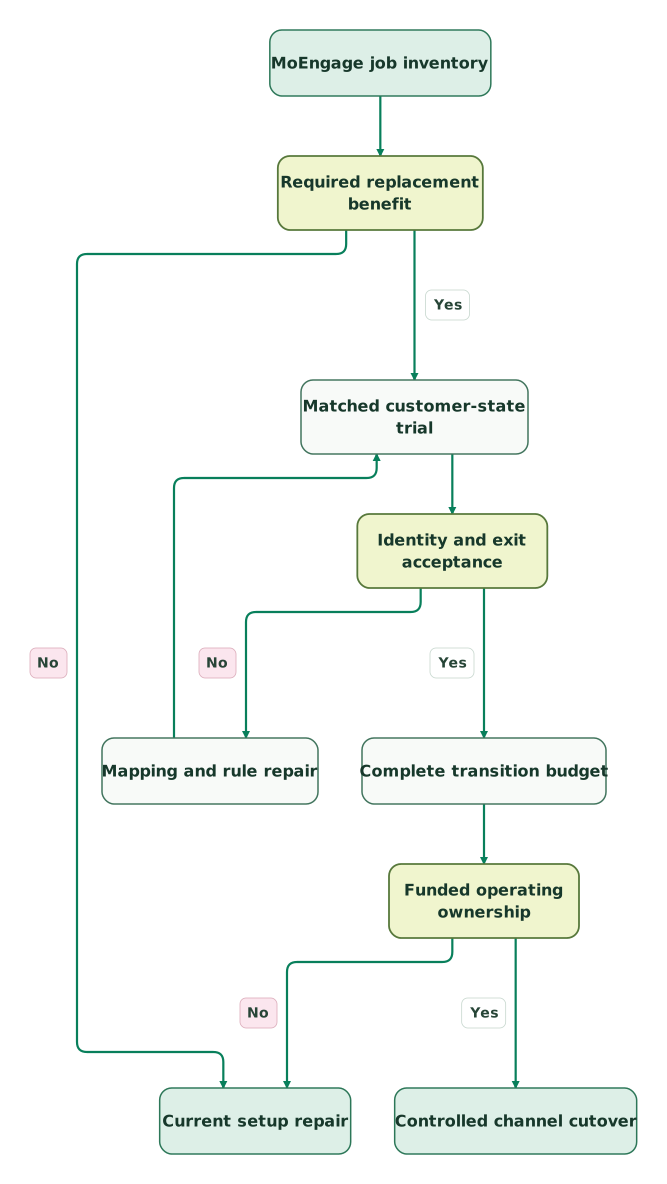
Read diagram as text
- MoEngage job inventory to Required replacement benefit.
- Required replacement benefit to Current setup repair: No.
- Required replacement benefit to Matched customer-state trial: Yes.
- Matched customer-state trial to Identity and exit acceptance.
- Identity and exit acceptance to Mapping and rule repair: No.
- Mapping and rule repair to Matched customer-state trial.
- Identity and exit acceptance to Complete transition budget: Yes.
- Complete transition budget to Funded operating ownership.
- Funded operating ownership to Current setup repair: No.
- Funded operating ownership to Controlled channel cutover: Yes
The diagram separates the reason to move from the ability to move safely. Passing the technical cases permits a commercial and operating decision; it does not make the migration mandatory.
Transition cost and the renewal decision
Compare the annual operating difference after the implementation scope is known. Include subscription, paid channels, data movement, support, retained infrastructure and the team's continuing administration. The software pricing tools help organize public plan inputs, but quoted platform scopes still need a consistent worksheet.
Consider a hypothetical company evaluating an annual operating saving of $6,000. Assume $9,000 of one-time transition work and no additional overlap expense for this simplified illustration. These are planning inputs, not vendor prices or expected results.
| Calculation | Formula | Result | Interpretation |
|---|---|---|---|
| Monthly operating saving | $6,000 ÷ 12 months | $500/month | Assumed recurring difference |
| Simple payback | $9,000 ÷ $500/month | 18 months | Time to recover the transition input |
| First-year net saving | $6,000 − $9,000 | −$3,000 | First-year cost increase |
| Two-year net saving | 2 × $6,000 − $9,000 | $3,000 | Before overlap and changed operating assumptions |
A renewal discount or a reduced workflow scope can change that result. So can a mobile release delay that extends the overlap period. Add those amounts explicitly instead of folding them into a vague contingency percentage. For a new public entry configuration, Customer.io Essentials would be $1,200 over 12 months at an unchanged $100 monthly base; that arithmetic says nothing about whether the company fits the included profile and message allowances.
Use the Braze versus Iterable comparison for a deeper shortlist between those two options. Keep this MoEngage assessment focused on the replacement requirement and the cost of preserving its actual program.
Best fit by operating model
| Company size or model | Best fit | Runner-up | Reason |
|---|---|---|---|
| Mobile business with several channels and dedicated lifecycle operations | Braze | Iterable | App behavior and governance drive the trial |
| Product company with an engineering owner and account relationships | Customer.io | Iterable | Product state and relationship data define the audience |
| Established campaign team with a suitable project identity model | Iterable | Braze | Daily journey maintenance and identity rules are decisive |
| Small team with a sound MoEngage setup and no material replacement benefit | Retain MoEngage | Customer.io | Repairing or simplifying the existing program may have the lower transition cost |
Company size is a useful planning clue, but the operating model makes the recommendation. A small app can need careful device and identity handling. A large business can run a deliberately narrow email program.
Migration acceptance checklist
- A specific replacement benefit has an owner and a measurable acceptance condition.
- Active Flows, transactional sends and customer exclusions have documented destinations.
- Identity, object and device cases pass with representative controlled records.
- Completion and preference changes prevent the intended later messages.
- Existing journey membership has a continuation, retirement or restart decision.
- Channel permissions, data exports and retained history are covered by the selected package.
- Subscription, overlap, implementation and ongoing ownership appear in the same budget.
- One system owns each production message during cutover, with a defined reversal point.
The lifecycle marketing audit skill provides a useful structure for reviewing the existing program before procurement. Preserve the accepted cases as operating checks after the new journeys launch.
Keep reading
Browse all CRM & Lifecycle guides
 CRM & Lifecycle
Customer.io vs ActiveCampaign for Product Events and Marketing Automation
Compare Customer.io and ActiveCampaign through product events, contact creation, relationships, plan-specific actions and a reproducible operating budget.
Jafrin Akter AloLast updated 11 min read
 CRM & Lifecycle
Customer.io vs Mailchimp for Campaigns, Product Events and Customer State
Compare Customer.io and Mailchimp by billable audiences, product events, store-dependent exits, automation limits and the full cost of changing platforms.
Jafrin Akter AloLast updated 11 min read
 CRM & Lifecycle
Braze vs Iterable for Cross-Channel Journeys and Customer Identity
Compare Braze and Iterable through customer identity, project rules, journey exits, operator ownership and a complete migration-cost model.
Jafrin Akter AloLast updated 11 min read
Lifecycle marketing
See the implementation scope, deliverables and acceptance checks.
Questions people ask
Is a MoEngage replacement necessary for a confusing Flow?
A confusing Flow does not automatically require a replacement. First identify whether its problem comes from data, conditions, ownership or a product limitation. Simplifying a journey can improve its operation without a platform change. A replacement becomes a stronger case when the required behavior still cannot be maintained after the current configuration has been examined and the migration benefit is specific.
Can Customer.io startup access justify leaving MoEngage by itself?
Startup access alone is a weak reason to migrate. Eligibility, approval, profile scope and the eventual paid plan all matter, while implementation and channel costs remain. Use the offer only after the required identity and journey cases pass. Compare the accepted post-program cost with the MoEngage renewal so a temporary benefit does not hide a more expensive operating arrangement.
Does an Iterable exit remove every message already scheduled?
An Iterable journey exit should not be treated as a universal cancellation of every scheduled message. Its documentation identifies a Send Time Decisioning case in which the selected delivery still occurs after exit. Include that configuration in the trial if the business uses it, and require the expected customer outcome before transferring a reminder or promotion that must stop after completion.
Are exported MoEngage segments enough to rebuild current journeys?
Exported segments alone do not describe the full journey state that a migration needs. Record current membership, last messages, delays, preferences and the intended next action separately. Verify the actual export fields and timing available in the account. Then decide which customers should continue, restart under explicit conditions or finish in MoEngage before that workflow is retired.
Can a smaller lifecycle team choose Braze over Customer.io?
A smaller team can choose Braze when the app and channel requirements justify it and the operating responsibilities are funded. Team size does not determine identity complexity or customer expectations. Compare a concrete mobile journey, the required governance and the complete quote. Customer.io remains a useful runner-up when its event and relationship model handles the same work with manageable ongoing effort.
Sources
- MoEngage plans and pricing
- MoEngage Flow visualization and versioning
- Braze pricing
- Braze startup options
- Braze user identification
- Customer.io pricing
- Customer.io plan and trial limits
- Customer.io startup eligibility
- Customer.io objects
- Customer.io automation exits
- Iterable evaluation route
- Iterable project types
- Iterable journey exits

Written by
Jafrin Akter AloData Engineer and Co-founder at Martechdevs and Growth and Analytics Partners
Jafrin writes practical guides to marketing technology, customer data, analytics and AI workflows. Martechdevs is a Growth and Analytics Partners company.