
Metabase vs Looker: Semantic Models, Reporting Work and Cost
Pick Metabase when a small team needs accessible database reporting with a manageable setup; pick Looker when reusable business definitions and a maintained LookML development process are central requirements. Metabase vs Looker is a choice about who owns the analytical model and its changes. Compare the complete reporting workflow, permissions and operating cost before treating either product as a collection of charts.
On this page
Metabase vs Looker comparison
The USD offers below separate Metabase subscriptions from Looker's quoted platform and user arrangements.
| Decision | Metabase | Looker, Google Cloud core |
|---|---|---|
| Commercial entry | Free self-hosted Open Source; Starter $100/month or $1,080/year with five users | Annual platform commitment priced through sales, plus the applicable user arrangement |
| Higher-scope example | Pro $575/month or $6,210/year with ten users | Standard, Enterprise and Embed editions with different scope |
| Shared definitions | Reusable metrics attached to a data source | LookML models describing dimensions, measures and relationships |
| Main operating responsibility | Prepared data, curated questions and appropriate permissions | Maintained LookML, development ownership and model acceptance |
| Typical selection reason | A focused reporting workflow the team can administer | A shared analytical model used across recurring business questions |
The subscription figures and included users come from Metabase pricing. Looker's pricing page distinguishes platform and named-user licensing; its platform tables direct buyers to sales. Looker here means the core BI platform, not the separate reporting product formerly called Looker Studio. The Looker and Data Studio comparison explains that distinction.
We would start with a report that several teams interpret differently. Ask its owner to define the population, business event, time window and allowed breakdowns. Then assess how each platform lets the team maintain that definition and investigate a disagreement.
At Martechdevs, we build the underlying models and reporting checks through our data warehouse and reporting service. A useful pilot shows that a second maintainer can explain the number and change it safely, alongside the original author.
Metabase and Looker decisions
Metabase
- Best for: A team with prepared database tables and a practical need for shared questions, dashboards and reusable calculations.
- Pros: Reusable metrics can standardize an aggregation across questions using the relevant source. The query builder makes that definition available without requiring every reader to rewrite it. See Metabase metrics.
- Cons: The chosen edition and query route affect access controls. A saved SQL question needs its own permission review; a protected query-builder table does not automatically protect every SQL result.
- Free plan and startup offer: Open Source is free to self-host. Starter and Pro advertise fourteen-day trials. The budget below uses ordinary pricing without an assumed startup concession. See deployment and trial options.
- Choose it if: The team can maintain the source data and required access boundaries, and its recurring reporting tasks fit the selected edition.
- Skip it if: The proposal assumes all model governance, isolation or identity requirements are available in the entry plan without qualification.
Looker
- Best for: An organization prepared to maintain a shared semantic model and a repeatable development process for analytical definitions.
- Pros: LookML describes calculations and relationships used to generate database queries. Developers can maintain that model while business users explore the approved fields. See LookML concepts.
- Cons: The model needs an owner and review process. A centrally defined metric can still be centrally wrong, and a platform quote alone excludes the work of maintaining it.
- Free plan and startup offer: The current core platform pricing uses a sales-assisted annual commitment. Agree evaluation access, included roles and duration in the offer; no permanent free core instance or startup credit is assumed. See Looker commercial scope.
- Choose it if: Shared model development solves a recurring organizational problem and the team can fund both the platform and its ongoing ownership.
- Skip it if: A small reporting requirement would acquire a development dependency that nobody has time to maintain.
Shared definitions and model ownership
LookML separates the model of the data from the questions asked of it. Model and view files describe tables, joins and calculations, typically with version control. The Explore interface uses that model to generate SQL for the connected database. This provides a development boundary that a team can review and maintain. See Looker's modeling introduction.
That boundary is valuable when many reports need the same business logic. A finance-approved revenue definition should not change merely because a marketer selects a different visualization. The useful outcome is consistent meaning across approved uses, with a clear process for correcting the definition.
Metabase also has a semantic layer. Its metrics define reusable aggregations and their available dimensions. A metric belongs to a particular data source, and questions using that metric pick up a changed definition. This makes the scope of reuse important: an identically named metric on another source is not automatically the same maintained object. See metric sources and changes.
Avoid reducing the comparison to a claim that one tool has definitions and the other has none. Identify the definitions the company needs, where they live and how changes reach dependent reports. Then test whether the proposed workflow makes those responsibilities clear.
The marketing metric contracts guide is a useful starting point. Write the expected numerator, denominator, event time and exclusions before expressing the metric in either platform.
A hypothetical revenue reconciliation
Consider a small synthetic dataset with two orders: order A for $100 and order B for $60. Order A has two line items; order B has one. Joining order totals directly to line items and then adding the repeated order amount produces $260, even though the actual order total is $160.
| Hypothetical measure | Calculation | Result | Interpretation |
|---|---|---|---|
| Order total at order grain | $100 + $60 | $160 | Each order counted once |
| Naive total after the line-item join | $100 + $100 + $60 | $260 | Order A repeated twice |
| Overstatement | $260 minus $160 | $100 | A modeling error, not additional revenue |
| Net amount after an assumed $40 return | $160 minus $40 | $120 | A separately defined business metric |
The pilot should recover $160 for gross order value and $120 for the stated net definition. A model that happens to return the right number for this one dataset still needs further cases. Add an order with no line items, another with a partial return and two orders with equal amounts. Those cases help expose a repair that merely hides the original error.
For example, summing distinct monetary values is not a general correction for repeated orders. Two genuine orders can have the same value. The business key and grain must determine the aggregation. Both platforms need an accepted source model or calculation that respects those relationships.
Keep the fixture small enough to calculate independently. A large dashboard total can look plausible while being wrong. A known set of orders, returns and customers lets the business owner explain exactly which records belong in each result.
Development checks and release control
Looker distinguishes syntax validation, content-reference validation and model data tests. A data test runs a query and checks an assertion for each result row. Project configuration can require those tests before production deployment. These are useful controls, but their coverage depends on the cases the developer writes. See LookML data tests.
A test for the synthetic revenue fixture should check the expected total and the relevant breakdowns. Also inspect a missing join and a changed dimension. Passing a query with one row says little about an untested customer segment or date boundary.
Google documents a 5,000-row limit for the test query's result set. Keep tests bounded and deliberate rather than interpreting a passing truncated result as complete validation of a large population. A useful assertion can often return a small aggregate or exception count. See data-test query limits.
For Metabase, retain expected results alongside the source model and the questions that depend on it. When a reusable metric changes, repeat the affected reports and filters. Metabase documents that dependent questions immediately use the new metric definition, so a seemingly small edit can affect several readers at once. See metric editing behavior.
In either workflow, make the review concrete. Record the old definition, intended change, affected reports and expected values. Have a second person reproduce a representative result before the change becomes the basis for a business decision.
Permissions and the SQL boundary
Metabase separates permissions for viewing data, creating queries, downloading results and managing metadata. Some controls, including the explicit View data permission, belong to Pro and Enterprise. Check the actual edition rather than treating a permission label in a demo as an entry-plan promise. See Metabase data permissions.
Its row and column security also has a specific boundary. The feature is available on Pro and Enterprise and applies to the query-builder route. Metabase states that row and column security does not restrict the results of SQL questions; collection permissions and the appropriate database access design therefore matter. See row and column security limitations.
Test a restricted user against the intended question, an export and any shared SQL content. A dashboard filter is not sufficient evidence of isolation. Include memberships in other groups, because a more permissive group can change the result of the access design.
Looker's named-user roles also differ. A Viewer can inspect and filter permitted content but cannot create Looks or dashboards or use Explore. A Standard user has broader analytical authoring access, while Development Mode belongs to the Developer role. Map actual tasks to those roles before building a cost model. See Looker user entitlements.
Authentication and data access are separate decisions. Metabase's free Google Sign-In option should not be confused with its paid identity-provider options. If SAML or JWT authentication is required, qualify that exact requirement rather than assuming every kind of single sign-on requires the same plan. See Google Sign-In and Metabase plans.
Metabase and Looker cost planning
Metabase Starter includes five users, with additional annual users at $65 each. Pro includes ten users, with additional annual users at $130 each. The table applies the published annual bases to hypothetical internal teams; it excludes infrastructure outside the subscription, implementation, data processing and optional usage. See Metabase prices.
| Hypothetical licensed team | Starter annual calculation | Starter annual amount | Pro annual calculation | Pro annual amount |
|---|---|---|---|---|
| 15 users | $1,080 + 10 × $65 | $1,730 | $6,210 + 5 × $130 | $6,860 |
| 30 users | $1,080 + 25 × $65 | $2,705 | $6,210 + 20 × $130 | $8,810 |
These totals compare editions, not equivalent feature packages. For fifteen Starter users on monthly billing, the corresponding base arithmetic is $100 + 10 × $6 = $160/month, or $1,920 across twelve unchanged payments. Annual billing is a different commitment, and the required features still determine whether Starter fits.
For Looker, obtain a quote specifying the platform edition, included roles, additional users and required usage. The public core platform offers include ten Standard and two Developer users; do not add those included roles again as if every user were incremental. The same quote should identify the treatment of external analytics and any additional usage. See Looker platform and user pricing.
A hypothetical operating worksheet might allocate $600 per month to maintaining the shared model, or $7,200 per year. This is an illustrative internal budget. Replace it with the ownership and work the pilot establishes, and keep it separate from the vendor subscription.
The Looker pricing guide and software pricing tool help organize the complete offer. Include database processing, model development, support and the overlap period during migration.
Best fit by reporting organization
| Company or operating model | Best fit | Runner-up | Decision reason |
|---|---|---|---|
| Small team with prepared tables and a focused dashboard set | Metabase | Looker | Administration and reporting scope can remain modest |
| Several departments sharing a maintained analytical model | Looker | Metabase with explicit metric ownership | Model development is part of the recurring operating process |
| Existing LookML team with reliable business definitions | Looker retention | Metabase pilot | Working models and knowledge have replacement value |
| Small team requiring row-level self-service access | Qualified Metabase Pro pilot | Looker | Actual permissions and SQL routes decide suitability |
| Team with unexplained duplicated totals | Model repair before purchase | Either tool after reconciliation | A new chart editor does not establish the correct grain |
The Metabase alternatives guide widens the shortlist if neither workflow fits. Keep the replacement reason specific enough that a pilot can resolve it.
Reporting-model selection workflow
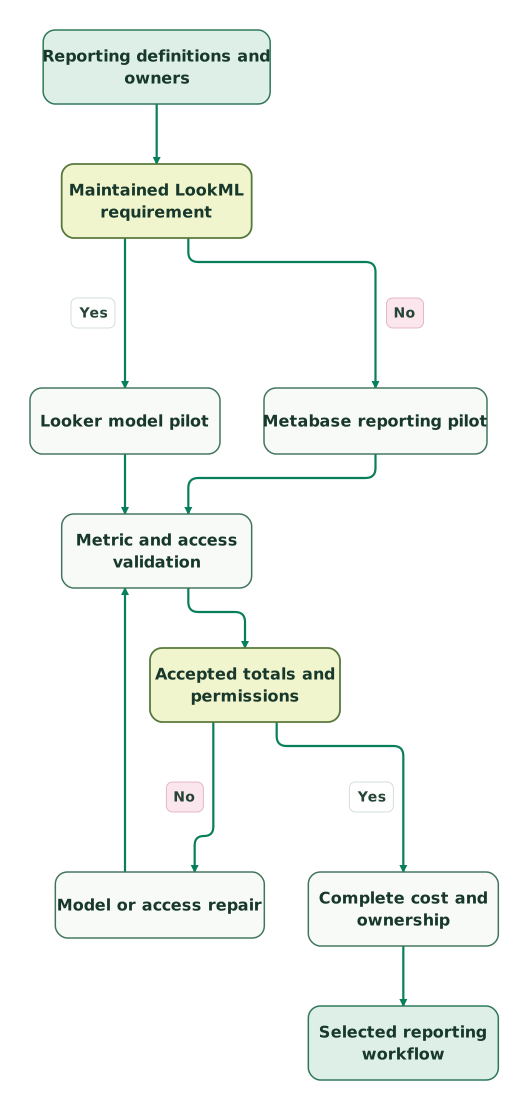
The graph selects an initial pilot from the team's model-development requirement. Both paths must pass metric and access checks; a repair returns to those checks before the commercial and ownership decision.
Read diagram as text
- Reporting definitions and owners to Maintained LookML requirement.
- Maintained LookML requirement to Looker model pilot: Yes.
- Maintained LookML requirement to Metabase reporting pilot: No.
- Looker model pilot to Metric and access validation.
- Metabase reporting pilot to Metric and access validation.
- Metric and access validation to Accepted totals and permissions.
- Accepted totals and permissions to Model or access repair: No.
- Model or access repair to Metric and access validation.
- Accepted totals and permissions to Complete cost and ownership: Yes.
- Complete cost and ownership to Selected reporting workflow
Metabase and Looker checklist
- A named owner for every important shared definition.
- Agreed source grain, business keys and time boundaries.
- Small fixtures for joins, returns and equal-valued records.
- A known expected total and filtered breakdowns.
- A second maintainer able to review a definition change.
- Restricted-user checks across queries, SQL content and exports.
- Edition and identity-provider requirements stated precisely.
- User roles and included seats reconciled with the quote.
- Database, model maintenance and transition costs included.
Use the marketing data audit skill to keep the source and reconciliation evidence together. The selected platform should leave the team able to explain its numbers and investigate the next disagreement.
Keep reading
Browse all Data Warehouse guides
 Data Warehouse
Looker Pricing: Platform Quotes, User Licences and the Full BI Bill
Build a Looker budget from quoted platform costs, user roles, API limits, warehouse queries and AI usage. Includes company examples and a contract checklist.
Jafrin Akter AloLast updated 11 min read
 Data Warehouse
Metabase Alternatives: Lightdash, Omni, Evidence, Superset and Power BI Compared
The best alternatives to Metabase: Lightdash for metrics in code, Omni for shared definitions, Evidence for code-built reports, free Apache Superset and Power BI.
Jafrin Akter AloLast updated 35 min read
 Data Warehouse
Marketing Metric Contracts: Make the Definition as Reliable as the Dashboard
Define reliable marketing metrics with clear grain, denominators, time windows, dimensions and tests. Includes an activation contract and worked examples.
Jafrin Akter AloLast updated 12 min read
Data warehouse & CDP
See the implementation scope, deliverables and acceptance checks.
Questions people ask
Does a Metabase comparison with Looker also cover the free Data Studio product?
A Metabase comparison with core Looker does not also cover the separate Data Studio reporting product. Core Looker uses LookML and its own platform and user arrangements. Confirm the product named in the proposal before comparing prices or implementation work. The Looker and Data Studio guide explains the different reporting and modeling boundaries.
Can two Metabase metrics with the same name be treated as one shared definition?
Two Metabase metrics with the same name should not automatically be treated as one shared definition. Metrics belong to their configured data sources, and their formulas and permitted dimensions can differ. Check the actual maintained object used by each question before claiming consistent revenue or conversion reporting. See Metabase metric sources.
Does a successful LookML syntax check prove that the revenue total is correct?
A successful LookML syntax check does not prove that the revenue total is correct. Looker separately provides data tests for assertions about query results. Those tests still need relevant cases and expected values, including join duplication and business exclusions. Keep the test result set within its documented limit. See LookML data testing.
Can Metabase row security be assumed to restrict every saved SQL result?
Metabase row security cannot be assumed to restrict every saved SQL result. Its documentation says row and column security does not apply to SQL-question results. Review collection permissions and the database access route, then test with the restricted reader. A protected query-builder table alone is insufficient evidence. See Metabase security limitations.
Should every person in a Looker cost estimate be added beyond the platform bundle?
Every person should first be reconciled against the roles already included in the Looker platform offer. The published core packages include ten Standard and two Developer users, while additional access depends on the purchased arrangement. List actual tasks, allocate the included roles and then identify incremental licenses. See Looker's platform and user scope.
Sources

Written by
Jafrin Akter AloData Engineer and Co-founder at Martechdevs and Growth and Analytics Partners
Jafrin writes practical guides to marketing technology, customer data, analytics and AI workflows. Martechdevs is a Growth and Analytics Partners company.