
Metabase Alternatives: Choose by How Your Team Builds and Owns Analytics
Data Engineer and Co-founder, martechdevs
Last updated 10 min read
Choose a Metabase alternative around the workflow your team cannot support well today. Lightdash emphasizes metrics defined in code, Omni connects local exploration with shared definitions, Evidence supports report development in code, Superset offers an open-source SQL-oriented platform, and Power BI has an established embedding architecture. Test the authoring, review and access model before comparing dashboard screenshots.
Last updated: 8 September 2026.
Leaving Metabase can be justified. It can also be an expensive way to avoid cleaning up duplicated questions, unclear metrics or unmanaged permissions. The deciding question is whether a different operating model solves a persistent need better than improving the current deployment.
This comparison focuses on who creates analytical definitions, how changes become trusted, and who maintains the result. Those responsibilities matter long after the initial dashboard demo.
What has Metabase actually stopped you from doing?
Write down the last three requests that caused difficulty. Name the requested result, the workaround and the time spent. Separate a product limitation from missing data, missing skills or an unfinished implementation.
Examples of useful reasons to evaluate alternatives include:
- Your analytics engineers want metric changes reviewed alongside transformation code.
- Analysts need freedom to investigate locally, with a clear route for promoting useful work into shared definitions.
- Your output is an explanatory report or analytical application, rather than a collection of charts.
- Your platform team wants a particular open-source deployment and customization model.
- Your product needs an embedded reporting experience that fits its identity and commercial architecture.
If the problem is simply “nobody trusts revenue,” first investigate the grain, joins and definitions. The Metabase implementation guide covers those checks. Our warehouse and analytics work can help turn the underlying requirement into a tested reporting model before the team commits to a tool migration.
Also examine current Metabase capabilities rather than an old comparison. Its modeling area now includes reusable measures and segments, a curated Library and dependency tools, with plan distinctions. A claim that Metabase has no shared modeling workflow would miss that evolution. Current Metabase modeling documentation.
Lightdash: evaluate it for metrics maintained as code
Lightdash supports metric definitions in dbt metadata and its own YAML format. Its documentation distinguishes aggregate, non-aggregate and post-calculation behavior, so implementation requires more than transferring a field name and display format. Lightdash metric reference.
This direction fits a team that already treats analytical definitions as reviewed code and wants its business-facing exploration to use those definitions.
Test the change process, not only the initial result. Ask an engineer to add a qualified-pipeline metric, review it, publish it and show a business user how to find it. Then change an exclusion rule and examine the effect on existing reports.
If you already use dbt MetricFlow, do not assume every metric translates automatically. Lightdash documents a supported subset, warnings for unsupported cases and same-model constraints for translated ratio and derived metrics. MetricFlow integration.
Use your hardest metric in the trial. A simple sum proves little if the business depends on a cross-model ratio, a time-shifted measure or a special filtering rule. Record the generated result and any translation warnings, then compare it with an independently agreed reference.
The ownership question is straightforward: who will maintain the definitions when the analyst who set them up leaves? If nobody is comfortable reviewing those files, the workflow advantage may become a maintenance burden.
Omni: evaluate the path from exploration to shared meaning
Omni documents three layers: a schema model reflecting the database, a shared model for organization-wide definitions, and workbook models for local analysis. Joins and fields developed locally can be promoted into the shared model. Omni's modeling approach.
That is worth evaluating when analysts need to investigate a new idea without immediately changing the model used by everyone else.
Use a realistic experiment. An analyst suspects that a new activation milestone predicts stronger retention. They create a provisional definition in their working analysis. A product manager reviews it. The data owner decides whether the milestone is stable enough to become shared.
The trial should show each transition. Who can create the local field? Who can promote it? How does a reader distinguish a provisional calculation from a trusted company metric? What happens to older workbooks after the shared definition changes?
Those questions are recommended acceptance criteria, not claims that every workflow is automatically governed by the product. The tool provides mechanisms; your team must decide who is accountable for using them.
Compare this with the equivalent disciplined workflow in your existing setup. If the practical improvement is small, avoid a migration justified only by an appealing description of the architecture.
Evidence: evaluate it for authored analytical reports
Evidence's current open-source project describes building reports with SQL and Markdown, developing locally or with its tools, and publishing through Evidence Studio or self-hosting. Official Evidence repository.
This is a different authoring choice from asking every business user to build charts interactively. It can suit a team delivering an explanatory weekly report, a customer-facing analysis or a carefully designed decision page.
Give the trial an editorial task: explain why net revenue fell, show the relevant breakdown, state the data cutoff and link to the records that support the conclusion. Ask a second author to update the explanation after a corrected data load.
Evidence's publishing documentation describes branch-based publishing, previews and validation checks, plus rollback through publish history. Publishing workflow.
Assess whether that review process fits your team's work. A report maintained like software needs someone to handle failed builds, changed data contracts and deployment settings. It also needs someone accountable for the explanation, because a technically valid report can still tell the wrong story.
For sensitive or customer-specific content, verify the exact hosting, authentication and data-access design in the version you deploy. Do not infer production authorization from a working local report or assume self-hosted and managed deployments have identical configuration requirements.
Apache Superset: evaluate an engineering-owned exploration service
Superset provides open-source visualization, SQL Lab, physical and virtual datasets, and a semantic layer for reusable analytical definitions. Superset overview.
It is a candidate when your team wants to operate and adapt that platform and already has the skills to support a shared analytical service.
The trial should include platform work, not only chart creation. Ask the team to connect through the intended database account, configure a restricted audience, deploy a change and recover a known configuration. Include the support path for a report that stops loading during a business review.
Avoid an unfair comparison in which a managed product includes an operational owner but the self-hosted option assumes someone will maintain it in their spare time. Assign the actual person, estimate their work and confirm their availability.
Also test the analyst's recurring tasks. If your team works primarily through a visual query interface, demonstrate the ordinary follow-up questions with its real users. A technically flexible SQL platform is useful only if the chosen workflow reaches the people who need the answers.
Power BI: evaluate it when embedding is a product requirement
For customer-facing analytics, Power BI distinguishes an app-owns-data embedding scenario and documents how effective identities and roles are supplied when generating embed tokens for row-level security. The application must map its customer context to the intended data scope. Microsoft's embedded RLS guidance.
This makes Power BI a relevant candidate when the problem is delivering governed reports inside your product, rather than only replacing internal Metabase charts.
Have your product and engineering teams define the experience first. Can customers explore, or only filter a prepared report? Can one person switch between several customer accounts? What must happen immediately when their access is removed?
Test the identity transition explicitly. Start with a user authorized for account A, switch to account B where permitted, then try a request for an unauthorized account C. Verify the data returned and token lifecycle. Do not use a browser-provided account identifier as sufficient authorization.
Include licensing and capacity design in the evaluation with a current quote. This guide does not assume that an internal Power BI seat arrangement automatically covers a customer-facing embedded application.
How do you compare ownership rather than feature counts?
Use a small set of repeatable change tasks. A tool is easier to judge when your team must maintain something in it, not merely admire a prepared demo.
For each candidate, run these exercises:
- Change a metric after the business approves a new rule.
- Add a new dimension without changing the existing total.
- Restrict one group's access and test all enabled delivery paths.
- Replace the original author with a second maintainer.
- Recover from a failed report or model change.
Record the people involved, elapsed effort, required specialist knowledge and evidence that the output remained correct. Distinguish hands-on measurements from vendor descriptions and estimates.
Do not invent a universal score. A team with a strong analytics engineering function may value reviewed metric files highly. A team whose analysts must investigate quickly may place more weight on local exploration. A small agency delivering fixed weekly reports may care most about repeatable publishing and client access.
Make the tradeoff explicit in a decision sentence: “We accept this maintenance obligation because it removes this recurring bottleneck.” If the team cannot complete that sentence, the evaluation is probably still comparing features without a clear problem.
A worked example: the cost of duplicated metric changes
Consider an illustrative team with 40 saved analyses that each contain their own version of a qualification rule. Changing the rule takes an assumed eight minutes per analysis, plus 80 minutes to reconcile inconsistent outputs.
That is 400 minutes, or six hours and forty minutes, per change. A proposed maintained shared definition takes 45 minutes to modify and review, followed by 55 minutes of regression checks. The proposed process takes 100 minutes, saving five hours per change.
At four such changes per month and an assumed $75 hourly labor cost, the avoided work is $1,500 monthly. These are hypothetical inputs, not a measured result or a vendor performance claim.
Now include the adoption cost. Suppose implementing and validating the new workflow takes 70 hours at the same rate, or $5,250, and adds $500 in monthly platform cost. The modeled net monthly saving is $1,000, giving a simple payback of 5.25 months.
The crucial test is whether the new workflow actually eliminates the duplicated logic. If users continue copying and editing definitions independently, the assumed savings disappear. A semantic feature on a plan page does not guarantee adoption.
Run the same exercise for improving Metabase. If its available modeling workflow can deliver the same change process, the migration may be unnecessary. Use the Metabase pricing guide to include the relevant plan rather than comparing an incomplete free configuration with a fully configured paid alternative.
What belongs in a migration specification?
Inventory decisions and dependencies, not just dashboard counts. Ten unused dashboards are less important than one report that triggers renewal outreach every morning.
For each critical output, record its owner, audience, source, definition, refresh requirement, delivery method and downstream action. Include links in documents and scheduled emails that will otherwise continue sending people to the old tool.
A freshness SLA and metric contract make these requirements testable across platforms.
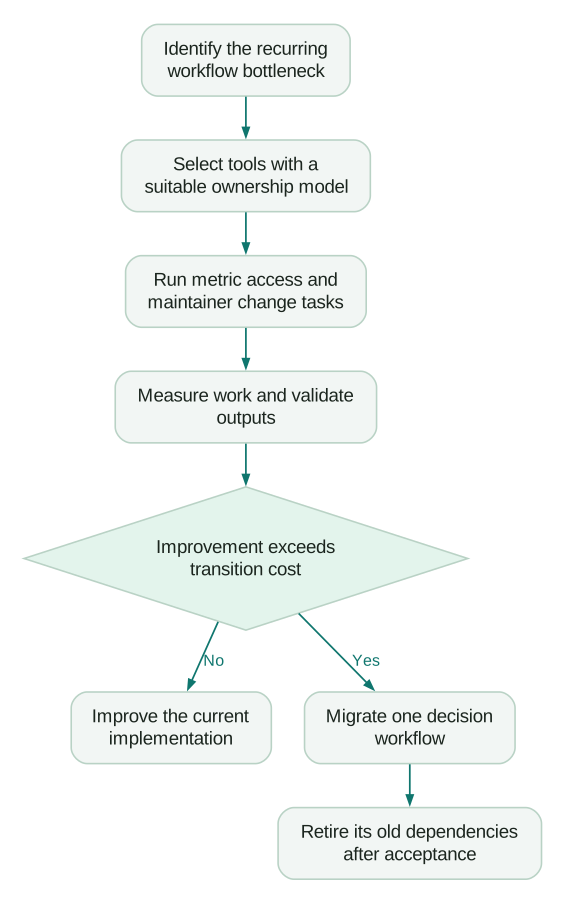
Do not force every report into the first migration wave. Start with one coherent workflow, including its delivery and access requirements. A successful first wave establishes a repeatable process for the remaining work.
What must pass before choosing an alternative?
- A specific recurring bottleneck is demonstrated in the current setup.
- The candidate completes the same task with the intended users.
- Metric changes have an owner, review process and regression evidence.
- Access tests cover every enabled delivery route.
- A second maintainer can operate the result without the original builder.
- The cost model includes migration, platform work and ongoing administration.
- Improving the existing deployment has been compared fairly.
The decision should leave the team with fewer unresolved responsibilities. If the new tool adds an unfamiliar operating model without removing the original bottleneck, keep evaluating before committing the migration budget.
Questions people ask
Which Metabase alternative is closest to our current workflow?
That depends on whether your users mainly explore, write SQL, consume fixed reports or use analytics inside a product. Reproduce those tasks with representative users before deciding. Similar dashboard layouts do not establish similar maintenance or access requirements.
Is Lightdash only useful with dbt?
Its current documentation also provides a Lightdash YAML approach. Existing dbt projects can be relevant to the workflow, but evaluate the supported metric definitions and deployment method directly. Do not assume all MetricFlow behavior transfers unchanged.
When is Evidence a better fit than a dashboard tool?
Consider it when the main deliverable is a deliberately authored analytical report or application and your team can maintain its code-based workflow. Test updates, publishing and reader access with your real content. It is not automatically the right replacement for unrestricted business-user exploration.
Should we migrate because our Metabase bill increased?
First identify whether the increase comes from accounts, required capabilities or operating work. Compare viable configurations with the same access and reliability requirements. A lower license total can be outweighed by migration and maintenance costs.
Can more than one BI tool remain in the stack?
Yes, when each has a defined audience and purpose. Shared metric definitions, access ownership and retirement rules become more important as the number of tools grows. Avoid keeping overlapping reports indefinitely without deciding which output is authoritative.
Sources
- Metabase: Current modeling tools. Accessed 8 September 2026.
- Lightdash: Metric reference. Accessed 8 September 2026.
- Lightdash: Supported MetricFlow translation. Accessed 8 September 2026.
- Omni: Modeling layers. Accessed 8 September 2026.
- Evidence: Official open-source repository. Accessed 8 September 2026.
- Evidence: Publishing workflow. Accessed 8 September 2026.
- Apache Superset: Platform overview. Accessed 8 September 2026.
- Microsoft: Embedded reporting with row-level security. Accessed 8 September 2026.
Written by
Jafrin Akter AloData Engineer and Co-founder, martechdevs
Jafrin Akter Alo is a data engineer and co-founder of martechdevs, where the team has delivered 74+ martech, data and growth stack implementations.