
LaunchDarkly vs Statsig for release control and experimentation
Pick LaunchDarkly when release controls and the behaviour of flags across services drive the purchase; pick Statsig when experiments, exposure quality and product metrics define the recurring work. Statsig vs LaunchDarkly now compares usage-based offers with free entry plans on both sides. Test rollout behaviour and trustworthy results before comparing service connections, active users or metered events as costs.
On this page
LaunchDarkly vs Statsig comparison
The table uses current public USD terms; each usage unit has a different definition.
| Decision | LaunchDarkly | Statsig |
|---|---|---|
| Free entry | Developer: 5 service connections and 1,000 client-side MAUs | Developer: 2 million metered events/month |
| Team access | Unlimited seats in the current offer | Unlimited seats in the current offer |
| Paid starting basis | Foundation usage beyond free allowances | Pro $150/month, including 5 million events |
| Example additional usage | $12/service connection and $10/1,000 client MAUs on monthly billing | $0.05/1,000 events above Pro allowance |
| Governance boundary | Optional approval requests on Foundation; required approvals on Enterprise | Pro includes change reviews and approvals; Enterprise adds broader access controls |
Sources: LaunchDarkly pricing and Statsig pricing. LaunchDarkly also publishes lower usage rates with annual billing. Statsig's unlimited flag and configuration checks do not make every analytics exposure unmetered; its pricing FAQ defines the events used for billing.
At Martechdevs, we connect experiment identity, event definitions and product decisions through product analytics implementation. We would begin with LaunchDarkly for a release-control requirement spanning production services and permissions. We would begin with Statsig for a team whose main need is a repeatable experiment process with clear exposure and outcome data.
Both products offer feature management and experimentation. A useful pilot should include those overlapping capabilities, then identify which workflow the team can maintain most reliably. Avoid selecting from an older description that treats either product as only a flag switch or only an experiment dashboard.

Tool decisions
LaunchDarkly
- Best for: Engineering teams prioritizing controlled releases, clear permissions and known behaviour across application services and environments.
- Pros: The current platform combines flags, targeting and experiments. Enterprise adds required approvals and broader release controls. Current plans, approval behaviour.
- Cons: Service connections include replicas, workers and environments, so application architecture affects the bill. Optional approval requests are different from enforced approval requirements.
- Free plan and startup offer: Developer is free without a card and includes five service connections and one thousand client-side MAUs. Other product allowances have their own limits. No startup concession is assumed in the steady-state budget. Developer offer.
- Choose it if: The team can demonstrate its actual release, emergency disable and permission workflow in the required plan.
- Skip it if: The business mainly needs a small experiment program and cannot justify the proposed release-governance scope or operating work.
Start the pilot with an ordinary rollout and an exception. The ordinary path should reach the intended audience. The exception should let an authorized operator stop the change and explain what happens to existing and newly initialized application instances. Record the expected behaviour before testing it.
An approval notification does not prove a change requires approval. LaunchDarkly distinguishes requesting a review from requiring it for an environment, with the mandatory behaviour tied to Enterprise. Approval settings. Match the plan to the actual control the business needs.
Statsig
- Best for: Product and analytics teams connecting feature changes with maintained experiment metrics and exposure diagnostics.
- Pros: Experiment health checks cover arriving SDK checks, matching unit IDs, exposure balance and crossover units. Those checks help establish whether the data can support a readout. Experiment monitoring.
- Cons: Metric results still depend on correct identity and logging. A successful flag evaluation does not establish that the exposure and outcome events share the right experimental unit.
- Free plan and startup offer: Developer includes two million monthly metered events. Pro costs $150 per month with five million events, with additional usage charged separately. No startup credit is assumed. Statsig plans.
- Choose it if: A named product or analytics owner will define outcomes, inspect health checks and make the experiment decision.
- Skip it if: The team wants flags but has no capacity to maintain the metrics and experiment process that justify the proposed scope.
A Statsig pilot should include a controlled event fixture. Assign a known set of test users, log the intended exposures and outcomes, then verify the identities appearing in the analysis. Include an ineligible user and a repeated event. The team should understand why each record appears in the result.
Statsig's documentation says short-lived processes can exit before events flush, leaving exposures or custom events missing. SDK FAQ. Include that execution pattern in the pilot if the application uses workers or scripts that terminate quickly. Data quality depends on the actual runtime, not just the configured experiment.
Release and experiment contracts
A flag and an experiment have related but different jobs. A flag decides the behaviour a context receives. An experiment needs a defensible relationship between assignment, exposure and outcome.
| Requirement | Release evidence | Experiment evidence |
|---|---|---|
| Intended audience | The correct context receives the intended variation | Eligible units enter the planned assignment population |
| Stable identity | A returning context receives the expected treatment | Exposure and outcome use the same experimental unit |
| Emergency handling | An authorized operator changes the release state | The analysis records the affected period and interpretation |
| Application failure | The code follows the agreed fallback behaviour | Missing or biased exposure data is detected |
| Completion | Temporary flags have an owner and retirement plan | A named owner records the experiment decision |
Define the randomization unit before implementing the test. A consumer experiment might use a user; a B2B workflow might need an account. If users within the same account can influence each other's outcome, individual assignment may answer a different question from the intended account-level change.
The experimentation platforms guide helps define the wider evaluation. The tracking-plan guide gives the event contract that supports it. Keep the exposure event distinct from a successful business outcome so the denominator remains interpretable.
Exposure health and metric interpretation
Statsig uses sample ratio mismatch checks to identify exposure splits that differ from the configured allocation beyond what randomness explains. Its guidance treats a persistent alert as a data-quality problem that needs investigation before trusting the metric lift. SRM guidance.
A different group size is not automatically an error, and equal group sizes are not complete proof of correctness. The useful check considers the expected allocation, collection path and identity. A client crash that prevents exposure logging can remove a different kind of user from one group, biasing the comparison.
For a hypothetical result, suppose control has 1,000 exposed users and 100 successful outcomes, while treatment has 1,000 exposed users and 110 outcomes. The observed rates are 10% and 11%. That is a one-percentage-point difference and a 10% relative lift, before any assessment of uncertainty, experiment health or decision criteria.
| Hypothetical result | Exposed users | Successful outcomes | Observed rate |
|---|---|---|---|
| Control | 1,000 | 100 | 10% |
| Treatment | 1,000 | 110 | 11% |
The arithmetic alone does not establish a winner. The experiment needs an agreed metric, analysis method, duration or stopping rule, and a check that assignment and exposure data remain valid. Record the decision criteria before looking for a favourable result.
If a data-quality repair changes exposure or metric meaning during the test, decide whether the existing experiment remains interpretable. A repaired implementation should repeat the health checks. It should not automatically combine incompatible before-and-after data into one confident conclusion.
Usage-based budget
LaunchDarkly defines a service connection as a server-side SDK connected to an environment, counted over time and averaged through the month. Replicas, workers and development or staging environments can all contribute. Client-side MAUs form a separate meter. LaunchDarkly usage definitions.
Statsig's Pro budget uses metered events. Its pricing FAQ includes experiment exposures, feature-flag exposures with Metric Lifts enabled, logged events, ingested metrics and custom metrics within that definition. Unlimited basic flag checks therefore do not mean that all analytical work is free. Statsig event definitions.
The following hypothetical USD examples use monthly billing, no discounts, no tax and no other products. They are separate workloads, with no claim that the configurations are equivalent.
| Configuration | Calculation | Monthly amount, USD | Scope |
|---|---|---|---|
| LaunchDarkly, 10 service connections and 2,000 client MAUs | (10 minus 5) × $12 + (2,000 minus 1,000) ÷ 1,000 × $10 | $70 | Foundation monthly usage rates |
| LaunchDarkly, 20 service connections and 10,000 client MAUs | 15 × $12 + 9 × $10 | $270 | Same stated meters |
| Statsig Pro, 5 million metered events | Included in base | $150 | One Pro project |
| Statsig Pro, 8 million metered events | $150 + 3,000,000 ÷ 1,000 × $0.05 | $300 | Base plus event overage |
Inputs: LaunchDarkly rates and Statsig rates. Statsig Pro subscriptions apply to one project; additional Pro projects need their own upgrade. The examples count measured billable usage rather than assuming that every application request contributes to the same meter.
An architecture change can therefore alter cost without a change in customer count. If additional workers create more measured service connections, the LaunchDarkly estimate changes. If additional analysis creates more metered events or metrics, the Statsig estimate changes. Keep those assumptions tied to the actual implementation and usage report.
Use the software pricing tool to add implementation, ongoing experiment analysis, required governance and any adjacent products. The LaunchDarkly alternatives guide broadens the shortlist if the required operating scope does not fit either candidate.
Fallback and failure behaviour
LaunchDarkly's network-resilience guidance distinguishes an initialized SDK with cached flag data from a new instance that cannot initialize. The latter can use the fallback supplied in the application's evaluation call; exact behaviour depends on the SDK and method being used. Network-failure guidance.
That makes fallback a code requirement. Define the acceptable behaviour for a missing flag, unavailable network, startup before initialization and a newly deployed application instance. Test the exact SDK integration. A flag's off variation in the product interface should not be assumed to describe every failure path in the application.
For Statsig, validate the defaults used by the chosen gate, experiment or configuration call and inspect event delivery in the actual runtime. Its FAQ describes defaults for unrecognized configurations and the need to flush events in short-lived environments. Statsig SDK behaviour.
A successful fallback test and a healthy experiment readout are separate acceptance conditions. The application can remain available while the experiment loses exposure events. Monitor both the customer-facing behaviour and the quality of the evidence used to judge it.
Governance and flag retirement
Assign a named owner, purpose and expected retirement condition to temporary release flags. A flag left indefinitely can preserve obsolete code paths and make later changes harder to reason about. The implementation team should know whether a flag represents a temporary release, a continuing permission or a long-running experiment.
The required approval model also belongs in the budget. Demonstrate who can change production targeting, who can review the change and whether the selected plan can enforce the restriction. Then test the documented emergency path so the team can respond without inventing a process during an incident.
For experiments, keep the hypothesis, metric definition, exposure window and final decision together. A result chart without that context is difficult to reuse. A second analyst should be able to explain the population and reproduce the intended metric from the accepted data.
Best fit by team model
| Company size or operating model | Best fit | Runner-up | Decision reason |
|---|---|---|---|
| Engineering team with formal production release controls | LaunchDarkly qualified plan | Statsig Enterprise | Enforced governance and runtime behaviour drive selection |
| Product team operating recurring experiments | Statsig | LaunchDarkly | Exposure diagnostics and metric workflow lead |
| Small application within free usage limits | A qualified Developer plan | The other Developer plan | Runtime fit matters before subscription cost |
| B2B product with account-level outcomes | An identity-focused experiment pilot | Either platform after validation | Assignment unit changes the question being measured |
| Team with flags but no metric owner | A bounded release workflow | A later experimentation expansion | Experiment features need an operating owner |
Release and experiment decision
Both pilots must validate the application's behaviour and the experiment's evidence before cost approval.
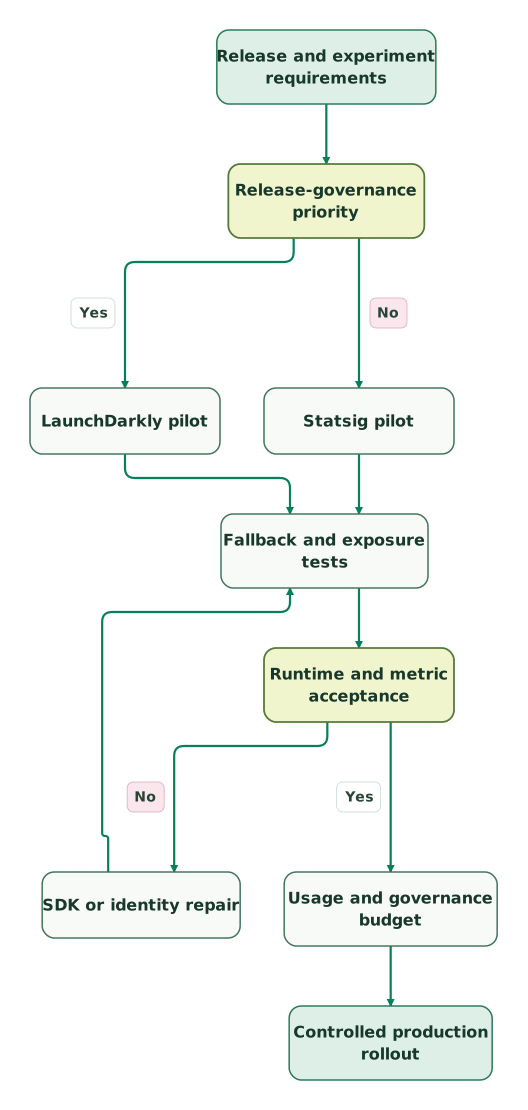
Read diagram as text
- Release and experiment requirements to Release-governance priority.
- Release-governance priority to LaunchDarkly pilot: Yes.
- Release-governance priority to Statsig pilot: No.
- LaunchDarkly pilot to Fallback and exposure tests.
- Statsig pilot to Fallback and exposure tests.
- Fallback and exposure tests to Runtime and metric acceptance.
- Runtime and metric acceptance to SDK or identity repair: No.
- SDK or identity repair to Fallback and exposure tests.
- Runtime and metric acceptance to Usage and governance budget: Yes.
- Usage and governance budget to Controlled production rollout
A repair repeats fallback and exposure validation. Keep the expected application result separate from the expected event stream so one successful side does not hide a failure on the other.
Platform evaluation checklist
- Define release controls separately from experiment decisions.
- Choose the experimental unit and stable identifier before logging exposure.
- Test eligible, ineligible, returning and account-switching contexts.
- Verify startup, network failure and missing-configuration behaviour.
- Inspect exposure health before interpreting metric lift.
- Confirm whether approval is optional or enforced on the chosen plan.
- Estimate service connections, MAUs and metered events independently.
- Repeat runtime and evidence checks after each repair.
- Assign a flag owner, retirement condition and experiment decision owner.
Use the tracking-plan audit skill to review exposure and outcome definitions. Preserve the test fixture with the implementation so future SDK or identity changes repeat the same acceptance checks.
Keep reading
Browse all Product Analytics guides
 Product Analytics
Experimentation Platforms in 2026: 15 Tools Compared by Price, Stats and Team Fit
Pick an experimentation platform by who runs tests and where metrics live. 15 tools compared on price, free limits and stats, plus cost at 3 traffic levels.
Jafrin Akter AloLast updated 54 min read
 Tracking & Attribution
Tracking Plan: Free Template, Examples by Business Type and How to Build One
A tracking plan defines each event: when it fires, its properties, IDs, owner and tools. Get a free two-tab template, six examples and an approval checklist.
Jafrin Akter AloLast updated 42 min read
 Product Analytics
LaunchDarkly Alternatives: Four Options for Flags, Experiments and Cost
Compare Statsig, GrowthBook, Unleash and ConfigCat as LaunchDarkly alternatives. Includes billing examples, rollout continuity, failure defaults and migration tests.
Jafrin Akter AloLast updated 12 min read
Product analytics
See the implementation scope, deliverables and acceptance checks.
Questions people ask
Does LaunchDarkly still require a per-seat budget for the current entry plans?
LaunchDarkly's current entry offers use unlimited seats and usage-based pricing rather than a per-seat charge. The relevant quantities include service connections and client-side MAUs, with other product meters where used. Count replicas, workers and environments according to the published definition, then confirm the chosen billing term. LaunchDarkly pricing.
Do unlimited Statsig flag checks make every exposure free?
Unlimited Statsig flag checks do not make every analytical exposure free. Its pricing FAQ defines metered events to include experiment exposures and feature-flag exposures with Metric Lifts enabled, alongside other logged or computed data. Separate ordinary flag evaluation from the analytical work being billed, and use the usage report to validate the estimate. Statsig pricing definitions.
Can a LaunchDarkly approval request enforce an Enterprise-style release policy?
A LaunchDarkly approval request is different from a mandatory release policy. The current Foundation offer permits review requests, while required approvals are part of Enterprise scope. Demonstrate the actual ability to prevent an unauthorized production change on the selected plan before approving the governance design. Pricing, approval guidance.
Should a Statsig sample ratio mismatch alert be ignored after normalizing conversion rates?
A persistent Statsig sample ratio mismatch alert should not be dismissed merely because conversion rates are normalized. The imbalance can indicate non-random missing or extra exposure data, making the groups incomparable. Investigate assignment, identity and event delivery before trusting the lift, and restart or narrow the analysis where the repair requires it. SRM guidance.
Does a feature flag's off state define the application's network-failure behaviour?
A feature flag's off state should not be assumed to define every network-failure path. Cached configuration, SDK initialization and the fallback specified in code can produce different behaviour. Test the exact SDK and evaluation method during startup and a connection failure. Record the accepted result before relying on the flag for an emergency response. LaunchDarkly resilience guidance.
Sources

Written by
Jafrin Akter AloData Engineer and Co-founder at Martechdevs and Growth and Analytics Partners
Jafrin writes practical guides to marketing technology, customer data, analytics and AI workflows. Martechdevs is a Growth and Analytics Partners company.